
In this guide
Full and Frank Disclosure Is the Standard Indian Courts Apply
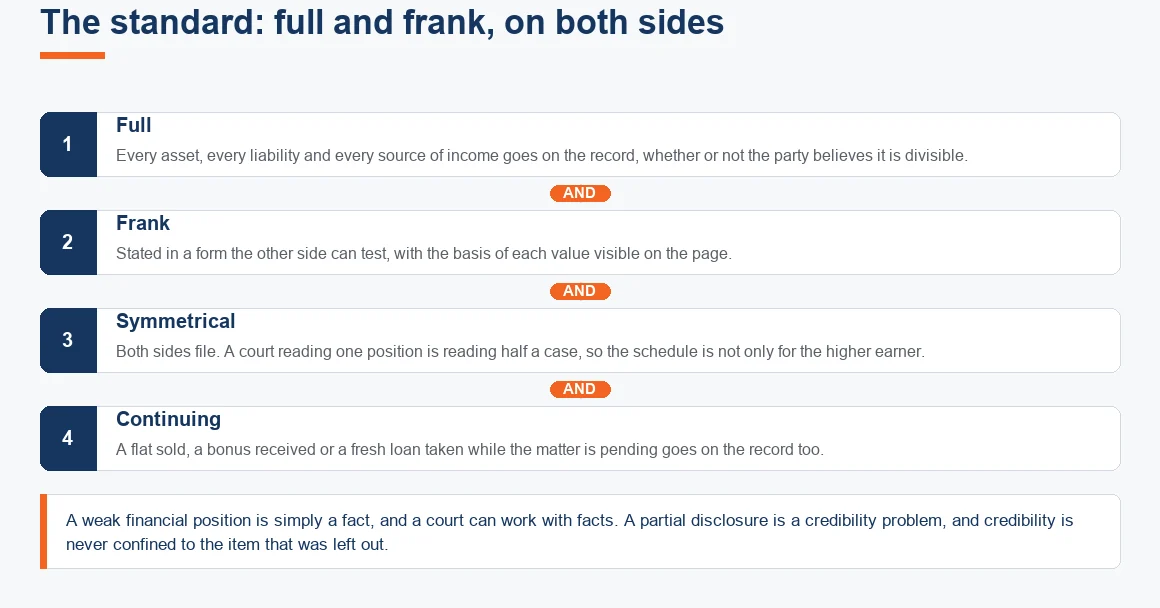
People arrive at this subject looking for protection and find an obligation instead. Net worth disclosure in divorce runs on one standard, which Indian courts describe as full and frank. Everything a party owns goes on the record, whether or not that party believes it is divisible.
Full covers every asset, every liability and every source of income. Frank means stated in a form the other side can test, with the basis of each value visible on the page. Either word can be satisfied on its own while the disclosure stays useless, which is why they are always quoted as a pair.
The duty also does not close when the affidavit is filed. A party who sells a flat, receives a bonus or takes a fresh loan while the matter is pending puts that on the record too. Disclosure is a position held through the proceeding, not a form submitted once and forgotten.
One comparison is worth making at the outset. A weak financial position is simply a fact, and a court can work with facts. A partial disclosure is a credibility problem, and credibility is never confined to the item that was left out.
Assets Both Spouses Are Expected to Put on Record
The obligation is symmetrical, which surprises the party who assumed the schedule was only for the higher earner. Both sides file. Rajnesh v. Neha requires the affidavit from applicant and respondent alike, and a court reading one position is reading half a case.
Self-acquired property, inherited property and property owned before the marriage all belong on the schedule. Whether an asset is available for division is a question of law, and it belongs to counsel. Whether it is disclosed is not a question at all. An inherited share often needs proving a claim to inherited assets before it can be dealt with, and that paper is itself disclosable.
Jointly held flats, joint accounts, joint lockers and assets where a spouse is the second holder are shown with the share stated and the co-holder named. Assets standing in a child's name but funded by a parent are shown the same way, with the source of the funds described.
Interests held through a firm, a company or a trust are stated as interests in the entity. A partner's capital account balance, a shareholding with its percentage, a beneficial interest under a trust deed. Directorships and shareholdings sit on public record at the Ministry of Corporate Affairs, so an omission here is visible without any enquiry at all. Property paid for by one person and standing in another person's name is disclosed as exactly that, with the funding described.
Income, Perquisites and Business Interests in the Affidavit
Income is the thinnest part of most schedules, because the number people carry in their heads is take-home pay. The affidavit asks for the gross, and then for everything an employer provides that never appears as cash.
Perquisites are the usual gap. A company car with a driver, accommodation or a rent-free flat, school fees paid directly. Club membership, medical cover, stock options vested and unvested, the annual bonus, and reimbursements settled every month. Most of these show up in Form 16 or in the annual information statement, which makes them checkable rather than arguable.
A proprietor or a partner draws no salary at all. The relevant figures are drawings, the share of profit, interest on capital, and any rent the business pays for premises owned personally. Turnover is not income and profit is not drawings. The affidavit needs the drawings, with the last filed return standing behind them.
Irregular receipts are disclosed with the basis on which they were estimated. Agricultural income, rent taken partly in cash, commission and seasonal trade all belong on the schedule. An estimate presented as an estimate is a disclosure. A round figure with nothing behind it reads as a guess, and it gets treated as one.
Consequences of Concealing or Understating Assets
Courts are not obliged to accept a schedule at face value. Where the disclosed position does not explain the life being led, a court can draw an adverse inference and proceed on what it concludes the position actually is. That is the practical risk. The figure the court works from stops being the party's own figure.
Procedural consequences follow separately. Rajnesh v. Neha allows a defence to be struck off where a respondent wilfully delays the affidavit past two opportunities. Orders can be recalled when a later disclosure shows what the first one left out. None of this requires proof of intent by the other side, because an unexplained gap is enough on its own to shift where a court starts.
A false statement on oath is an offence in its own right. The Bharatiya Nyaya Sanhita 2023 makes giving false evidence an offence at section 227, with the punishment at section 229. A court does not act on that directly. Section 379 of the corresponding procedure code sets out the enquiry that comes first, which makes the exposure real without making it automatic.
The damage is rarely confined to the concealed item. A party caught understating one account argues every remaining issue from behind. Conduct, the custody arrangement and the reasonableness of a claim are all decided by the same judge reading the same file.
Legitimate Planning Against Concealment: Where the Line Falls
Pre-marital agreements come up first in almost every conversation. Across most of India they are not enforceable as contracts. An agreement contemplating separation is treated as opposed to public policy under section 23 of the Indian Contract Act 1872. Goa is the exception, where ante-nuptial contracts under the Portuguese Civil Code 1867 bind. Elsewhere such an agreement may evidence what the parties once intended. It does not displace a statutory maintenance right.
Ordinary transactions do not become suspicious because a marriage is failing. A loan repaid on schedule, a business expense paid, an asset sold at market value with the consideration reaching a disclosed bank account: each is explained by its own record. Every one of them is still disclosed, with the date and the consideration stated.
The transfers that fail are the ones with nothing behind them. Section 39 of the property statute on gratuitous transfers lets a maintenance right be enforced against a transferee who took the property as a gift. The same applies to a transferee who knew of the right. Section 53 of that Act makes a transfer intended to defeat creditors voidable at their option. Where an asset stands in a relative's name with no funding trail, the benami property law is engaged, in the 1988 Act as amended from 1 November 2016.
So the line does not run between careful structuring and careless structuring. It runs between what is disclosed and what is hidden. What a court may ultimately divide is a legal question, and it belongs to counsel rather than to an accountant.
Working With Your Counsel and a CA on the Disclosure
Two professionals, two jobs, and the boundary between them is worth respecting. Counsel decides what is claimed, what is contested, and what the law says about entitlement and division. A chartered accountant advises on none of that. The accountant assembles, values, certifies, and can be examined on the figures.
What a chartered accountant can independently support is specific. Valuing an unlisted shareholding. Reconstructing a partner's capital account. Reading Form 26AS and the AIS against a declared income. Putting the whole position on one page as a single view of the position as at a stated date. Where the other side's disclosure looks incomplete, rebuilding a trail from records is a separate exercise with its own limits.
One constraint is worth stating plainly, because it is what makes the document worth filing. The ICAI Code of Ethics bars a member from knowingly being associated with information containing a materially false or misleading statement. Figures a client will not substantiate therefore do not get certified. A verified statement for the file is prepared on that footing, and how the schedule is drafted follows from it.
This post supports What You Must Disclose About Net Worth in a Divorce, which sets out what Patron delivers and for whom.