
In this guide
Courts Want a Sworn, Line-by-Line Schedule of Assets, Liabilities and Income
Knowing how to write a statement of net worth for a matrimonial court begins with the shape of the thing. It is not a summary. It is a schedule, sworn on oath, setting out every asset, every liability and every stream of income on its own line.
A judge is not asking what a party is worth in round figures. The question is what the party holds, item by item, and whether each item can be checked against a record somebody else produced. A narrative invites argument. A list invites verification, which is the whole point of the exercise.
Two features separate this schedule from an ordinary financial summary. The first is the oath. The deponent signs personally, so the figures become that person's own statement to the court rather than an accountant's estimate. The second is completeness. A heading left blank reads as a positive claim that nothing sits under it, which makes the empty rows as loaded as the filled ones. Both features push the drafting the same way: fewer adjectives, more identifiers. This post covers the drafting only, and the scope of the obligation is a separate question altogether.
Gathering Records Before You Fill Anything In
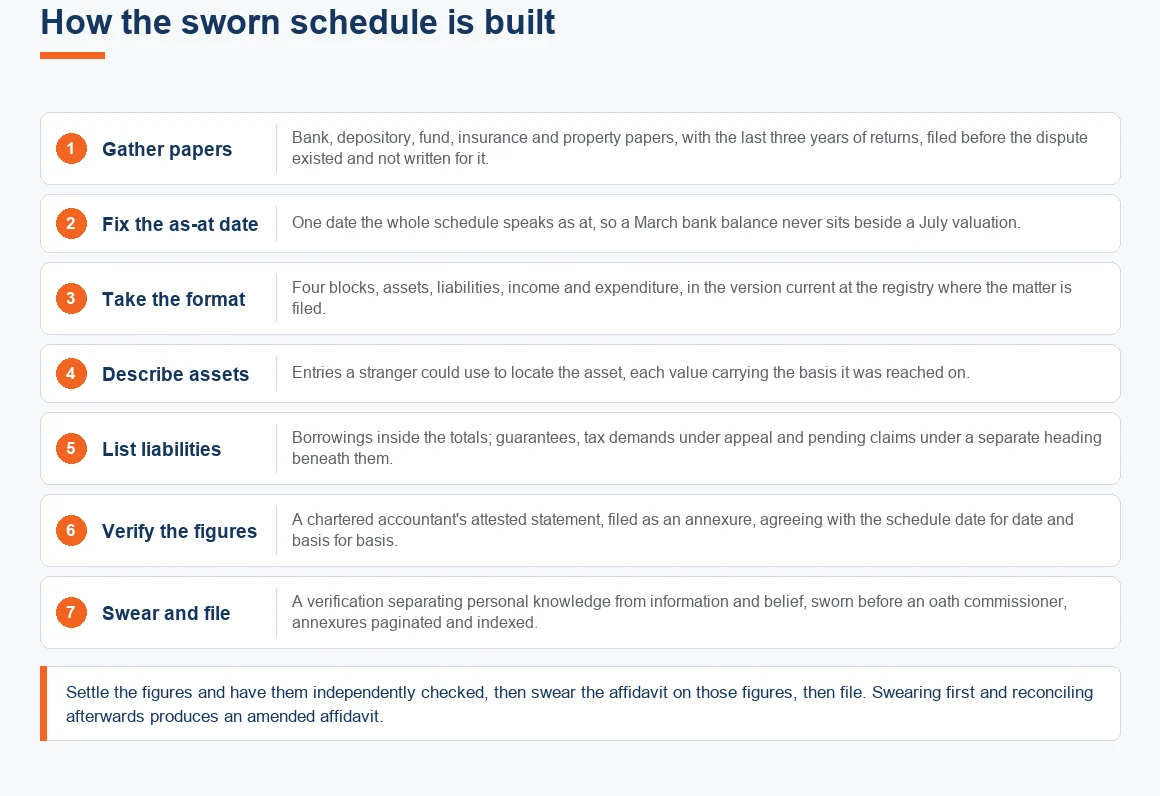
Nothing goes into the schedule from memory. The document is built from paper first, and the paper decides what each entry is allowed to say. Assembling first and drafting second is the order that avoids a redraft at the registry counter.
The core set is predictable. Statements for every bank account across the period the registry asks for. Fixed deposit receipts and the consolidated holding statement from the depository. Mutual fund statements, provident fund passbooks, and insurance policies carrying the surrender value the insurer last declared. On the property side, the sale deed or allotment letter, the mutation record and the latest municipal tax receipt. Vehicle registration certificates, jewellery invoices, and a valuer's note where one exists.
Tax records matter for a different reason. The last three years of returns with their computation, Form 16 or a salary certificate, Form 26AS and the AIS, and GST returns where a business is run. These were filed before the dispute existed and were not written for it, which is exactly why a court gives them weight.
Records held jointly, or held by the other side, are not a reason to leave a line empty. The entry is made, with a note that the supporting paper has been applied for. An entry marked as awaited is a disclosure; a missing line is not. The exercise is the same one an accountant runs when setting out the whole position as at a single date.
Schedule Structure and the Format Courts Expect
Four blocks carry the document: assets, liabilities, income and expenditure. The last two surprise readers expecting a balance sheet. A matrimonial court is fixing a monthly figure as well as looking at a division, so what flows in and out matters as much as what is held. Both halves later feed how the figure is weighed when an order is made.
The format in use traces to a single Supreme Court decision. Rajnesh v. Neha was handed down on 4 November 2020, and the enclosures annexed to it are the formats now filed. The direction reached maintenance proceedings everywhere in the country, pending matters included. Separate versions were annexed for agrarian and non-agrarian deponents, because a farmer's schedule and a salaried deponent's schedule ask different questions.
High Courts have since notified their own versions implementing the direction, and family court registries print their own. The version current at the registry where the matter is filed governs. Checking it before drafting saves a redraft: column headings and the number of annexures differ between states. Where a local format carries a heading the Supreme Court version does not, the local heading is filled rather than ignored.
One structural rule is worth stating on its own. The schedule speaks as at a date, and every figure inside it speaks as at that same date. Mixing a March bank balance with a July valuation is the commonest structural error, and it is visible to anybody reading two columns side by side.
Describing Each Asset With Enough Specificity
Specificity here is not thoroughness for its own sake. The working test is whether a stranger holding only the entry could locate the asset. That test decides how much detail each line needs, and the answer varies sharply by class of asset.
A dematerialised holding is identified by depository participant and client identification numbers, a physical holding by folio. A vehicle goes in by registration number, make and year of manufacture. An insurance policy goes in by policy number, with the surrender value the insurer last declared. Jewellery is described by article and weight rather than compressed into one figure at the foot of a column.
Every value carries the basis on which it was reached. Cost, book value, the notified circle rate, a registered valuer's report, the closing market price on a stated date, or the insurer's own figure. Two schedules showing the same flat at different amounts are reconciled through the basis, not through argument. A number with no stated basis is the weakest line on the page.
Joint and indirect holdings need particular care. A jointly held asset is shown in full with the share stated, not quietly halved. A nominee is not an owner, and treating a nomination as ownership overstates the position. An interest held through a firm or a company is shown as the interest in that entity, named, rather than as the underlying property it happens to own.
Disclosing Liabilities, Guarantees and Contingent Claims
The liabilities block is where most schedules thin out. Borrowings get remembered. The obligations that are not yet debts get forgotten, and those are usually the ones that change how the whole page reads.
A borrowing is a present obligation with a named lender and a running balance. A guarantee is not. It is a promise to pay if somebody else does not, and it sits outside the totals until the day it is called.
Guarantees given for a business are the common omission. A director who has personally guaranteed a company's working capital limit has committed part of the personal position, whether or not the company is currently paying. The sanction letter names the guarantor, and the lender's charge is registered with the Registrar of Companies. It already sits on a public record, which is why it belongs under the totals rather than nowhere at all.
A separate heading beneath the totals carries the rest. Tax demands under appeal, a pending recovery suit, a disputed cheque proceeding, an indemnity given on a sale, each with the amount and the stage it has reached. These are obligations that may crystallise later, and they move the net figure only if they do. Setting them out separately keeps that figure honest without deflating it.
An Affidavit Against a Professionally Attested Statement
Two different people stand behind the two documents, and that is the whole of the distinction. An affidavit is the deponent's own word, sworn. A professionally attested statement is a chartered accountant's, given after examining the underlying papers. It carries a membership number, a firm registration number, and a unique document identification number a recipient can look up. The oath and the attestation are different commitments, and a court reads them as different things.
Courts do not always call for the second document. It becomes useful where the position is not simply a salary and a savings account. A business with drawings instead of a payslip, a partner's capital account, unlisted shares, property held across two states: these are positions a bare affidavit can state but cannot evidence. Registry formats leave room for annexures, and the accountant's statement is filed as one of them.
Filed together, the two have to agree. The certified figures are the schedule's figures, drawn as at the same date and on the same valuation basis, and each annexure is cross-referenced from the line it supports. A difference between them is explained on the face of the schedule rather than left to be found. Reading the two side by side is the first thing opposing counsel does with the file.
Signing, Notarising and Filing the Statement
The last page is where files come apart. A verification clause states which paragraphs are true to the deponent's own knowledge and which rest on information and belief. It follows the form the procedural code governing verification prescribes for pleadings. A verification claiming personal knowledge of everything is weaker than one that separates the two honestly. The affidavit is then sworn before an oath commissioner or a notary, whose stamp and register entry go on the same page.
Annexures are numbered, paginated continuously and listed in an index that names each one. Every entry in the schedule points to the annexure page supporting it. Registries return files where the index and the pagination disagree with each other.
The order of work is worth stating plainly. Settle the figures and have them independently checked, then swear the affidavit on those figures, then file. Swearing first and reconciling afterwards produces an amended affidavit, which is a poor first entry on any record. An independently certified set of figures is the base the sworn schedule stands on, not an attachment added at the end of it.
This post supports How to Write a Statement of Net Worth for Court, which sets out what Patron delivers and for whom.