In this guide
A Forensic Review Rebuilds the Money Trail From Records, Not Suspicion
Forensic accounting in divorce answers one narrow question. Is the disclosed position complete? The work is reconstruction. Bank entries, statutory filings and registrations are put back into sequence until the money either accounts for itself or does not. Suspicion is the starting condition, never the method.
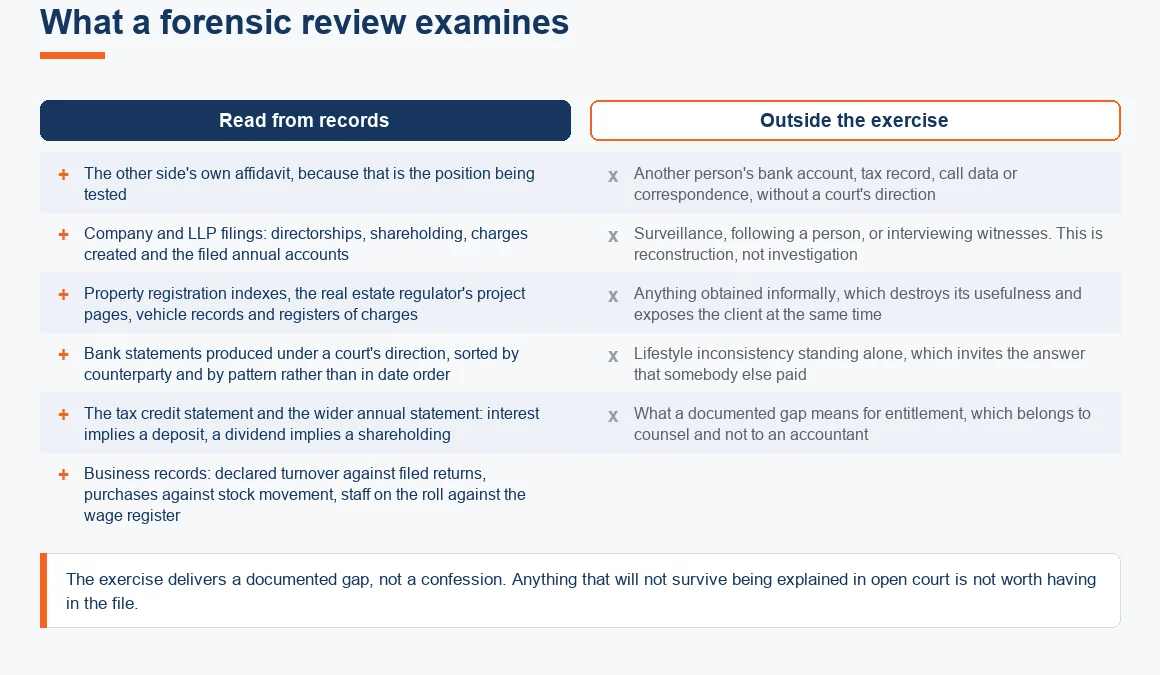
This is not investigation in the sense the word usually carries. Nobody is followed. There is no surveillance, no access to another person's accounts, and no interviewing of witnesses. An accountant works from documents that can be lawfully obtained, and from what those documents imply once they are read against each other. The distinction sets what the exercise can deliver, which is a documented gap rather than a confession.
The review starts with the other side's own affidavit, because that is the position being tested. It stops at a finding about records. This asset appears in a filing and not in the schedule. These transfers left the account in the six months before the petition. What any of that means for entitlement belongs to counsel, and how the award is arrived at is a separate question again.
Records a Forensic Accountant Can Lawfully Obtain
The strongest route is procedural rather than investigative. Order XI of the Code of Civil Procedure 1908 lets a party seek discovery, deliver interrogatories and apply for production of documents. A court can direct a bank, an employer or a registrar to produce what it holds. Family courts follow civil procedure for this purpose.
A surprising amount needs no order at all. Company and LLP filings at the Ministry of Corporate Affairs show directorships, shareholding, charges created and the filed annual accounts. Property registration indexes are searchable in most states through the registration department's portal. The real estate regulator's portal names promoters project by project. Vehicle records and registers of charges are open as well. Pleadings and orders in other pending matters can also be inspected, so a litigation that was disclosed can be checked against its own file.
The boundary is firm, and it is worth stating before anything else. Another person's bank account cannot be reached without a court's direction. Neither can their tax record, their call data or their correspondence. A professional who obtains any of that informally has destroyed its usefulness and exposed the client at the same time.
One test settles most questions of method. Anything that will not survive being explained in open court is not worth having in the file.
Tracing Transfers to Relatives, Firms and Shell Entities
Tracing runs on the party's own statements, which usually arrive under a court's direction. Debits are sorted by counterparty and by pattern rather than read in date order. A transfer repeating monthly to the same account is a standing arrangement. A single large debit two weeks before the petition is a question.
Names on their own prove very little, so the work is matching. A payee's name against a director list. A partner's name against a firm's filings. An account number against the account named in a sale deed. Where the related party's own filings show a corresponding credit, the two ends of the transfer meet.
Corporate holdings are the easiest interests to establish and the most frequently left out. A director identification number ties one person to every company they have sat on. A partner's capital account appears in an LLP's annual statement. Shares in an unlisted company appear in the annual return, together with the transfers made during the year.
Round-tripping shows up as a shape rather than as a single entry. Money leaves as a loan to a relative. It returns months later as a gift or as a repayment from a third name, and the asset it funded stands somewhere else entirely. No individual leg looks unusual. The sequence does. Two accounts and one obliging relative are enough to build the shape, which is why it turns up in small files as readily as in large ones.
Reading Form 26AS and the AIS for Undisclosed Assets
Two documents from the income tax portal do more work than anything else available. The tax credit statement carries tax deducted and collected at source, advance tax and self-assessment tax. The statement the department compiles is considerably wider, and the department's own description sets out what sits inside it.
The logic of reading them is simple. Interest credited on a deposit implies a deposit. A dividend implies a shareholding. A capital gain implies an asset that was sold, on a date, for a consideration. Any of these can sit in the statement and be absent from the affidavit, and that gap is the finding.
Reporting entities file statements of financial transaction, and the results surface in the wider statement. Large cash deposits, credit card settlements, purchases of mutual funds and bonds, and outward foreign remittance. Those sit alongside four other categories in the same part of it: tax deducted and collected at source, payment of taxes, demand and refund, and other information.
Property transactions reach the statement from the registering authority once they cross the reporting threshold. A sale shows a stated consideration, and that consideration is read against the state's notified minimum value for the locality. The comparison often explains a figure that looked implausibly low on the schedule.
Benami and Cash-Business Patterns That Surface
An asset standing in a relative's name with no visible funding is the oldest pattern in this work. The Prohibition of Benami Property Transactions Act 1988, in its amended form from 1 November 2016, deals with property held by one person and paid for by another.
The Act carves out an exception where an individual funds property registered to a spouse or to a child. That exception holds provided the money paying for it came from that individual's own known sources. The carve-out is why the accounting question is narrower than the statutory one. Where did the money come from, and does the record show it arriving?
A relative on a modest declared income who acquired a flat in the year the marriage broke down is a line of enquiry. It is not a conclusion, and a report that treats it as one gets taken apart.
Cash-heavy trades are read through their own records. Declared turnover against filed GST returns. Purchases against stock movement. Electricity consumption against production. Staff on the roll against the wage register. A turnover that fell sharply in the quarter proceedings began is compared with the same quarter in earlier years.
Lifestyle inconsistency is the weakest evidence and the most persuasive story. It directs the enquiry without closing it. Standing alone it invites the answer that somebody else paid, which is why the funding trail is the thing actually tested.
How the Findings Are Presented to the Court
A report that will be filed is written to be attacked. Scope first. Then the records examined and where each one came from. Then the procedures performed. Then the findings, each tied to the document supporting it. Copies of the records are appended and cross-referenced from the finding they support.
Limitations are stated inside the report rather than left for cross-examination to discover. Records not produced, periods not covered, valuations taken from a third party, assumptions made where a document was missing. Inference is kept apart from finding, and the report says on its face which is which. A report that conceals its own gaps is worth less than one naming them, because the gaps get found in any event.
The Institute of Chartered Accountants of India has issued Forensic Accounting and Investigation Standards, mandatory for members on such assignments from 1 July 2023. The board that issued them continues to maintain them, and they cover planning, evidence and reporting alike.
A report is worth only what its author is worth under questioning. The professional can be summoned, and the questions run to method and to documentation rather than to opinion. A finding that cannot be traced to a page in the annexure is abandoned in the witness box.
Limits of a Forensic Review and How Long One Takes
Scope discipline is what keeps a review useful. Reading eight years across four accounts because one figure looked odd is effort spent in the wrong place. The period is fixed by events: the years around an acquisition, the months before the petition, the quarters in which a business changed shape.
Effort scales with the number of accounts, the number of years and the state of the records. A single salary account over three years is a short exercise. Twelve accounts, two firms and a decade of property dealings is not. Where the amount in dispute is modest, the honest answer is often that the affidavit and its annexures are already enough.
Elapsed time is mostly governed by other people. Records held by a bank arrive when the court's direction reaches it. Filings arrive when a registry portal produces them. The analysis is rarely the slow part of any of it.
A review also needs a baseline on the party's own side, and the certified statement on the file is what supplies it. Whether a gap on the other side matters at all is decided by the standard the disclosure must meet, which is a question of law rather than of accounting.
This post supports Forensic Review of a Spouse's Net Worth, which sets out what Patron delivers and for whom.