In this guide
A CA-Certified Statement Backed by Source Documents Is the Proof
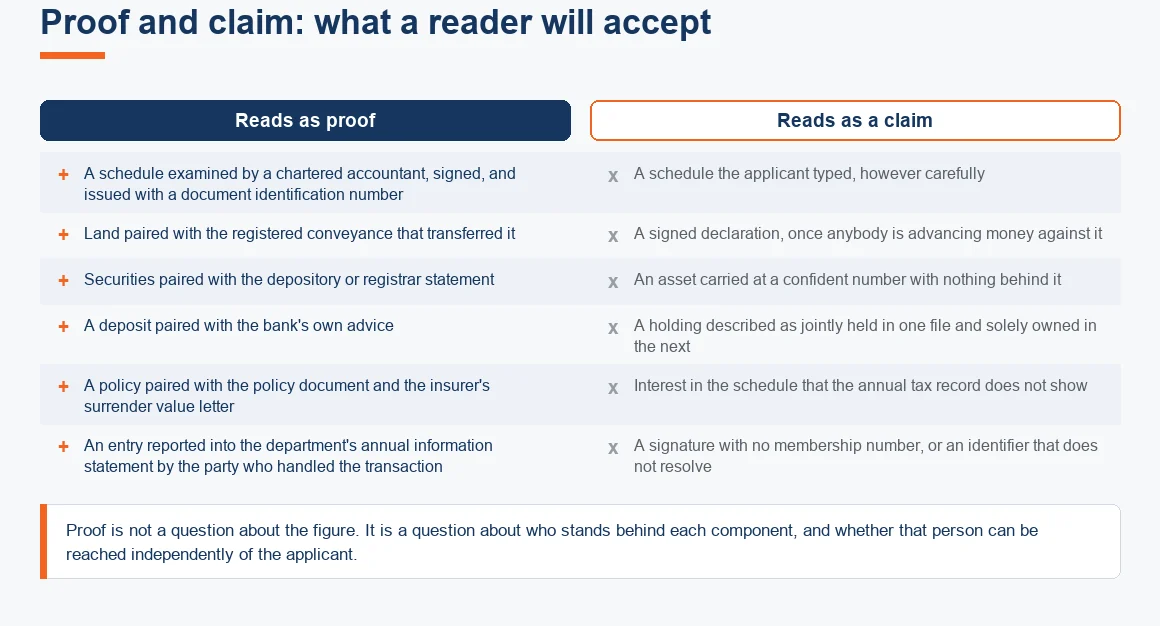
Proof, to a bank or a mission, means a statement somebody else is answerable for. A schedule the applicant typed is a claim. That same schedule examined by a chartered accountant, signed, and issued with a document identification number is evidence. A statutory body can be asked about the person who signed it.
There are two layers here and they fail separately. The upper layer is the attested statement itself, naming a date, a basis and an addressee. The lower layer is the file of source records sitting behind each line of it. Readers who accept the first without opening the second still open the second the moment a number looks unusual.
Working out how to prove a net worth figure is therefore not a question about the figure at all. It is a question about who stands behind each component, and whether that person can be reached independently of the applicant. Building the schedule itself is a separate exercise that comes first.
Self-Declaration Works Only Where Nobody Is Lending You Money
A signed declaration has a real place, and it is a narrow one. School admission forms, club memberships, some scholarship applications and a range of internal employer processes accept the applicant's own word about what is owned. Nobody is advancing money against it, so nobody is paying to check it.
Credit and immigration files sit outside that place entirely. A lender is deciding how much of its own money to put at risk, and a visa officer is deciding whether an applicant will return home. Both are structurally unwilling to rely on the interested party's arithmetic, which is exactly why their formats name an independent signatory rather than leaving the choice open.
Overstating in a declaration is not costless either. Deceiving a person into parting with property is cheating under section 318 of the Bharatiya Nyaya Sanhita 2023, which replaced the Indian Penal Code with effect from 1 July 2024. Making or using a false document is dealt with by section 336 of the same Sanhita. A declaration inflated to obtain credit engages both provisions rather than neither, and the declaration is signed evidence of what was claimed.
Building the Evidence File Behind Each Asset You Claim
Pair every claimed asset with the one record that created it or registers it. Land pairs with the registered conveyance, securities with the depository or registrar statement, deposits with the bank's advice. An insurance policy pairs with the policy document and the insurer's surrender value letter. The test is simple: can a stranger go back to the issuer and confirm the item without the applicant's help.
Corroboration then comes from a second and unrelated direction. Tax deducted on deposit interest appears in the department's annual information statement. A taxpayer reaches that statement through the e-filing account rather than through the bank that deducted the tax. Large purchases, securities transactions and property registrations are reported into that same statement by the parties who handled them. An asset visible from two unconnected sources is rarely argued about.
Consistency across applications is the part most people neglect. An asset described as jointly held in one file and solely owned in another is precisely the contradiction a careful reader finds. Where a file has to support a demonstration that funds are available, the description chosen should be one that can be repeated without amendment for the next two years.
Proving Ownership When Assets Sit in Joint or Family Names
Indian households routinely hold assets in names that do not match who paid for them. A flat bought from one person's savings and registered in a spouse's name is the ordinary case, and living in it is not an answer to the question. What a reader wants is the share, and the share follows the instrument and the money rather than the occupation.
The law is unforgiving of loose arrangements here. The statute on benami holdings, as amended with effect from 1 November 2016, prohibits holding property in a name other than that of the person who paid. It carves out an exception where an individual buys in a spouse's or a child's name, provided the consideration came from that individual's known sources. Claiming a spouse's flat without fitting inside that exception is a claim worth examining before it is written down.
Ancestral and joint family holdings need their own treatment. Section 6 of the Hindu Succession Act 1956, as amended in 2005, makes a daughter a coparcener by birth on the same footing as a son. The Supreme Court settled in 2020 that the right does not depend on the father having been alive on 9 September 2005. A coparcenary interest is stated as a share rather than as a property, and a search of the registered entries shows what has since been done with the property itself.
How Much Proof Different Acceptors Ask For
How much a reader asks for tracks how much that reader stands to lose. A summary statement satisfies applications where the figure is a qualifying condition rather than the basis of an advance. An educational institution, a professional registration and a visitor visa all sit there, with funds one factor among several. In those files the annexures are rarely opened unless something on the face of the statement invites it.
Files where money actually moves get read line by line. A credit committee reads the annexures, matches the property description against the title document, and tests the loan outstanding against its own records. A tender evaluation compares the certified figure with the threshold printed in the notice, and a rupee below that threshold ends the bid without discussion.
Escalation after a first review is normal and is not a sign of suspicion. An officer who sees an unusual concentration in a single asset asks for the record behind that asset. An officer who sees a figure that does not sit comfortably with the declared income asks how the two relate, which is the question the income record answers differently.
Why Acceptors Send Proof Back on First Submission
Three failures account for most returned files, and none of them concerns the total. The first is an asset carried at a confident number with nothing behind it. Confidence reads as evidence to the person who wrote the schedule and as a gap to everybody else who picks it up.
The second is a mismatch with the tax record. Interest appearing in the schedule but not in the annual tax record is one form of it. A property sale reported to the department but absent from the movement in assets is another. Either hands the reader two versions of the same year. Neither version is accepted until the difference has been explained in writing.
The third is an attestation the reader cannot check. A signature without a membership number stops a file. So does a firm name that returns nothing on the institute's register, or an identifier that does not resolve. The underlying facts can be sound and the file halt anyway. Where the evidence holds and only the attestation is weak, the certificate a chartered accountant issues is the single part that has to be done again.
This post supports How Do I Prove My Net Worth to a Bank or Consulate?, which sets out what Patron delivers and for whom.