
In this guide
No Statute Fixes an Expiry Date; the Acceptor Sets It
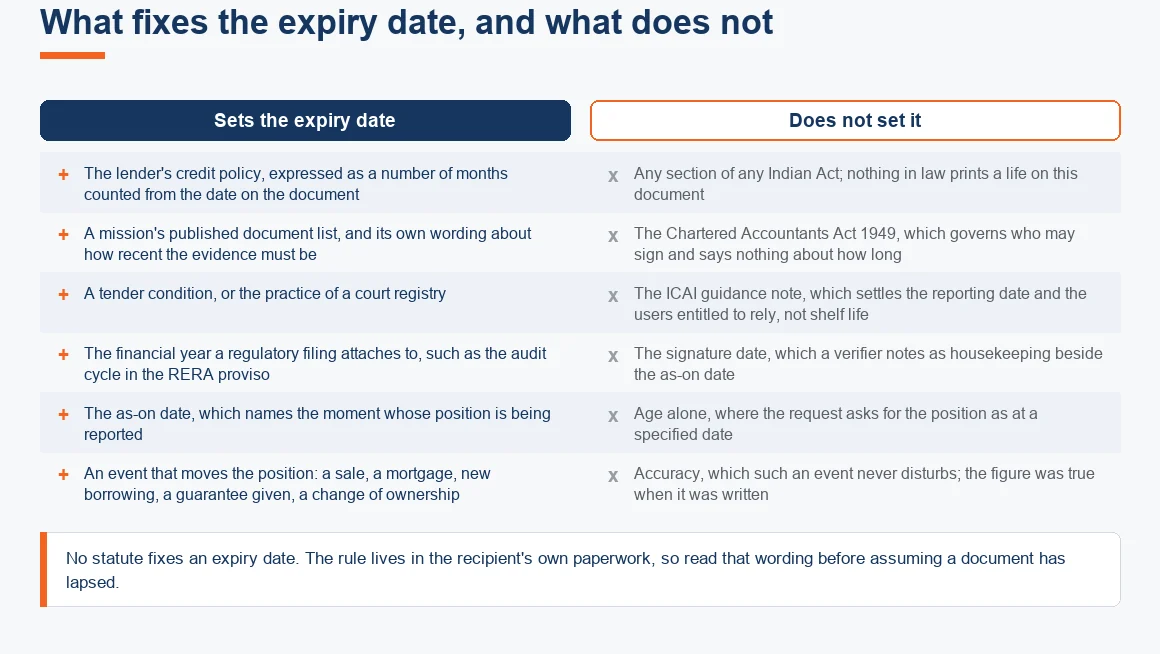
Nothing in Indian law prints a life on this document. Searches for net worth certificate validity assume a statutory period exists somewhere, and none does. The Chartered Accountants Act 1949 governs who may sign such a statement, and says nothing at all about how long a signed one stays usable.
The institute's own framework points the same way. Its guidance on special purpose certificates was revised by the Auditing and Assurance Standards Board in 2016. That guidance treats a document of this kind as addressed to identified users for an identified purpose. It settles the date of the information reported and the users entitled to rely on it. Shelf life is not among the things it settles.
So the expiry rule lives in the recipient's paperwork instead. A sanction letter, a tender condition, a court registry practice or a mission's document list will say how recent the figures have to be. That single sentence, and not any section of any Act, is what turns a document stale.
The Windows Banks, Consulates and Tender Boards Apply in Practice
Lenders express the requirement as a number of months counted from the date on the document, and the number is theirs to choose. A credit policy fixes it; nothing external does. What one bank still treats as current, another has already asked to be refreshed, and a borrower usually discovers the difference only when the file moves to the sanctioning desk.
Missions publish document lists, and those lists carry their own freshness wording. Financial evidence is normally expected to describe a recent position, and each mission decides for itself what recent means for a given category of application. Where a list is silent, the safer reading is that the officer applies the same standard to an attested statement as to the bank records filed beside it.
Regulatory and tender filings behave differently again, because they attach to a financial year rather than to a rolling window. Take the third proviso to section 4(2)(l)(D) of RERA, the 2016 statute governing real estate projects. It requires a promoter to have the project accounts audited by a practising chartered accountant. That audit falls due within six months after the end of every financial year. A document tied to that cycle stays current until the cycle turns, whatever its age in months. Reading the request before ordering anything is the same discipline that decides the standard of proof applied to the file as a whole.
Why the As-On Date Matters More Than the Signing Date
Two dates appear on the face of the document and they do different jobs. The as-on date names the moment whose position is being reported. The signature date records when the member actually signed. A verifier reads the first as the substance and notes the second as housekeeping, and a reader who confuses them draws the wrong conclusion about how old the figures are.
The as-on date is what the certifying member has taken responsibility for. Every balance, holding statement and loan confirmation behind the schedule is pulled as at that date, and the conclusion speaks about it alone. Nothing occurring afterwards is covered, including a sale completed the following week.
A gap between the two dates is normal, since evidence takes time to assemble. A long gap invites a question the holder should be ready to answer. Where the position is stated as at 31 March and the signature is dated in September, the reader is being shown figures six months old, however fresh the ink looks. A dated list of holdings and dues is only ever as useful as the date printed on it.
Events That Make a Valid Certificate Stale Overnight
Some events end a document's usefulness the day they happen, without making it inaccurate. Selling a flat that carried a fifth of the certified figure is the clearest of them. Mortgaging one does the same, because a charge created after the reported date changes what the identical assets can support. Buying works the same way in reverse, since a purchase funded by borrowing moves both sides at once.
New borrowing does the same damage from the other direction. A fresh term loan, an overdraft limit newly drawn, or an enhancement of a facility already running all move the liability total. Standing surety for somebody else's borrowing is subtler, because it reduces nothing at all. A reader who learns of it afterwards treats the earlier document as incomplete rather than as wrong.
A change of status can be as decisive as a transaction. Partition of a joint family property, a settlement recorded in a matrimonial proceeding, a partner's retirement from a firm, or the death of a co-owner each redraws who owns what. The certified figure was true when written and describes somebody else's position afterwards. None of these events cancels the document; they simply move the person it describes.
Refresh or Reissue: What a CA Actually Redoes
What gets redone depends on how far the position has moved. Where the earlier schedule was built recently and nothing material has changed, the same working is rolled forward. Balances are refreshed, the property valuation basis is reconsidered rather than commissioned again, and the structure of the statement survives intact.
A new as-on date pulls fresh paper regardless. Bank confirmations, deposit advices, holding statements and loan outstandings all have to be obtained again for the new date, because the old ones no longer describe it. Where a property was bought or sold in between, its papers enter or leave the file entirely, and the schedule changes shape rather than merely changing figures.
The attestation itself is always new. ICAI made a unique document identification number compulsory for certificates signed on or after 1 February 2019. The number is generated for each document, within fifteen days of the date that document carries. A refreshed statement is therefore a separate document with its own identifier, which is why matching the number against the register distinguishes the current version from the superseded one.
Holding a Certificate That Has Gone Stale: What to Do Next
Read the recipient's wording first, before assuming anything has lapsed. Many requests ask for a document not older than a stated period, and one falling inside that period needs nothing done to it at all. Others ask for the position as at a specified date, in which case age is irrelevant and only the reported date counts. A surprising number of reissues are ordered against neither requirement.
Where it has genuinely gone stale, the choice is narrow. If holdings and dues have barely moved, a fresh statement on a new date is a short exercise built on the file already assembled. If a property has changed hands or a large facility has been taken since, the evidence is gathered again from the beginning. The second document then has little in common with the first.
Either way, a chartered accountant has to examine the evidence and sign again at the end of it. The attested version of the statement is what the acceptor is asking for. The earlier document is worth keeping rather than discarding, since it records a position somebody may later ask about.
This post supports What Is the Validity of a Net Worth Certificate in India?, which sets out what Patron delivers and for whom.