In this guide
Verification Starts With the UDIN Printed on the Certificate
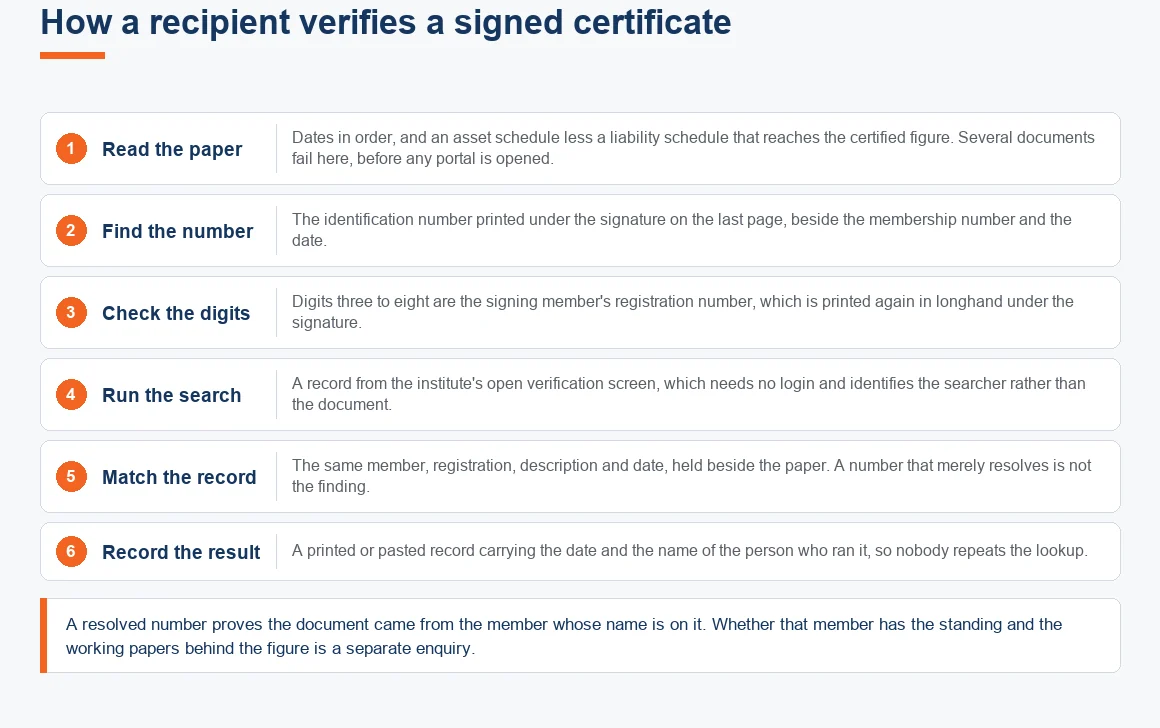
Turn a signed certificate to its last page and read the block under the signature. A member in practice prints an 18-digit Unique Document Identification Number there, alongside the membership number and the date. Anyone working out how to verify a net worth certificate begins at that one field, because nothing else on the page can be tested against an independent register.
The number is not a code a reader has to unpick. Its opening two digits carry the year of generation. A block of six inside it belongs to the signing member. Everything after that is produced by the portal and means nothing on its own. No client name, no amount and no stated purpose is encoded anywhere in the string.
Age is the one innocent reason for a blank. Certificates came inside the ICAI mandate on 1 February 2019, and paper signed earlier will not carry a number. A recipient holding a document of that vintage is left with a signature and a member register, with no portal entry standing behind either. Whether that is enough is the acceptor's call and not the portal's.
Running a UDIN Search on the ICAI Portal, Step by Step
The search itself sits on the institute's own portal and asks for no membership login. From udin.icai.org a visitor opens the route addressed to authorities, regulators, banks and others, which reaches the open verification screen. No relationship with ICAI is needed to use it.
What the screen asks for is unexpected the first time. It identifies the searcher rather than the document: a category, a name, a mobile number, an email address, then the number itself and a captcha. Every lookup therefore leaves a record of who ran it. There is no field for the client's name and none for the certified amount.
Matching is the actual work, and a resolved number is only the start of it. Hold the returned record beside the paper and compare the member named, the registration quoted, the description the member selected and the date recorded against it. A number that resolves is not the finding. A number that resolves to the same member, the same description and the same date is.
Dates are where honest discrepancies surface. The portal shows the date the member recorded when generating. The certificate shows a signature date and an as on date, which are different things. Only the first two are expected to agree, and a wide gap between them is worth a question.
Matching the Membership and Firm Details Printed on the Certificate
A second check runs on arithmetic alone and needs no portal at all. Digits three to eight of the number are the signing member's registration number. That figure is printed again under the signature in longhand. Where the two disagree, the number on the page did not come from the person who signed the page.
Two further printed identifiers carry weight. A certificate signed for a firm shows a firm registration number on the letterhead, and the signature block states whether the member signs personally or on the firm's behalf. Only a member who holds a full time practising certificate can generate a number at all. A number that resolves is therefore evidence of practising status on the date it was generated.
This is where the checking stops. Whether the signing member has the standing, the independence and the working papers to support the figure is a separate enquiry. That one runs on the professional rather than on the paper, and due diligence on the signing professional belongs there. A recipient matching printed details is answering something narrower: did this document come from the member whose name is on it.
Red Flags That Show Up Before You Even Check the UDIN
Several documents fail on a first reading, before any portal is opened.
Dates come first. A certificate states a position as on one date and is signed on another. The signing date should follow the as on date rather than precede it. A document with no as on date at all states nothing checkable, since a net worth figure without a date has no subject.
Arithmetic comes second and takes about a minute. Add the asset schedule, subtract the liability schedule, and set the result against the certified figure. Rounding of a few hundred rupees is ordinary. A gap in lakhs means either that a schedule is incomplete or that the figure was written first and the schedules assembled around it.
Presentation comes third and is the weakest of the three. A pasted signature image, an absent stamp, a figure set in a different typeface, a page number that jumps: none of these proves anything alone. Together they justify running the portal check rather than replacing it, because the weight a signature carries is exactly what an altered page attacks.
What to Do When the UDIN Returns No Result
A blank result has three ordinary explanations before it has a serious one.
Transcription is the first. The tail of the number mixes letters and digits. A zero read as the letter O, or a one read as an I, produces a plausible string that resolves to nothing. Retyping from text rather than from a scan removes most of these. Asking the issuer to send the number as typed characters, not as an image of a stamp, removes the rest.
The wrong register is the second. Cost accountants and company secretaries generate their own numbers on their own institutes' portals, and neither returns anything on the ICAI search. The document may be entirely genuine and the search still empty. Which institute a signature belongs to is usually settled by one reading of the signature block.
Refusal is the third and the most telling. An issuer who will not put the number in writing has already answered. Where a recipient concludes that a document was fabricated, the complaint goes to the Director (Discipline) at ICAI in Form I. The Institute sets out the procedure for filing one. Impersonating a member is a matter for the police rather than for the Institute.
Verification Habits Inside Lending, Consular and Tender Files
Three habits separate an institution that verifies from one that merely files.
Recording the result is the first and the one most often skipped. A lookup that leaves no trace on the file has to be repeated by whoever opens the file next. Teams that print the returned record, or paste it into the appraisal note with the date and the name of the person who ran it, spend that effort once.
Sampling is the second, and it is a policy question rather than a technical one. Checking every certificate received is the only approach that catches a first offence. Sampling finds patterns and misses individual cases, which is defensible on small exposures and hard to defend where the certificate is the security. A lookup takes about a minute, so the argument for sampling is usually about habit rather than about resource.
A fresh document is the third. A figure certified as on 31 March says nothing about a position in November, however clean the lookup was. Where a decision has slipped well past the as on date, requesting a new certificate is more useful than a second search. How long a certified figure stays current is set by the acceptor's rule and not by the portal.
If You Are the Applicant: Getting a Certificate That Passes These Checks
An applicant can read the same list backwards. A certificate that survives a recipient's check carries the number, the signing member's registration number and the firm registration number where a firm signs. It also carries an as on date, a signature date, and schedules whose totals reach the certified figure without adjustment. All of that is visible on the page before anything is submitted.
Timing is the part an applicant cannot repair afterwards. The date a member records against the number is the date a recipient will compare with the signature on the paper. Where the two sit weeks apart, the lookup succeeds and the comparison still fails.
Which document to request is the earlier decision and the one that governs everything downstream. A statement built for a bank appraisal and a statement built for a consular file are not interchangeable, and the acceptor's own wording is the only reliable guide. A list sorted by the request rather than by document name is the faster way through that.
This post supports How to Verify a Net Worth Certificate Using UDIN, which sets out what Patron delivers and for whom.