In this guide
Ind AS applicability turns on two simple questions: is the company listed, and what is its net worth. Every company with shares or debt listed on an Indian stock exchange (other than the SME platform) must prepare its accounts under Indian Accounting Standards, and so must any unlisted company whose net worth reaches Rs 250 crore or more. Their holding, subsidiary, associate and joint venture companies are pulled in alongside them. This guide sets out who must comply for FY 2025-26, how the threshold is measured and what triggers the switch. For the standards themselves and an implementation view, see our reference on Ind AS: complete list, applicability and implementation guide.
Where the Ind AS applicability rule comes from
The obligation is not a matter of choice or accounting policy. Ind AS are the IFRS-converged standards notified in the Companies (Indian Accounting Standards) Rules, 2015, issued under section 133 of the Companies Act, 2013. The Ministry of Corporate Affairs set out a phased roadmap in those Rules, and the Institute of Chartered Accountants of India develops the underlying standards. Once a company falls within the roadmap, applying Ind AS is a statutory requirement, and the auditor reports against it. The Rules are published by the Ministry of Corporate Affairs and the standards by the ICAI.
Who must comply with Ind AS
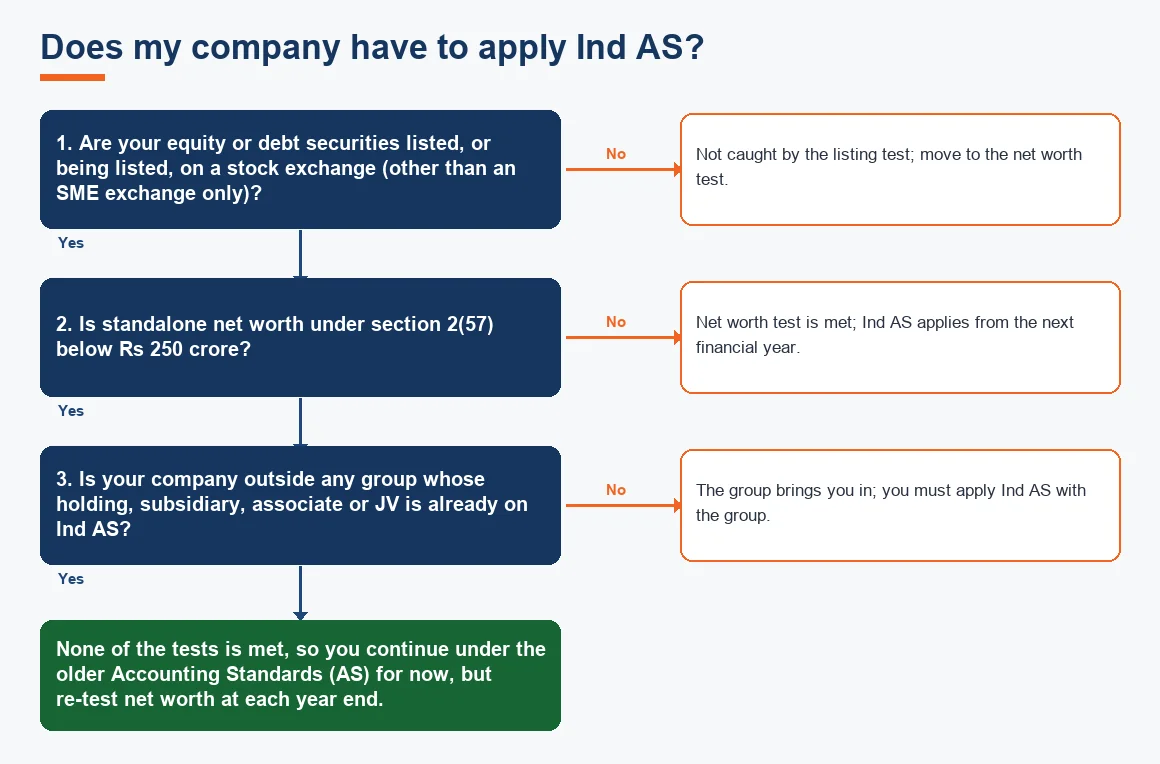
Two independent tests decide the question. A company is caught if it meets either one.
- The listing test. Any company whose equity or debt securities are listed, or are in the process of being listed, on any stock exchange in India or outside India must apply Ind AS, whatever its net worth. Companies listed only on an SME exchange are the single exception and stay on the older Accounting Standards.
- The net worth test. An unlisted company must apply Ind AS once its net worth reaches Rs 250 crore or more.
If neither test is met, the company continues under the Companies (Accounting Standards) Rules, that is, the older AS regime. The interactive Ind AS applicability checker walks through both tests in a couple of minutes.
The phased roadmap: how the thresholds arrived
The Rules brought companies in over two phases, and voluntary early adoption was allowed from FY 2015-16. The table below summarises the mandatory phases that set today's thresholds.
| Phase | Applies from | Companies covered |
|---|---|---|
| Voluntary | FY 2015-16 | Any company could adopt Ind AS early, but could not revert. |
| Phase I | FY 2016-17 | Listed or to-be-listed companies with net worth of Rs 500 crore or more, and unlisted companies at the same Rs 500 crore mark. |
| Phase II | FY 2017-18 | All remaining listed or to-be-listed companies, and unlisted companies with net worth of Rs 250 crore or more. |
Because Phase II lowered the unlisted threshold to Rs 250 crore and swept in every listed company, that is the position that still governs applicability today. A growing company that crosses Rs 250 crore in FY 2024-25 is tested against exactly the same rule.
How to calculate net worth for the Ind AS test
Net worth follows the definition in section 2(57) of the Companies Act, 2013, and it is not the same as the balance sheet total. It is the aggregate of paid-up share capital and all reserves created out of profits and securities premium, reduced by accumulated losses, deferred expenditure and miscellaneous expenditure not written off. Crucially, it excludes reserves created out of revaluation of assets, write-back of depreciation and amalgamation.
Two further points matter. The figure is taken from the standalone balance sheet, not the consolidated one, and it is measured as at the end of the relevant financial year. A revaluation surplus that inflates equity in the accounts does nothing to the Ind AS count, so a company can look large on paper yet sit below the threshold once revaluation is stripped out.
Group companies are pulled in together
Applicability is not decided company by company in isolation. Once any company in a group meets the listing or net worth test, its holding company, subsidiaries, associates and joint ventures must also apply Ind AS for the same period. This keeps the whole group on one measurement basis so that parent-subsidiary consolidation is coherent and inter-company figures line up. A small subsidiary with a modest net worth can therefore find itself on Ind AS purely because its parent crossed the threshold.
Banks, insurers and NBFCs follow separate roadmaps
The 2015 Rules deliberately left out banking companies, insurance companies and non-banking financial companies. NBFCs were given their own roadmap: Phase I from FY 2018-19 for NBFCs with net worth of Rs 500 crore or more, and Phase II from FY 2019-20 for listed NBFCs and unlisted NBFCs with net worth of Rs 250 crore or more. Scheduled commercial banks and insurers are governed by their sector regulators and by directions from the Reserve Bank of India, so they do not read across from the corporate thresholds. If you sit in financial services, check the sector roadmap rather than the general one.
What happens once you cross the threshold
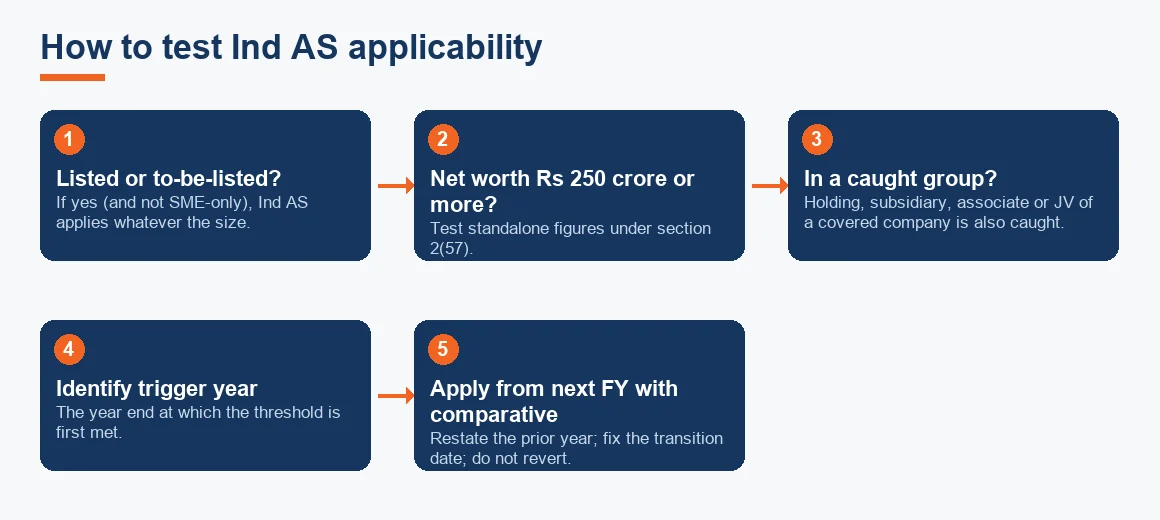
Crossing the threshold does not force a mid-year restatement. It sets a clear sequence for the following year.
- Identify the trigger year. Measure net worth at each year end. The year in which it first reaches Rs 250 crore is the trigger year.
- Apply from the next financial year. Ind AS becomes mandatory from the accounting year immediately following the trigger year.
- Fix the transition date. Because a full comparative period is required, the opening balance sheet is prepared at the start of the comparative year. This transition date drives every Ind AS 101 first-time adoption adjustment.
- Restate the comparative. The prior year is re-presented under Ind AS, with differences routed through retained earnings at the transition date.
- Continue, without reverting. Once you are on Ind AS you stay there, even if net worth later falls below Rs 250 crore. The switch is irreversible.
The restatement work reaches beyond the primary statements into the notes to accounts, the cash flow statement and the wider disclosures, which is why teams often start the exercise well before the first Ind AS year begins. Our year-end closing and finalisation and financial statement preparation pages explain how that work is scoped.
Worked example: testing a company for FY 2025-26
Take an unlisted manufacturing company that has grown quickly. To know whether Ind AS applies for FY 2025-26, we compute net worth from the standalone balance sheet as at 31 March 2025. All figures are in Rs crore.
| Component (section 2(57)) | Amount (Rs crore) | Counts? |
|---|---|---|
| Paid-up equity share capital | 45 | Yes |
| Securities premium | 55 | Yes |
| General reserve (out of profits) | 90 | Yes |
| Surplus in Statement of Profit and Loss | 70 | Yes |
| Revaluation reserve | 30 | No (excluded) |
| Less: deferred expenditure not written off | (5) | Reduces |
| Net worth for the Ind AS test | 255 |
The net worth is 45 + 55 + 90 + 70 - 5 = Rs 255 crore. The Rs 30 crore revaluation reserve is set aside, so it plays no part. At Rs 255 crore the company is above the Rs 250 crore mark as at 31 March 2025, so FY 2024-25 is the trigger year. Ind AS therefore applies from FY 2025-26, with FY 2024-25 restated as the comparative and 1 April 2024 as the transition date. Had the revaluation reserve been counted in error, the company would still clear the mark, but a firm just under the line could be wrongly pushed in, which is why the exclusion matters. You can sanity-check the crossover using the AS versus Ind AS comparison matrix.
What changes in practice after adoption
Applicability is only the threshold question; the substance is the wholesale change in measurement and disclosure. Ind AS brings fair value into areas that AS carried at cost, introduces other comprehensive income, and applies the five-step model in Ind AS 115 revenue recognition in place of the old revenue standard. Share-based payments fall under Ind AS 102, and every set of accounts is presented on the Schedule III format for Ind AS filers. The disclosure load is materially heavier than under AS, which is the real cost of crossing the line.
Key terms
- Schedule III Balance Sheet: the prescribed presentation format that Ind AS filers must use for the balance sheet.
- Parent-Subsidiary Consolidation: combining group accounts on one basis, which is why applicability runs across the group.
- Ind AS 115 Revenue Recognition: the five-step model that replaced the earlier revenue standard from FY 2018-19.
- Ind AS 102 Share-based Payment: the standard governing ESOP and other equity-settled awards under Ind AS.
- Equity: the residual interest whose components feed the section 2(57) net worth test.
Key takeaways
- Listed companies (except SME-listed) are on Ind AS regardless of size; unlisted companies join at Rs 250 crore net worth.
- Net worth uses section 2(57) on standalone figures and excludes revaluation, depreciation write-back and amalgamation reserves.
- Group members follow the company that is caught, so test subsidiaries and associates too.
- Crossing the threshold applies Ind AS from the next year with a restated comparative, and the change cannot be reversed.
- Banks, insurers and NBFCs sit on separate roadmaps, not the general 2015 Rules.
Decision guide