In this guide
The difference between revenue under AS 9 and under Ind AS 115 comes down to the question each standard asks. AS 9 asks when the significant risks and rewards of ownership have passed to the buyer. Ind AS 115 asks when each promise inside a contract has been satisfied, worked out through a five-step model. For most goods sold outright the two reach the same number, but for bundled deals, long projects and contracts with variable pricing the amount and the timing can move. This explainer sets out both, shows which companies use which, and works a numeric example so the mechanics are clear.
What AS 9 says: the risks and rewards model
AS 9 Revenue Recognition applies to companies that follow the Accounting Standards notified under the Companies (Accounting Standards) Rules 2021. For the sale of goods, revenue is recognised when the seller has transferred the significant risks and rewards of ownership to the buyer and no significant uncertainty exists about the amount that will be collected. For services, revenue is recognised either on a proportionate completion basis or on completion of the service, depending on the arrangement. Interest accrues on a time basis, royalties on the terms of the agreement and dividends when the right to receive payment is established. The standard is short, principle based and sits comfortably on the accrual accounting convention. Where recognition is postponed because of collection uncertainty, AS 9 asks for that fact to be disclosed.
What Ind AS 115 says: the five-step model
Ind AS 115 Revenue from Contracts with Customers replaced the older Ind AS 18 and Ind AS 11 for accounting periods beginning on or after 1 April 2018. It was developed alongside IFRS 15 and the United States standard ASC 606, so the mechanics are common across the three. Instead of a single risks-and-rewards test, it recognises revenue as a company transfers control of promised goods or services, measured through five ordered steps. The Ind AS 115 revenue recognition approach forces a contract to be broken into its separate promises before any amount is booked.
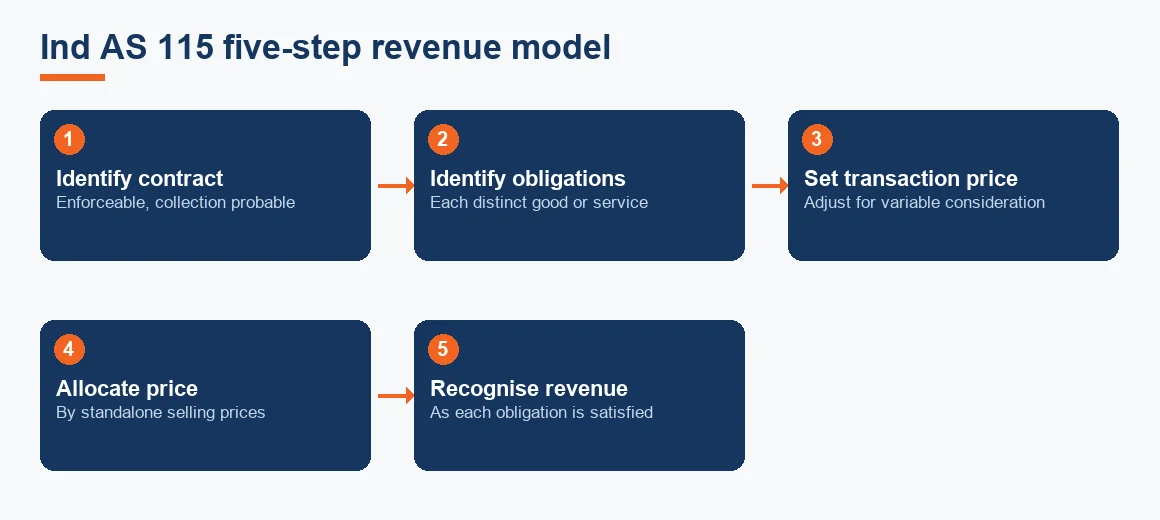
The five steps in order
- Identify the contract with the customer, including whether it is enforceable and collection is probable.
- Identify the performance obligations, the distinct goods or services promised.
- Determine the transaction price, adjusting for discounts, refunds and other variable consideration.
- Allocate the transaction price to each obligation using standalone selling prices.
- Recognise revenue when, or as, each obligation is satisfied, either at a point in time or over time.
Which companies follow AS 9 and which follow Ind AS 115
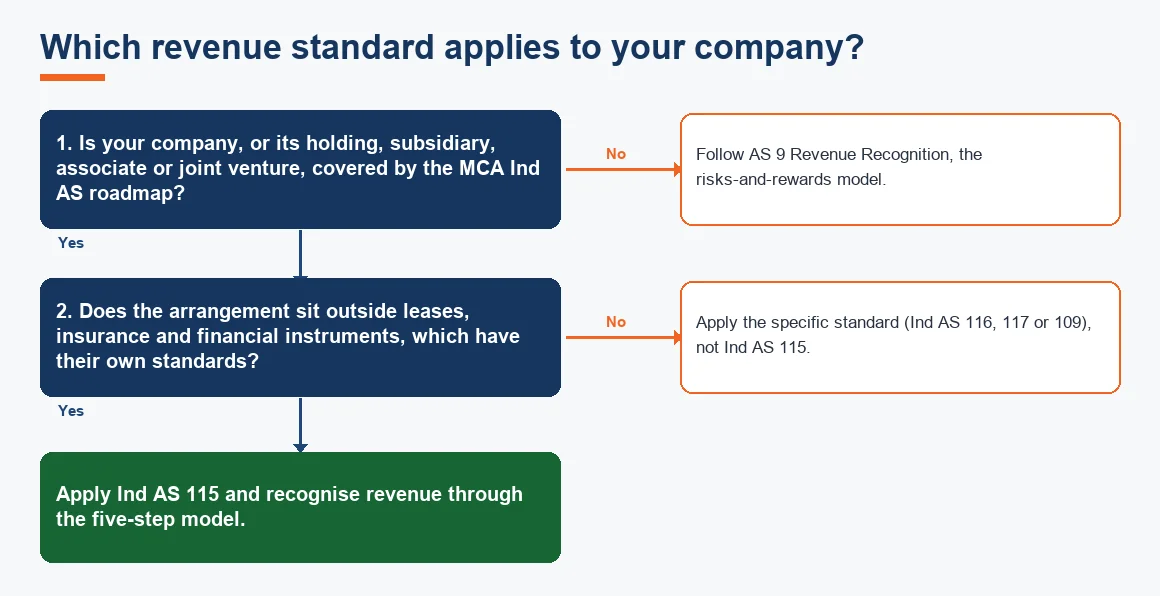
The dividing line is the MCA Ind AS roadmap. Listed companies and unlisted companies with net worth of Rs 250 crore or more sit inside the roadmap and apply Ind AS 115, and so do the holding, subsidiary, associate and joint venture entities of any company already on Ind AS. Every other company, broadly the unlisted small and medium sized ones below that net worth line, continues with AS 9. Banks, insurers and non-banking finance companies follow the separate timetables set by their own regulators. If you are unsure where an entity falls, the Ind AS Applicability Checker walks through the roadmap tests, and the parent reference list at Accounting Standards (AS) in India: Complete List shows how AS 9 sits among the other notified standards.
AS 9 vs Ind AS 115: the core differences
The table below sets the two standards side by side on the points that change day-to-day accounting. Read it as a map of where a migration will create work, not as a full rulebook.
| Point of difference | AS 9 | Ind AS 115 |
|---|---|---|
| Recognition trigger | Transfer of significant risks and rewards | Transfer of control, obligation by obligation |
| Bundled contracts | Usually recognised together | Split into distinct obligations, price allocated |
| Variable consideration | Recognised when reasonably certain | Estimated up front, capped to avoid reversal |
| Timing | Point of sale or proportionate completion | Point in time or over time, per defined tests |
| Long-term contracts | Percentage of completion (via AS 7) | Over time only if one of three tests is met |
| Disclosure | Policy and postponed revenue only | Disaggregation, contract balances, remaining obligations |
For a filterable version of this comparison across more standards, the AS vs Ind AS Comparison Matrix lets you line up individual topics.
Worked example: a bundled software and support contract
A company sells a perpetual software licence together with twelve months of support for a single price of Rs 12,00,000 (indicative, Exl GST). The licence is delivered on day one; the support is delivered evenly across the year. Under Ind AS 115 the price is allocated across the two obligations by their standalone selling prices, then recognised on each obligation's own timeline. The standalone prices are Rs 9,00,000 for the licence and Rs 3,60,000 for support, a total of Rs 12,60,000.
| Obligation | Standalone price (Rs) | Allocation working | Allocated price (Rs) | Recognition |
|---|---|---|---|---|
| Software licence | 9,00,000 | 12,00,000 x 9,00,000 / 12,60,000 | 8,57,143 | Point in time, on delivery |
| Annual support | 3,60,000 | 12,00,000 x 3,60,000 / 12,60,000 | 3,42,857 | Over 12 months, Rs 28,571 each |
| Total | 12,60,000 | 12,00,000 |
Under AS 9 a company might well recognise the full Rs 12,00,000 closer to the point of sale, with a simpler treatment of the support element. Under Ind AS 115, Rs 8,57,143 is recognised on delivery and the remaining Rs 3,42,857 becomes deferred revenue, released at Rs 28,571 a month. Same cash, same customer, different profile of profit through the year.
How the disclosures differ
The biggest practical gap between the two standards is not recognition, it is disclosure. AS 9 asks only for the accounting policy and for any revenue whose recognition has been postponed for uncertainty. Ind AS 115 asks for a great deal more: revenue disaggregated into categories such as product line, geography and contract duration; opening and closing balances of contract assets and liabilities; revenue recognised in the year from balances brought forward; the value of remaining performance obligations; and the judgements behind the timing chosen. These land in the notes to accounts and usually mean the underlying contract data has to be captured obligation by obligation, not just invoice by invoice.
Long-term contracts and services
For construction and other long projects, AS 7 applied percentage of completion whenever the outcome could be estimated reliably. Ind AS 115 is stricter: revenue is recognised over time only when one of three tests is met, most commonly that the asset being built has no alternative use to the contractor and there is an enforceable right to payment for work completed to date. Contracts that fail all three tests are recognised only on handover. The percentage of completion method survives in substance for qualifying contracts, but it now sits behind an over-time gate rather than being the default. Service firms that bill on stages face the same discipline, which is why unbilled revenue and the split between milestone and retainer billing need clean records before the standard can be applied.
Key terms
- Ind AS 115 Revenue Recognition: the five-step, control-based revenue standard aligned with IFRS 15.
- Revenue: income arising from an entity's ordinary activities.
- Deferred Revenue: amounts billed but not yet earned, carried as a liability.
- Percentage of Completion Method: recognising long-contract revenue in step with work done.
- Accrual Accounting: recording income and costs when earned or incurred, not when cash moves.
Getting the transition right
A move from AS 9 to Ind AS 115 is a data project as much as an accounting one. Contracts have to be read for their separate obligations, standalone prices set, variable consideration estimated, and the opening balances of contract assets and liabilities established. Because the change flows straight into the primary statements, it is best handled alongside your financial statement preparation so the notes, the disclosures and the comparatives stay consistent. Ongoing accounting and bookkeeping then has to capture contract data at the obligation level rather than the invoice level, which is a change to the chart of accounts and the billing workflow, not just the year-end.
Key takeaways
- AS 9 turns on risks and rewards; Ind AS 115 turns on control, tested obligation by obligation through five steps.
- Applicability follows the MCA Ind AS roadmap and group membership, not the company's own preference.
- Bundled contracts, variable pricing and long projects are where the number and the timing actually change.
- Ind AS 115 demands far heavier disclosure, so contract data must be captured at the obligation level.
- For a simple outright sale of goods, both standards usually reach the same result.
Sources: ICAI for the text of AS 9 and Ind AS 115, and the Ministry of Corporate Affairs for the Companies (Indian Accounting Standards) Rules and the Ind AS roadmap.
Decision guide