In this guide
AS 22 and Ind AS 12 answer the same question, how much tax to carry forward or back because the books and the tax return disagree, but they take different routes. AS 22 works from timing differences between taxable income and accounting income, an income statement idea. Ind AS 12 works from temporary differences between the carrying amount of an asset or liability and its tax base, a balance sheet idea. For most ordinary items, depreciation, gratuity and other section 43B provisions, the two reach a similar figure. The route and the edge cases are where they part company, and that is what this explainer sets out, with the working.
Deferred tax in one line, and how to calculate it
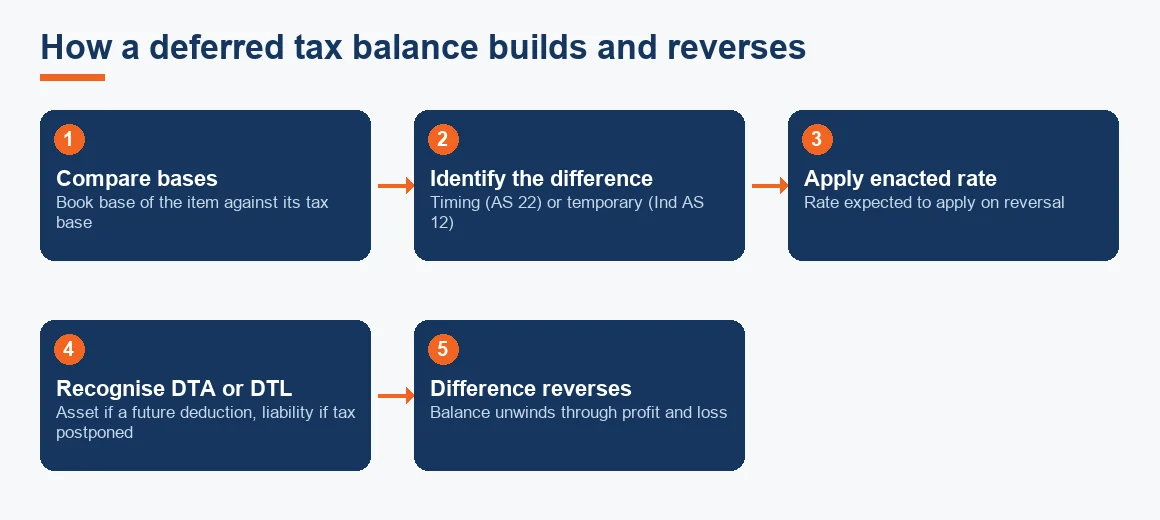
Deferred tax is the tax effect of a difference between the value of an item in the books and its value for tax, multiplied by the tax rate that is expected to apply when the difference reverses. If depreciation is Rs 10 lakh in the books and Rs 15 lakh under the Income Tax Act, the Rs 5 lakh gap at an effective 25.168 per cent creates a deferred tax liability of about Rs 1.26 lakh for that year. The rate matters: a company that has opted for section 115BAA pays a base rate of 22 per cent, which grosses up to 25.168 per cent after surcharge and cess, so that is the rate used to measure the deferred balance for such a company. Deferred tax rides on the same accrual accounting logic that produces every other balance in the balance sheet.
AS 22 and timing differences: the income statement view
AS 22, Accounting for Taxes on Income, notified under the Companies (Accounting Standards) Rules and issued by the ICAI, defines a timing difference as a difference between taxable income and accounting income for a period that originates in one period and is capable of reversal in one or more later periods. The classic example is depreciation: the Income Tax Act allows written down value rates that are usually higher than the straight line rates commonly used in the books, so tax paid early in an asset's life is lower and the shortfall is carried as a liability until the position reverses in later years. A permanent difference, by contrast, never reverses (a disallowed penalty, for instance) and so creates no deferred tax at all.
Because AS 22 looks at the profit and loss account, it only sees differences that pass through it. That keeps the standard simple and, for a private company with a plain set of accounts, entirely sufficient. AS 22 measures deferred tax at the tax rates and tax laws enacted or substantively enacted by the balance sheet date, and it does not permit discounting.
Ind AS 12 and temporary differences: the balance sheet view
Ind AS 12, Income Taxes, notified by the Ministry of Corporate Affairs for companies on the Ind AS roadmap, defines a temporary difference as the difference between the carrying amount of an asset or liability in the balance sheet and its tax base. The tax base is the amount attributed to that asset or liability for tax purposes. This balance sheet approach is wider than AS 22's income statement approach: every timing difference is a temporary difference, but a temporary difference can also arise from items that never touch profit and loss, such as a revaluation of fixed assets, a fair value gain taken to other comprehensive income, or assets and liabilities recognised in a business combination.
Ind AS 12 carries the tax with the item. If a gain sits in other comprehensive income, the related deferred tax also sits in other comprehensive income rather than in profit and loss. AS 22 has no equivalent mechanism because it starts from the income statement. Like AS 22, Ind AS 12 uses enacted or substantively enacted rates and forbids discounting. If your entity is on the Ind AS roadmap and you want the reconciling detail behind the accounts, our note on AS 15 vs Ind AS 19 employee benefits shows the same timing-versus-temporary pattern for gratuity and actuarial gains.
AS 22 vs Ind AS 12: the differences that matter
For a routine set of accounts the two standards produce almost the same deferred tax balance. The differences bite when items sit outside the profit and loss account, when losses are involved, or when a group is restructured. The table below summarises where they diverge.
| Aspect | AS 22 (timing differences) | Ind AS 12 (temporary differences) |
|---|---|---|
| Underlying approach | Income statement: taxable income vs accounting income | Balance sheet: carrying amount vs tax base |
| Scope of differences | Narrower, only items routed through profit and loss | Wider, includes revaluations, fair value and business combinations |
| Deferred tax asset on losses | Virtual certainty supported by convincing evidence | Recognised where future taxable profit is probable |
| Items in OCI or equity | Not addressed; everything flows through profit and loss | Deferred tax follows the item into OCI or equity |
| Discounting | Not permitted | Not permitted |
| Presentation | Non-current; netting where the same governing taxation laws apply | Non-current; offset only with a legal right to set off and the same taxing authority |
If you want to see how these rules cascade across a full set of standards, the AS vs Ind AS comparison matrix lays out the position standard by standard, and the parent guide to Accounting Standards (AS) in India gives the complete list.
When is a deferred tax asset created?
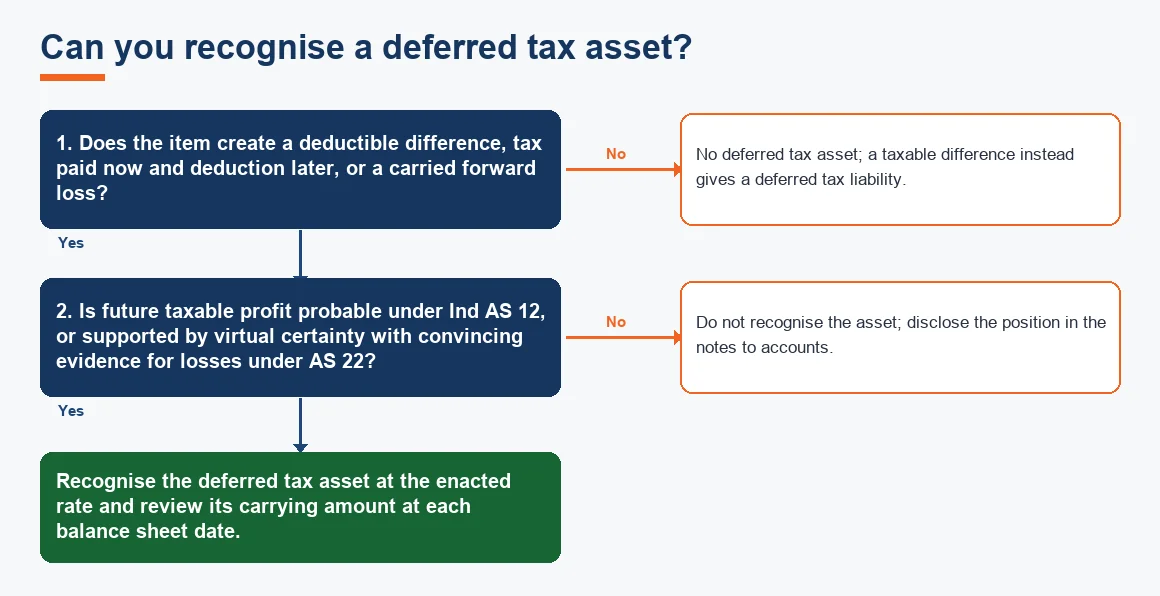
A deferred tax asset arises when tax paid now exceeds the tax expense recognised in the books, so a future deduction is stored up. Common triggers in India are provisions for gratuity, bonus, leave encashment and other statutory dues that section 43B disallows until they are actually paid, and carried forward business losses and unabsorbed depreciation. The recognition test is where the standards separate. AS 22 permits a deferred tax asset against unabsorbed depreciation or carried forward losses only where there is virtual certainty, supported by convincing evidence, that future taxable income will be available. Ind AS 12 sets a lower bar: recognise the asset to the extent it is probable that future taxable profit will be available against which the deductible difference can be used.
The disallowance clock also interacts with the section 43B(h) MSME clock, which pushes deductions for dues to micro and small suppliers into the year of actual payment, creating exactly the kind of deductible difference that generates a deferred tax asset.
Worked example: a depreciation-driven deferred tax liability
Take plant purchased for Rs 20,00,000. The books charge straight line depreciation at 12.5 per cent (Rs 2,50,000 a year); tax allows written down value depreciation at 15 per cent. The schedule below tracks the timing difference, the closing deferred tax liability at the 25.168 per cent effective rate, and the charge or credit that hits profit and loss each year.
| Year | Book depreciation (Rs) | Tax depreciation, WDV (Rs) | Timing difference, tax less book (Rs) | Cumulative difference (Rs) | Closing DTL at 25.168% (Rs) | Charge / (credit) for year (Rs) |
|---|---|---|---|---|---|---|
| 1 | 2,50,000 | 3,00,000 | 50,000 | 50,000 | 12,584 | 12,584 |
| 2 | 2,50,000 | 2,55,000 | 5,000 | 55,000 | 13,842 | 1,258 |
| 3 | 2,50,000 | 2,16,750 | (33,250) | 21,750 | 5,474 | (8,368) |
In year one, tax depreciation exceeds book depreciation, so taxable profit is lower than book profit and a liability builds: the journal entry is debit deferred tax expense (profit and loss) Rs 12,584, credit deferred tax liability Rs 12,584. By year three the written down value base has shrunk enough that tax depreciation falls below the flat book charge, the difference reverses, and part of the liability is released as a credit of Rs 8,368. That reversal is the whole point of the standard: the liability unwinds as the timing difference turns around. You can reproduce this for any block of assets with the deferred tax calculator.
Is deferred tax deductible, and how is it presented?
Deferred tax is a book entry, not a cash tax. It is added back while computing taxable income and is not allowed as a deduction under the Income Tax Act. It is also added back to book profit for minimum alternate tax under section 115JB, charged at 15 per cent plus surcharge and cess, although a company that has opted for section 115BAA at the 22 per cent base rate is outside MAT altogether. On presentation, both standards classify deferred tax assets and liabilities as non-current under Schedule III of the Companies Act, and neither permits discounting to present value. Offsetting is allowed only in narrow circumstances: Ind AS 12 requires a legally enforceable right to set off current tax with balances relating to the same taxing authority, while AS 22 permits netting where the same governing taxation laws apply. A clean deferred tax working also keeps your current liabilities and the reported net profit honest, which is why it belongs in the year-end closing and finalisation and financial statement preparation stages rather than being left to the last day.
Which standard applies to your company
You do not choose between AS 22 and Ind AS 12; the applicable framework decides for you. Companies on the Ind AS roadmap, broadly listed companies and unlisted companies meeting the net worth threshold along with their holding, subsidiary, associate and joint venture companies, apply Ind AS 12. Everyone else applies AS 22 under the Companies (Accounting Standards) Rules. If you are unsure which framework your entity falls under, the Ind AS applicability checker walks through the tests. The recognition decision within each standard is set out below.
Key terms
- Depreciation: the systematic write-down of an asset's cost, the most common source of a timing or temporary difference in India.
- Schedule III Balance Sheet: the Companies Act format under which deferred tax is shown as a non-current balance.
- Section 43B(h) MSME Clock: the rule deferring deductions for dues to micro and small suppliers to the year of payment, a frequent deferred tax asset trigger.
- Accrual Accounting: recognising income and expense when earned or incurred, the basis on which deferred tax arises at all.
Key takeaways
- AS 22 measures deferred tax from timing differences (income statement); Ind AS 12 from temporary differences (balance sheet), a wider set.
- For routine items the number agrees; Ind AS 12 additionally captures OCI, fair value and business combination differences.
- Deferred tax assets need virtual certainty under AS 22 and a probability test under Ind AS 12.
- Deferred tax is non-cash: added back for taxable income and for MAT under section 115JB, and shown non-current under Schedule III.
- Measure the balance at the rate expected on reversal, and let the difference unwind rather than remeasuring from scratch each year.
Decision guide