
In this guide
A Company Is an NBFC When Financial Assets and Income Both Cross Half
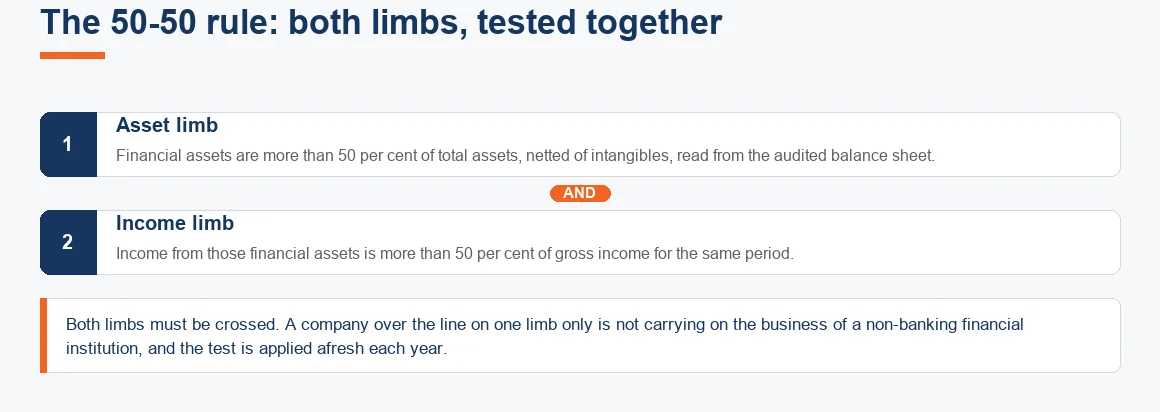
Both limbs have to be crossed, and both are read off the same audited accounts. Financial assets must exceed half of total assets after intangible assets are netted off. Income from those financial assets must exceed half of gross income. Clear one limb and nothing follows; clear both and the company is carrying on the business of a non-banking financial institution. Practitioners call the pair of tests the 50-50 rule for NBFCs.
The rule is not in the statute. It comes from a press release issued in 1999, numbered 1998-99/1269 and dated 8 April 1999. That release set out how the Reserve Bank would identify a company whose principal business is financial. Paragraph 38 of the Reserve Bank's 2025 registration and scale based regulation directions now reproduces the criteria in terms. The test therefore carries more weight than a press release alone would.
What follows from crossing is a registration requirement rather than a penalty. Section 45-IA makes a certificate of registration a precondition of carrying on the business, so a company already across is expected to hold one before it continues. That is a materially different position from a company that has merely parked some surplus in investments.
The Asset Test: Financial Assets Above Half of Total Assets
Financial assets are defined by the activities that create them. Section 45-I(c) lists financing any activity other than the company's own, and acquiring shares, stock, bonds, debentures or other marketable securities. Hire-purchase, insurance business, chit business and prize or benefit collection schemes complete the list. Assets thrown off by those activities form the numerator. Loans given, investments held, and hire-purchase or lease receivables are the ordinary examples.
The denominator is where the drafting bites. Total assets are netted off by intangible assets before the ratio is struck, so goodwill, brand and capitalised software reduce the bottom of the fraction and push the ratio up. A company that has written a large intangible on to its balance sheet is closer to the line than its own reading of the accounts suggests.
The ratio is computed from the last audited balance sheet, which fixes both halves of the fraction to a single date. A company can therefore sit above the line for eleven months and below it on the day that counts, or the reverse. A working capital line drawn down in March, or an investment sold that month, changes the answer without changing the business at all.
The Income Test: Financial Income Above Half of Gross Income
The income limb reads the profit and loss account against the same standard. Interest on lending, dividend on shares, gain on the sale of investments, and hire-purchase or lease income are income from financial assets. They are measured against gross income, so the comparison is made before expenses rather than at the profit line.
Operating income from a non-financial business sits in the denominator and nowhere else. A manufacturer's sales, a service company's fees and a trader's margin all work against the limb being crossed. This is why an operating company with substantial treasury holdings often satisfies the asset limb, fails the income limb, and stays outside the definition on that basis alone.
One-off receipts are the trap. The limb can be crossed by the denominator falling rather than the numerator rising. A year in which operating revenue collapses can turn an ordinary trading company into one whose income is majority financial. A single large gain on selling investments does the same thing from the other side. Neither is a decision to enter finance, and both are read off the accounts as though they were.
Reading the Principal Business Criteria the Regulator Applies
Principal business is a question of substance, and the Act approaches it by exclusion. Section 45-I(c) puts outside the definition any institution whose principal business is agricultural operations or industrial activity. The same exclusion covers the purchase or sale of goods other than securities, the providing of services, and dealings in immovable property. The property limb carries a condition: no part of the institution's income may come from financing such purchases, constructions or sales by other people. Industrial activity is not left loose either, and takes its meaning from the list in section 2(c) of the Industrial Development Bank of India Act 1964.
A second group sits outside because the Reserve Bank has exempted it. Insurance companies registered under section 3 of the Insurance Act 1938 are carved out of the registration provisions. So are recognised stock exchanges, stock brokers and sub-brokers registered with the market regulator, alternative investment funds, nidhi companies, chit companies, merchant bankers and housing finance institutions. Being financial is therefore not enough by itself. Being financial and unclaimed by another regulator is closer to the working test, and what follows for a company that is inside is a structure of its own.
None of this is mechanical at the margin. The FAQ the regulator publishes states the two limbs plainly, yet it is the composition behind the ratio that gets read where a company sits close to the line. A ratio a fraction above half, in a company with no lending activity and none intended, differs from that ratio in a company building a book.
Companies That Slip Into This Territory Unknowingly
Holding companies are the standard case. Their assets are shares in the companies below them and their income is dividend and gain, so both limbs read financial without a loan being written. Family investment vehicles behave the same way.
Trading companies with large surplus investments are the second group, and they arrive by drift. Cash accumulates, it is parked in mutual funds and bonds, and one year the ratio flips. Nothing moved towards finance; the balance sheet simply rebalanced around it.
From 1 July 2026 some of these companies sit outside the registration requirement altogether. Amendment directions issued in April 2026 exempt a company that neither avails public funds nor has any customer interface, where its asset size is below 1,000 crore rupees. An annual board resolution and a disclosure in the notes to accounts are the conditions. Asset sizes aggregate across such companies within a group. Lending to group entities, or placing inter-corporate deposits with them, counts as customer interface, so a vehicle funding its own group does not qualify.
Where the exemption does not reach, the Act supplies the consequence. Section 58B(4A) makes contravention of section 45-IA punishable with imprisonment of not less than one year and up to five years. The fine runs from not less than one lakh rupees to twenty-five lakh rupees. Section 58G lets the Reserve Bank impose a penalty of ten lakh rupees or twice the amount involved, whichever is more. A continuing default draws a further penalty of up to one lakh rupees a day.
The Annual Nature of the Principal Business Test
Because it is applied to signed accounts, the test produces one answer a year. A company close to the line therefore has a working paper problem rather than a monitoring one. It needs the ratio computed on the final numbers, with the classification of every asset and every income stream shown, and it needs that file kept.
The papers that matter are the ones a reviewer cannot rebuild from the accounts alone. An asset-by-asset split between operating and financial, an income-by-income split on the same basis, and a note explaining any item whose classification moved from the previous year are the three. A year-on-year comparison of the two ratios is the fourth, because a jump with no transaction behind it is the thing that draws a question.
Crossing the test also puts a second computation on the desk. Registration under section 45-IA turns on a capital condition as well as a business one. The arithmetic behind that condition becomes the next question, and the capital a registered lender holds becomes a continuing obligation rather than a single hurdle. Where the position has to be established and stated formally, the certified capital position for an NBFC is where that work sits.
This post supports What the 50-50 Rule Means for NBFC Classification, which sets out what Patron delivers and for whom.