
In this guide
Scale-Based Regulation Sorts Every NBFC Into Four Layers
Four layers replaced a two-way split. Until October 2022 the sector was sorted mainly by whether a company took deposits and whether it counted as systemically important. Scale based regulation kept both facts but subordinated them to one ordering. The layers of NBFC supervision now run base, middle, upper and a fourth layer the Reserve Bank abbreviates NBFC-TL, with regulatory intensity rising through them.
Placement follows size, activity and perceived riskiness rather than any single number. The registration and scale based regulation directions of 2025 carry the framework now, and they were amended twice during 2026, most recently on 24 June 2026. The older vocabulary is mapped across rather than abandoned. From 1 October 2022, references to a non-systemically important non-deposit taking company read as base layer. References to a deposit taking or systemically important company read as middle or upper layer.
The layers are reviewed rather than fixed. The upper layer is drawn up annually, and the criterion behind it is itself due for review every three years. A company does not choose its layer, and it is advised by the Reserve Bank when the answer changes.
Base Layer: Who Falls In and What Applies
The base layer holds non-deposit taking companies below an asset size of 1,000 crore rupees, together with four kinds of company that stay there whatever their size. Peer to peer lending platforms, account aggregators and non-operative financial holding companies are the first three. Companies that neither avail public funds nor have any customer interface are the fourth. All four are placed here by activity rather than by scale.
One transitional line is worth knowing. A company once classified as systemically important and non-deposit taking, holding assets of 500 crore rupees and above but below 1,000 crore rupees, is now a base layer company. That holds unless something else puts it in the middle layer.
The lightest set of obligations attaches here, and since 1 July 2026 part of this layer has left the perimeter altogether. Amendment directions in force from July 2026 exempt some of these companies from holding a certificate of registration at all. The exemption reaches a company with no public funds, no customer interface and assets below 1,000 crore rupees. Above that asset size the same company registers, as what the directions call a Type I NBFC. Everything that takes public funds or faces customers is a Type II NBFC.
Movement out of the layer is by growth. Crossing the asset size threshold moves a company into the middle layer. The framework treats the crossing as effective when it happens rather than when the next balance sheet is signed.
Middle Layer and the Deposit-Taking Distinction
Deposit taking is the sharper of the two entry routes. Every deposit taking company sits in the middle layer whatever its asset size, because accepting public deposits raises the stakes on its own. Companies that do not take deposits enter the same layer on scale instead, at an asset size of 1,000 crore rupees and above.
Five activities land here regardless of anything else. Standalone primary dealers, infrastructure debt fund companies, core investment companies, housing finance companies and infrastructure finance companies are placed in the middle layer or above. None of them sits in the base layer. Standalone primary dealers and infrastructure debt fund companies stay in the middle layer permanently.
Group consolidation is what catches promoters by surprise. Companies floated by a common set of promoters are not read on a standalone basis. The total assets of all the group's finance companies are added together to test the middle layer threshold. If the consolidated figure reaches 1,000 crore rupees, the classification follows for every investment and credit company, microfinance institution, factor and mortgage guarantee company in that group. Their own size stops mattering.
A temporary fall below the threshold does not reverse anything. A company whose assets dip in a given month continues to report and comply as a middle layer entity. That holds until its next audited balance sheet reaches the Reserve Bank and a specific dispensation follows.
Upper Layer and the Parameters That Push You There
The parameters in this heading are no longer what they were. When the framework began, the upper layer was identified through a scoring methodology that weighted size, interconnectedness, complexity and supervisory judgement. A fixed number of the largest companies were always included. That machinery was deleted on 24 June 2026.
What replaced it is a single test. The upper layer now consists of companies with an asset size of 1,00,000 crore rupees and above, taken from the latest audited balance sheet for the financial year. The Reserve Bank still identifies them annually and still advises each company, so placement remains a matter of record rather than of self-assessment.
The transition is timed rather than immediate. A company advised of its inclusion has three months to put a board approved policy and an implementation plan in place. It then has a maximum of 24 months from the date of that advice to meet the enhanced requirements, and the three months are counted inside the 24.
Leaving is slower than arriving. The five year floor runs from classification, and it is measured by failing the criterion for five consecutive years rather than by a single year below it. An earlier exit is available where the scaling down is a deliberate board approved strategy. It is not available where the company has shrunk because its finances deteriorated.
Top Layer: Reserved, and Why It Is Usually Empty
The fourth layer is a power rather than a population. The directions say it will ideally remain empty, and it can be filled only by moving a company out of the upper layer. No company arrives in it from below, and none applies to be there.
The condition for moving one is written as an opinion rather than as a measurement. The layer gets populated where the Reserve Bank forms the view that potential systemic risk from specific upper layer companies has increased substantially. There is no ratio to cross and no list to appear on, which is deliberate.
What attaches is a higher capital charge, communicated to the company at the point of classification, together with enhanced and intensive supervisory engagement. The design says something about the framework as a whole. Three layers are rule driven and the fourth is judgement driven. That is how a supervisor keeps room to act before a rule has been written for the situation in front of it.
Activity-Based Categories Cutting Across the Layers
A category answers what a company does and a layer answers how closely it is watched. Every registered company carries both at once, which is why the two lists never map on to one another. Investment and credit companies, microfinance institutions, factors and mortgage guarantee companies can sit in any of the layers. Placement is decided by the framework's parameters rather than by their category.
Some categories are pinned in place. Peer to peer platforms, account aggregators and non-operative financial holding companies never leave the base layer. Deposit taking companies, core investment companies, infrastructure finance companies and housing finance companies never sit in it. Standalone primary dealers and infrastructure debt fund companies are fixed in the middle layer.
Each category also brings its own rulebook. Microfinance institutions, peer to peer platforms, account aggregators and core investment companies each have one. So do standalone primary dealers, mortgage guarantee companies, housing finance companies and non-operating financial holding companies. Each is governed by a dedicated set of directions issued for that activity, in addition to the layer rules. A company therefore reads two documents to find its obligations, and the answer is the union of the two rather than the stricter of them.
How a company entered the perimeter at all is a different question again, and the test that applies first is answered on the accounts before any of this arises.
What Changes as You Move Between Layers
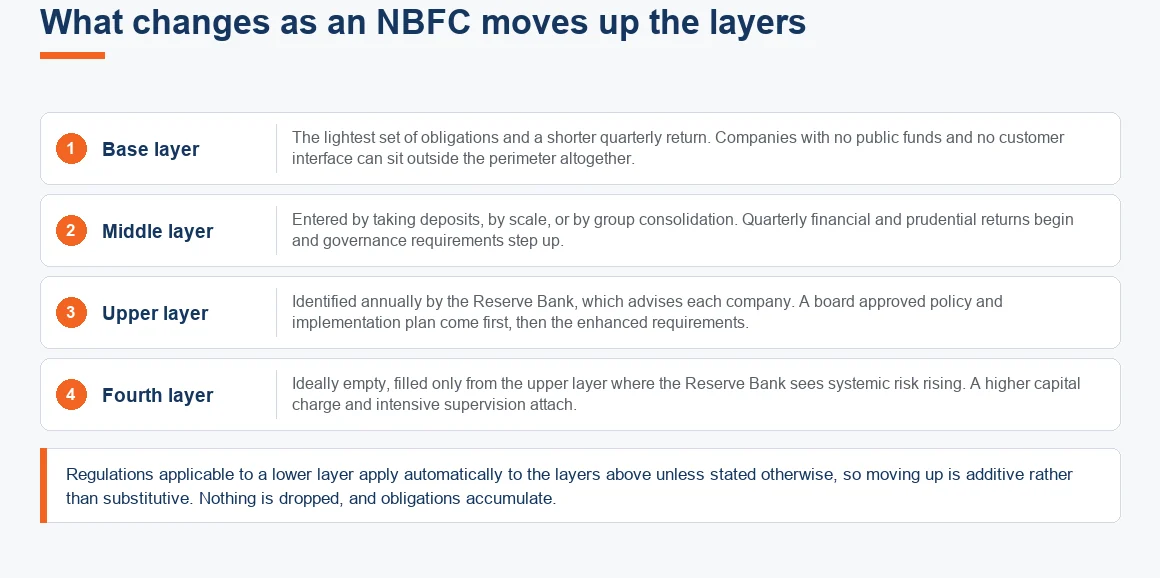
Regulations applicable to a lower layer apply automatically to the layers above it unless stated otherwise, so moving up is additive rather than substitutive. Nothing is dropped on the way. Obligations accumulate.
Reporting changes first. Financial and prudential returns run quarterly for the middle and upper layers, and the return set differs between those two. The base layer files a shorter quarterly return of its own. An annual return carrying the statutory auditor's certificate applies to every registered company whatever its layer, which makes it the one fixed point across the framework.
Governance and capital obligations step up next. Board composition, risk management structures, internal capital assessment and disclosure requirements all tighten as a company moves. The ratio the supervisor measures is struck against a capital base whose composition is prescribed rather than chosen. What sits inside that base is the core capital component and the rules on how it may be built.
The base itself is where the layers meet the arithmetic. Building the regulatory capital figure works the same way in every layer, and what changes is how often it is reported and how much rests on it. Where that number must be fixed to a date and stated formally, the position an NBFC has to evidence is set out separately. What is required turns on what the company is rather than on the layer alone.
This post supports NBFC Layers and Types Under RBI Classification, which sets out what Patron delivers and for whom.