
In this guide
Only Free Reserves Make the Cut; Revaluation-Created Ones Do Not
One test decides which reserves are included in net worth, and it is a test of origin rather than of size. A balance that came out of profit the company actually earned counts. A balance that came out of writing an asset up to a higher value does not. Section 2(57) of the Companies Act 2013 states the rule and then names the three origins it shuts out.
The reason for the exclusion is circularity. If a company could revalue its land and book the uplift to a reserve, counting that reserve as worth would raise its own standing. The number would have been written by the company in its own accounts. No cash moved and no profit was earned. The carve-out stops a valuation opinion from turning itself into evidence of financial position.
Wrong inclusions surface at review rather than at preparation. A verifier compares the attested total against the equity block in the filed accounts, finds a difference, and asks which line explains it. An unexplained exact match is the worse outcome of the two, because it usually means the revaluation surplus went in untouched.
How the Companies Act Defines a Free Reserve
Section 2(43) supplies the term the rest of company law leans on. A free reserve is a reserve which, as per the latest audited balance sheet, is available for distribution as dividend. Two carve-outs follow immediately. The first strips out unrealised gains, notional gains and amounts representing revaluation of assets, whether they are shown as a reserve or in some other form.
The second strips out any change in the carrying amount of an asset or a liability recognised in equity. That reaches a fair value surplus sitting in the profit and loss account. Between them the two clauses catch every route by which an unrealised gain could reach a reserve balance. Reserves available for dividend carries the term itself; what matters here is the width of what it refuses.
The net worth clause does not use the phrase free reserves at all. It says reserves created out of profits, and it then excludes reserves created out of revaluation of assets, write-back of depreciation and amalgamation. The two definitions arrive at almost the same place by different wording, which is why a practitioner quotes whichever one the recipient's own format cites. Reading the Act's own definition clauses beside each other takes less time than reading a commentary on either.
Securities Premium: Counted, With Restrictions on Its Use
Premium is the balance people most often try to leave out, and it belongs in. The definition names the securities premium account in the additive half of the build, without qualification. It is money subscribers actually paid, above face value, into the company. Realisation is the test the exclusions apply, and premium passes that test without argument.
Restriction on use is a separate question. Section 52(1) requires the amount to be transferred to an account of its own. Section 52(2) then lists what it may be applied to: bonus shares, preliminary expenses, share and debenture issue costs, premium payable on redemption, and a purchase under section 68. Outside that list the account is treated as if it were paid-up share capital, so touching it means going through capital reduction.
A verifier tests the balance against the allotment record, not against the profit history. Each addition should trace to a return of allotment filed with the Registrar, showing how many shares went out and at what price. Where premium appears with no matching filing behind it, the reserve is the symptom and the filing is the problem. Premium received above face value is the account under examination.
Revaluation Reserve and Why It Is Excluded
This balance appears when a company restates an asset, usually land or a building, from historical cost to a current valuation. The credit has nowhere else to go, so it lands in equity. Under Accounting Standard 10 it is described as a revaluation reserve. Under Ind AS 16 the same movement passes through other comprehensive income and accumulates as a revaluation surplus, with no change of substance.
Company law treats the balance as fragile wherever it sits. Section 63 forbids a bonus issue capitalised out of reserves created by the revaluation of assets. Section 2(43) refuses it the status of a free reserve. The net worth clause keeps it out of the figure entirely. Three provisions, one instinct: an unrealised uplift should not become capital, dividend or proof of standing.
None of that hides the balance. It stays on the balance sheet and in the note at its full amount, available to anybody who wants the asset-rich view. The statement reports the statutory result and then discloses what it left out, with the amount beside it. A reader can add it back and see precisely what was done. The surplus a revaluation creates is defined separately for that reason.
Capital Redemption, Debenture Redemption and Other Statutory Reserves
A third group exists because a statute says it must, not because a board chose to appropriate. Section 55(3) requires a sum equal to the nominal amount of redeemed preference shares to go to a capital redemption reserve where the redemption is funded out of profits. Section 69 requires the same transfer on a buy-back funded from free reserves or the premium account. Section 71 read with rule 18(7) of the Companies (Share Capital and Debentures) Rules 2014 governs the debenture redemption reserve.
Two questions get run together at this point. The first asks where the money came from. The second asks what the company may now do with it. Only the first bears on the computation. A balance funded out of taxed profit stays inside the base even where the Act locks its use tightly. A restriction on application is not a reversal of the profit that created it.
The same reasoning reaches reserves that other kinds of company are made to keep. A banking company transfers not less than twenty per cent of each year's profit to a reserve fund under section 17 of the Banking Regulation Act 1949. The transfer is compulsory and the balance is locked, and the money still came out of profit the bank earned. Release works the same way in reverse. When the debentures are redeemed or the buy-back is complete, the balance moves to another line inside the same block. The total does not shift, and neither does the figure built from it.
Unrealised Gains Sitting in Other Comprehensive Income
Ind AS moved a whole category of movement out of profit and into other comprehensive income. Fair value gains on equity investments designated at fair value through OCI land there. So do remeasurements of a defined benefit obligation, revaluation surplus on property, and exchange differences on translating a foreign operation. None of it passed through the profit line on its way in.
Ind AS 1 requires the two kinds to be presented apart from each other. Some balances will later be reclassified to profit or loss, cash flow hedge movements and translation differences on disposal being the usual examples. Others never will, including revaluation surplus and fair value gains on designated equity instruments. That split says little about the computation and a good deal about how a reader will treat the balance.
Section 2(43) settles it in a single line. Anything representing an unrealised gain, a notional gain or a change in carrying amount recognised in equity is not a free reserve. What the standard calls it and where the standard puts it make no difference. A company on Accounting Standards has less of this to consider, because AS keeps most fair value movement out of the equity block. A company on Ind AS should expect the reserve note to be read line by line.
A Reserve-by-Reserve Ready Reckoner for Your Balance Sheet
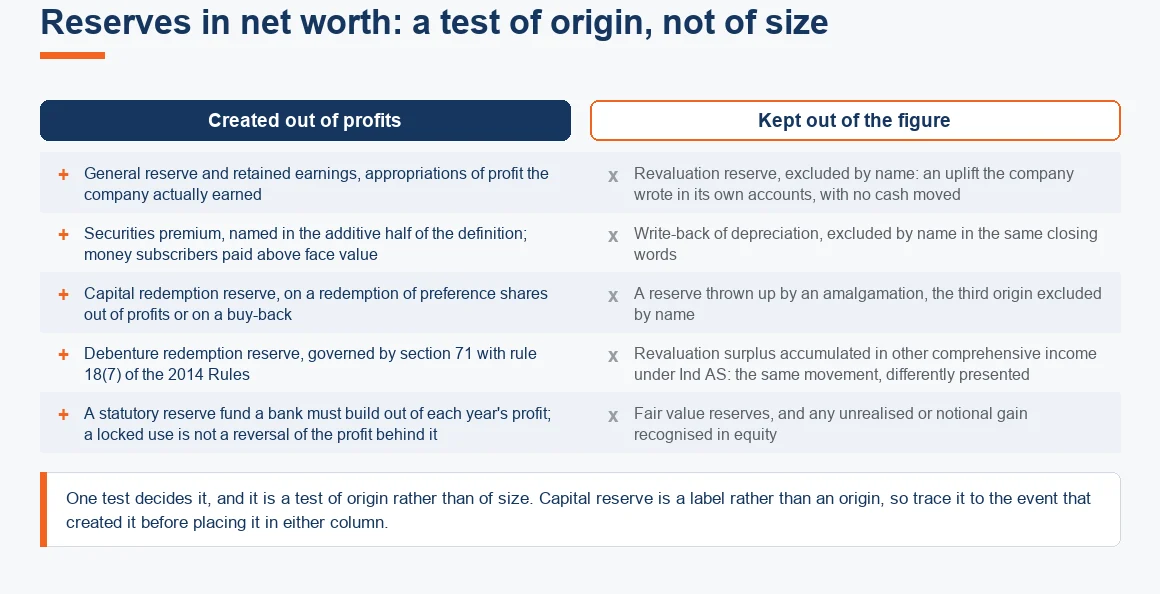
Set the balances out in one column and the reason in the next. General reserve, retained earnings, securities premium, capital redemption reserve and debenture redemption reserve all trace back to profit and stay in. Revaluation reserve, revaluation surplus held in OCI, fair value reserves and any reserve thrown up by an amalgamation stay out. Nothing in either column depends on how large the balance happens to be.
Two entries need prose instead of a tick. Capital reserve is a label rather than an origin, so it has to be traced to the event that created it before it can be treated either way. A balance created by a write-back of depreciation is excluded by name. Saying so on the face of the working is more useful to a reader than dropping it quietly.
A reckoner sorts the lines; it does not produce the total. The full computation in sequence applies the deductions once the sorting is done, and when the total falls below zero picks up from there. What a recipient actually tests is not the sorting but the signature above it, which is what an attested statement of the position carries.
This post supports Which Reserves Count Toward Company Net Worth Under Section 2(57), which sets out what Patron delivers and for whom.