
In this guide
Each Joint Owner Carries Only Their Share Into Their Own Statement
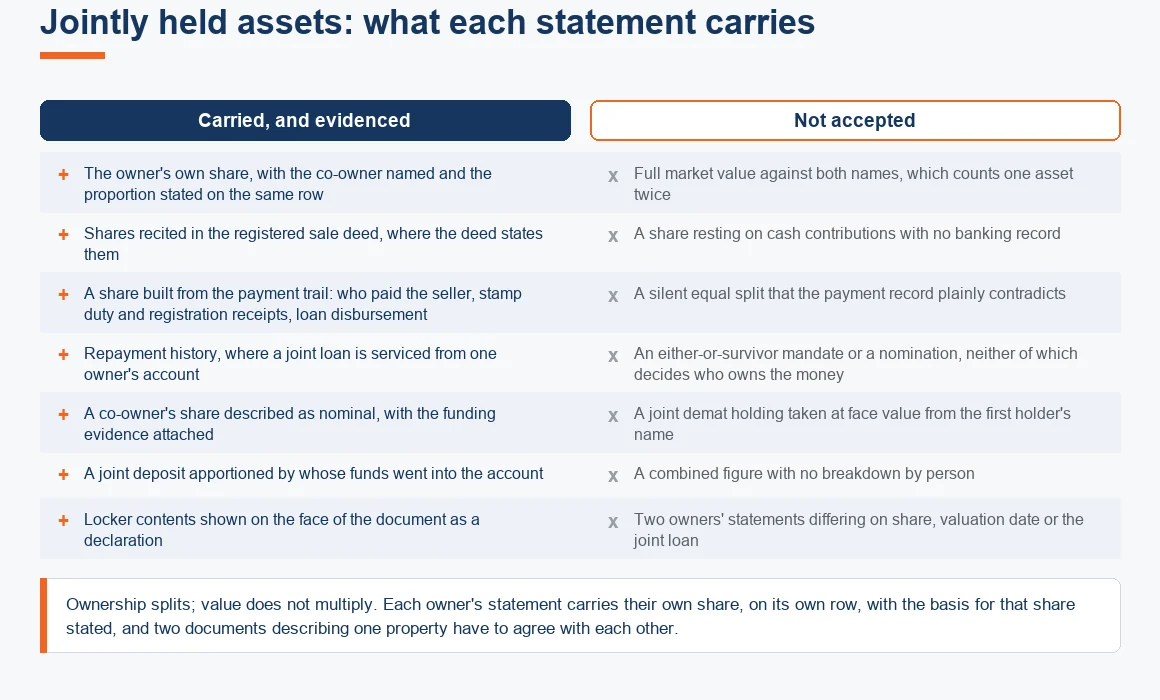
Ownership splits. Value does not multiply. Where two people hold a flat, each carries their own share into their own statement, and neither carries the whole of it. A net worth certificate for joint owners that shows full market value against both names has counted one asset twice, and any reader holding both documents will see it.
The double count is not a technicality. If a husband and wife each show a property worth four crore, a lender reading both files sees eight crore of property where four exists. When the same lender later takes that property as security, the shortfall appears at precisely the moment it matters most. Co-applicant files are read side by side for exactly this reason.
The subject of a certificate stays one person. A statement is prepared for a named individual and reports what that individual owns and owes. Jointly held items enter it as a share, with the co-owner named and the proportion stated on the same line. The other owner's position is a separate document with its own arithmetic and its own supporting papers.
Establishing Share Percentages From the Sale Deed and Payment Trail
The registered sale deed is the first place to look. Many Indian deeds recite the shares directly, naming two purchasers in equal halves or in stated proportions. Where the deed says so, the share is settled and the schedule simply follows it. A copy of the deed, and the registry search for charges over the property, are what a lender asks to see alongside it.
Deeds are frequently silent, and then the funding trail decides. Contribution to the purchase price is the usual basis. The schedule is then built from bank statements showing who actually paid the seller. Stamp duty and registration receipts sit beside them, together with any loan disbursement credited towards the price. Cash contributions with no banking record are the weak point of this method. A share resting entirely on one is difficult to certify and easy for a credit team to question.
Repayment history corroborates a split rather than creating it. Where a joint home loan is serviced entirely from one owner's account, the pattern supports that owner's larger economic interest even though the deed reads equally. Whoever prepares the statement records the basis used, because a reader who cannot see the basis will assume an equal split. Files have been queried for nothing more than that silence.
Spouse and Family Co-Ownership: The Funding Question
The most common Indian pattern is a property in a spouse's name paid for by the other spouse. The registered owner holds the title. The economic contribution sits elsewhere. Both facts have to be reconciled before either person's statement is drawn up, because they point in opposite directions.
Income tax follows the funding rather than the name on the deed. Section 99(1)(a)(ii) of the Income-tax Act 2025 includes in an individual's total income the income from assets transferred to a spouse otherwise than for adequate consideration. It carries the same effect as section 64 of the 1961 Act, which it replaced when the Income-tax Act 2025 came into force. Rent from a flat bought in one spouse's name out of the other's funds is therefore taxed in the funder's hands. A statement that shows the asset in one place and its income in another needs a note explaining the split.
Nominal co-owners are added for succession convenience, and they create a different problem. A parent added to a deed so that a later transfer is simpler has contributed nothing and expects nothing. The registry does not record intention, so the certificate has to. Saying that a co-owner's share is nominal, with the funding evidence attached, is more credible than a silent equal split that the payment record plainly contradicts.
Whether a CA Can Issue One Certificate for Two People
Practice runs to separate documents, and the reason is administrative rather than legal. Each applicant in a lending file is assessed as a person, with their own liabilities, their own credit record and their own income proof. A document naming two people has to be filed against both applications at once. The branch holding one application then has to satisfy itself that the other file carries the identical document.
Where an acceptor asks for a combined statement, the presentation carries the weight. Schedules run per person. Each asset appears once, against the owner who holds it. Jointly held items are shown with the share against each name and a subtotal that reconciles to the whole property. A combined figure with no breakdown by person is the version that comes back across the counter.
Two documents describing one property have to agree with each other. If one owner's statement treats a flat as sixty and forty while the other treats it as equal halves, the inconsistency is visible the moment a lender holds both. Preparing them together, from one set of deeds and one payment trail, is what stops two statements contradicting each other in front of the same reader.
Joint Bank Accounts, Lockers and Demat Holdings
Deposits raise a question the account title cannot answer. An either-or-survivor mandate governs who may operate the account and who receives the balance on a death. It does not decide who owns the money. Nomination under sections 45ZA, 45ZC and 45ZE of the Banking Regulation Act 1949 works the same way, since a nominee receives on behalf of whoever succession law entitles. For a statement, the balance is apportioned by whose funds went into the account.
Lockers carry an evidence problem no certificate can solve. The bank knows the locker exists and knows who is authorised to open it, and it holds no record at all of the contents. A locker's existence and its joint holding can be confirmed from the bank's own letter. Anything said about what is inside rests on the owner's declaration, and it should be presented on the face of the document as a declaration.
Demat accounts hide the split behind a single name. Holdings in a joint account appear against the first holder in the statement, and the second holder's interest is invisible in that document. Where both names funded the purchases, the contribution has to be evidenced from the bank accounts that paid for them. Where such a holding is later offered as security to a lender, every holder has to join in creating the charge.
Presenting Jointly Held Assets in a Lending File
One line does most of the work. The asset, the co-owner's name, the share carried and the basis for that share belong on the same row of the schedule, with the deed reference beside them. A reader forced to reconstruct the split out of annexures treats the file as incomplete, even where the arithmetic underneath is correct.
Consistency across both statements is a test lenders apply without announcing it. Same share, same valuation date, same treatment of the joint loan sitting on the asset. Where two owners used different professionals and different dates, the mismatch itself becomes the finding, ahead of anything in the underlying position.
The rest of the file follows the same discipline. Evidence that supports a stated figure applies to jointly held assets exactly as it does to sole holdings. A co-owner asked to stand behind the borrowing as well takes on the obligations set out in someone standing behind the borrowing. Both owners' documents land in the same credit file in the end. What that file expects for each type of facility is mapped at where lending certificates are drawn up.
This post supports Joint Owners on a Net Worth Certificate, Explained, which sets out what Patron delivers and for whom.