
In this guide
They Overlap, but the Regulator Strips Out What Company Law Keeps
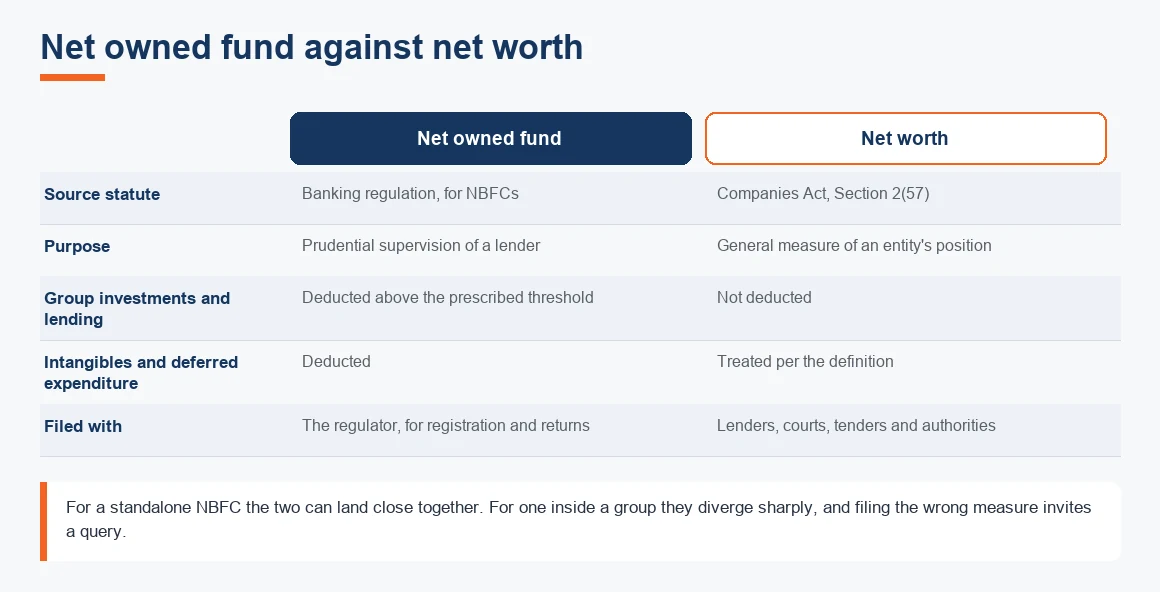
Is net owned fund the same as net worth? No, and the difference is structural rather than a matter of rounding. Both measures begin on one audited balance sheet and both aggregate capital with reserves. Only one of them then asks where the company has put that capital.
For a standalone lender with no subsidiaries and no intra-group funding, the two land close together and the distinction rarely surfaces. For a company holding shares in its subsidiaries or funding them, the two separate. The regulatory figure falls away from the accounting one by the amount deployed inside the group above the allowance.
The consequence is that they answer different questions. One is a condition attached to a certificate of registration, and it is tested whether or not anyone has lent the company a rupee. The other sizes obligations under company law and fixes eligibility wherever another statute borrows the term. A company can satisfy one and fail the other in the same year, on the same accounts, without anything in those accounts being wrong.
Two Definitions Drawn From Two Different Statutes
The Reserve Bank of India Act 1934 defines the regulatory measure in the Explanation to section 45-IA, and its purpose shows in the drafting. It asks what capital is genuinely available inside this company to absorb loss. That is why capital sent to a subsidiary or into another finance company is stripped out above an allowance. The definition exists to hold up a licence, so it is written to resist the same rupee being counted twice across a group.
The Companies Act 2013 is doing something else at section 2(57). It builds an aggregate from share capital, distributable reserves, the premium account and retained earnings, then strips out losses and expenditure still carried unwritten. Three categories of reserve are shut out by name, revaluation among them. Which reserves survive that test is a company law question with a company law answer. The premium account and retained earnings were added to the aggregate by the Companies (Amendment) Act 2017, with effect from 9 February 2018.
One company is measured both ways because the two statutes were aimed at different readers. A registered finance company is a company, so section 2(57) applies to it for every company law purpose turning on the term. It is also a supervised entity, so the 1934 Act applies to it for the purpose of holding its registration. Neither displaces the other, and neither was drafted with the other in view. How the deduction is worked out is a question only the regulatory definition raises.
Line Items Each Measure Treats Differently
Group investments and intra-group lending are the first divergence and the largest. The regulatory definition removes shares held in subsidiaries, in group companies and in other finance companies. It removes bonds, loans and deposits placed with group entities too, once the total passes the ten per cent allowance. Section 2(57) has no step of that kind anywhere in it. Capital deployed into a subsidiary stays in the accounting figure in full.
Intangible assets are the second divergence, and this one runs the other way. The regulatory definition deducts other intangible assets by name. Section 2(57) does not. Its deductions stop at losses and at expenditure still carried unwritten, and it says nothing at all about goodwill or capitalised software. A company carrying a large intangible balance can therefore report a comfortable company law figure and a materially smaller regulatory one before any group exposure is considered at all.
Ordering is the third difference and the easiest to miss. In the regulatory computation a deduction taken in the first limb also shrinks the allowance in the second, because the allowance is a percentage of the first limb's result. Under section 2(57) a deduction is simply a deduction, with nothing downstream of it. Revaluation is where the two converge. One shuts out any reserve thrown up by revaluing an asset. The other admits only capital reserves arising from the proceeds of an asset sale. The capital line beneath both is a separate comparison again.
The Same Company Read Under Both Yardsticks
One balance sheet, two runs. The company has paid-up equity capital of 100 crore rupees and a securities premium balance of 60 crore rupees. Reserves created out of profits, together with the surplus in the profit and loss account, come to 35 crore rupees. It carries miscellaneous expenditure not written off of 2 crore rupees, intangible assets of 8 crore rupees and a revaluation reserve of 25 crore rupees.
The company law run is short. Add the capital, the premium and the reserves to reach 195 crore rupees. Take off the 2 crore rupees of unwritten expenditure, and leave the revaluation reserve alone because the section excludes it. The figure is 193 crore rupees, and the intangible assets are untouched.
The regulatory run keeps going. The same 195 crore rupees loses the 2 crore rupees and then the 8 crore rupees of intangibles, leaving an owned fund of 185 crore rupees. The allowance is a tenth of that, or 18.5 crore rupees. Group exposure runs to 45 crore rupees, being 40 crore rupees of subsidiary and group shares plus 5 crore rupees of deposits with group entities. It exceeds the allowance by 26.5 crore rupees, so the regulatory figure is 158.5 crore rupees.
The gap is 34.5 crore rupees on identical accounts. Eight crore of it is the intangible balance only one measure removes. The remaining 26.5 crore is capital already working inside the group. Neither number is wrong, and neither can be derived from the other by inspection.
When an NBFC Is Asked for One and Submits the Other
The failure usually runs in one direction. A general statement of position is prepared, it carries a figure built on company law lines, and the supervisor's question about deployment inside the group is left unanswered. The submission is not rejected as false. It comes back as not responsive, which costs the same time and reads considerably worse.
The reverse happens too, and it is the more expensive of the two. A tender condition or a lender's eligibility test drawn from section 2(57) is answered with the regulatory computation, which for a group company reads well below the accounting figure. A bidder can fail a threshold it comfortably clears, on a number that was perfectly correct for a different question.
Filings that name the measure are the easy case. Where a return cites section 45-IA or asks for the regulatory figure as at a stated date, one computation answers it. The ratio supervisors watch is struck from the same base. Correcting a submission already made is usually a matter of recomputing on schedules that already exist, since both runs read from one set of accounts.
Choosing the Right Measure for Your Filing
Read the form's own words before anything else. A citation settles it outright, and where no section is cited the phrase used is the instruction. The regulatory term means the computation with the group deduction in it. The company law term means the aggregate without that step.
Some filings need both, and they need them as two schedules rather than one. A group finance company raising debt is often asked for the accounting figure by its lender and the regulatory figure by its supervisor in the same quarter. Preparing one and adjusting it into the other invites a reconciliation question that neither reader asked for.
Establishing the regulatory figure as at a date, and supporting it, is a defined piece of work with a defined output. Where the regulatory figure is attested sets out what that covers. The accounting figure travels with the accounts and needs no separate apparatus, which is the last practical difference between the two.
This post supports Is Net Owned Fund the Same as Net Worth? Not Quite, which sets out what Patron delivers and for whom.