
In this guide
Most Consulates Ask For It, and a Few Treat It as Mandatory
Is an ITR required for a visa? For most visitor and business routes it is asked for, and on some it is a listed document whose absence leaves the application incomplete. Very few routes ignore it altogether.
Where the return is listed, the checklist says how many years and in what form, and nothing is left to interpret. Where it is not listed, it still gets read, because it is the one paper in the pack that a government other than the applicant already holds a copy of.
A missing return is not read as dishonesty. It is read as a gap in the account of how somebody lives, and gaps get filled by the reader's own inference. An applicant with no return and a large balance has invited a question that an applicant with a modest return and the same balance has already answered. Where each document does its work is the prior question, settled before a visa pack is ever assembled.
Where the ITR Sits in a Standard Document Checklist
Financial documents travel as a group and get read as one. Bank statements, returns, salary evidence, an employer letter and any asset schedule sit together, each read against the others rather than on its own terms.
The return's job inside that group is corroboration. Salary credits in the statement should be consistent with the salary head in the return. A business applicant's receipts should be consistent with the turnover declared. Where the two describe different lives, the reader has learned something without having asked anything.
There is a second trail behind the return that applicants rarely attach and reviewers sometimes want. The tax credit statement behind it records tax deducted and reported by third parties, tying named employers, banks and tenants to the applicant independently of anything the applicant filed. It corroborates the return in the same way the return corroborates the statement.
Order within the file matters less than completeness, but a pack whose years do not line up costs the reader time. Time spent reconciling is time spent doubting.
How Many Years of Returns to Attach
The count comes from the route rather than from custom, and the years attached should end with the most recent completed one. What causes more trouble than the count is the labelling.
Indian returns are filed for an assessment year running one year behind the income they report, so a return marked 2025-26 reports the year ended 31 March 2025. Reviewers abroad read the label on the acknowledgement, not the Indian convention behind it. A single covering line stating which financial year each return reports removes that confusion at no cost.
There is a further wrinkle for anything filed from 2026 onwards. The Income-tax Act 2025 took effect on 1 April 2026 and works in tax years rather than assessment years. Returns relating to earlier periods stay under the Income-tax Act 1961 and keep the old label. A set of three years can therefore carry two labelling systems at once, which is worth explaining rather than leaving for the reader to untangle. The department's own transition notes set out which act governs which year.
Where a year is genuinely missing, attaching the years that exist with a short explanation beats attaching nothing. An acknowledged gap is a fact. A silent one is a question.
Applicants With No Taxable Income: Students, Homemakers and Retirees
This is the largest affected group and the one most often told, wrongly, that its position is hopeless. Income below the filing threshold is an ordinary fact about a great many people, and every mission knows it.
In a sponsor-led file the sponsor's return does the work the applicant's cannot. What the applicant then supplies is the link and the consent: the document establishing the relationship, and the sponsor's written statement of what exactly is being funded. The applicant's own account still goes in, however small the balance, because it shows how they actually live.
Where no return has ever been filed, the evidence shifts onto what does exist. A student attaches a fee receipt, a scholarship or stipend letter, and the account the family operates for them. A homemaker attaches the joint account, any property standing in their name, and interest certificates. A retired applicant attaches the pension payment order and the annual statement from the disbursing bank.
Exempt and non-taxable income is worth stating rather than hiding. Agricultural income, tax-free interest and a return of capital can leave somebody holding substantial assets with almost no taxable income. That combination looks odd only until it is explained, and documenting the origin of each holding is the explanation.
Filing a Belated or Updated Return Just Before You Apply
The shortcut is obvious and its weakness is equally obvious. An acknowledgement carries the date it was generated, so three years of returns filed in one week announce themselves.
The mechanics are worth knowing precisely. A return filed after the due date is a belated return. That is section 139(4) of the Income-tax Act 1961, and section 263(4) of the Income-tax Act 2025 for tax years under the new one. A return correcting an earlier filing, or filed where none was made, is an updated return. That is section 139(8A) of the old act and section 263(6) of the new, with additional income tax payable under section 267.
Under the current act an updated return may be filed within forty-eight months from the end of the financial year following the relevant tax year. Only one may be filed for a tax year. A belated return runs on a much shorter clock of nine months from the end of the tax year.
Filing helps where it corrects a genuine omission and the corrected figures agree with the assets on display. It draws attention where income appears for the first time in an amount that happens to match the balance being shown. A reader who can see both the filing date and the number is being asked to believe a coincidence.
What to Submit Alongside the ITR to Round Out the Picture
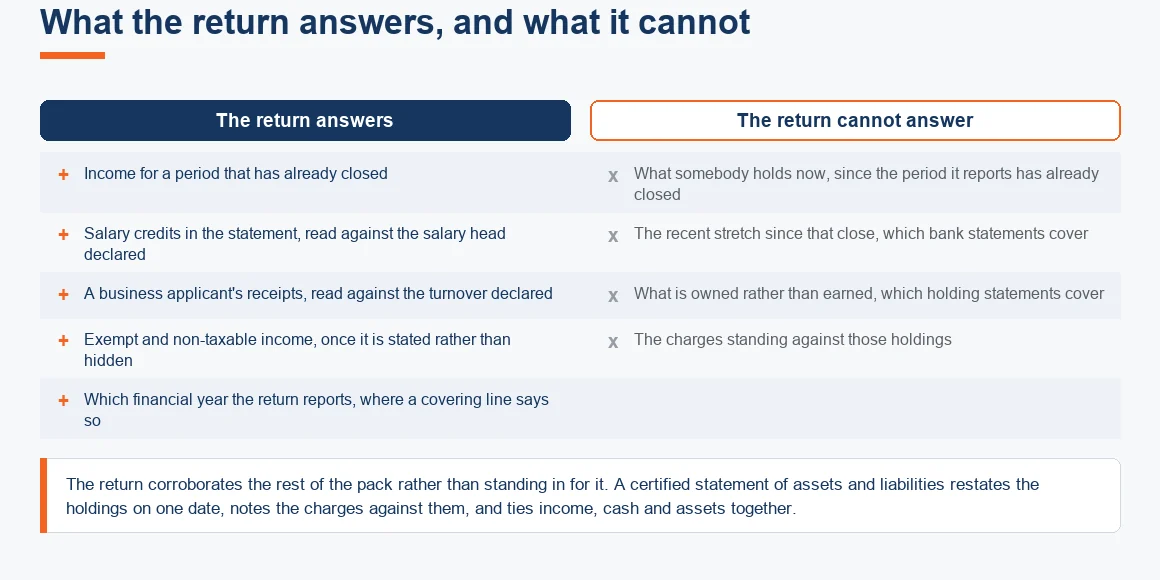
A return reports income for a period that has already closed. What it cannot report is what somebody holds now, which is the other half of the question being asked.
Bank statements cover the recent stretch the return cannot reach, and holding statements from a depository or fund house cover what is owned rather than earned. Taken with the return, the three describe income, cash and assets without any one of them being asked to do another's job. The figure the file must cover then decides whether the cash half is sufficient.
A certified statement of assets and liabilities is what ties the three together. It restates the holdings on one date, notes the charges against them, and is signed by somebody who examined the underlying records. For an applicant whose return is modest and whose assets are not, it turns an apparent contradiction into a stated position.
Where that statement has to be drawn for a consular reader rather than a lender, the attested version prepared for missions is the form it takes.
This post supports Is an ITR Required for Visa Applications From India?, which sets out what Patron delivers and for whom.