
In this guide
There Is No Single Number; It Tracks Trip Length, Cost and Sponsorship
No fixed figure exists, and the applicants who suffer most are the ones who go looking for one. The bank balance required for a visa application is derived from the trip rather than looked up in a table. Change the length of the stay and the number changes with it.
Three variables do most of the work. How many days the applicant will be in the country sets the multiplier. How much of the trip is already paid for sets the deduction. A prepaid hotel and a return ticket are costs that no longer come out of a balance. Who is paying decides whose account is being read at all.
A figure copied from a forum thread fails on all three. It was somebody else's trip length, somebody else's booking position and often somebody else's year. Where an authority does publish an amount, it publishes the basis alongside, and the basis is the part that travels between cases.
How Consulates Arrive at a Daily Maintenance Figure
The arithmetic is duller than the anxiety around it. A daily maintenance amount is multiplied by the number of days of stay. Whatever is already paid for comes out. What remains has to be shown as money available without a sale, and the cost of getting home is added on top of it.
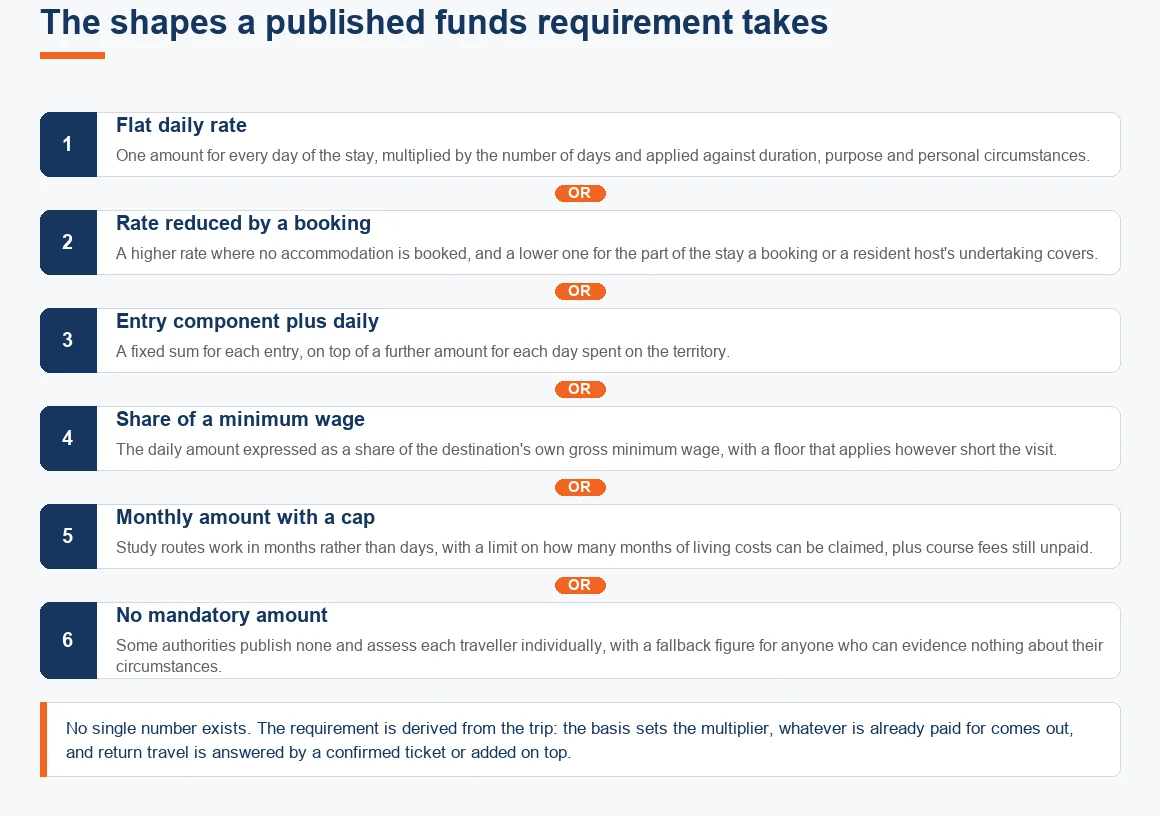
The deduction is the interesting half. Several authorities publish two daily rates: a higher one for a traveller with no accommodation booked, and a lower one covering the part of the stay a booking accounts for. Others reduce the rate where a resident host has signed an undertaking to accommodate the visitor. The rate is not a measure of how expensive the country is. It is a measure of how much of each day remains unfunded.
Structures differ far more than the numbers do. Some states set one flat amount for every day. One adds a fixed sum for each entry on top of the daily amount. One expresses the requirement as a percentage of its own minimum wage, with a floor that applies however short the visit. Study routes usually work in months rather than days, with a cap on how many months can be claimed.
Return travel is handled as a separate condition rather than folded into the maintenance sum. A confirmed ticket answers it outright. Without one, the fare has to sit inside the balance as well.
Balance Expectations by Visa Type: Tourist, Student and Business
Visa type changes the question more than destination does. A short visit, a multi-year course and a three-day conference are assessed on different logic. Anyone who reads a student thread before a visitor appointment will over-prepare in the wrong direction.
A visitor file is the purest version of the calculation. The itinerary sets the days, the bookings set the deduction and the residual is the number. Because the file is small, the balance carries more of the weight, since there is no employer letter and no institution standing behind the applicant. Personal ties are assessed alongside it, and which holdings can stand behind that matters more here than anywhere else.
A student file has two components and only one of them is maintenance. Course fees still unpaid are shown separately from living costs, and the living-cost element is normally a published monthly amount multiplied by a capped number of months. That cap is why a three-year course does not call for three years of living costs. Fees already paid to the institution reduce the fee side, not the maintenance side.
A business or conference file shifts the question onto the payer. Where an employer or a host organisation is covering costs, the evidence becomes the payer's written commitment and the payer's own standing. The traveller's balance is then asked only to cover incidentals. Where a business trip is self-funded, the file reverts to the visitor calculation without any special treatment.
Where Published Thresholds Exist, and Where They Do Not
Evidence handling matters here, because half the honest answer is that there is no answer. Within the Schengen area each state notifies its own reference amount for crossing the external border, and those notifications are collected into a single annex of the Visa Code handbook. Reading the reference amounts each state notifies shows how far apart the bases sit.
Some of those notifications state plainly that no mandatory amount has been set. Officials assess each traveller individually, with a fallback figure for anyone who can evidence nothing about their circumstances. Another states that there are no reference amounts at all. Those are not gaps in the publication. They are the requirement.
Routes that do publish tend to publish precisely. A study route will state a monthly amount, a maximum number of months and a holding period, in wording exact enough to apply without interpretation. The route's own money page is the only version worth relying on, because summaries reproduce last year's figure long after it has moved.
The table below sets out what a handful of authorities published as at 4 August 2026. It is here to show the range of bases rather than to serve as a checklist. Every figure moves, and the version date on the source matters as much as the amount printed on it.
How Long the Money Must Have Been Sitting There
Statement periods run from three months to six, and the period does more work than the closing figure. A reader given six months sees the shape of an income, the rhythm of spending and any point at which the account ran nearly empty.
Average balance and closing balance are different measurements, and the difference is the whole point. A statement that ends high after running low all year describes an account that was filled for the occasion. Some routes formalise this by requiring the balance never to fall below the stated amount across the period. That makes the daily balance column the operative record rather than the final line.
This is also why a late credit shortly before filing is visible without any investigation at all. It sits in the same document the applicant supplied, on a date the applicant chose to include.
Where a route wants certainty instead of history, it reaches for a different device altogether. A controlled account released monthly takes the seasoning question off the table. Funds are held at the destination and paid out in instalments, which is why it appears as an option on several study routes.
Sponsored Applicants: Whose Balance Gets Counted
Sponsorship does not remove the financial test. It moves it. The sponsor's income, the sponsor's balances and the sponsor's existing obligations are assessed on the basis the applicant would have faced, and usually over the same statement period.
Income and assets are read differently even when both belong to one sponsor. A salary recurring every month evidences a capacity to keep paying for the length of a course. A single large holding evidences a capacity to pay once. A route expecting support across years leans on the first; a route covering a fortnight is answered by the second.
The link between the two people has to be documented rather than asserted. A birth certificate, a marriage certificate or a family register extract establishes the relationship. The sponsor's written consent to this particular use of the money establishes that it is actually earmarked.
Files where both parties are assessed are the most common and the most misread. The applicant shows what they hold, the sponsor covers the shortfall, and the shortfall is the figure that gets tested. Understanding the checks behind a submitted file matters more for the sponsor's papers than for the applicant's, because the sponsor is the party the mission has never met.
Reading a Foreign-Currency Threshold From a Rupee Balance
A published requirement is expressed in the destination's currency and the account is held in rupees, so a conversion sits between them. The conversion itself is arithmetic. The choices around it are not.
A rate has to be chosen and then fixed. The rate on the date of the statement, quoted with its source, is defensible. A rate picked afterwards to make the number work is not. The rupee figure stays primary, because that is what the bank certified, and the converted figure is shown as derived from it with the rate and its date printed alongside.
Movement between filing and decision is the reason for a margin. A balance clearing the threshold by one per cent may not clear it a fortnight later. Converting a dated rupee position with a stated rate makes that assumption visible instead of burying it inside a single number.
Once the position and the rate are settled, both need attesting together. A statement drawn for a consulate can carry the two currencies and the rate used. That is what a reader on the other side needs in order to check the arithmetic.
This post supports How Much Bank Balance Do Visa Applications Need?, which sets out what Patron delivers and for whom.