In this guide
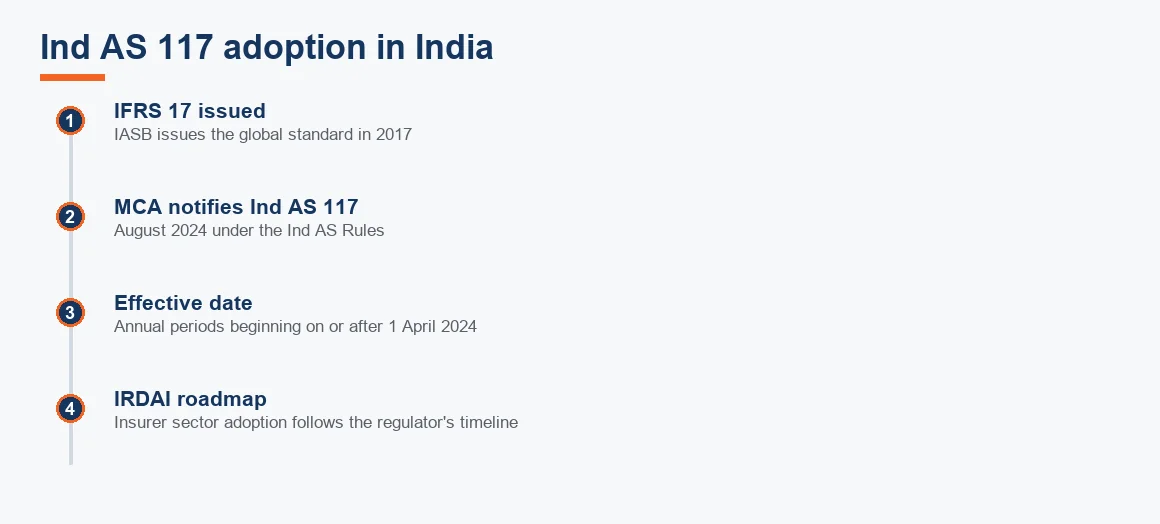
Ind AS 117 is the Indian accounting standard for insurance contracts, corresponding to IFRS 17, and it replaces Ind AS 104 with a single measurement model that every entity issuing insurance contracts must apply. It was notified by the Ministry of Corporate Affairs in August 2024 for annual reporting periods beginning on or after 1 April 2024. The standard removes the old freedom to carry on with legacy accounting policies and instead sets out how to measure, present and disclose insurance contract liabilities on a consistent basis. This guide explains what the standard covers, who it actually binds in India, and how the measurement mechanics work in practice. For the full family of standards, see our overview of Ind AS: complete list, applicability and implementation guide.
What Ind AS 117 covers and why it exists
An insurance contract, in the standard's language, is a contract under which one party (the issuer) accepts significant insurance risk from another party (the policyholder) by agreeing to compensate the policyholder if a specified uncertain future event adversely affects them. Ind AS 117 applies to insurance contracts an entity issues, reinsurance contracts it holds, and investment contracts with discretionary participation features, provided the entity also issues insurance contracts. The purpose is comparability. Under the previous standard, two insurers writing near-identical policies could report profit on quite different bases, which made it hard for users of the balance sheet to compare them.
The standard matters beyond the insurance sector too. A manufacturer offering extended cover, a bank writing financial guarantees, or a non-financial company giving fixed-fee service contracts may all need to test whether they hold insurance contracts within scope. That is why the scope exclusions, covered further below, are worth reading carefully.
Which standard does Ind AS 117 replace
Ind AS 117 replaces Ind AS 104, which was an interim standard that let entities continue their existing accounting policies for insurance contracts, subject to limited improvements. That grandfathering is now gone. Where Ind AS 104 tolerated diversity, Ind AS 117 prescribes one measurement approach with defined building blocks, so that profit emerges as the insurer provides cover rather than when premium happens to arrive. This aligns insurance accounting with the wider move towards accrual accounting across the Ind AS framework, and mirrors the treatment of upfront receipts as deferred revenue that you see elsewhere.
Who does Ind AS 117 actually bind in India
This is the point most summaries miss. The Companies (Indian Accounting Standards) Rules notify Ind AS 117, but Indian insurance companies do not prepare their statutory accounts under Ind AS. They prepare them in the formats prescribed by the Insurance Regulatory and Development Authority of India (IRDAI) under the insurance regulations. So the practical adoption of Ind AS 117 by the insurance sector follows a separate IRDAI implementation roadmap and not the Companies Act notification date.
For a non-insurance company that reports under Ind AS and happens to issue a contract meeting the insurance definition, the standard applies from the notified date. In short, the notification binds Ind AS reporters in general, while sector-wide insurer adoption waits on the regulator. If you are unsure whether your entity is even an Ind AS reporter, our Ind AS applicability checker walks through the net-worth and listing thresholds.
The general measurement model and its building blocks
The default approach is the general measurement model, sometimes called the building block approach. It measures a group of insurance contracts as the sum of the fulfilment cash flows and the contractual service margin. The fulfilment cash flows are themselves three components: unbiased, probability-weighted estimates of future cash flows; an adjustment to discount those cash flows to present value for the time value of money; and a risk adjustment for the non-financial risk the insurer bears. The contractual service margin sits on top and represents unearned profit.
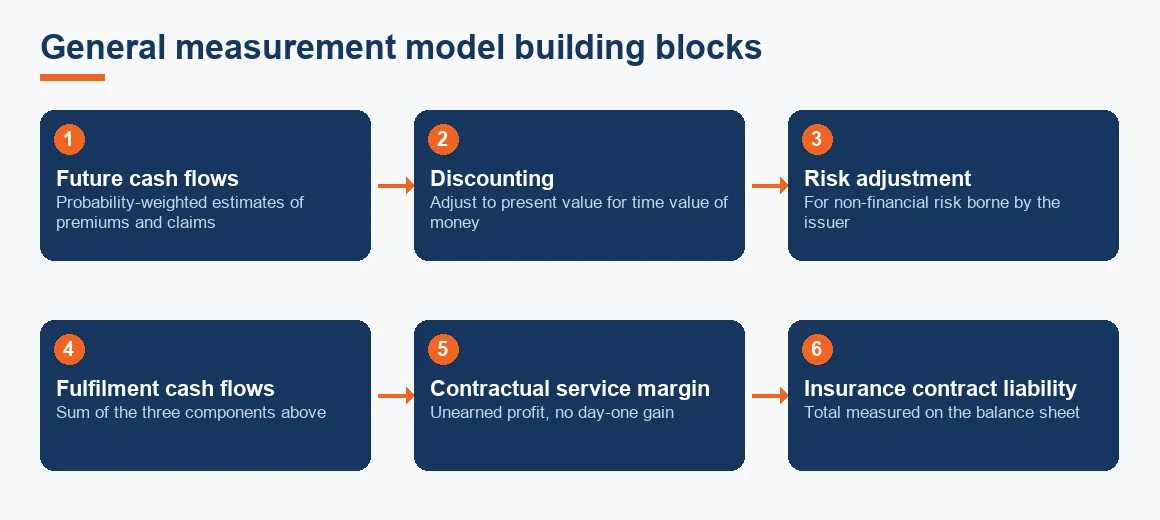
Two variants exist. The variable fee approach applies to direct participating contracts, where policyholders share in the returns on underlying items. The premium allocation approach, covered next, is a simplification for short-duration cover. Each affects how the profit and loss statement unwinds over time, so choosing the correct model is not a cosmetic decision.
The contractual service margin
The contractual service margin is the unearned profit in a group of contracts. At initial recognition it is set at the amount that makes the total of fulfilment cash flows and risk adjustment equal to nil, so no day-one gain arises. It is then released to revenue as coverage is provided across the coverage period, giving a smoother and more faithful profit pattern than premium-based recognition. If a group of contracts is onerous, there is no margin to absorb the loss, and the loss is recognised immediately.
When the premium allocation approach can be used
The premium allocation approach (PAA) is the practical route for most general insurance. It is permitted where the coverage period of each contract in the group is one year or less, or where using it would not produce a measurement that differs materially from the general model. It works much like a traditional unearned premium reserve: the liability for remaining coverage is the premium received less the amount already earned, released over the coverage period.
This is why the PAA suits short-duration motor, health and property covers, which dominate the Indian general insurance book. The general model, by contrast, is built for long-duration life and annuity business where the contractual service margin genuinely spreads profit over many years.
Which contracts fall outside the scope of Ind AS 117
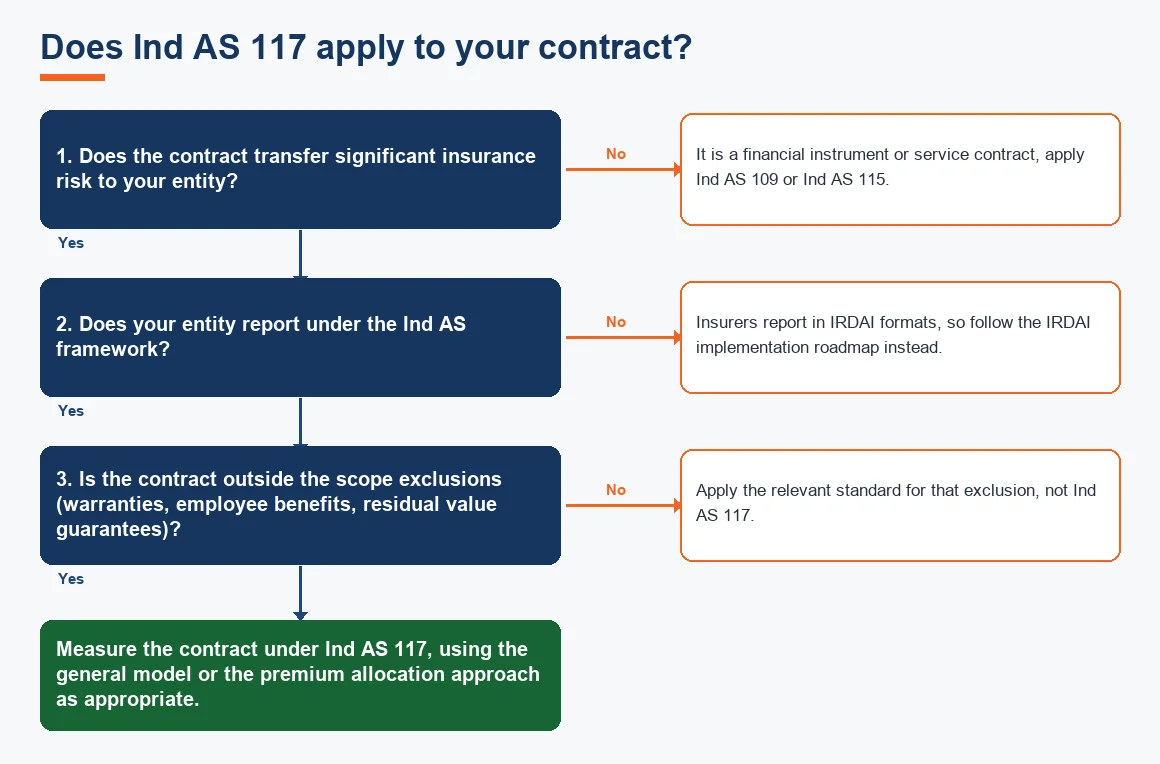
Several arrangements that look like insurance are deliberately excluded, and are accounted for under other standards. The list below is the practical filter to run before you reach for Ind AS 117.
- Product warranties given by a manufacturer, dealer or retailer, which stay under Ind AS 115.
- Employers' assets and liabilities under employee benefit plans, which fall under Ind AS 19.
- Contractual rights or obligations that depend on the future use of a non-financial item, such as a licence fee.
- Residual value guarantees provided by a lessee under a lease.
- Financial guarantee contracts, unless the issuer has previously elected to apply insurance accounting to them.
- Contracts that create only significant financial risk without significant insurance risk, which remain within Ind AS 109.
Where a contract transfers only financial risk and no meaningful insurance risk, it is a financial instrument, not an insurance contract, and the classification drives everything that follows in your cash flow statement and disclosures.
Worked example: a one-year policy under the premium allocation approach
Assume an issuer writes a single 12-month property policy on 1 April with an annual premium of INR 12,000 received upfront. Ignoring acquisition cash flows for simplicity, the liability for remaining coverage starts at the full premium and is earned evenly over the coverage period. The figures below are indicative and illustrate the mechanics only.
| Quarter | Opening liability for remaining coverage (INR) | Insurance revenue recognised (INR) | Closing liability for remaining coverage (INR) |
|---|---|---|---|
| Q1 (Apr-Jun) | 12,000 | 3,000 | 9,000 |
| Q2 (Jul-Sep) | 9,000 | 3,000 | 6,000 |
| Q3 (Oct-Dec) | 6,000 | 3,000 | 3,000 |
| Q4 (Jan-Mar) | 3,000 | 3,000 | 0 |
Over the year, the full INR 12,000 premium is recognised as insurance revenue in equal instalments, and the liability runs down to nil at the end of cover. Any claims incurred are accounted separately as a liability for incurred claims. Presenting revenue this way, rather than booking the whole premium on receipt, is the core shift from the old regime and feeds directly into the finalisation work covered in our year-end closing and finalisation service and the financial statement preparation that follows.
How Ind AS 117 changes the numbers you present
The visible effects are three. First, profit follows service delivery through the contractual service margin, so a large book of new business no longer flatters current-year profit. Second, onerous contracts are recognised as a loss the moment they are identified, which sharpens governance over pricing. Third, the disclosures expand considerably: reconciliations of the contractual service margin, the risk adjustment and the liabilities for remaining coverage and incurred claims all belong in the notes to accounts. If you are weighing the wider AS versus Ind AS gap, our AS vs Ind AS comparison matrix sets the differences side by side.
Key terms
- Deferred Revenue (Unearned Revenue): income received before the related service is delivered, held as a liability until earned.
- Ind AS 115 Revenue Recognition: the standard that governs product warranties and service contracts excluded from Ind AS 117.
- Liabilities: present obligations of the entity, of which the insurance contract liability is one type.
- Notes to Accounts: the disclosures accompanying the financial statements, greatly expanded under Ind AS 117.
- Prior-Period Adjustments: corrections applied on transition from Ind AS 104 to the new measurement model.
Key takeaways
- Ind AS 117 replaces Ind AS 104 with one measurement model and mirrors IFRS 17.
- Notified by the MCA in August 2024 for periods beginning on or after 1 April 2024, but insurer adoption tracks the IRDAI roadmap.
- The general model builds a liability from fulfilment cash flows plus a contractual service margin that releases profit as cover is given.
- The premium allocation approach is the simpler route for cover of one year or less.
- Warranties, employee benefit plans and pure financial-risk contracts are outside scope.
The statutory position here rests on the MCA notification of the Companies (Indian Accounting Standards) Rules, published at mca.gov.in, and on the interpretive guidance issued by the ICAI at icai.org. Always confirm the effective date and any sector-specific timeline against those primary sources before finalising your treatment.
Decision guide