
In this guide
Courts Weigh Earning Capacity and Assets Together, Not Income Alone
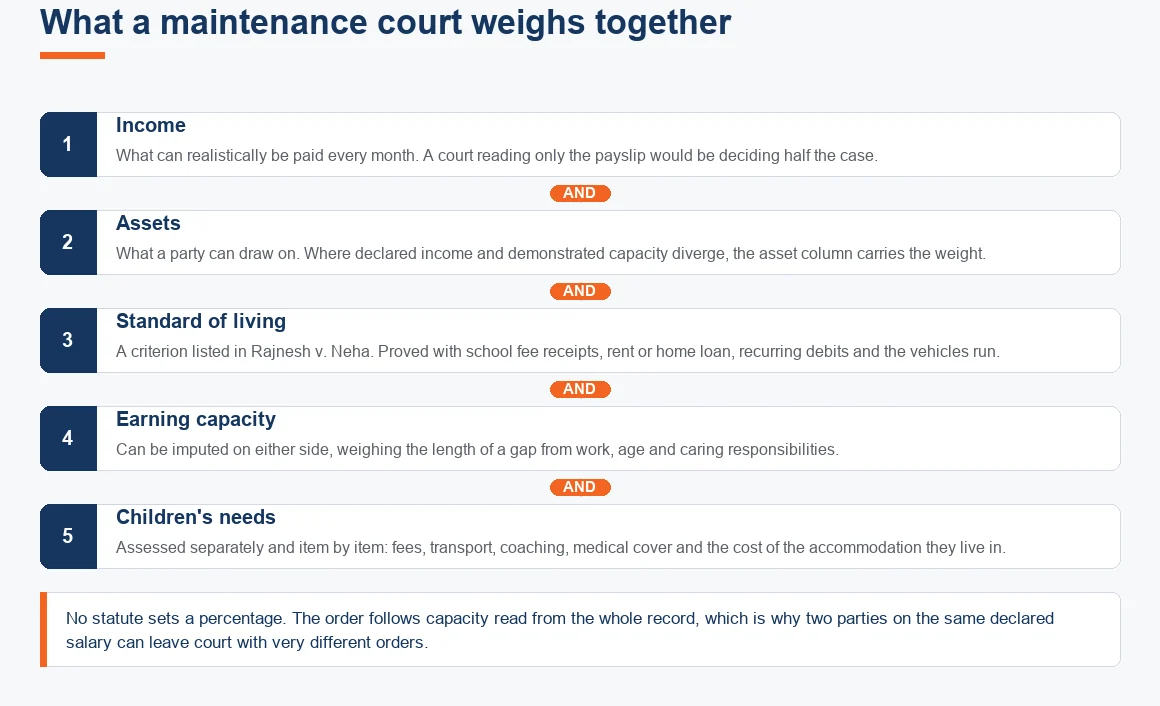
Two people on the same declared salary can leave court with very different orders. One owns a flat outright and holds shares. The other rents, runs a car loan and has nothing at all behind the payslip. The order follows capacity, and capacity is read from both sides of the schedule.
Treating net worth for alimony calculation as a share of the asset column is the commonest misreading of what actually happens. No statute sets a percentage. Assets tell a court what a party can draw on; income tells it what can realistically be paid every month.
Where declared income and demonstrated capacity diverge, the asset column carries the weight. A business shown at a loss while three loans are serviced and a school fee is paid invites a question about the loss, not about the loans. That is the point at which a schedule stops being paperwork and starts being evidence.
Two similar incomes therefore produce different orders as a matter of course, and nothing about that is inconsistent. The inputs were never the incomes alone. A court reading only the payslip would be deciding half the case, and both sides usually know it.
Statutory Basis: Section 144 BNSS and the Matrimonial Statutes
The route most claimants take is criminal procedure, and its section number changed recently. Section 125 of the Code of Criminal Procedure 1973 is now section 144 of the Bharatiya Nagarik Suraksha Sanhita 2023, in force from 1 July 2024. Older citations still circulate because matters filed before that date continue under the earlier code, so both numbers appear in current orders.
The provision lets a Magistrate order a monthly allowance where a person with sufficient means neglects a wife, a child or a parent unable to maintain themselves. Interim maintenance and the expenses of the proceeding can be ordered while the application is pending. Such an application is to be disposed of, as far as possible, within sixty days of service of the notice. The current criminal procedure statute carries the operative text.
Personal law provisions run alongside it. Section 24 of the Hindu Marriage Act 1955 covers maintenance pendente lite and the expenses of the litigation, and it is available to either spouse. Section 25 covers permanent alimony, granted when a decree is passed or at any time afterwards, and it can later be varied. Sections 36 and 37 of the civil marriage statute do the same work for marriages solemnised under the Special Marriage Act 1954.
Claims frequently run in parallel across these provisions, which is where double recovery becomes a live worry. The Supreme Court has directed that an order already made under one provision be disclosed. Overlapping amounts are then adjusted, so that neither party is paid twice nor made to pay twice.
The Rajnesh v. Neha Disclosure Affidavit
One judgment governs the paperwork in almost every maintenance matter in the country. Rajnesh v. Neha, reported at (2021) 2 SCC 324, directed both parties to file an affidavit setting out assets, liabilities and income before the enquiry goes any further.
The direction reached pending matters as well as fresh ones, and it applies in family courts, district courts and magistrates' courts alike. Formats were annexed to the judgment itself, with separate versions for agrarian and non-agrarian deponents. High Courts have since notified their own implementations, so the local version is the one that governs at the counter.
The affidavit is organised by head rather than as a narrative. Personal information, income from each source, monthly expenditure, assets grouped by class, liabilities, and the position of any dependent children. Reading it, a court has both the stock and the flow in front of it before hearing a word of argument. What has to go on record is governed by that same structure.
The judgment also set a timetable, which is where defective affidavits bite. Four weeks for the respondent's reply with the affidavit, and no more than two opportunities to produce it. A maintenance enquiry that stalls on the affidavit is the usual reason a matter runs well past the sixty days the statute contemplates.
Standard of Living as a Yardstick for the Award
Standard of living during the marriage is one of the criteria Rajnesh v. Neha listed for a court to weigh. It works as a comparator rather than as a target, and it is proved with entirely ordinary documents.
School fee receipts, the rent or the home loan on the matrimonial home, holiday bookings, credit card statements, club and society dues, the vehicles run, and the domestic help employed. A photograph proves considerably less than a recurring debit does. Each of those records was created by somebody else, which is precisely what gives it weight. The party asserting a standard produces them, and the party disputing it answers with a counter-record rather than with a denial.
The expenditure block is then read against the income block. Where outgoings exceed declared income year after year, a court asks what funds the gap. The answer is usually what can actually be realised being drawn down, a business receipt that never reached a return, or steady support from family. Each of those pushes the picture in a different direction.
Children's needs are assessed separately and item by item. School fees, transport, coaching, medical cover, and the cost of the accommodation they live in. That head is not a proportion of the spouse's figure, and treating it as one produces an order that fits nobody's actual circumstances.
Treatment of Non-Earning Spouses and Homemakers
The largest group of applicants has no salary slip at all. Indian courts have long treated a homemaker's contribution as real work with economic value, and the absence of an income record is not read as an absence of contribution.
Assets standing in the homemaker's own name are still disclosed and still counted. Stridhan, jewellery, a flat purchased in her name, investments funded from family money: all of it appears. Counting them does not extinguish a claim. It tells a court what each side already holds before any order is made at all.
Capacity can be imputed on either side of the case. A qualified spouse who stopped working during the marriage may be treated as capable of earning again, with the court weighing the length of the gap, age and caring responsibilities. The same reasoning runs the other way when a payer pleads unemployment while holding substantial assets.
None of this reduces to arithmetic. It is a judgment made on a complete record, which is why the record matters far more than the argument built on top of it. A homemaker's schedule is therefore prepared with the same care as an earner's, and for the same reason.
Revisiting an Award When Net Worth Changes
An order fixing maintenance is not final in the way a decree is. Both routes contemplate variation on a change in circumstances, and the change can run in either direction. A payer's business failing, a payee remarrying, a substantial inheritance on either side, a serious illness: each can support an application. Courts expect the change to be shown as material rather than as a temporary dip. The application goes back to the court that made the order, which is comparing against its own earlier finding.
A variation application needs the change evidenced rather than asserted. Fresh returns, the audited accounts of a business, medical records, and a current statement of the position. A court is comparing two positions, so the second has to be built on the same basis as the first. The consolidated financial picture is therefore updated rather than redrafted from scratch.
Refreshing the figure is the step most applicants skip. The certified position behind the claim is what a court reads before it reads the argument, and building the schedule line by line is the work standing behind it. An application supported by a stale figure invites the answer that nothing much has changed.
This post supports How Courts Use Net Worth in Maintenance and Alimony Cases, which sets out what Patron delivers and for whom.