In this guide
Visa Officers Test the Trail Behind the Balance, Not Just Its Size
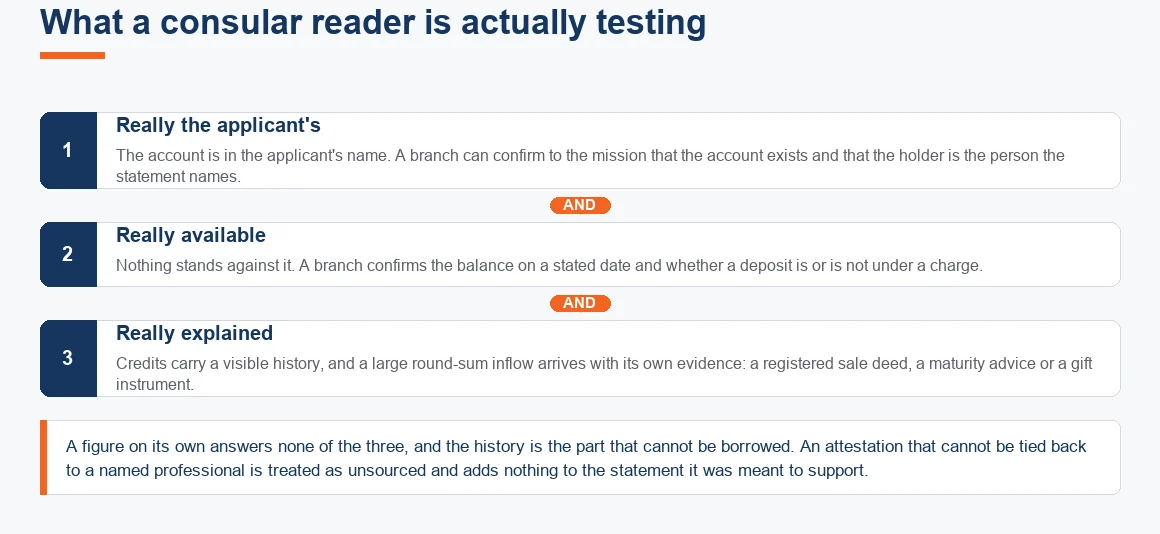
Ask how embassies verify proof of funds and the answer turns out to be procedural rather than arithmetic. An officer is testing whether the money is really the applicant's, really available and really explained. A figure on its own answers none of those three.
Size helps only once credibility is settled. A balance that appears in the last month of a six-month statement reads as a balance arranged for the appointment. A smaller sum with a visible history of salary credits, interest postings and ordinary spending is stronger evidence. The history is the part that cannot be borrowed.
The pack is also read together rather than document by document. The statement, the return, the attested schedule and the sponsor's papers are compared against each other, and a figure appearing in only one of them stands out. The evidence a mission accepts is a narrower category than personal wealth, and what the expected figure rests on is a separate question from whether the officer believes it.
Checks Consulates Run Directly With Indian Banks
The channel applicants underestimate is the one that runs outside the application. A mission that doubts a statement does not usually go back to the applicant. It asks the issuer, or it asks a local verification agent to ask the issuer, and the applicant hears nothing while that happens.
What a branch can confirm is narrower than applicants expect. It can say that an account exists and that the holder is the person the statement names. It can confirm that the balance on a stated date matches its records, and that a deposit is or is not under a charge. It cannot say where the money came from. A bank letter addressed to the mission therefore settles authenticity and leaves the source question entirely open.
Form matters as much as content here. A statement pulled from net banking carries no branch identity, so a verifier has nobody to call. A statement printed at the branch, stamped, signed with a legible name and designation, and carrying the branch code and telephone number, gives that verifier a route. Missions differ on which of the two they will accept, and the published document list decides it.
External checking costs time rather than a decision. A file sent out for confirmation waits on the bank's reply, and banks answer consular queries at their own pace. Applicants read the silence as a refusal in progress. It is more often a query sitting in a queue.
Why Sudden Large Deposits Get Flagged
Seasoning is the word for the expectation behind this. Money that will fund a trip is expected to have been the applicant's money for some months before the trip was planned. Routes that prescribe a holding period write that expectation into a rule. Routes that do not still apply it as judgement.
A round-sum credit is what triggers the question in practice. Salary arrives in odd amounts on predictable dates. Business receipts arrive in many sizes. A single credit of a round figure, from a name appearing nowhere else in the statement, has neither signature. Two such credits in the fortnight before an appointment read as a borrowed balance, because that is usually what they are.
Genuine inflows are common and are not themselves the problem. A property sale, a maturing deposit, a retirement payout and a family gift all produce exactly the pattern that draws a query. The answer is to file the evidence with the application rather than wait to be asked. A registered sale deed closes it. So does a maturity advice naming the same account, or a gift instrument accompanied by the donor's own statement and evidence of their means. Each of them closes the question at the point it opens.
The attested schedule should tell the same story as the statement. Where a certificate shows an asset that was sold to create the balance, the schedule should show the sale and not the asset.
How the Signing CA and the UDIN Get Cross-Checked
Attestation is itself a claim, and it gets tested like any other. A consular reader looks at the face of the certificate for four things. The signer's name and membership number come first. Then the firm's registration number, where a signature is given on behalf of a practice. Then the place and date of signature, and last the unique number generated for that document.
Each of those points at a record held by somebody other than the applicant. A membership number resolves to a named person, and to whether that person holds a certificate of practice, which is what makes a signature an attestation rather than an opinion. A firm number places the practice. The document number ties this particular certificate to that member, so a copy altered after signature stops matching.
Mismatches turn out to be far more common than forgeries. Take a member number transposed by one digit, a firm number belonging to a different practice, or a signature dated before the balance it reports. None of these is fraud, and every one of them stops a file. The reader cannot distinguish a typing error from a fabrication, and is not asked to.
An attestation that cannot be tied back to a named professional gets treated as unsourced. At that point it adds nothing to the statement it was meant to support, and the application rests on the bank documents alone.
Apostille and Attestation Steps for Documents Going Abroad
A document that will be read abroad usually has to be authenticated at home first. India has been a member of the Hague Convention of 5 October 1961 since 2005, so documents going to another member of that Convention take the apostille route. Where the destination is not a member, the older chain applies and the destination's own mission in India attests the paper.
The Ministry of External Affairs issues the apostille, but it is neither the first step nor a counter service. A document reaches the ministry only after a designated state-level authority has authenticated it, and the ministry has not accepted documents directly from individuals since 2012. Submissions travel through the authorised outsourced providers listed on the ministry's own document route.
Sequence decides whether the chain works at all. The stamp that replaces consular legalisation authenticates a signature that already exists, so the certificate has to be signed before anything can attach to it. Applicants who book the authentication slot first and then ask for the certificate lose the slot. Applicants who apostille a photocopy discover that the destination wanted the signed original. Building the order backwards from the destination's own requirement is the only reliable way to sequence it.
Consequences of Submitting Doctored Statements
The finding that matters attaches to the person rather than to the application. Under United States law, someone who seeks a visa by fraud or by wilfully misrepresenting a material fact is inadmissible. That is the misrepresentation ground in the code, and the provision states no end date. Relief runs through a waiver rather than through the passage of time.
Materiality and intent form part of the test rather than being afterthoughts. The finding needs evidence that a false statement was made to an authorised official and that it mattered to the decision. That is a real threshold. It is also why an altered bank statement is such a poor risk, since the alteration is deliberate by construction and the balance is material by definition.
The professional who signed answers for it separately. A certificate issued without examining the records behind it is a matter for the signer's own institute, quite apart from what happens to the applicant.
Where an application system allows a withdrawal request before the decision is issued, that route exists for precisely this situation. Whether it is available, and up to what point, is set out in the route's own published guidance rather than in general advice.
Building a File That Survives Verification
Consistency is very nearly the whole of it. The closing balance on the statement, the cash figure in the attested schedule and the income declared in the return should describe one life. Where they do not, the difference belongs in the file with its own evidence, rather than left for a reader to find.
A verifiable attestation carries its proof on its face. There is a named signer with a membership number, a firm reference, a place and a signature date. There is a separate date to which the figures speak, and a number the reader can check. A schedule listing each asset with its evidence and any charge against it is doing the same job in more detail. Checking the destination's own layout before anything is drafted saves the second attempt.
None of this makes a thin file strong. It makes an honest file legible, which is a different and far more achievable aim. Where a position has to be set out for consular reading, a statement drawn for consular use is the document that does it. What can go into it is decided by which holdings a mission will read.
This post supports How Embassies Verify Proof of Funds From Indian Applicants, which sets out what Patron delivers and for whom.