
In this guide
Consulates Rank Assets by How Fast They Turn Into Cash
Liquidity, not value, sets the order in which an asset schedule gets read. Showing an FD as proof of funds for a visa file works because a deposit is a bank obligation that turns into money quickly. A flat worth many times more does not work the same way, because it cannot.
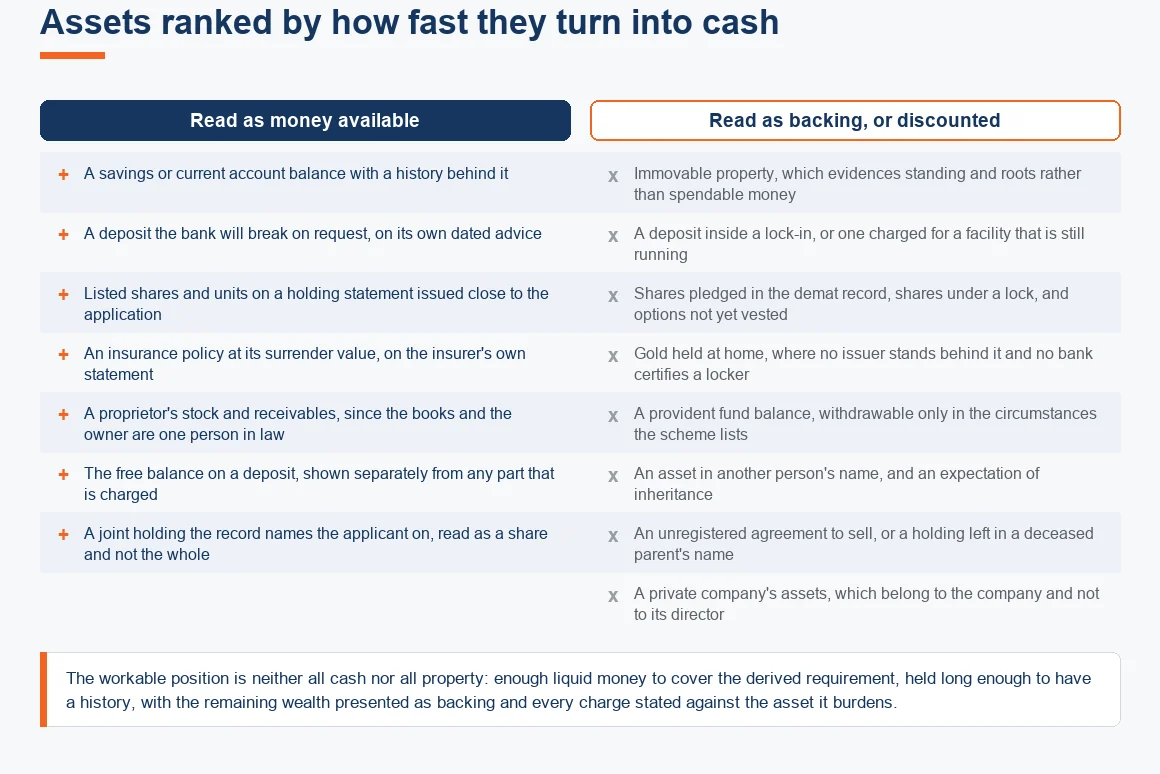
The ranking runs roughly like this. Money in a savings or current account comes first, then deposits a bank will break on request. After those come holdings that can be sold and settled within days, and last everything that needs a buyer found for it. Holdings convertible without a sale process sit at the head of that list for exactly this reason.
A schedule of assets on its own rarely satisfies a maintenance requirement, because the requirement asks about money during the trip. The cushion an officer looks for first is the ordinary one: an account with enough in it and a history behind it. Everything else in the schedule is supporting evidence for a different question.
Fixed Deposits: Accepted, With Conditions on Lock-In and Lien
A deposit advice is a better document than a statement line, because it carries terms and not merely a number. It names the depositor, the principal, the date of deposit, the maturity date and whether the deposit renews automatically. A verifier can take every one of those back to the branch.
Maturity falling after the return date is not the obstacle applicants assume. What matters is whether the bank will break the deposit on request, and that is a question the bank can answer in writing. Where a deposit was made under a scheme carrying a lock-in, it cannot be encashed inside that period, and it then evidences wealth rather than availability.
A charge is the condition that actually causes refusals. A charge marked against a deposit pledged for an overdraft, a term loan or a guarantee makes that money unavailable while the underlying facility runs. The bank's records carry the mark whether or not the advice mentions it, so a confirmation letter discloses it even when the holder has forgotten.
Presenting a pledged deposit without saying so reads as concealment rather than oversight. Disclosing the charge, and showing the free balance separately, costs an applicant far less than being caught holding it back.
Immovable Property as Backing Rather Than Liquidity
Property answers a different question from the one most applicants think they are answering with it. It evidences standing, roots and a reason to come back. It does not evidence money that will be spendable during a fortnight abroad, and no amount of value changes that.
The documents a consulate can actually read are narrower than the folder people assemble. A registered sale deed establishes ownership and the consideration recorded at the time. A current property tax receipt establishes that the holding is live and stands in the applicant's name. An encumbrance certificate establishes whether anyone else has a claim over it.
Where a value is asserted, it needs a source outside the applicant. A registered valuer's report gives the reader a named professional to check, as does a reference to the official circle rate. A number written into a schedule with nothing behind it is the weakest form the same claim can take.
A mortgaged property is worth its equity and not its market value. The outstanding loan is disclosed against it and the schedule shows the net. Applicants who present the gross figure and the loan several pages apart invite the officer to do the subtraction and to wonder why they did not. What the maintenance figure rests on is a cash question, and property is rarely part of that answer.
Listed Shares, Mutual Funds and Demat Holdings
Market-linked holdings are strong as evidence of wealth and weak as evidence of availability, and settlement time is the gap between the two. Selling, settling and withdrawing takes days, and a mission asking whether next month's costs are covered treats that as a reason for caution rather than a disqualification.
Dating is what makes these statements usable at all. A holding statement issued close to the application reflects a position the reader can still recognise. One issued four months earlier reflects a market that has since moved. The statements come from the depository and the fund houses rather than from the holder, which is what makes them checkable.
Value gets read conservatively for the same reason. Where a file clears a requirement only if a portfolio holds its price, the file is fragile, and it will be treated as fragile.
Restricted holdings are the trap in this class. Shares pledged for a loan show a pledge marking in the demat record. Shares under a contractual or regulatory lock cannot be sold until it lapses. Options that have not vested are not holdings at all, and a grant letter is not a statement of assets. Each of these belongs in the schedule with the restriction printed next to it.
Gold, Insurance Policies and Provident Fund Balances
These three classes attract far more weight from applicants than from officers, and for the same reason in each case: the money is real but the paper is thin.
Gold held at home has no issuer standing behind it. A purchase invoice from a jeweller establishes what was bought and when, and a hallmark identifies the article, but nothing establishes that it is still held. A bank locker adds rent receipts and an access log, and banks do not certify what a locker contains. The evidence stops short of the claim being made.
An insurance policy is worth its surrender value while it remains in force, not its sum assured, and the two figures sit far apart in the early years. The insurer issues a surrender value statement on request, and that document is the one that belongs in the schedule.
A provident fund balance is genuine and largely inaccessible. The passbook shows the balance. It does not show that withdrawal is permitted only in the circumstances the scheme's own rules list. Including the balance with the restriction stated is accurate. Including it inside a total described as available funds is not.
Assets Consulates Routinely Discount to Zero
Some entries are worth nothing to a file however much they are worth in life, and knowing which ones saves a wasted submission.
An asset in another person's name is the largest category by far. A parent's flat, a spouse's portfolio and a sibling's deposit are not the applicant's, and an expectation of inheritance is not a holding at all. Where the applicant is genuinely a joint holder, the record has to say so, and joint ownership is then read as a share rather than as the whole.
Unregistered and disputed holdings come second. An agreement to sell that was never registered transfers nothing on the record. Property held through a general power of attorney arrangement does not appear in the applicant's name anywhere. An inherited holding still standing in a deceased parent's name needs the succession document before it becomes anybody's asset.
Third is business property claimed personally. A proprietor's stock and receivables can be claimed, because the books and the proprietor are one person in law. A private company's assets belong to the company, and a director who lists them personally has told the reader something unhelpful about the rest of the schedule. How each holding gets traced applies to all three categories equally.
Pairing Illiquid Assets With a Liquid Cushion
The workable position is neither all cash nor all property. Enough liquid money to cover the derived requirement, held long enough to have a history, with the remaining wealth presented as backing. That is what a strong file looks like, and most applicants who already own the assets can reach it.
Presentation does most of the remaining work. One schedule, each asset with the document that evidences it, each charge stated against the asset it burdens. A clear line runs between what is available and what is merely owned. Two figures rather than one.
Where funds have to move to the destination before travel, they move under the remittance rules for resident individuals. The remittance route for individuals carries an annual ceiling of USD 250,000 per financial year, and studies abroad and private visits are both among its permitted purposes. An account opened at the destination is funded that way where a route calls for one.
Where the whole mix has to appear in one attested document for consular reading, the certified route for consular filings is where that document is prepared.
This post supports FD, Property and Shares as Proof of Funds, which sets out what Patron delivers and for whom.