In this guide
Identity, Asset Proof and Liability Proof: The Three Piles
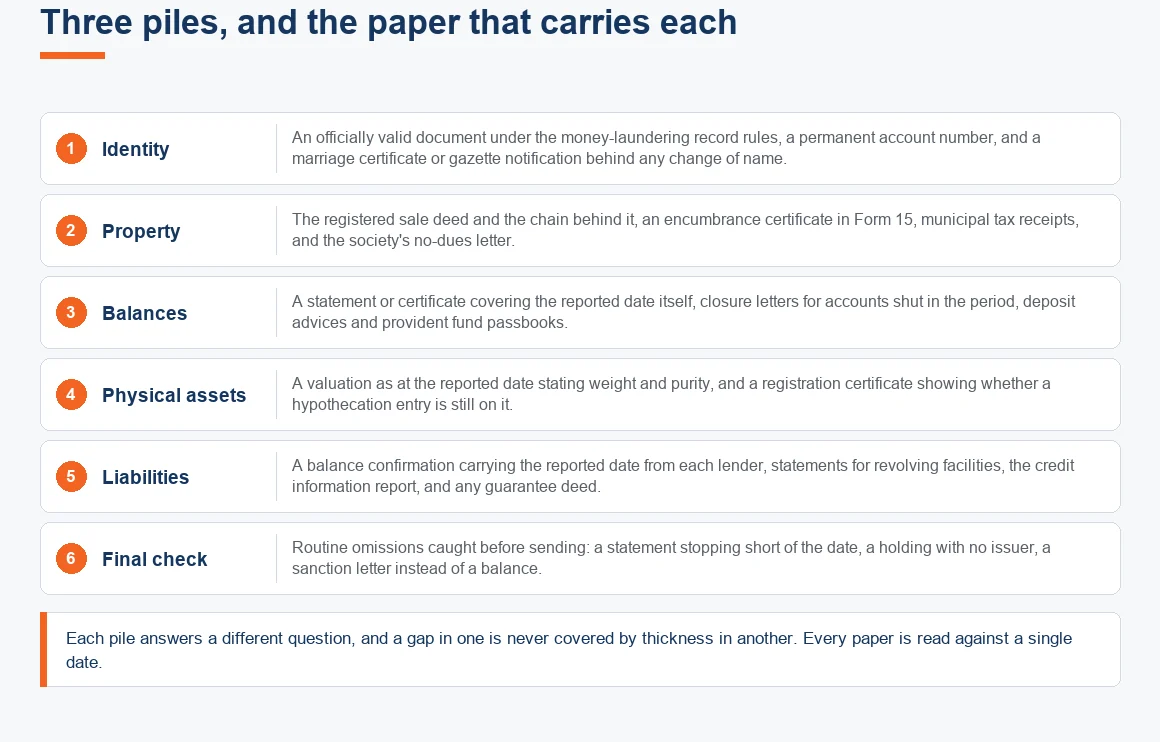
Three piles, sorted before anything is read: who the applicant is, what is held, what is owed. A chartered accountant works through them in that order, because each pile answers a different question and a gap in one is never covered by thickness in another.
Identity establishes that the person named on the schedule is the person named on the title deed. Asset papers establish that a holding exists and belongs to that person. Liability papers establish what is charged against it. The documents required for a net worth certificate are simply the evidence for those three propositions, and nothing in a file that serves none of them earns its place.
Every one of them is read against a single date. A statement covering a period that stops two months short of the reported date proves the wrong thing, however complete it looks on the surface. Which paper carries which claim is a separate matter, and what turns a claim into evidence governs that question rather than this one.
KYC Papers Every CA Asks For First
Identity documents come first, and the list behind them is not arbitrary. The Prevention of Money-laundering (Maintenance of Records) Rules 2005 define what counts as an officially valid document. The list runs to a passport, a driving licence and proof of possession of an Aadhaar number. It also covers a voter identity card issued by the Election Commission, an NREGA job card and a National Population Register letter. Banks and professionals both work from that same definition.
A permanent account number is asked for in every case, because the schedule is organised around it and the tax record is reached through it. Where a business is involved, its own identity papers travel alongside. That means the certificate of incorporation, the partnership deed or the LLP agreement, and the goods and services tax registration where one exists.
Name mismatches cause more delay than any other identity problem. Those same rules accept a document despite a later change of name, provided a marriage certificate or a gazette notification supports the change. Producing that supporting paper at the outset is faster than answering a query about it three weeks later.
Property Papers: Sale Deed, Encumbrance Certificate and Tax Receipts
Property is the largest number in most schedules and the one examined hardest. The registered sale deed establishes the current transfer, and the deeds behind it establish that the seller had something to sell. A chain covering the preceding decades is what a lender's panel advocate looks for, and its absence raises a title question rather than a valuation one.
The encumbrance certificate answers a different question: what else has been registered against this property. It is produced from the registers a sub-registrar keeps, which the 1908 registration statute opens to inspection under section 57. It is issued in Form 15, setting out each registered entry for the period searched. A record of registered charges is not a title document. A nil certificate means only that nothing was registered, which is not the same as nothing having happened.
Municipal tax receipts and evidence of possession finish the pile. A receipt in the owner's name for the current year corroborates ownership and occupation together, and an electricity or water bill does similar work at lower weight. For a flat, the society's share certificate and its no-dues letter matter, since a maintenance arrear behaves as a charge in practice even where nothing is registered. Allotment letters and builder demand notes carry an under-construction property, which enters at the amount actually paid rather than at agreement value.
Bank, Deposit and Investment Statements Worth Attaching
Bank statements are requested so routinely that the wrong ones get sent. What settles a balance is a statement or a certificate covering the reported date itself, not simply the most recent month available in the app. Where an account was closed during the period, the closure letter belongs in the file too. A reader who meets that account in an earlier statement will ask what became of it.
Deposits and market holdings each have an issuer of their own. A fixed deposit advice shows principal, rate and maturity, and interest accrued to the reported date is computed from it. Employee provident fund balances come from the passbook. Public provident fund balances come from the account statement, the scheme now running under the Public Provident Fund Scheme 2019 notified on 12 December 2019, which replaced the 1968 scheme.
Instruments held on paper are the ones most often forgotten. National savings certificates, Kisan Vikas Patras and post office time deposits sit in drawers rather than on a dashboard. A useful sweep for anything overlooked is the annual tax record. Interest paid and tax deducted show up there against the payer's name, which is why the department's record of tax credits is worth reading before the schedule is closed.
Proving Gold, Vehicles and Other Physical Assets
Physical assets are where documentation thins out fastest. Gold accumulated across thirty years rarely has invoices covering all of it. What can be produced is a jeweller's valuation as at the reported date, stating weight and purity. An insurance schedule listing the items covered does similar work, as do hallmark records for recent pieces. Photographs and locker rental receipts support existence and say nothing about value.
Vehicles are documented better than almost anything else an individual owns. A hypothecation is entered on the registration certificate under section 51 of the Motor Vehicles Act 1988. It stays there until the financier's no objection letter and Form 35 reach the registering authority. A vehicle shown as unencumbered while the certificate still carries the endorsement produces an immediate query, and the fix is administrative rather than difficult.
Assets with no paper behind them at all are handled openly rather than dropped. Machinery bought without an invoice, an inherited holding never mutated, and household articles of real value are stated on the client's written representation. The schedule records openly that this is the basis. A reader can then decide what to do with the line, which is a better outcome than discovering it during a review.
Loan and Liability Documents That Reduce Your Number
Liability papers reduce the figure, which is why they tend to be sent last and incompletely. A sanction letter is not a substitute for a current statement: it records what was lent, and the schedule needs what is still owed on the reported date. A balance confirmation carrying that exact date is what each lender should be asked for, and most issue one on request.
Revolving facilities need statements rather than letters, because they move daily. A card outstanding, an overdraft utilised, a gold loan and a loan taken against securities all change between the request and the reply. The credit information report catches what a client has genuinely forgotten, since every regulated lender reports its facilities to those companies. Individuals are entitled to one free full credit report each calendar year from each credit information company, a facility the Reserve Bank required from 1 January 2017.
Guarantees are documented even though they reduce nothing. The guarantee deed, or the sanction letter of the borrowing it supports, evidences an exposure disclosed below the total. Charges registered against a property in favour of a lender should be reconciled against the loan papers. A satisfaction of charge should be on record wherever the borrowing has been repaid.
Run Your File Through the Document Checklist Before You Send It
A file that looks complete on the sender's desk is often not complete on the reader's. Running it against an itemised list built for this purpose before sending catches the routine omissions, and the routine omissions are usually the same three.
Two of the three are a statement that stops before the reported date, and a holding claimed with no issuer standing behind it. The third is a borrowing evidenced by a sanction letter rather than by a dated balance. Each of them generates a return trip, and each is avoidable inside an hour.
Everything assembled here supports a single output. Once the file is whole, the figure is built from it and a chartered accountant's attested position is issued against that evidence. The working behind the figure is the step that sits in between the two, and it is far quicker on a file with no gaps in it.
This post supports Documents Required for a Net Worth Certificate, which sets out what Patron delivers and for whom.