
In this guide
Fit-and-Proper Tests Look at the Director's Personal Worth, Not the Company's
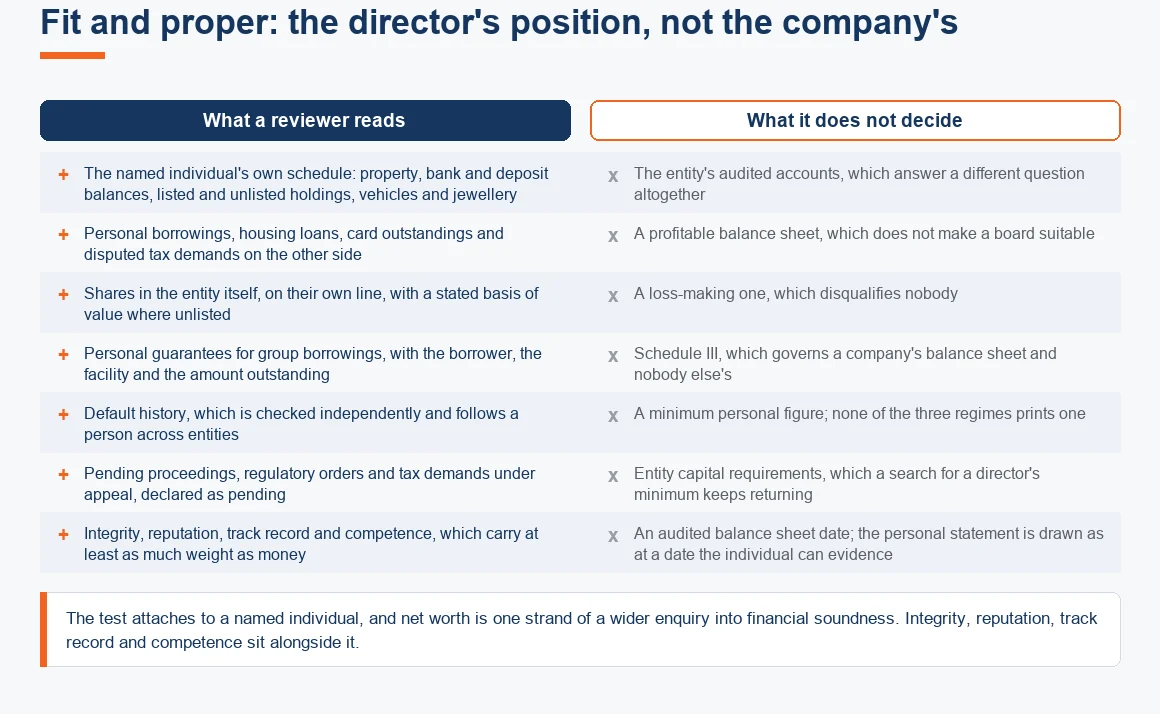
The declaration a director signs is about the director. Getting that right first saves a great deal of wasted effort, because the test attaches to a named individual and the entity's audited accounts answer a different question altogether. A profitable balance sheet does not make a board suitable, and a loss-making one disqualifies nobody.
Inside the fit and proper criteria, net worth is one strand of a wider enquiry into financial soundness. Integrity, reputation, track record and competence sit alongside it and carry at least as much weight. What the regulator is deciding is whether a particular person should hold a position of trust inside a licensed entity. Money answers only part of that.
What reaches the regulator is a signed declaration in a prescribed format, held by the entity and produced on demand rather than filed routinely. It is a self-declaration. Where it asserts a financial position, a professional's certificate is what allows a reviewer to test the assertion against something other than the signer's word.
Where the Requirement Comes From: RBI, SEBI and IRDAI Rules
The Reserve Bank set the pattern the others follow. For non-banking financial companies the operative source is the Reserve Bank's own direction on scale based regulation, issued on 19 October 2023. Annex XIII carries the criteria for directors. Annex XIV is the declaration and undertaking the individual signs. Annex XV is a deed of covenant executed between the director and the company. Boards are required to constitute a nomination committee to scrutinise what comes back.
SEBI works from a schedule rather than an annex. Schedule II of the SEBI (Intermediaries) Regulations 2008 applies the test to an applicant, an intermediary, its principal officer and its key management personnel. Three heads are listed in the market regulator's schedule: integrity, reputation and character; absence of convictions and restraint orders; and competence including financial solvency and networth. The third head is the only place a money question appears, and it arrives without a rupee figure attached.
Insurance follows the same architecture again. The IRDAI (Corporate Governance for Insurers) Regulations 2024 were notified on 20 March 2024. They require a board to satisfy itself on suitability before recommending anyone as managing director, chief executive or whole-time director. The insurance regulator's governance rules sit alongside its own declaration formats. Sectoral regulators outside financial services borrow the same language when they license, so the phrase travels further than its statutory basis does.
Thresholds and Declarations a Director Signs
Directors expect a number here and usually do not find one. None of the three regimes prints a minimum personal figure a director must clear. What each prints is a set of questions whose answers are read together and weighed. Numeric floors in this area attach to the licensed entity rather than to the individual, which is why a search for a director's minimum keeps returning entity capital requirements instead.
The format does the work the number would have done. A declaration asks for directorships and shareholdings held, relationships with the entity and its group, professional and academic qualifications, and any adverse order, conviction or pending proceeding. It asks the signer to undertake to keep all of it current. Annexures follow where the entity wants them: a personal schedule of assets and liabilities, and the evidence standing behind each line of it.
Nothing is collected and left unread. The nomination and remuneration committee examines the declarations, decides whether to accept them, and the board records the conclusion in its minutes. That is the moment a self-declared figure either stands on evidence or visibly does not. The written representation obtained describes the same mechanism as it works in an assurance engagement.
How a Director's Certificate Differs From the Company's
The two statements share a name and very little else. A director's schedule lists immovable property, bank and deposit balances, listed and unlisted holdings, vehicles and jewellery on one side. Housing loans, personal borrowings, credit card outstandings and disputed tax demands sit on the other. There is no Schedule III to follow, because Schedule III governs a company's balance sheet and nobody else's.
Shares in the entity itself need separate handling. They are an asset of the director, and they are also the reason the declaration exists. A reviewer wants them shown on their own line instead of folded into a total for investments. Unlisted holdings need a stated basis of value beside them. Where the entity's own position is thin, a personal schedule leaning heavily on those shares tells a reviewer almost nothing.
Dating differs as well. An entity statement is tied to an audited balance sheet date and cannot move off it. A personal statement is drawn as at a date the individual can evidence, often a recent month end, from bank statements, demat holdings and title documents. Reviewers then restate what they are shown, discounting unlisted holdings and removing what cannot be sold, which is the instinct behind worth stripped of intangibles in lending generally.
Disclosures on Guarantees, Defaults and Pending Cases
A personal guarantee never appears among a director's assets and can still dominate the reviewer's view. Promoters routinely guarantee group borrowings, and the exposure stays contingent right up until it is not. Declaring the guarantee, the borrower, the facility and the amount outstanding is what a reviewer expects to see. Under the Insolvency and Bankruptcy Code a personal guarantor to a corporate debtor can be proceeded against in his own right, which is what makes the disclosure material.
Default history is checked independently of what gets declared. The Reserve Bank's Master Direction on treatment of wilful defaulters and large defaulters was issued on 30 July 2024 and took effect on 1 November 2024. It requires lenders to examine accounts with an outstanding of 25 lakh and above from a wilful default perspective. The classification attaches to the borrower and to the guarantor alike. It follows a person across entities, and no declaration format is going to bury it.
Pending proceedings are declared as pending, not as decided. Criminal proceedings, regulatory orders, restraint orders and tax demands under appeal each take a line of their own. Understating here is treated far more seriously than the underlying matter, because it goes to integrity rather than to solvency. A director of a regulated entity should also expect which supervisory layer applies to change how closely the file is read.
Renewal and Annual Reconfirmation Duties
The obligation does not end at appointment. Boards obtain a declaration when a director joins and again each year, and the annual one either confirms that nothing has changed or sets out precisely what has. The duty to report a change in between sits with the individual rather than with the secretarial team collecting the forms.
Some events cannot wait for the annual cycle. A new personal guarantee, a default on a facility, a fresh directorship, an adverse regulatory order or a charge sheet each trigger an update as they occur. So does a material change in the position already declared. A director of a company whose capital is gone will be asked about it at the next committee meeting, not at the next renewal.
Where a declaration rests on a financial figure, the evidence behind it ages at the same rate the figure does. A schedule drawn eighteen months ago supports an eighteen month old assertion and nothing more recent. Refreshing it on the annual cycle keeps the two in step, and the certification behind the declaration is what a committee reads beside the signed form.
This post supports Director Fit-and-Proper, which sets out what Patron delivers and for whom.