In this guide
One Is a Sponsor's Sworn Promise, the Other Is a CA's Attested Figure
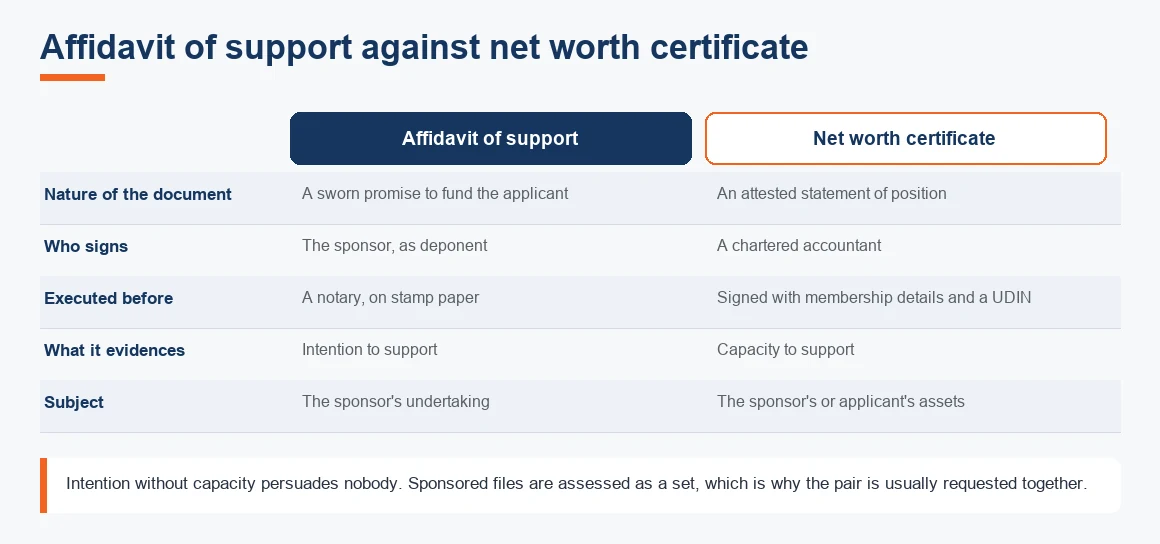
Set an affidavit of support vs a net worth certificate side by side and the difference is who is speaking. In the first, a sponsor speaks about what they will do. In the second, a chartered accountant speaks about what the records show.
That changes what each one can be wrong about. A promise can be entirely sincere and still fail, because circumstances move. A statement of position can be accurate on its date and say nothing at all about next year. Neither weakness is a defect. They are simply different instruments doing different work.
The subject differs as well. An affidavit is always about the sponsor, whatever figures it happens to recite. A certificate is about whoever the accountant examined, which may be the sponsor, the applicant, or each of them in a separate document. Files carry both because the two papers are about different subjects and neither one stands in for the other.
Who Signs, Who Swears and Who Stamps Each One
Execution is where the two stop resembling each other. An affidavit is signed by the deponent in the presence of a notary or an oath commissioner, who administers the oath and affixes a seal and signature. It is executed on stamp paper of the value the relevant state's schedule prescribes, which is why the same undertaking is sworn on differently valued paper in different states.
The certificate carries a different set of identifiers, and all of them point outward. The member's name and membership number, the firm registration number where the signature is given for a firm, the place, the date and a unique document number for that certificate. A reader who wants to test any of it has somewhere to go.
The seal proves that an oath was administered. It does not certify that what was sworn is true, and it was never meant to. The accountant's signature makes a different claim altogether: that records were examined and the figures follow from them.
Dates behave differently too. An affidavit is dated the day it is sworn and speaks from that day. A certificate states an as-at date for the position, which can precede the day of signature, so both dates on its face are real and both are necessary.
Legal Weight of an Affidavit Before an Indian Notary
An affidavit binds the person who swore it to the truth of what they said. It does not, on its own, create a debt owed to the applicant or a right the applicant can enforce. What it creates is exposure.
A person legally bound by oath who makes a statement they know to be false is giving false evidence. The Bharatiya Nyaya Sanhita 2023 says so at section 227, inside the chapter on false evidence. Section 229 sets the punishment. It is up to seven years where the false evidence is given at a stage of a judicial proceeding, and up to three years otherwise.
Reading an Indian affidavit from abroad adds a further step. A foreign authority cannot check an Indian notary's seal against anything it holds, so the document usually has to be authenticated before it will be received at all. Whether that means an apostille or an attestation depends on the destination rather than on the document.
The practical effect is that an affidavit is strong on intention and silent on capacity. It is not weak. It is narrow. Treating it as evidence of means is the error that produces the refusals people afterwards describe as unfair.
Why Sponsors Are Usually Asked for Both
In practice the two papers are assessed as one set, alongside the sponsor's statements and returns. The evidence bundle a sponsor files is read for agreement between its parts before any single part is read on its own.
Disagreement is expensive. An affidavit reciting a figure the certificate does not support is worse than an affidavit with no figure in it, because it converts a gap into a contradiction. The checks applied to sponsor papers are the checks applied to the applicant's, with the relationship added, so a contradiction surfaces rather than passing quietly.
Where only one is asked for, which one it is tells you what the route is testing. A route that names a sponsor and wants their undertaking is testing responsibility. A route that wants an assessment of the sponsor's means is testing capacity, and the amount the file must cover is then the number under examination.
In both cases the sponsor's own evidence carries the weight. An undertaking with nothing behind it is the one combination that reliably fails, and it fails on the first reading rather than the second.
Drafting the Sponsorship Undertaking Without Overcommitting
Scope is the variable that decides real exposure, and it is usually settled without much thought. An undertaking limited to named costs, for a named person, over a named period, is a bounded commitment. An undertaking to meet all expenses for the duration of a stay is bounded by nothing.
Duration deserves the same attention. A course runs for a stated number of years and an undertaking can say so. Where it is silent on duration, the sponsor has left the endpoint to be argued about later. In a system that treats the undertaking as recoverable, that argument carries a cost.
Open-ended exposure usually enters through generality rather than through any specific promise. Wording that reaches any liability the applicant may incur reaches much further than the sponsor intends. So does an undertaking given jointly with somebody whose own position the sponsor has never seen.
The figure recited has to be the certified figure, on the certified date, described the same way. Where the affidavit says one thing and the schedule says another, the reader has two documents and no fact. Where the sponsor's money originates should be the same story in both. A sponsor who cannot explain the source of what they have undertaken to spend has answered only half the question.
Verdict: When an Affidavit Alone Will Carry the Application
There is a real set of files where the affidavit is enough on its own, and pretending otherwise would be dishonest. Take a short visit with modest costs, a sponsor whose income arrives as salary, and a route asking only for an undertaking and the sponsor's own statements. In that combination a certificate answers a question nobody asked.
The certificate becomes necessary when capacity cannot be read off a bank statement. Wealth sitting in deposits, property and holdings across several institutions does not present itself. It has to be assembled and attested by somebody who examined it. The same is true wherever a route asks for an assessment of means rather than a balance.
The third case is documentary rather than financial. Where a sponsor's papers are numerous, in several formats and partly in a language the mission does not read, one attested schedule replaces a folder. Having the sponsor's position attested is worth doing for that reason alone, and not worth doing where the route has not asked and the statements already speak for themselves.
This post supports Affidavit of Support vs Net Worth Certificate, which sets out what Patron delivers and for whom.