In this guide
An LLP Certifies From Filed Accounts; a Firm Certifies From Its Books
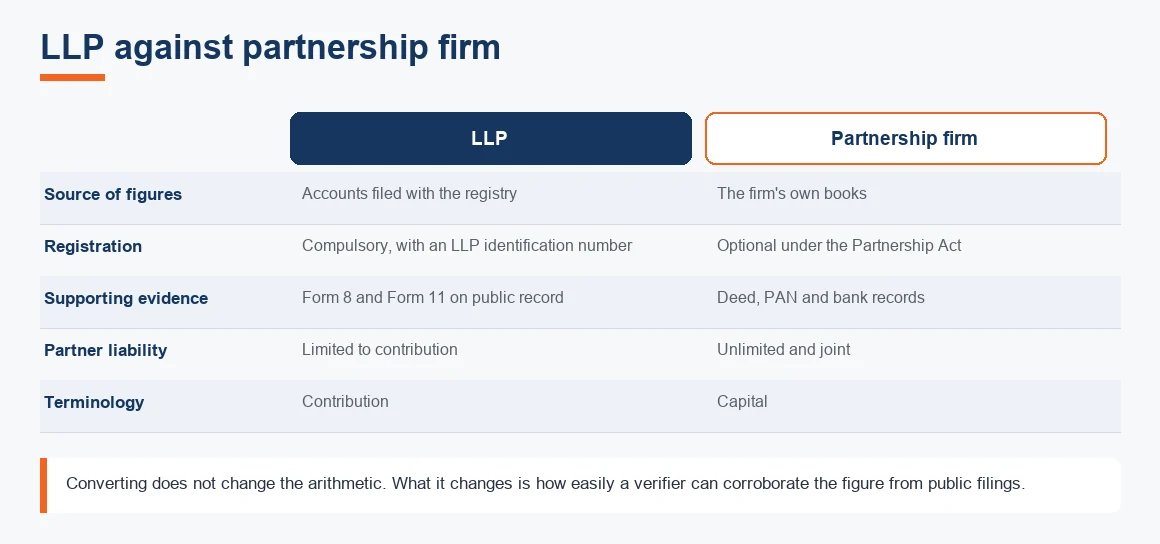
Two documents that look alike come from entirely different places. An LLP net worth certificate rests on accounts the entity has already filed with the Registrar. A general firm's rests on books that have never left the office. That one difference decides how much independent checking a reader can do before accepting the figure.
The LLP side is a public record by design. Section 36 of the Limited Liability Partnership Act 2008 opens four filings to inspection by any person. They are the incorporation document, the names of partners and changes in them, the statement of account and solvency, and the annual return. Inspection is on payment of the prescribed fee, and nothing else is required of the person asking.
A general firm publishes none of that. Its entry in the Register of Firms, where it is registered at all, records the firm name, its places of business and its partners. Section 66 opens that register to inspection, but it carries no financial statement whatsoever. The consequence for a verifier is direct. For one entity the figure can be tested against a filed document, and for the other it can be tested only against records the firm itself produces.
Statutory Backing: LLP Act Filings Against the Partnership Act
Existence is proved differently in each case. A limited liability partnership is incorporated, is a body corporate with perpetual succession under section 3, and carries a limited liability partnership identification number that stays with it for life. Incorporation is what brings the entity into being, so an unincorporated one does not exist at all.
Registration of a general firm is optional. Sections 58 and 59 of the 1932 Act's registration provisions set out how a firm is entered with the Registrar of Firms, and nothing compels the partners to do it. What follows from skipping it is procedural. Section 69 bars an unregistered firm from suing a third party on a contract, and bars a partner from suing a co-partner to enforce one. Suits for dissolution, and for accounts of a dissolved firm, sit outside that bar. A third party can still sue the firm either way.
Audit obligations diverge as well. Rule 24(8) of the Limited Liability Partnership Rules 2009 makes audit compulsory once turnover crosses 40 lakh rupees or contribution crosses 25 lakh rupees. A general firm has no statutory audit at all. It reaches an audit only through the income-tax route. Section 63 of the Income-tax Act 2025 sets the trigger at 1 crore rupees of turnover. That rises to 10 crore rupees where cash receipts and cash payments each stay within 5 per cent. A modest incorporated entity can therefore arrive with audited accounts while a larger unincorporated one arrives with none.
Limited Liability and What It Does to the Certified Number
Arithmetic is untouched by liability structure. Assets less liabilities produces the same number whether or not the partners can be pursued personally. What changes is what stands behind that number once it is exhausted, and no accounting convention records that.
The statutory position is precise on both sides. Section 27(3) of the LLP Act's liability clauses makes an obligation of the entity solely the obligation of the entity. Section 28 then says a partner is not personally liable for it merely by being a partner. That protection stops at a partner's own wrongful act or omission, for which the partner stays liable personally. Section 25 of the Partnership Act runs the other way entirely. Every partner is liable jointly with the others, and severally too, for anything the firm does during that partner's time in it.
The effect is on what a reader does next, not on the figure itself. Where recourse stops at the entity, the entity's own funds carry the weight, and anyone wanting more has to ask for it expressly. Where the partners are already reachable, a lender reads the business and the people behind it as a single exposure. Designated partners also carry compliance duties of their own under section 8 of the LLP Act, which is a further liability again and unrelated to the balance sheet.
Form 8 and Form 11 as Supporting Evidence
Form 8 is the statement of account and solvency. It is filed under section 34(3) of the LLP Act with rule 24 of the 2009 Rules. The due date falls 30 days from the end of six months after the financial year closes. For a year ending on 31 March that lands on 30 October. Part A carries a solvency declaration by the designated partners, and Part B carries the statement of assets and liabilities with the statement of income and expenditure.
Form 11 is the annual return. It is filed under section 35 with rule 25(1), and is due within 60 days of the close of the financial year. For a 31 March year end that is 30 May. It carries the particulars a reader uses to place the entity: partners and designated partners on record, changes during the year, and total contribution received from the partners.
Reconciling either form against a certified figure takes some care. A filed form states the position at 31 March, and certification is usually sought at a later date. The gap is bridged by a position stated at that date carried forward from the filed balance sheet, with the intervening movements evidenced separately. Anyone who finds the certified figure below the last filed one will ask what left the entity, so those movements are worth setting out before being asked.
Contribution in an LLP Against Capital in a Firm
Contribution is not a synonym for capital, though the two words are traded as if they were. Section 32 of the LLP Act allows contribution in tangible or intangible property, movable or immovable. It also allows money, promissory notes, other agreements to contribute cash or property, and contracts for services performed or to be performed. Section 33 makes the obligation to contribute an obligation created by the agreement between the partners.
Non-monetary contribution has a valuation rule attached to it. Rule 23(2) of the 2009 Rules requires such contribution to be valued independently. The valuer is a practising chartered accountant, a cost accountant in practice, or someone drawn from the panel maintained by the Central Government. The monetary value then has to be accounted for and disclosed in the accounts. Capital in an unincorporated firm has no equivalent rule, and an asset brought in is recorded at whatever the partners agreed among themselves.
The trap is the unpaid balance. Contribution stated in the agreement and reported in Form 11 is the amount agreed, which is not always the amount received. Contribution still outstanding is a receivable from the partner rather than own funds, and reading the agreed figure as own funds overstates the entity. The same distinction runs through an unincorporated firm's books as capital called for against capital introduced, and how the partner accounts aggregate follows the amounts actually received.
Which Acceptors Treat the Two Differently
Acceptors give their position away in the form itself. A tender or empanelment format offering a single field for a registration number usually wants the identification number of an incorporated entity. An unincorporated firm has nothing to enter there. Some formats name company and limited liability partnership and then stop, which excludes a firm before any figure is read. Reading the entity field first saves preparing a document nobody will accept.
Lender templates split the same way. A credit application for a non-individual borrower typically asks for constitution, registration or identification number, and the last audited financial statements. An incorporated entity fills those fields from its filings. A firm fills them from its deed and its own accounts, and frequently has to explain in writing that no statutory audit applies to it at all.
Partner-level documents are asked for on both, and more insistently where recourse to the partners already exists. Where an acceptor is taking personal guarantees it wants each guarantor's position as well as the entity's. What a partner signs separately is a distinct document with a distinct subject.
Verdict: Does Converting to an LLP Improve Your Certificate?
Conversion does not improve the number. Assets less liabilities is the same on either side of the change, and a business converting on Monday is worth on Tuesday what it was worth on Monday. What conversion buys is a filing trail, and a trail has to accumulate before it is worth anything to a reader. The first Form 8 falls due seven months after the first financial year ends, so the benefit is not available for some time.
There are cases where the trail genuinely decides the outcome. A counterparty in another state with no way to visit the office can read filed accounts and cannot read a deed. So can a buyer running diligence on its own account. Set against that, unlimited recourse to the partners is worth something real, and a lender will often read an unincorporated business with substantial partners as the stronger exposure. Neither form wins by default.
The exercise itself is the same for both, and certification for either partnership form runs from whatever evidence the business actually holds.
This post supports LLP vs Partnership Firm, which sets out what Patron delivers and for whom.