In this guide
A One-Page Request Naming the Amount, Purpose and Acceptor Does the Job
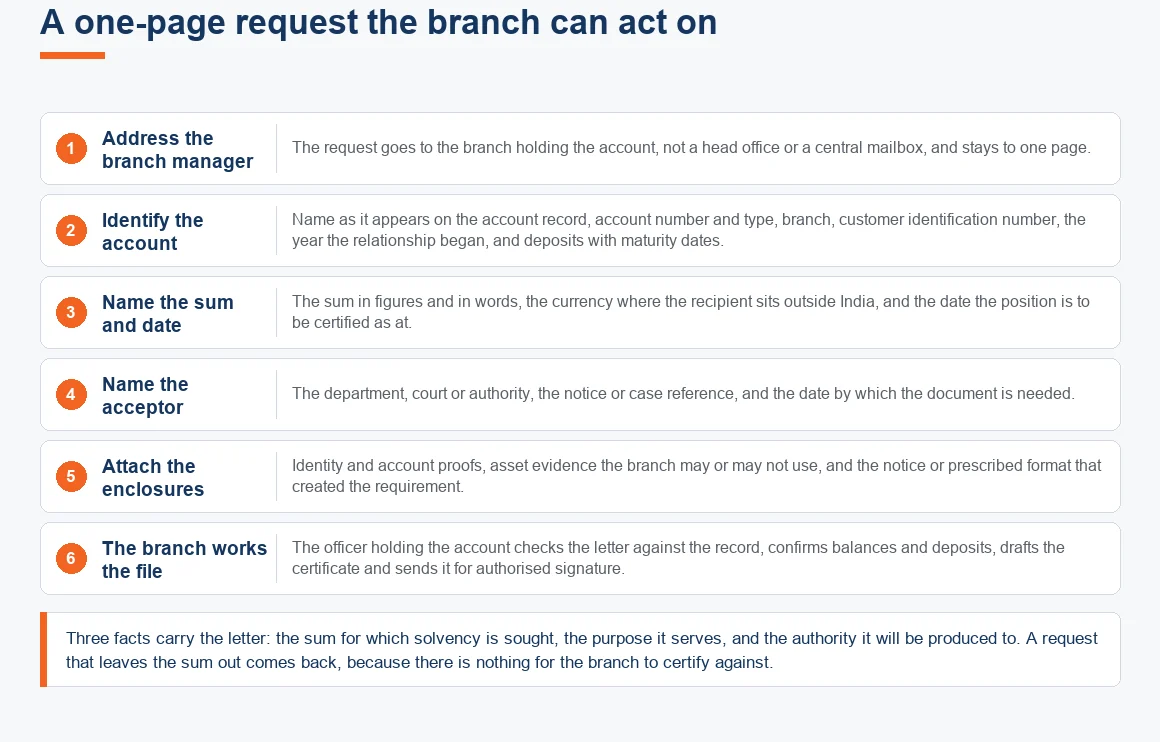
Branches handle these requests as routine correspondence, and the ones that move are short. Three facts carry the letter: the sum for which solvency is sought, the purpose it serves, and the authority it will be produced to. An application for a solvency certificate from a bank that leaves out the sum comes back, because there is nothing for the branch to certify against.
Address it to the branch manager at the branch holding the account, not to a head office or a central mailbox. The officer who signs is the one who can see the relationship on screen. Where the account sits with a corporate or mid-corporate branch, the request still starts there and travels upward internally if an approval is needed.
Keep it to one page and to plain statements of fact. No argument is required and none helps, because the branch is deciding whether its own records support the figure asked for. Settling which document each acceptor names before drafting saves the commonest wasted cycle of all.
Details Your Branch Will Ask You to State
Open with identification the branch can match against its own file. Name exactly as it appears in the account record, account number, account type, branch name and the customer identification number printed on the statement. Add the year the relationship began, since length of relationship is one of the things the signing officer weighs. Where deposits are held, list them with their maturity dates. Where a facility is sanctioned, state the limit and the amount outstanding on it.
State the sum plainly, in figures and again in words. Where the recipient sits outside India, name the currency the figure is to be expressed in, because a branch will not convert on its own initiative. The letter should also name the date the position is to be certified as at. A certificate without a date describes nothing, and acceptors reject it on sight.
Then name the acceptor and the reference. The department, court or authority, the notice or case number, and the date by which the document is needed. Where the sum is tied to the deposit lodged with a bid or to an instrument the bank issues instead, say so plainly. That single line tells the officer which internal desk the request belongs to.
A Sample Application Letter You Can Adapt
The specimen below is written for an individual applicant. Every value is masked; replace each bracket with the figure or name from the record.
To: The Branch Manager, [Bank name], [Branch name and address]. Date: [XX.XX.XXXX]. Subject: Request for a certificate of solvency to the extent of [Rupees XX,XX,XXX only].
Sir or Madam, I have maintained savings account number [XXXXXXXX1234] at your branch since [XXXX], and I hold term deposits under receipt numbers [XXXXXX]. I request a certificate confirming my solvency to the extent of [Rupees XX,XX,XXX], as at [XX.XX.XXXX].
The certificate is required for submission to [name of authority] against [notice or case reference], which has to be filed by [XX.XX.XXXX]. Documents in support are enclosed and listed overleaf. The applicable charge may be debited to the above account. Yours faithfully, [Name], [Address], [Mobile], [PAN].
For a firm or a company, four lines change. The applicant is the entity, so the letter goes on its letterhead and is signed by a partner or a director authorised for the purpose. The account described is the current account and any facility running on it. A copy of the authorising resolution is enclosed. The entity's registration particulars replace the personal ones.
Where the acceptor has prescribed its own wording, reproduce it rather than paraphrase it. Attach the printed format to the letter and ask for the certificate in those terms. Branches decline language they cannot support, and learning that at the application stage costs far less than learning it after a document has been issued in the wrong words.
Enclosures to Attach With the Letter
Identity and account proofs come first. A copy of the PAN card, a current address proof, and statements for the period the branch asks for. Deposit receipts or advices where deposits form part of the figure. Where the signature on file is old, the branch may ask for fresh specimen signatures before it acts on the request at all.
Asset evidence is the second layer, and the branch decides how much of it to use. Copies of title documents for immovable property, the latest tax receipt for it, and a recent search from the sub-registrar. Holding statements for shares or mutual fund units. Registration particulars for vehicles. Supplying these does not oblige the branch to count them, since it certifies from what it can verify itself.
The third layer is the paperwork that explains the request. A copy of the tender notice, court direction or departmental letter that created the requirement, showing the sum and the deadline. Any certificate issued earlier, with its date, so the branch can see what it wrote last time. The prescribed format, where the acceptor publishes one.
Turnaround at the Branch and Why Requests Get Delayed
The request enters at the counter or the service desk and is marked to the officer who handles the account. That officer checks the letter against the record, confirms the balances and deposits, and drafts the certificate. It then goes to an authorised signatory. Sums above an internal ceiling are referred to a controlling office, and applicants rarely learn that the ceiling exists until they cross it.
Requests stall for ordinary reasons. The sum is missing or stated only in words. The name on the account does not match the name on the notice. The relationship is short, or the balance sits well below the figure sought. The credit information report carries an adverse entry. Records are not current, so the file goes to the compliance desk before it goes anywhere else.
Following up is a matter of staying on the same file. Quote the acknowledgement or inward reference on every message, and ask for status in writing rather than by telephone. A fresh application resets the file and loses the position already gained. Where nothing moves at all, the bank's own grievance channel is the route, and its service commitments are set out in the master circular on customer service.
If the Bank Declines: The CA Route as an Alternative
A branch can decline, and it does so more often than applicants expect. Issuance is a commercial decision rather than a right attaching to an account. Short relationships, thinly operated accounts, an adverse credit record, or a sum far above the balance held are the usual grounds. The most common ground of all is simply that the assets carrying the figure sit somewhere the branch cannot see.
The professional route answers that limitation directly. A chartered accountant works across every lender and every asset class, and examines title and the registered position. A view then follows on capacity to meet the obligation named in the notice. The figure is built rather than read off a screen, and how the number is arrived at is worth understanding before the evidence is gathered.
That document is not a substitute the applicant falls back on. It is a different instrument answering a wider question, and many notices ask for it in the first place. What the accountant route covers sets out the scope, the evidence examined and what appears on the face of the signed document.
This post supports How to Write a Bank Solvency Certificate Application, which sets out what Patron delivers and for whom.