In this guide
How Often a Chain Should Count
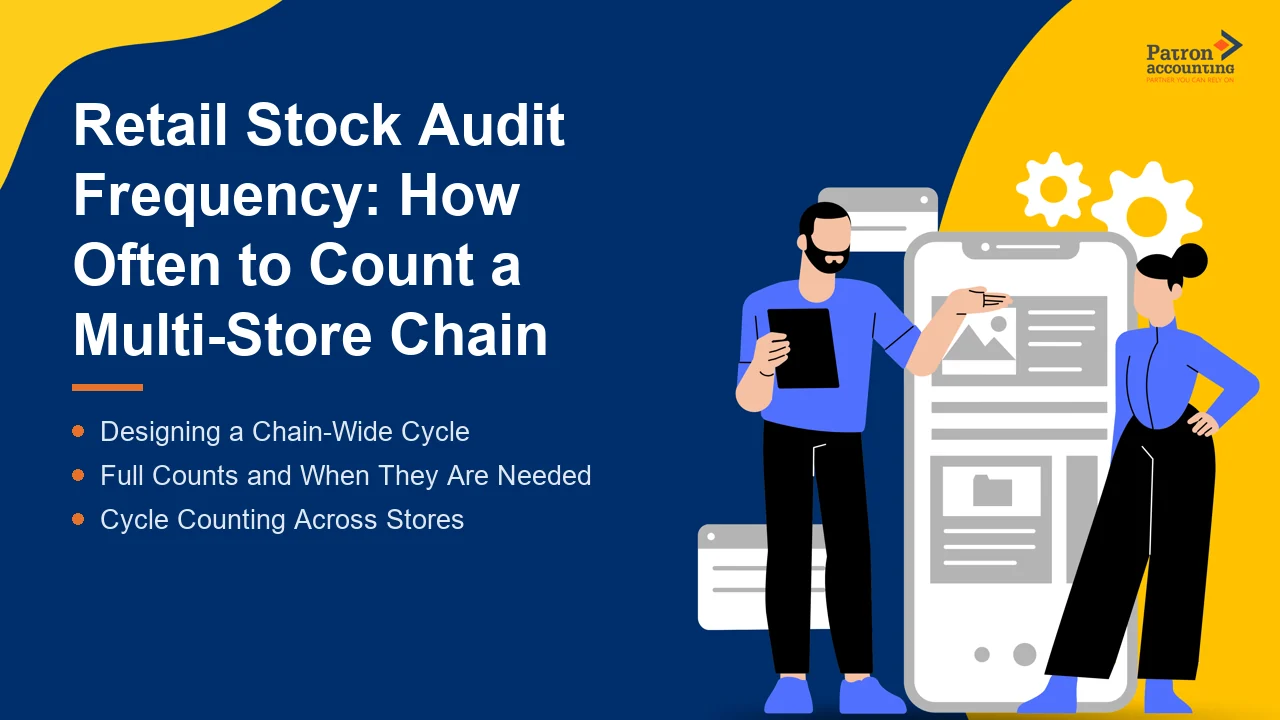
A chain should count each store at an interval set by that store's shrinkage history and stock value, not by a policy applied uniformly across the estate. The choice is between a full count, which closes the store and produces a clean figure for a single date, and cycle counting, which runs continuously without closing and produces a rolling picture. Most chains need both: cycle counting for control through the year and a full count to establish a position everybody accepts. The interval is driven by stock value at the store, by the shrinkage the store has actually recorded, by staff turnover, and by how much of the range is high-theft. Putting every store on the same cycle is usually wrong because it overspends on the stores that are performing and underspends on the ones that are not, which is precisely the reverse of what the counting budget is for.
Full Counts and When They Are Needed
A full count establishes a complete position at one moment, and there are situations where nothing else will do. Year-end and lender-driven counts are the main ones. A figure carrying an audit opinion, or a figure a bank will compute drawing power from, has to relate to a specific date with known coverage, and a rolling programme cannot supply that however diligently it has run. Trading disruption is the cost, and in retail it is substantial. Closing a store to count means lost sales for the period, and where the count runs into trading hours it also means customers who found the doors shut. Counting overnight avoids the sales loss and adds a premium for the hours. Either way the cost is real and it scales with the number of stores. What a full count establishes that cycles cannot is a single dated position across the whole population, with every line reached and the coverage complete rather than sampled. Cycle counting produces continuous assurance about a process; only a full count produces a position. Businesses that rely entirely on cycles usually discover this at the year end, when somebody asks for a figure as at a date.
Cycle Counting Across Stores
Cycle counting spreads verification through the year and works because it is selective rather than complete. Category rotation is the usual structure: the range is divided into groups, each group is counted on its own schedule, and the whole range is covered over a defined period without the store ever closing. Counting happens in quiet trading hours by store staff, which is what keeps the cost low enough to sustain. High-value lines counted more often is the weighting that makes the effort worthwhile. Electronics, spirits, cosmetics and similar categories carry disproportionate value and disproportionate loss, so they justify a much shorter interval than bulk grocery, and a programme counting everything at the same frequency is spending most of its effort where least is at stake. Coverage over a defined period is the measure that replaces a coverage percentage at a date. The programme reports what proportion of lines and of value has been reached within the cycle and how recently each category was last counted, and a category that has quietly not been reached for several cycles is the gap this reporting exists to expose.
Risk-Weighting the Schedule
Once the model is chosen, the allocation of counting effort across stores matters more than the total amount of it. Stores with prior variance are the first weighting. A store that produced material differences at its last count is where the next one is most informative, because it establishes whether the underlying cause was addressed, and treating it identically to a store that has counted cleanly for three cycles wastes the budget in both places. New stores and new managers are the second. Accuracy in the opening months is both worse and more correctable, since processes are unsettled and habits are forming, and a store that establishes poor receiving discipline early tends to keep it. Counting early and often at a new site is cheaper than correcting the pattern later. Format and category risk is the third weighting. A self-service format is exposed differently from a counter-service one, a store carrying a high proportion of small high-value items faces different loss from one carrying bulk goods, and a store's shrinkage should be judged against comparable formats rather than against the chain average, which is also how the schedule should be built.
What the Auditor Tests in Either Model
Whichever counting model a chain adopts, three things are tested and the model changes only how they are evidenced. Coverage over the cycle is the first: under a full-count model that is a single date and a stated completeness; under cycle counting it is what proportion of locations and of value was reached across the period, and how recently each was last counted. A cycle-counting programme that has never reached certain categories has a coverage gap regardless of how many counts it performed. The second is whether the counts were independent of the people responsible for the stock. A store team counting its own stock, with no supervision and no recount of differences, produces a number that reflects the team's expectations, and this is tested by looking at who counted, who checked, and whether any recount was performed by different people. The third is what happened to the differences found. Counts whose differences are posted as adjustments without investigation convert a control into a bookkeeping routine, and a pattern of adjustments in one direction is itself the finding.
Designing a Chain-Wide Cycle
Build a schedule that survives trading rather than one that assumes it can be paused. Counting before doors open, overnight, or on the quietest trading day of the week is what makes a full count possible without closing, and those windows have to be identified store by store because they differ by location and format. A schedule built centrally on an assumed quiet period will collide with local reality at a proportion of sites and quietly not happen there. Give the store-level accountability somewhere to land. A count whose differences are reported to the store manager, discussed, and followed up at the next cycle changes behaviour; a count whose results go only to head office does not, however accurate it is. Publishing store results against the chain is usually enough. Independence is required where the figure supports the accounts, where a lender relies on it, or where a particular store's results are contested, since a team counting its own stock cannot settle a dispute about its own stock. Stock audit for retail chains work is planned around the trading calendar rather than the finance one.