In this guide
The short answer to tally vs zoho books is that they solve the same job in two different shapes: Tally Prime is offline, installed software bought once and renewed for updates, while Zoho Books is a cloud subscription you log into from anywhere. For most Indian businesses the choice comes down to four things: how you file GST, how many people need access at once, how heavy your inventory is, and what the software costs you over five years rather than in month one. This explainer walks through each so you can decide, without a sales pitch.
Tally vs Zoho Books: what actually differs
Both run proper double-entry bookkeeping and produce a clean trial balance, general ledger and financial statements. The real differences are structural, not accounting-theory. The table below sets them side by side so you can see where each tool pulls ahead.
| Area | Tally Prime | Zoho Books |
|---|---|---|
| Deployment | Installed, runs offline on a PC or LAN | Cloud only, needs internet |
| Licence model | One-time perpetual licence + annual TSS | Per-organisation subscription, monthly or annual |
| Free tier | None (paid licence) | Free below Rs 25 lakh turnover |
| GST filing | Prepares returns, exports JSON for the portal | Files GSTR-1 and GSTR-3B in-software (GSP) |
| Access | Single machine or LAN, remote add-on | Any browser, any location, native mobile app |
| Inventory | Batch, expiry, godown, bills of material | Items, warehouses, reorder alerts; Zoho Inventory for depth |
| Best fit | Inventory-heavy, single-office, offline sites | Services, multi-user teams, remote working |
Which is better, Zoho or Tally, for your business?
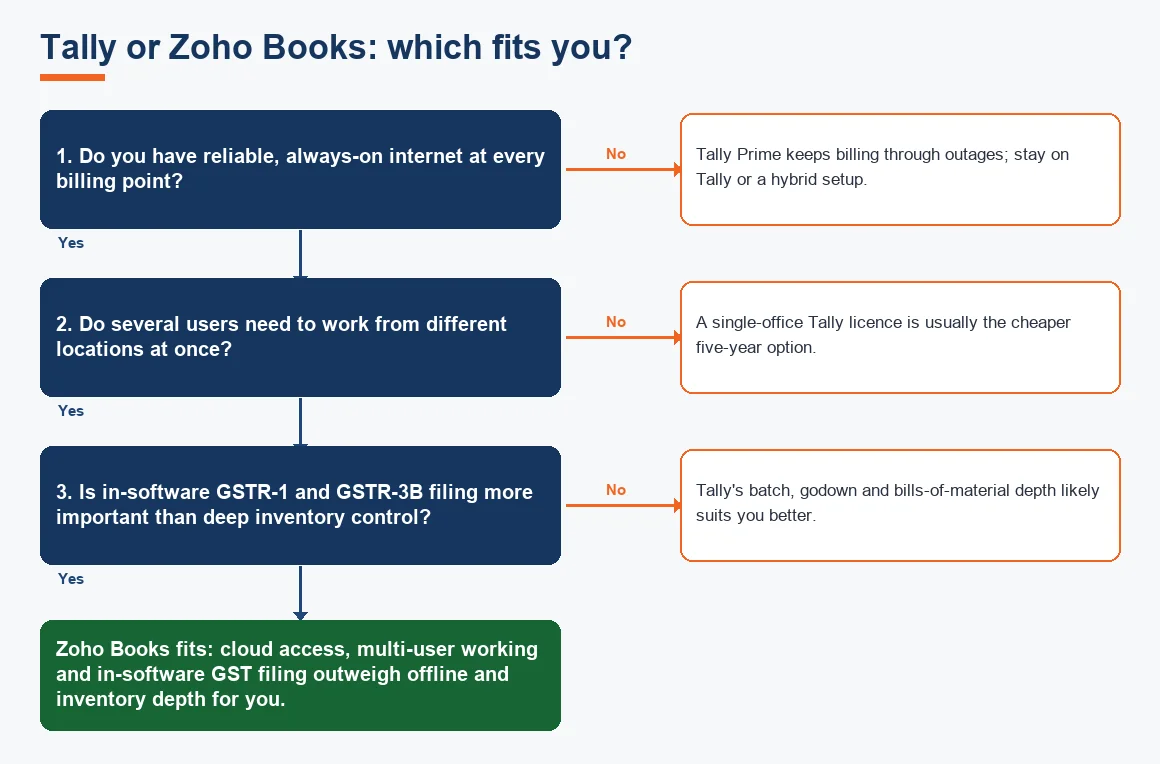
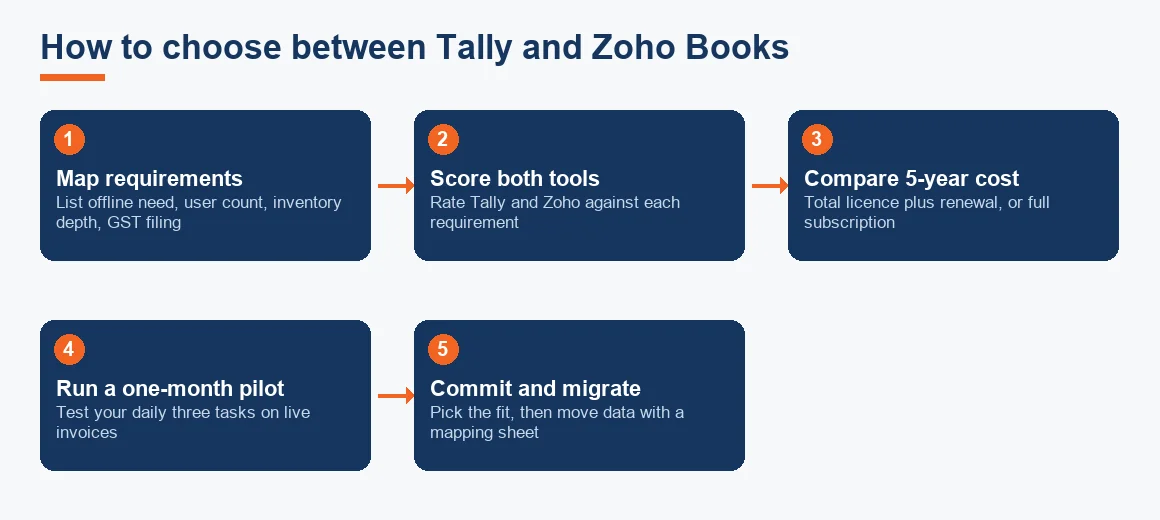
There is no single winner, and any answer that claims one is dishonest. The better question is which fits your working pattern. A distributor with three godowns and daily stock movement will feel Tally's inventory depth every day. A design studio with staff working from home will value logging into Zoho from any laptop far more than offline speed. Map your requirements first, then score both against them.
If you are weighing this because you already run Tally and are thinking of moving, the reasoning is covered in why businesses are migrating from Tally to Zoho Books, and the how-to sits in the step-by-step migration guide. This page stays on the comparison itself.
Does Zoho Books work offline like Tally?
No. Zoho Books is cloud-only and needs a live internet connection to record transactions. Tally Prime is installed software that keeps working through an outage on a local machine or LAN, with optional browser access for those away from the desk (see remote Tally access). For a retail counter or a factory in an area with patchy connectivity, this is decisive: Tally keeps billing when the line drops, Zoho does not. The Zoho mobile app caches limited data but cannot record full transactions offline.
GST filing: which handles returns better
Zoho Books is a GST Suvidha Provider, so it files GSTR-2B-matched GSTR-1 and GSTR-3B directly from the software, with reconciliation built in. Tally Prime prepares the same returns and exports a JSON file that you upload on the GST portal, alongside e-invoice and e-way bill connectors that follow the schema published by CBIC. In plain terms: Zoho is faster to file because the filing happens inside the tool; Tally gives you more control over the data before it leaves your hands. Neither removes your obligation to check the numbers before submitting, whichever route you take. Correct GSTIN setup matters on both, and Zoho's structure is explained under Zoho GSTIN mapping.
Inventory and manufacturing: where Tally still leads
For stock-heavy businesses, Tally Prime remains the stronger tool. It offers batch and expiry tracking, godown-wise stock, manufacturing journals with bills of material costing, and multiple price levels out of the box. Zoho Books covers items, warehouses, serial and batch numbers and reorder alerts, and pairs with Zoho Inventory for deeper control at extra cost. Distributors, pharmacies and manufacturers usually stay on Tally for this reason. A services firm carrying no stock will never notice the gap. Both compute fixed-asset depreciation adequately, and if you want to sense-check a schedule outside either tool, the depreciation calculator works to Schedule II.
Pricing compared: one-time licence versus subscription
This is where the two models feel most different. Tally Prime is a one-time perpetual licence (indicative Silver single-user around Rs 18,000, Exl GST) plus an annual Tally Software Services renewal for updates and remote access, so year one is expensive and later years are cheap. Zoho Books is a per-organisation subscription billed monthly or annually, free below Rs 25 lakh turnover and then rising by plan. The headline monthly figure looks small, but it recurs forever. Over a long horizon a single office often pays less on Tally; a growing multi-user team frequently gets more value from Zoho. The worked example below puts real numbers on this.
Is Zoho Books compatible with Tally? Moving data across
There is no native two-way sync. Zoho Books exports masters and transactions as CSV or Excel, which must be converted into Tally XML using a third-party utility or a custom script before import, and the reverse (Tally to Zoho) works the same way through export files. Because voucher types and ledger groups differ between the two, you need a ledger mapping schema and should compare trial balances immediately after any import. The full sequence, including what to preserve, sits in the migration checklist and, for statutory history, preserving your GST history when moving from Tally to Zoho. If you are comparing destinations rather than tools, migration from Tally to Odoo is the other common route.
Disadvantages to weigh on each side
Every honest comparison lists the downsides. The main disadvantage of Tally Prime is that it is tied to the machine it is installed on: real remote and multi-user working needs the Gold licence or add-ons, the interface feels dated to newer staff, and collaboration is clumsy compared with a browser tool. The main disadvantages of Zoho Books are its cloud dependence (no internet, no billing), the ongoing subscription that never converts to an asset you own, and inventory that, while capable, does not match Tally for manufacturing. Neither is a dealbreaker on its own; the weight you give each depends entirely on how you work.
Worked example: five-year cost of ownership
Consider a single-office business choosing between Tally Prime Silver (single user) and Zoho Books Standard, held for five years. Prices are indicative and Exl GST; Tally's first-year TSS is treated as bundled with the licence, with renewal from year two. The point is the shape of the cost, not the exact rupee.
| Cost head | Tally Prime Silver (INR) | Zoho Books Standard (INR) |
|---|---|---|
| Year 1 licence or subscription | 18,000 (one-time) | 8,988 (12 x 749) |
| Renewal, years 2 to 5 (TSS 3,600/yr) | 14,400 (3,600 x 4) | 35,952 (8,988 x 4) |
| Five-year total | 32,400 | 44,940 |
| Users included | 1 | Up to 3 |
Read this carefully before drawing a conclusion. Tally is about Rs 12,540 cheaper over five years, but Zoho includes cloud access for up to three users while the Tally figure is single-user only. Add a second and third Tally user (Gold licence and higher TSS) and Zoho becomes the cheaper multi-user option. So the number does not crown a winner; it tells you that single-user offices lean Tally and multi-user teams lean Zoho. That is the whole comparison in one table.
Is Tally still in demand, and will AI replace it?
Yes, Tally remains widely used across Indian businesses of every size, and it is not being replaced by AI or by Zoho wholesale. Both vendors are adding automation and assisted data entry, but the underlying accounting, the ledgers and the returns, still needs a human to review. What is changing is that cloud tools have taken a large share of new, smaller and services-led businesses, while Tally holds firm in inventory-heavy and offline settings. Choosing between them is a fit decision, not a bet on which one survives.
Key terms
- Tally XML Export: the file format Tally uses to import and export data, needed when moving records in or out.
- Zoho GSTIN Mapping: linking each branch GSTIN to the right organisation and tax setting inside Zoho Books.
- Remote Tally Access: the browser and TSS-based way to reach an offline Tally company from outside the office.
- Ledger Mapping Schema: the sheet that maps one tool's ledger groups to the other's before a data move.
- GSTR-2B ITC Matching: reconciling purchase records against the auto-drafted GSTR-2B to claim correct input tax credit.
Key takeaways
- Tally is offline and bought once; Zoho is cloud and paid as you go. Your internet reliability and user count decide more than any feature.
- Zoho files GST returns in-software; Tally exports JSON for the portal with more hands-on control.
- Tally leads inventory and manufacturing; Zoho leads multi-user, multi-location access.
- Single offices often pay less on Tally over five years; multi-user teams usually favour Zoho.
- Run a one-month parallel pilot before committing, and when you do switch, the actual work belongs on the Tally to Zoho migration service, supported by the wider accounting and bookkeeping hub and accounting services in India.
Decision guide