In this guide
Zoho Books pricing in India starts at zero. There is a free plan for businesses whose annual turnover stays below Rs 25 lakh, and above that the paid tiers run from Standard through to Ultimate, charged per organisation per month and billed either monthly or annually. The plan that suits you is decided less by the sticker price and more by three numbers: your turnover, how many people need to log in, and how many invoices and bills you raise in a year. This guide explains what each plan actually includes, where the caps bite, and how the 18 per cent GST on the subscription works out after input tax credit. All prices below are indicative and Exl GST; always confirm the current figure on Zoho's India pricing page before you commit to an annual term.
How much does Zoho Books cost per month in India?
Zoho Books is sold as a monthly subscription per organisation, not per user, so the headline price covers a fixed number of users and a set of features. Paying annually is cheaper than paying month to month, usually by the equivalent of about two months a year. The table below sets out the plan ladder with indicative annual-billing prices; user counts and caps change from time to time, so treat these as a shape rather than a quote.
| Plan | Indicative price per month (annual billing, Exl GST) | Users included | Best suited to |
|---|---|---|---|
| Free | Rs 0 | 1 + 1 accountant | Turnover under Rs 25 lakh, light invoicing |
| Standard | Rs 749 | 3 | Small GST business, basic reporting |
| Professional | Rs 1,499 | 5 | Purchase and sales orders, multi-currency |
| Premium | Rs 2,999 | 10 | Vendor portal, budgeting, custom domain |
| Elite | Rs 4,999 | 15 | Advanced inventory and warehouses |
| Ultimate | Rs 7,999 | 25 | Advanced analytics, larger teams |
If you are still choosing between accounting tools rather than tiers, the platform overview on our Zoho Books Accounting page compares the software against the wider market, and you can weigh alternatives such as Xero Accounting Services, Odoo Accounting Services and Tally Prime Accounting Services before you settle.
Is Zoho Books free or paid, and is the free plan for lifetime?
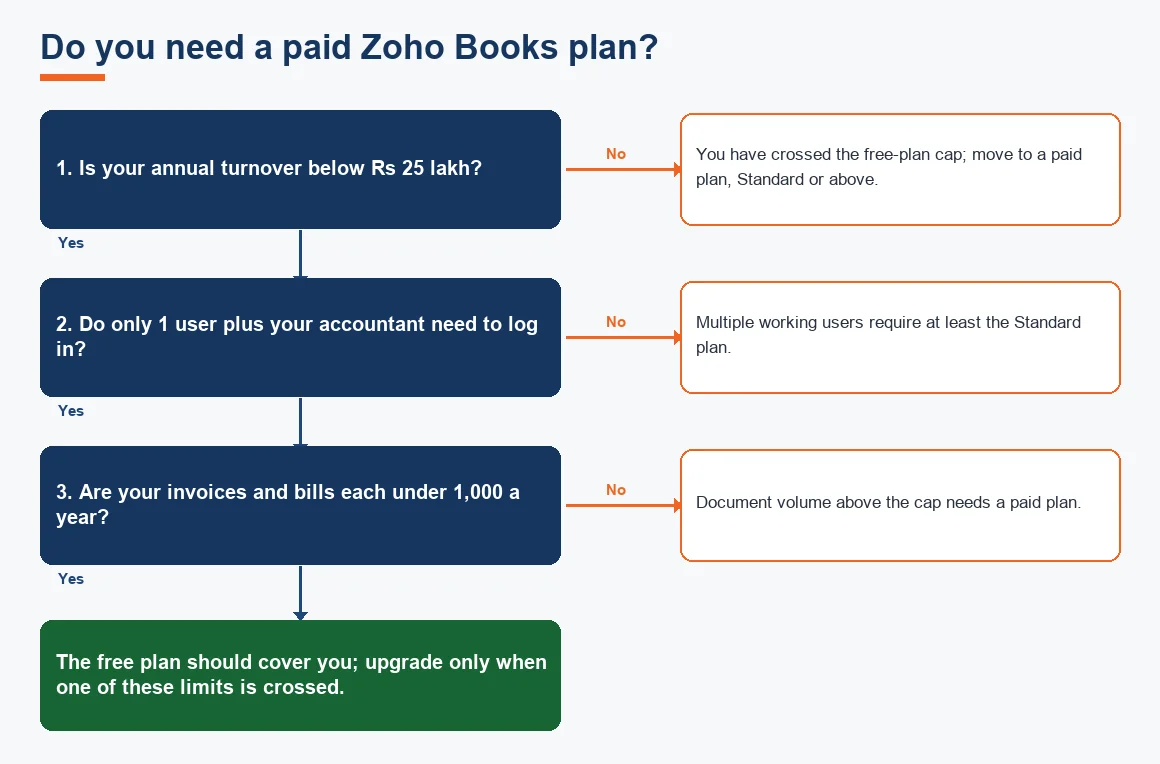
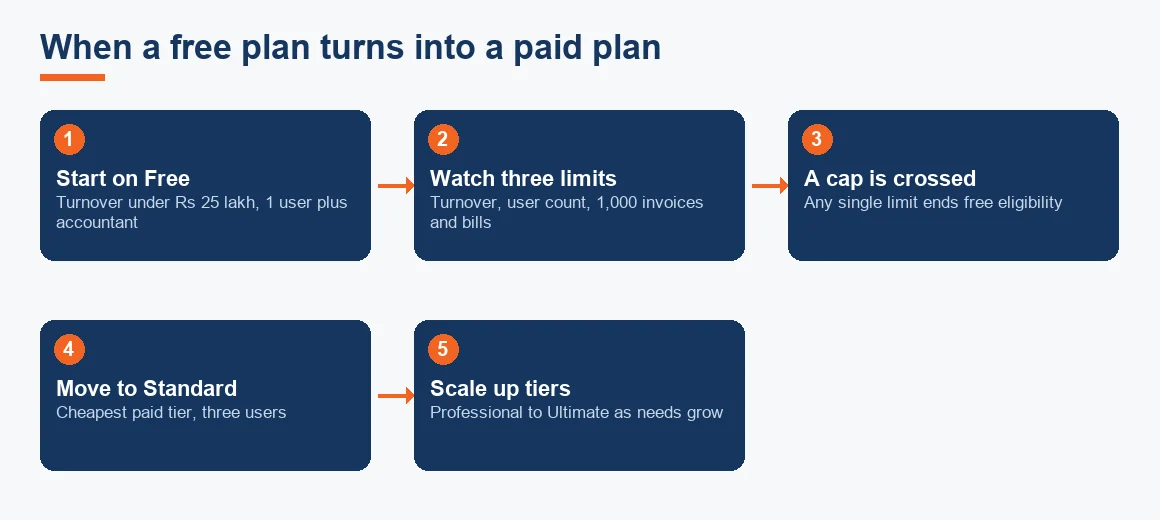
Both. The free plan is a permanent tier in India, not a trial, so there is no clock counting down and no card on file. It stays free for as long as you remain within its limits. The eligibility test is an annual turnover below Rs 25 lakh. Inside that, you get 1 user plus 1 accountant, up to 1,000 invoices and 1,000 bills a year, GST invoicing, e-way bill generation and bank reconciliation. That is enough to run a genuinely small business end to end.
The free plan stops being free the moment any one of three things happens: turnover crosses Rs 25 lakh, you need a second working user, or you exceed the 1,000-document ceilings. None of these is a price change; they are eligibility caps. So the honest answer to "how long is Zoho Books free for" is: indefinitely, until your business outgrows one of those numbers.
What does each paid plan add over the one below it?
The paid ladder is cumulative: each tier keeps everything below it and adds a defined block of features. Knowing exactly what triggers the jump to the next tier stops you overpaying.
Standard
This is the entry paid plan. It lifts the user count to three and the document caps well above the free tier, and it opens up recurring invoices, payment reminders and reporting that the free plan keeps basic. Most single-location service businesses that have crossed Rs 25 lakh land here first.
Professional
The common upgrade for trading and product businesses. Professional adds purchase orders, sales orders, multi-currency, project profitability, retainer invoices and custom roles. If you buy and sell stock, or bill clients in dollars, this is usually the tier that pays for itself.
Premium and above
Premium adds a vendor portal, budgeting and a custom domain for your customer portal. Elite and Ultimate move into advanced inventory, multiple warehouses and deeper analytics, and are aimed at larger teams rather than typical SMEs. If you are weighing these, the deciding factor is usually inventory depth and headcount, not price.
How do I choose the right Zoho Books plan?
Work from your constraints, not the feature list. Ask the questions in order and stop at the first plan that clears all three caps: turnover, users and document volume. Only then look at whether you need a specific feature such as purchase orders or a vendor portal, which pulls you up a tier regardless of size.
- Check turnover against Rs 25 lakh to decide free versus paid.
- Count the people who genuinely need to log in, including your in-house bookkeeper but not your external CA, who fits in the accountant seat.
- Estimate annual invoices and bills, then match against the plan caps.
- Layer on feature needs (orders, multi-currency, inventory) last, and only if a real workflow requires them.
For the setup that follows once you have picked a plan, our walkthroughs on setting up GST in Zoho Books and filing GST returns from Zoho Books cover the configuration that makes the software worth its price.
Is Zoho Books worth the cost?
For a GST-registered business raising more than roughly 50 invoices a month, the answer is usually yes, because direct GSTR-1 and GSTR-3B filing, e-invoicing with IRN generation, and automated bank feeds tend to save more accountant hours than the subscription costs. The right comparison is not plan price against zero; it is plan price against the hours currently spent preparing returns and reconciling statements by hand. A subscription is a period expense recognised on an accrual basis, not a capitalised asset you run through a depreciation calculator, so the whole annual fee lands in your profit and loss in the year you use it.
Where Zoho Books earns its keep is the reconciliation loop: Zoho banking feeds pull transactions in, rules categorise them, and month-end bank reconciliation closes in a fraction of the manual time. If most of your work is batch-wise manufacturing inventory, some businesses still find Tally cheaper to operate day to day; our comparison of Zoho Books versus Tally and the practical guide to automating bank reconciliation in Zoho Books go into that trade-off.
Is Zoho Books cheaper than QuickBooks or Tally?
QuickBooks is no longer a live comparison in India: Intuit withdrew QuickBooks from the Indian market and access ended in April 2023, so any "Zoho versus QuickBooks price" question is now academic here. Against Tally, the pricing models differ in kind rather than degree. Tally is a one-time perpetual licence with an annual renewal for updates; Zoho Books is a recurring cloud subscription. Over three to four years the total cost can land close together, so the real decision is cloud access and direct GST filing against a fixed on-premise licence, not the monthly figure alone.
Worked example: what a Professional plan really costs after GST and ITC
Sticker price is not net cost for a GST-registered business. Zoho charges 18 per cent GST on the subscription, and you can reclaim that as input tax credit if your GSTIN sits in the billing profile before the invoice is raised. Here is the Professional plan, billed annually, worked through end to end. Figures are indicative and Exl GST at the base line.
| Line item | Amount (Rs) |
|---|---|
| Professional, annual base (Rs 1,499 × 12) | 17,988 |
| Add: GST at 18% | 3,238 |
| Invoice total payable | 21,226 |
| Less: input tax credit (GSTIN on invoice) | (3,238) |
| Net cost to the business, per year | 17,988 |
| Effective net cost per month | 1,499 |
The credit only appears in your books once the invoice reflects in your GSTR-2B and the GSTIN was captured correctly, which is why GSTIN mapping in the billing profile matters before you pay. A business that is not GST-registered, or leaves the GSTIN blank, absorbs the full Rs 21,226 with no credit to claw back.
Key terms
- Zoho GSTIN Mapping: linking your GSTIN to the billing profile so the subscription invoice qualifies for input tax credit.
- GSTR-2B Input Tax Credit Matching: the auto-drafted statement your claimed credit must reconcile against.
- Automated Bank Feeds: bank transactions pulled straight into the software, cutting manual entry.
- Accrual Accounting: recognising the subscription as an expense over the period it covers, not when paid.
Key takeaways
- The free plan is permanent below Rs 25 lakh turnover, capped at 1 user plus accountant and 1,000 invoices and bills a year.
- Paid tiers run Standard to Ultimate; annual billing saves roughly two months versus monthly.
- Pick a plan by turnover, users and document volume first, features second.
- GST at 18 per cent is fully reclaimable as input tax credit when the GSTIN is on the invoice, so net cost equals the base price for a registered business.
- All prices are indicative and Exl GST; confirm current figures on Zoho's India pricing page.
Decision guide