F&O
Futures and options- Type of income
- Business income (non-speculative)
- Tax rate
- Your slab rate
- Loss in the same year
- Can reduce other income, except salary (see below)
- Loss carried forward
- 8 years, only against business income

Income Tax & ITR
File your futures and options return with a CA: F&O and intraday income reported in the right form, your turnover worked out for the tax audit test, and your losses kept alive for future years.
In short
Profit or loss from futures and options traded on a recognised stock exchange is business income, not capital gains. It is taxed at your normal slab rates, under the old or the new regime, together with your other income.
Intraday trading in shares, where the trade is squared off without delivery, is treated differently: it is a speculative business, with its own rules for losses.
FY 2025-26 returns (filed in 2026) are under the Income-tax Act, 1961. The Income-tax Act, 2025 applies from tax year 2026-27 (returns filed in 2027).
See a sample
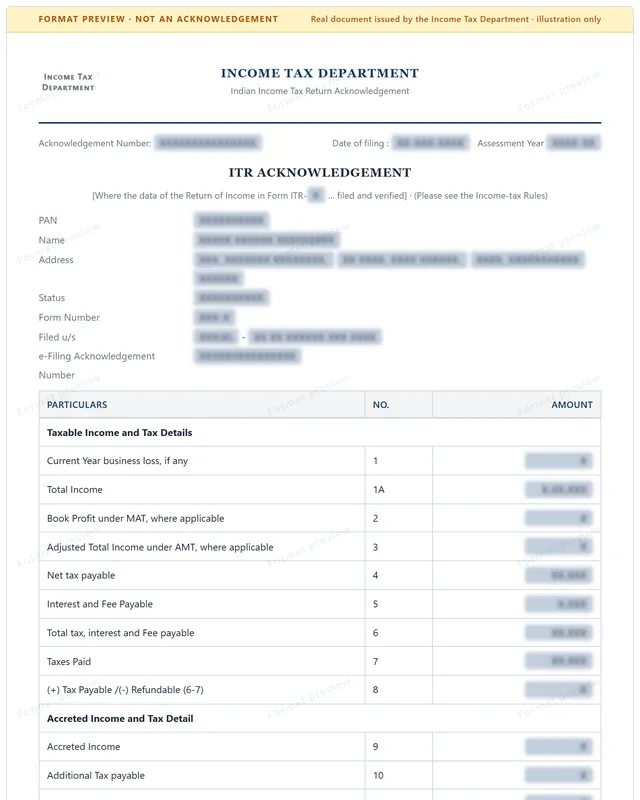
ITR acknowledgement
The acknowledgement that an income-tax return was filed.
Values hidden for privacy. Names, numbers and dates are covered. Your own document carries your details.
Download ITR acknowledgement sample (PDF) View ITR acknowledgement sample
Three kinds of trade
The same demat account can hold three kinds of trade, and each goes into the return under a different rule.
Delivery-based shares and mutual funds are a separate subject. If you also sold shares or funds held for investment, see ITR for Capital Gains.
Commodity derivatives traded on an exchange are also non-speculative under the Income-tax Act, 2025.
For FY 2025-26 the 1961 Act says the same. An eligible commodity derivatives trade on a recognised stock exchange that is charged commodities transaction tax is not speculative (clause (e) of the proviso to section 43(5)). For agricultural commodity derivatives the CTT condition does not apply.
The form
Your return form
ITR-3 The form for individuals and HUFs with business incomeIf you report F&O or intraday income from your own accounts, the form is ITR-3. This holds for FY 2025-26 and for tax year 2026-27 (rule 164 of the Income-tax Rules, 2026).
Read more about the form in Income Tax Return 3 (ITR-3).
The simpler forms do not apply. The forms for salaried people do not cover business income, so a trader who files one of them has used the wrong form.
Asked about the presumptive scheme? Some traders ask about the scheme for small businesses (declaring a fixed share of turnover as profit and using ITR-4). We do not choose this route for a trader without checking its conditions first, because it limits what you can declare in later years (see the tax audit section).
The law does not bar F&O trading from the scheme in FY 2025-26 (section 44AD of the 1961 Act) or tax year 2026-27 (the corresponding provision of the 2025 Act). However, the trader must meet its conditions: a resident individual, HUF or firm (not an LLP), turnover worked out under the ICAI Guidance Note within the scheme's limit, and none of its exclusions, such as commission or brokerage income or an agency business.
How we work
Seven steps, in the order they happen.
The tax profit and loss report and ledger from every broker, your AIS and Form 26AS, last year's return (for losses brought forward), and bills for trading expenses.
F&O results and intraday share results are kept as two separate businesses in the return, because their losses follow different rules. Delivery-based share and fund sales go to capital gains.
For the tax audit test, F&O turnover is not the value of your contracts. For squared-off trades it is the total of the favourable and unfavourable differences, each counted as a positive figure (ICAI Guidance Note on Tax Audit).
Premium received on options sold is added where it is not already part of the profit or loss worked out on the trade, so the same amount is never counted twice.
We compare your turnover with the audit limits and check whether you used the presumptive scheme in an earlier year (see the next section).
Brokerage, STT and other expenses of the trading business are claimed against F&O and intraday income. STT paid on business trades is deductible under both Acts (section 36(1)(xv) of the 1961 Act; the corresponding provision of the 2025 Act).
Each loss is set off only where the law allows, and the balance is recorded for carry forward.
We compare your AIS with the broker reports, clear differences before filing, compare the old and the new regime, file ITR-3 by the due date and help you e-verify it. For FY 2025-26 returns, e-verification is due within 30 days of filing.
The audit test
A trader needs a tax audit when turnover for the year is above the limit. The limit depends on how much of your money moved in cash.
Same limits for FY 2025-26 (1961 Act) and tax year 2026-27 (2025 Act).
For FY 2025-26, a person who declared profit under the presumptive scheme and then, within the next five years, declares profit on another basis cannot use the scheme for the following five years. If the five-year rule applies and total income is above the basic exemption limit, books of account and a tax audit are needed.
For tax year 2026-27, the Income-tax Act, 2025 ties books and audit to the scheme itself. They are needed only if you are within the presumptive scheme (its conditions and turnover limit met), declare profit below the deemed 6% or 8%, and your total income is above the basic exemption limit (sections 58, 62 and 63). The five-year bar applies only if you declared profit under the scheme in an earlier year. A loss on its own brings neither an audit nor the five-year bar.
If your turnover crosses the limit, we arrange the audit through our Tax Audit service.
For tax year 2026-27 (the corresponding provision of the 2025 Act, inserted by the Finance Act, 2026).
For FY 2025-26, section 271B of the 1961 Act applies: a penalty of 0.5% of total sales, turnover or gross receipts, or ₹1,50,000, whichever is less.
Losses
A trading loss is only useful if it is reported in the right place, in a return filed on time.
Under the Income-tax Act, 2025 (tax year 2026-27), a non-speculative business loss such as an F&O loss can be set off against income under any other head except salary, for example interest, rent or capital gains.
For FY 2025-26 the rule is the same: under section 71(2A) of the 1961 Act, a business loss cannot be set off against salary. But it can be set off against other heads in the same year.
Any F&O loss left over can be carried forward for 8 years, and set off only against business income in those years.
An intraday loss can be set off only against speculative income, in the same year or in the next 4 years.
Under the Income-tax Act, 2025, a business loss or speculation loss can be carried forward only if it was worked out in a return filed by the due date (section 121). A loss from house property is not covered by this rule.
For FY 2025-26 the condition is the same. Under section 80 of the 1961 Act, a business, speculation or capital loss is carried forward only if it was worked out in a return filed within the time allowed under section 139(1).
Example, FY 2025-26
| F&O profit | ₹1,00,000 |
|---|---|
| Intraday profit | ₹80,000 |
| Intraday loss | ₹1,20,000 |
| Net intraday loss | ₹40,000 |
The ₹1,00,000 F&O profit is taxed as business income. The ₹40,000 intraday loss cannot reduce the F&O profit; it is carried forward for up to 4 years against speculative income.
Read more: Carry Forward of Losses · Set-off of Losses
Rates
The Finance Act, 2026 raised Securities Transaction Tax on derivatives.
| Transaction | Earlier rate | New rate |
|---|---|---|
| Sale of an option (on the premium) | 0.1% | 0.15% |
| Option exercised | 0.125% | 0.15% |
| Sale of a future (on the traded price) | 0.02% | 0.05% |
The new rates apply to trades from 1 April 2026 (Memorandum to the Finance Bill, 2026).
STT is a business expense for a trader. Where your F&O trading is business income, the STT you pay is a deductible business expense.
Read more: Securities Transaction Tax (STT)
Checklist
Most of this comes from your broker's tax-reports page and the e-filing portal.
For tax year 2026-27, an individual or HUF trader must keep books if either limit was exceeded (the corresponding provision of the 2025 Act). For FY 2025-26, section 44AA(2) of the 1961 Act sets the same limits for an individual or HUF: business income above ₹2,50,000 or turnover above ₹25 lakh in any one of the three preceding years.
When
The return date depends on whether a tax audit applies. Both years are shown.
| Return | FY 2025-26 (1961 Act) | Tax year 2026-27 (2025 Act) |
|---|---|---|
| No tax audit | 31 August 2026 | 31 August 2027 |
| Tax audit report | 30 September 2026 | 30 September 2027 |
| Return with tax audit | 31 October 2026 | 31 October 2027 |
Section 234F of the 1961 Act for FY 2025-26; the corresponding provision of the 2025 Act from tax year 2026-27. A late return also loses the right to carry forward a business or speculation loss (see above).
For FY 2025-26, a belated return under section 139(4) of the 1961 Act can be filed up to 31 December 2026, or before the assessment is completed, whichever is earlier. · Read more: Belated Return
If your tax for the year, after TDS, is ₹10,000 or more, you pay it in advance in these instalments. Interest applies for short or late payment.
What it costs
The fee depends on how many brokers you used, whether you also have salary, capital gains or crypto, and whether a tax audit is needed.
Professional fee
Send us your broker tax reports and we will tell you what the filing will cost.
Questions
What traders ask most before they send us a return.
A speculative transaction is one that is settled without actual delivery, such as intraday share trading where you buy and sell on the same day. Income from it is speculative business income. Futures and options on a recognised exchange are left out of this definition, so F&O is a normal (non-speculative) business. The difference matters because speculative losses can only be used against speculative income.
If you want to use the loss in later years, yes. An F&O loss can be carried forward for 8 years against business income, but under the Income-tax Act, 2025 only if it was worked out in a return filed by the due date. A return that leaves the loss out, or is filed late, gives up that benefit. For FY 2025-26, section 80 of the 1961 Act sets the same condition: the loss must be worked out in a return filed by the due date.
Yes, where your F&O trading is taxed as business income. STT paid on those trades is allowed as a business deduction (section 36(1)(xv) of the 1961 Act; the corresponding provision of the 2025 Act). It is not deductible where a sale is taxed as capital gains.
For FY 2025-26, 31 August 2026 if no tax audit is needed, and 31 October 2026 if it is (with the audit report by 30 September 2026). For tax year 2026-27 the same dates apply in 2027.
Expenses directly related to trading are deductible. These are brokerage and commission, STT, exchange and SEBI turnover charges, internet and telephone bills, trading software and advisory subscriptions, depreciation on a computer or laptop used for trading, rent of a trading room or office, and CA fees. Personal expenses, food, entertainment and travel not related to trading are not deductible, and claiming them invites disallowance. Keep the invoices for each claim.
Often not. Salary TDS covers only your salary, so the tax on your F&O profit is extra. If your total tax after TDS is more than ₹10,000, pay advance tax by 15 June (15%), 15 September (45%), 15 December (75%) and 15 March (100%). Missing it brings interest of 1% a month under section 234B on a shortfall and section 234C on late instalments.
Yes, if you want to keep the loss. Even when your total income is below the basic exemption limit, file ITR-3 by the due date so the F&O loss can be carried forward for up to 8 years.
Get a quote
Send us your broker tax reports and tell us what else you had this year: salary, share sales, crypto or a loss brought forward. We will tell you which form you need, whether an audit applies and what the filing will cost.
Leave your details and we will call you back.
By sending this form you agree to our privacy policy.
Sources