
Incorporation
Public Limited Company Registration in India
A public limited company can invite the public to buy its shares, has no upper limit on members and lets shares change hands freely. We prepare the documents for every subscriber and director, file the incorporation application on the MCA portal and stay with you through the certificate of incorporation and the first steps after it.

- Members No cap on the number of members
- Shares May be offered to the public and transferred freely
- Resident director At least one director who stayed in India for 182 days or more in the year
- Name Ends with "Limited"
The short answer
Public limited company registration at a glance
A public limited company is a company registered under the Companies Act, 2013 that is not a private company. It may offer its shares and debentures to the public, it has no cap on the number of members, and its shares can be transferred freely. Its name ends with "Limited".
| Point | What applies |
|---|---|
| Governing law | Companies Act, 2013 (Section 2(71)) |
| Members | Minimum set by the Act, no maximum (7, under Section 3(1)) |
| Directors | Minimum set by the Act; at least one director must have stayed in India for 182 days or more in the year (minimum 3, under Section 149(1)) |
| Minimum capital | No minimum amount is fixed in the Act; the ₹5 lakh minimum was removed from Section 2(71) on 29 May 2015 |
| Share transfer | Free; no restriction in the articles (Section 2(71)) |
| How you apply | Online, through SPICe+, the MCA's integrated incorporation web form (Part A for the name, Part B for incorporation, with linked forms) |
| What you receive | A certificate of incorporation with the company's CIN |
| Before starting business | A declaration that subscribers have paid for their shares, filed within 180 days of incorporation (Section 10A) |
| Government fee | No MCA filing fee up to ₹15 lakh of authorised capital; stamp duty varies by state |
| Our fee | Starting from ₹19,999 (Exl GST and Govt. Charges) |
Defined by what it is not
What is a public limited company?
The Companies Act defines a public company by what it is not: a company that is not a private company. (Section 2(71)) A private company's articles must restrict share transfers, cap members at 200 and bar any invitation to the public to buy its securities. A public company has none of those limits.
Like any company, a public limited company is a legal person separate from its shareholders. It owns property, signs contracts and can sue or be sued in its own name, and its shareholders' liability is limited to any amount unpaid on their shares.
Two kinds of public company are worth telling apart:
Registering a public company does not list it. Listing is a separate process that comes later, through a public offer under the securities law.
Key terms you will see
- Subscriber
- A person who signs the memorandum and agrees to take shares when the company is formed.
- Prospectus
- The document a public company issues when it invites the public to buy its shares or debentures. (Section 2(70))
- Commencement of business declaration
- The declaration, filed after incorporation, that every subscriber has paid for the shares they took. It is filed within 180 days of incorporation (section 10A).
- Table F
- The model articles of association for a company limited by shares, in Schedule I to the Companies Act. Public companies often base their articles on it.
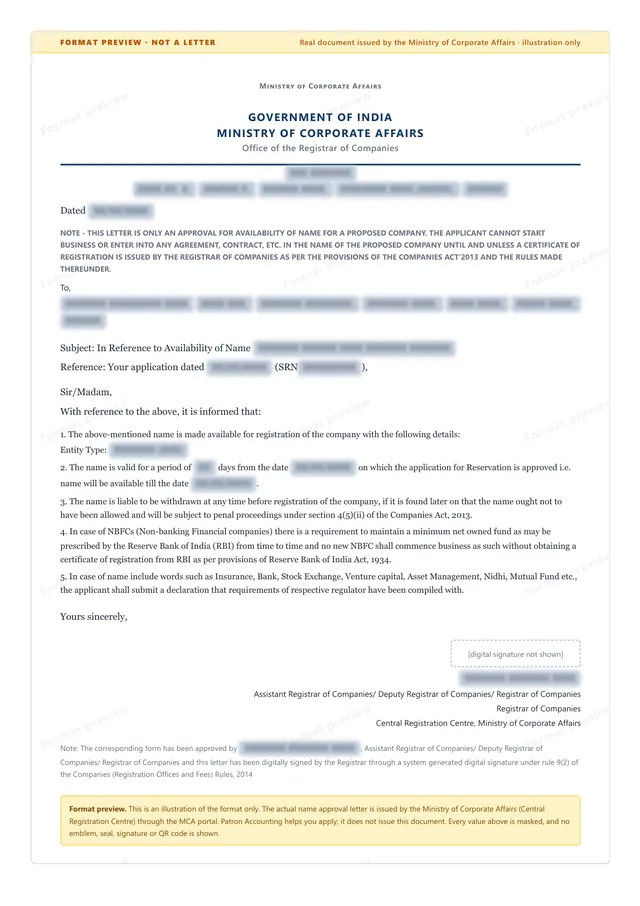
See a sample
Name approval letter
The letter that confirms the proposed name is approved and reserved.
- Issued by
- Ministry of Corporate Affairs (Central Registration Centre)
- When you get it
- Once the name application is approved.
Values hidden for privacy. Names, numbers and dates are covered. Your own document carries your details.
Download name approval letter sample (PDF) View name approval letter sample
Is it right for you?
Who should register a public limited company?
A public limited company suits you if:
- You plan to raise money from the public, through shares or debentures, now or in the future.
- You expect more than 200 shareholders, which a private company cannot have.
- You want shares to be freely transferable, for example where many investors, employees or members of a community will hold them.
- You plan to list on a stock exchange. A company must be a public company to list.
- Investors, institutions or contracts require it. Some funding arrangements, public-private projects and tenders expect a public company.
Requirements in short
| Requirement | Detail |
|---|---|
| Members (subscribers) | Minimum 7; no maximum |
| Directors | Minimum 3; maximum 15, or more with a special resolution (Section 149(1)) |
| Resident director | At least one director who stayed in India for 182 days or more in the year |
| Other director rules | Some larger public companies need independent and woman directors. Two independent directors are needed if paid-up capital is ₹10 crore or more, turnover is ₹100 crore or more, or loans, debentures and deposits exceed ₹50 crore. A woman director is needed if the company is listed, or has paid-up capital of ₹100 crore or more or turnover of ₹300 crore or more. (Rules 3 and 4, Companies (Appointment and Qualification of Directors) Rules, 2014) |
| Capital | No minimum amount is fixed in the Act; the ₹5 lakh minimum was removed from Section 2(71) on 29 May 2015 |
| Director identity | A DIN and a digital signature certificate for each director (up to 3 new DINs can be applied for in SPICe+) |
| Registered office | An address in India (Section 12; the MCA asks for a utility bill not older than 2 months) |
| Name | Unique, not misleading, ending with "Limited" (Section 4(1)(a)) |
What we do
Our public limited company registration services
- Digital signatures and DINs We arrange digital signature certificates for every director and apply for DINs in the incorporation form (up to 3 new DINs can be applied for in SPICe+)
- Name check and reservation We check proposed names against the company register and the trade mark register and apply for the name (₹1,000; up to two names; reserved for 20 days from approval)
- Memorandum and articles Drafted for a public company: objects, share capital, free transfer of shares, board and meeting rules, often built on Table F
- Subscriber documents We collect and check the documents and signatures of every subscriber and director, wherever they are
- Incorporation filing The SPICe+ application and linked forms, filed and followed up until the certificate of incorporation is issued
- Linked registrations PAN, TAN, EPFO and ESIC; GSTIN and a bank account through the linked AGILE-PRO-S form
- First steps after incorporation Commencement declaration, first auditor, first board meeting and a compliance calendar (within 30 days: registered office verification, first board meeting, first auditor; within 180 days: commencement declaration)
Digital signature certificates and GST registration are also available as separate services.
Seven steps
How to register a public limited company: step by step
Digital signature certificates
Every proposed director, and every subscriber who signs online, needs a digital signature certificate.Director identification numbers
Every director needs a DIN. New directors can be given one through the incorporation form, up to a set number; others apply separately.
Up to 3 new directors can be given a DIN through the SPICe+ form itself.Choose and reserve the name
The name must end with "Limited". We check your options against the company register and the trade mark register and apply through Part A of SPICe+ or the separate name service.
A name is reserved through Part A of SPICe+ for ₹1,000, with up to two proposed names, and stays reserved for 20 days from approval.Draft the memorandum and articles
The memorandum sets out the name, registered office state, objects and capital, and is signed by every subscriber with the number of shares each takes. The articles set the company's internal rules.
SPICe+ (Form INC-32) has Part A for the name and Part B for incorporation; its linked forms are the e-MoA (INC-33), the e-AoA (INC-34), AGILE-PRO-S and the INC-9 declaration.File SPICe+ Part B
Part B carries the company details, directors, subscribers, registered office and linked applications, with the directors' consents and declarations, certified by a practising professional. The government fee and state stamp duty are paid with it.
The declaration by the subscribers and first directors is in Form INC-9. A practising advocate, chartered accountant, cost accountant or company secretary engaged in the formation also declares that the requirements are met (Section 7(1)(b)). No MCA filing fee applies where the authorised capital is up to ₹15 lakh; state stamp duty is still payable. Stamp duty varies by state; only the central stamp duty on the issue and transfer of shares and debentures under the Indian Stamp Act, 1899 is uniform.Certificate of incorporation
When the Registrar approves, the company receives its certificate of incorporation with its CIN, along with PAN and TAN.
The Registrar issues the certificate and allots the CIN under Section 7; from the date in it the company is a body corporate (Section 9). PAN and TAN are applied for in the SPICe+ form itself.Commencement of business
Before it starts business or borrows, the company files a declaration that every subscriber has paid for their shares. We also help appoint the first auditor and hold the first board meeting.
The commencement declaration is due within 180 days of incorporation (Section 10A). The Board appoints the first auditor within 30 days of registration (Section 139(6)). The first board meeting is held within 30 days of incorporation (Section 173(1)).
What to collect
Documents required for public limited company registration
| Document | From whom | Notes |
|---|---|---|
| PAN card | Every director and subscriber who is an Indian national | Foreign nationals give a passport |
| Identity proof (Aadhaar, voter ID, passport or driving licence) | Every director and subscriber | None |
| Address proof (recent bank statement or utility bill) | Every director and subscriber | We tell you how recent it must be (the MCA's SPICe+ FAQs ask for a bank statement or an electricity or telephone bill not older than 2 months) |
| Passport-size photograph | Every director and subscriber | None |
| Passport | Foreign directors and subscribers | Documents signed abroad may need notarisation or apostille (MCA: notarised in Commonwealth countries; notarised and apostilled in Hague Convention countries; notarised and authenticated by the Indian embassy elsewhere) |
| Registered office proof | The company | Utility bill, plus the rent agreement and owner's no-objection letter if rented, or ownership papers if owned |
| Memorandum and articles | Drafted by us | Signed digitally by every subscriber |
| Consent and declarations | Every director and subscriber | Drafted by us (Form INC-9) |
| Board resolution | Any subscriber that is a company | Authorising its representative |
Once the company is incorporated, banks ask for the certificate of incorporation, PAN, the memorandum and articles, a board resolution and the directors' identity documents to open its account.
Where applications slip
Common challenges and how we handle them
- Many subscribers in different places
- Delays while documents and signatures are collected
- We send one checklist per person, track every document and chase what is missing
- Articles for a public company
- Clauses that do not fit free share transfer or public company rules
- We draft from the model articles and your plans for shares, meetings and directors
- Name refused as too similar
- A fresh name application
- We check names against the company and trade mark registers first and keep back-ups
- Missing the commencement declaration
- The company cannot start business or borrow
- We prepare the declaration as soon as the share money is in the bank account
- Board and meeting rules
- More meetings and filings than a private company
- We give you a compliance calendar from day one (at least four board meetings a year, not more than 120 days apart, Section 173(1); an annual general meeting each year, Section 96)
See all our company incorporation services.
What it costs
Public limited company registration fees
What the total cost is made of:
| Cost | Paid to | Amount |
|---|---|---|
| MCA filing fee for SPICe+ | Ministry of Corporate Affairs | No MCA filing fee up to ₹15 lakh of authorised capital; stamp duty varies by state |
| Stamp duty on the memorandum and articles | The state government | Varies by state (except uniform central stamp duty on issue and transfer of shares/debentures under the Indian Stamp Act, 1899) |
| Name reservation | Ministry of Corporate Affairs | ₹1,000 per application |
| Commencement declaration | Ministry of Corporate Affairs | Set by nominal share capital under the Companies (Registration Offices and Fees) Rules, 2014: ₹200 where it is below ₹1 lakh |
| Digital signature certificates | A licensed certifying authority | Confirmed in your written quote |
| Professional fee | Patron Accounting | Starting from ₹19,999 (Exl GST and Govt. Charges) |
Timing
How long does registration take?
The time depends on collecting every subscriber's documents and signatures, the digital signatures, the name approval and the Registrar's processing.
With more people involved than in a private company, the biggest saving comes from having every subscriber's documents ready on day one. We give you a dated plan when we start.
Six reasons
Benefits of a public limited company
- Access to public money. It can raise funds from the public through shares and debentures, subject to the securities law.
- No cap on members. Shareholding can grow beyond 200.
- Free transfer of shares. Shareholders can sell without the restrictions a private company's articles impose.
- A route to listing. Only a public company can list its shares on a stock exchange.
- Limited liability and a separate legal identity, as with any company.
- Credibility with institutions, from the stricter governance and disclosure rules a public company follows.
The trade-off is more compliance: more directors, stricter board and meeting rules, and in some cases independent directors and a company secretary. Two independent directors are required where paid-up capital is ₹10 crore or more, turnover is ₹100 crore or more, or loans, debentures and deposits exceed ₹50 crore: Rule 4 of the Companies (Appointment and Qualification of Directors) Rules, 2014.
Ltd and Pvt Ltd
Public limited vs private limited company
| Point | Public limited (Ltd) | Private limited (Pvt Ltd) |
|---|---|---|
| Members | Minimum 7; no maximum | Minimum 2, maximum 200 |
| Directors | Minimum 3 | Minimum 2 |
| Resident director | At least one | At least one |
| Share transfer | Free | Restricted by the articles |
| Raising money from the public | Allowed, under the securities law | Not allowed |
| Stock exchange listing | Possible | Not possible without converting |
| Name ends with | "Limited" | "Private Limited" |
| Compliance load | Higher | Lower |
A private company can convert into a public company when it needs to; our separate conversion service handles that change.
Where the rules come from
How we check this page
This page explains the law as it stood on the date below.
- Written and reviewed byWritten by CS Aashima Goyal · reviewed by Subham Jhunjhunwala
Sources
- Companies Act, 2013, sections 2(68) and 149(3), as published on India Code (the private company limits and the resident director)
Seven questions
Frequently asked questions
What is a public limited company in India?
It is a company that is not a private company (section 2(71)): it can invite the public to buy its shares and debentures, has no upper limit on members, and its shares are freely transferable. Its name ends with "Limited". It may be listed on a stock exchange or stay unlisted.
How does a public limited company differ from a private one?
A private limited company restricts share transfers, has at most 200 members and cannot raise money from the public. A public limited company has none of those limits but carries more compliance and needs more members and directors. A name like "XYZ India Ltd" is a public company whose name includes the word "India"; "XYZ India Pvt Ltd" would be private. A public company needs at least 7 members (Section 3) and 3 directors (Section 149).
What is the difference between PLC and Ltd?
"PLC" (public limited company) is the ending used in the United Kingdom. In India a public limited company's name ends with "Limited" or "Ltd", and a private company's with "Private Limited" or "Pvt Ltd".
Who owns a public limited company?
Its shareholders own it, in proportion to their shares, and the board of directors manages it on their behalf. In a listed company the shareholders can be thousands of members of the public and institutions.
How do I register a public limited company?
Get digital signatures and DINs for the directors, reserve a name ending "Limited", draft the memorandum and articles signed by every subscriber, and file SPICe+ on the MCA portal with the documents, government fee and stamp duty. After the certificate of incorporation, file the commencement of business declaration before starting business.
How is a private company converted into a public company?
The shareholders pass a special resolution to change the articles and the name, the company brings its members and directors up to the public company minimums, and the change is filed with the Registrar for approval. Founders should plan for more compliance afterwards, more directors, stricter meeting rules and wider disclosure. The company passes a special resolution, files it in Form MGT-14 and then files Form INC-27. A public company needs at least 7 members (Section 3) and 3 directors (Section 149).
What are the benefits of registering a public limited company?
Access to money from the public, no cap on members, freely transferable shares, the possibility of listing, limited liability and a separate legal identity. The cost is a heavier compliance load than a private company.
Get a quote
Register your public limited company with us
Tell us the proposed names, the number of subscribers and directors, whether any are non-resident or foreign, your capital plan and the state of your registered office. We will confirm the documents you need, the government charges for your state and our fee, and agree a plan to the certificate of incorporation and the commencement declaration.
Patron professional fee: Starting from ₹19,999 (Exl GST and Govt. Charges)
Get a quote
Leave your details and we will call you back.
By sending this form you agree to our privacy policy.
Call us
What to tell us
- The proposed names
- The number of subscribers and directors
- Whether any are non-resident or foreign
- Your capital plan
- The state of your registered office