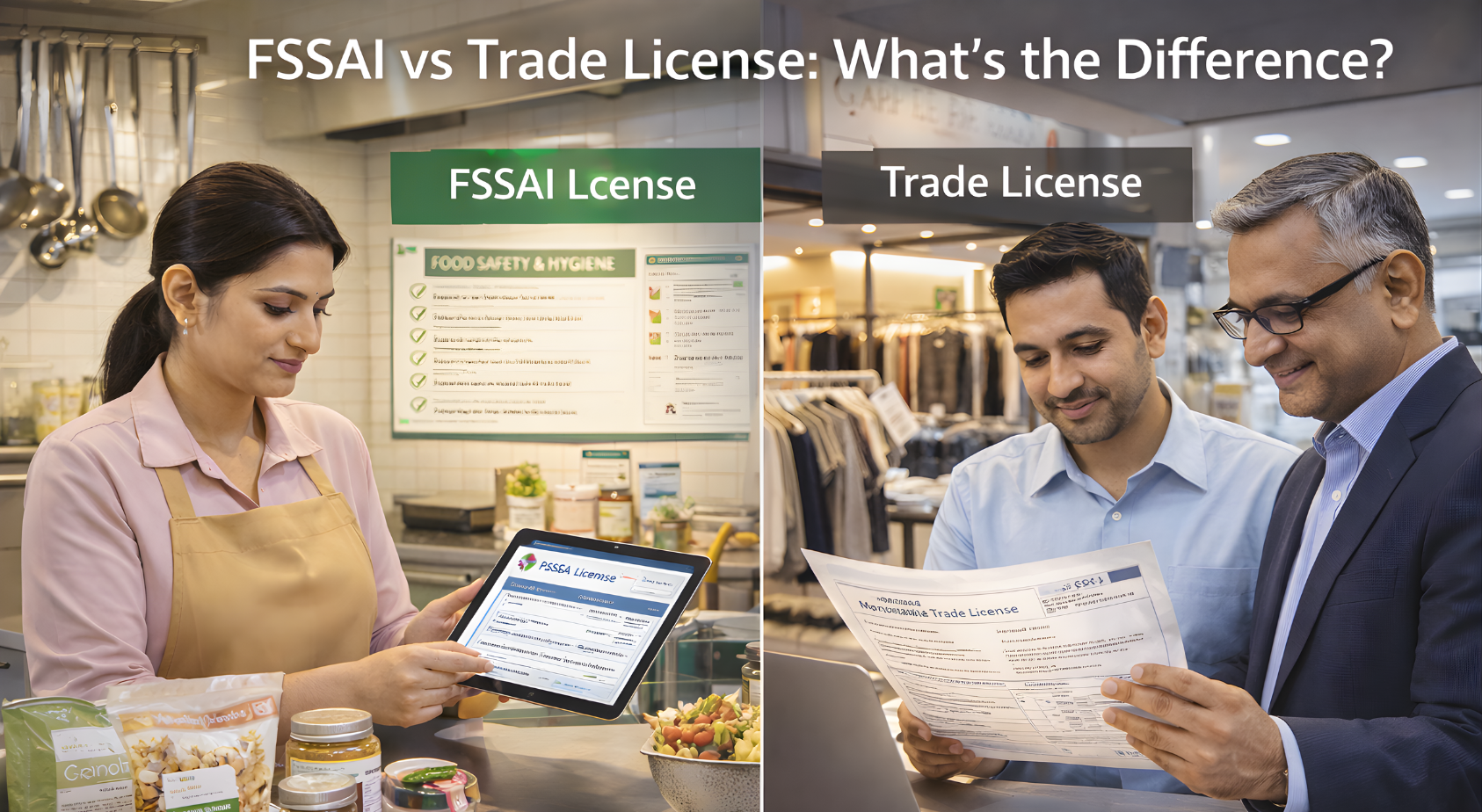
FSSAI vs Trade License: What’s the Difference?
If you're launching or running a business in India, particularly in the food sector, you've likely come across two important compliance requirements: the FSSAI License and the Trade License. Though they may sound similar, these are two distinct legal documents serving different regulatory purposes.
Understanding the difference between FSSAI and Trade License is essential for business owners, especially food entrepreneurs, retailers, and small manufacturers. In this comprehensive guide, we break down each license, highlight its core distinctions, and help you determine whether your business needs one or both in 2025.
What is an FSSAI License?
An FSSAI license is required for businesses operating in the food industry. It is issued by the Food Safety and Standards Authority of India under the FSS Act of 2006.
Purpose:
To regulate and monitor the safety, hygiene, and quality of food products sold or distributed in India.
Applies to:
- Cloud kitchens
- Restaurants and cafes
- Food manufacturers
- Grocery stores
- Online food aggregators
- Home-based sellers (if crossing turnover limits)
The license comes in three categories:
- Basic Registration (turnover up to ₹12 lakh)
- State License (₹12 lakh–₹20 crore)
- Central License (above ₹20 crore or interstate)
What is a Trade License?
A Trade License is a municipal permit issued by local authorities such as a Municipal Corporation, Municipality, or Panchayat. It allows a business to operate legally from a specific premise.
Purpose:
To ensure that the business complies with local laws relating to zoning, public health, safety, and structure usage.
Applies to:
- Shops and retail stores
- Manufacturing units
- Warehouses
- Offices
- Cafes, stalls, salons, gyms
This license is location-specific and is mandatory for any business using commercial premises.
Key Differences Between FSSAI and Trade License
| Aspect | FSSAI License | Trade License |
| Issued By | FSSAI (Govt. of India) | Local Municipal Body |
| Purpose | Food safety, hygiene compliance | Legality of commercial activity |
| Applies To | Only food-related businesses | All commercial business types |
| Territorial Validity | Pan India | Limited to the jurisdiction of the issue |
| Inspection Requirement | Yes (especially manufacturers) | Yes (local premises check) |
| Legal Basis | FSS Act, 2006 | Municipal Corporation Acts |
| Need for Online Business | Yes, if food is involved | Possibly, if operating physically |
Do You Need Both Licenses?
Yes, if you run a food-related business from any commercial or physical location.
Examples:
| Business Type | FSSAI Needed | Trade License Needed |
| Restaurant | Yes | Yes |
| Home chef (above ₹12L turnover) | Yes | Yes, if space is commercialized |
| Online snacks store | Yes | Yes, if the warehouse is used |
| Clothing shop | No | Yes |
| Grocery retail | Yes | Yes |
Note: FSSAI covers what you sell (food safety). The trade license covers where you operate (local approval).
How to Apply for an FSSAI License
- Go to https://foscos.fssai.gov.in
- Register business profile
- Choose license type (Basic, State, Central)
- Fill Form A (Basic) or Form B (State/Central)
- Upload required documents
- Pay government fee
- Wait for approval and inspection (if applicable)
Timeline: 7–30 days
Cost: ₹100 to ₹7,500/year
How to Apply for a Trade License
- Visit your city’s municipal portal or office (e.g., NDMC, BBMP)
- Fill the trade license application with business details
- Submit documents like NOC, premises proof, PAN, etc.
- Schedule premises inspection
- Pay the applicable license fee
- Get digital/physical license after approval
Required Documents for Each
FSSAI License Documents
- PAN card (owner/business)
- Aadhaar card
- Business address proof
- Rent/lease deed
- Food category & product list
- FSMS declaration
- Passport photo
- Utility bill
- Water testing report (for manufacturers)
Trade License Documents
- PAN & Aadhaar of applicant
- Address proof of premises
- Rental agreement or ownership papers
- NOC from landlord
- Municipal tax receipt
- Layout plan
- Business registration certificate
Validity and Renewal
| License Type | Validity | Renewal |
| FSSAI | 1–5 years | Renew 30 days before expiry via FoSCoS |
| Trade License | 1 year (standard) | Renew annually via the local municipality |
Late renewals may attract fines or license suspension.
Penalties for Non-Compliance
| Offense | FSSAI Penalty | Trade License Penalty |
| No License | Up to ₹5 lakh or imprisonment | Business closure + penalty |
| Selling unsafe food | Up to ₹10 lakh | Not applicable |
| False information | License cancellation | Cancellation or fine |
| Using residential space | N/A | Eviction, sealing of premises |
Conclusion
Both FSSAI and Trade Licenses are crucial for running a legally compliant business in India. While they serve different purposes, they complement each other in protecting consumer interests and regulatory enforcement.
To summarize:
- FSSAI ensures you’re serving safe food
- Trade license ensures you’re allowed to operate your business
Ignoring either can result in legal trouble, fines, or forced closure. For long-term growth and credibility, compliance is non-negotiable.