
Choosing the Right Business Form in India: Non-Profit vs. For-Profit Structures
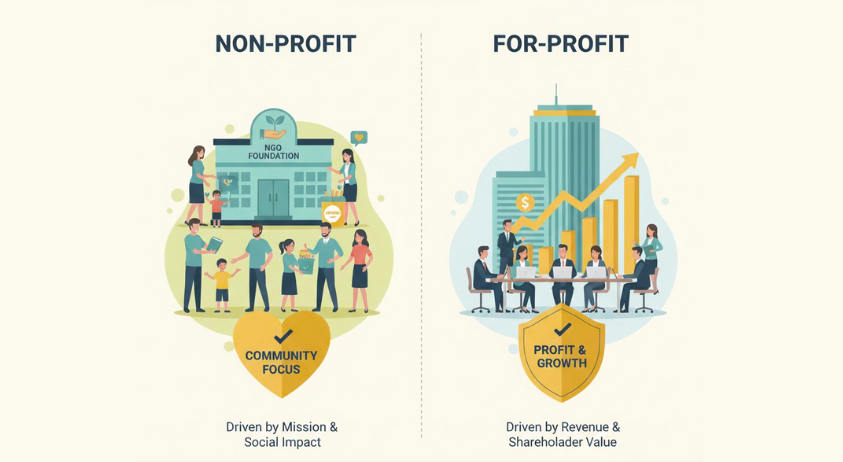
Starting an organization in India—whether to drive social impact or build a commercial enterprise—requires picking the right legal structure. The choice impacts everything from taxation to scalability. This blog compares three non-profit forms (Trust, Society, Section 8 Company) with four common for-profit forms (Sole Proprietorship, Partnership, Limited Liability Partnership (LLP), and Private Limited Company). Let’s break down their differences to help you decide.
Non-Profit Business Forms
Non-profits reinvest all profits into their mission and are ideal for charitable, social, or community-driven goals.
1. Trust
A Trust, governed by the Indian Trusts Act, 1882 (or state-specific laws like the Bombay Public Trusts Act), involves a settlor transferring assets to trustees for beneficiaries (e.g., public welfare).
- Formation: Simple; requires a Trust Deed and 2–3 trustees. Costs ₹2,000–₹5,000.
- Governance: Trustee-led, often authoritarian. No member voting.
- Compliance: Low; minimal filings (state-dependent). Audits if income >₹2.5L.
- Pros: Easy setup, flexible operations, low cost.
- Cons: Limited credibility for funding, hard to dissolve (irrevocable).
- Best for: Small, family-run charities or private causes.
2. Society
Societies, under the Societies Registration Act, 1860, are member-driven entities for literary, scientific, or charitable purposes.
- Formation: Needs 7 members (same state) or 8 (different states), Memorandum of Association, and Rules. Costs ₹1,000–₹3,000.
- Governance: Democratic; elected governing body with annual meetings.
- Compliance: Moderate; annual filings, audits if income >₹10L.
- Pros: Member collaboration, easier dissolution (2/3rd vote).
- Cons: State-specific rules, less scalable for national operations.
- Best for: Community projects, educational forums.
3. Section 8 Company
A Section 8 Company (Companies Act, 2013) operates like a corporate entity but for non-profit objectives, with no dividends.
- Formation: Requires 2 directors/shareholders, Memorandum & Articles of Association, and ROC license. Costs ₹10,000–₹20,000.
- Governance: Board of Directors; corporate-style with high transparency.
- Compliance: High; mandatory audits, ROC filings.
- Pros: Credible for funding (FCRA-friendly), scalable, perpetual succession.
- Cons: Costly setup, stringent compliance.
- Best for: Large NGOs, international collaborations.
For-Profit Business Forms
For-profit entities aim to generate profits for owners/shareholders and are suited for commercial ventures.
4. Sole Proprietorship
A single individual owns and operates the business with no separate legal entity.
- Formation: No formal registration (optional GST/PAN). Costs <₹1,000.
- Governance: Owner-controlled; no board or partners.
- Compliance: Minimal; income tax filing, GST if applicable.
- Pros: Easiest and cheapest to start, full control.
- Cons: Unlimited liability (personal assets at risk), hard to raise capital.
- Best for: Small businesses (shops, freelancers).
5. Partnership
A Partnership (Indian Partnership Act, 1932) involves 2–20 partners sharing profits/losses.
- Formation: Partnership Deed; registration optional. Costs ₹2,000–₹5,000.
- Governance: Partner-managed; decisions per deed terms.
- Compliance: Low; income tax filing, no mandatory audits unless turnover >₹25Cr.
- Pros: Easy to form, shared resources.
- Cons: Unlimited liability, partner disputes, no perpetual succession.
- Best for: Small-medium firms (e.g., retail, consultancies).
6. Limited Liability Partnership (LLP)
An LLP (Limited Liability Partnership Act, 2008) blends partnership flexibility with limited liability.
- Formation: Needs 2 partners, LLP Agreement, and ROC registration. Costs ₹7,000–₹10,000.
- Governance: Partner-managed; flexible per agreement.
- Compliance: Moderate; annual ROC filings, audits if turnover >₹40L.
- Pros: Limited liability, easier compliance than companies.
- Cons: Less credible for large investors vs. companies.
- Best for: Professionals (lawyers, CAs), medium businesses.
7. Private Limited Company
A Private Limited Company (Companies Act, 2013) is a corporate entity with shareholders and directors.
- Formation: Needs 2 directors/shareholders, Memorandum & Articles of Association, ROC registration. Costs ₹10,000–₹15,000.
- Governance: Board-managed; shareholder oversight.
- Compliance: High; mandatory audits, ROC filings, board meetings.
- Pros: Limited liability, investor-friendly, perpetual succession.
- Cons: Costly compliance, complex dissolution.
- Best for: Startups, scalable businesses.
Comparison Table
Here’s a side-by-side look at key parameters:
| Parameter | Trust | Society | Section 8 Company | Sole Proprietorship | Partnership | LLP | Private Limited Company |
|---|---|---|---|---|---|---|---|
| Purpose | Non-profit | Non-profit | Non-profit | For-profit | For-profit | For-profit | For-profit |
| Governing Law | Trusts Act, 1882 | Societies Act, 1860 | Companies Act, 2013 | None | Partnership Act, 1932 | LLP Act, 2008 | Companies Act, 2013 |
| Minimum Members | 2–3 (Trustees) | 7/8 (Members) | 2 (Directors) | 1 (Owner) | 2 (Partners) | 2 (Partners) | 2 (Directors/Shareholders) |
| Registration | Charity Commissioner | Registrar of Societies | ROC | None (Optional) | Registrar of Firms | ROC | ROC |
| Liability | Unlimited (Trustees) | Limited (Members) | Limited | Unlimited | Unlimited | Limited | Limited |
| Compliance | Low | Moderate | High | Minimal | Low | Moderate | High |
| Cost of Setup | ₹2,000–₹5,000 | ₹1,000–₹3,000 | ₹10,000–₹20,000 | <₹1,000 | ₹2,000–₹5,000 | ₹7,000–₹10,000 | ₹10,000–₹15,000 |
| Funding Access | Low (Hard for FCRA) | Medium (State-level) | High (FCRA-friendly) | Low (No investors) | Low (Partner funds) | Moderate (Debt/Loans) | High (Equity/VC) |
| Dissolution | Difficult | Easier (Member vote) | Structured (ROC) | Simple (Owner choice) | Simple (Agreement) | Moderate (ROC) | Complex (ROC) |
| Best for | Small charities | Community projects | Large NGOs | Freelancers, shops | Small firms | Professionals | Startups, corporations |
Note: Costs and compliance vary by state and scale. Consult a legal expert.
Which Structure Should You Choose?
- Non-Profit Goals: Choose a Trust for small, private initiatives; a Society for collaborative, community-driven projects; or a Section 8 Company for scalable, credible NGOs.
- For-Profit Goals: Pick a Sole Proprietorship for solo ventures, a Partnership for shared small businesses, an LLP for professional services, or a Private Limited Company for investor-backed growth.
Each form has trade-offs. Non-profits offer tax exemptions (12A/80G) but restrict profit distribution. For-profits allow wealth creation but face higher taxes (25–30% corporate tax). Align your choice with your vision, scale, and funding needs.