In this guide
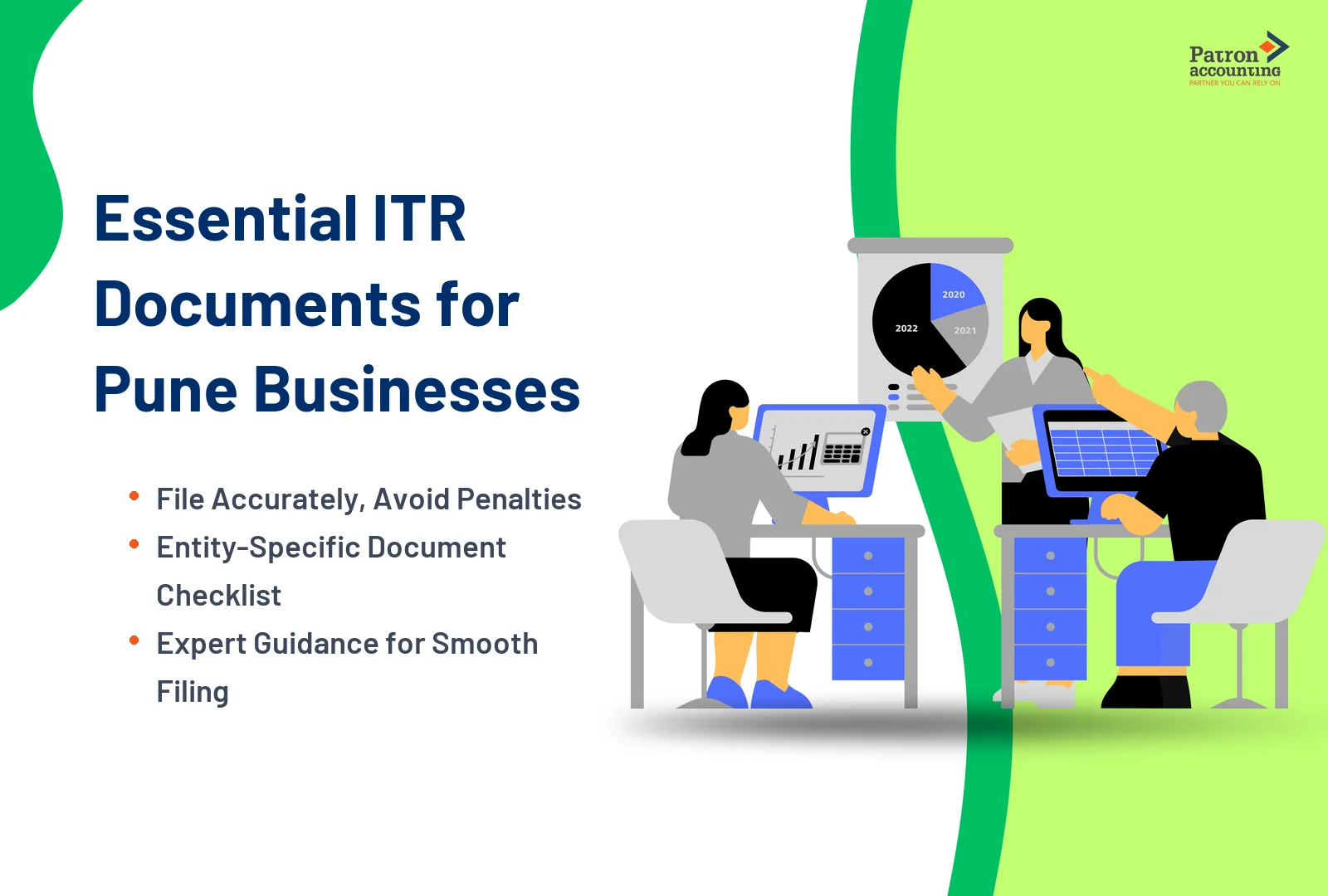
Filing a business ITR is fundamentally different from filing a salaried individual’s return. The document requirements are broader, the computations are more complex, and the consequences of errors are more severe. In 2026, the Income Tax Department’s cross-verification between ITR, Form 26AS, AIS, GST returns, and MCA filings is at its strictest - any mismatch triggers automated notices.
For Pune businesses, the ITR filing ecosystem includes not just the IT Department but also the GST portal (for turnover reconciliation), MCA (for company/LLP financials), and EPFO/ESIC (for payroll deductions). This blog provides the entity-by-entity document checklist and our Pune office’s step-by-step filing methodology.
What Is a Business ITR?
A business Income Tax Return is the annual filing with the Income Tax Department declaring: (a) business income (profit from trade, commerce, manufacturing, services, or profession), (b) all other income sources (salary, house property, capital gains, other sources), (c) deductions and exemptions claimed, (d) taxes paid (advance tax, TDS, self-assessment), and (e) the final tax computation (demand/refund). Businesses using ITR filing services (know more) get the complete filing managed from document collection to e-verification.
Key Terms You Should Know
ITR-3: For individuals/HUFs with business or professional income (full books of accounts). Sole proprietors with non-presumptive income.
ITR-4 (Sugam): For resident individuals/HUFs/firms (not LLP) opting for presumptive taxation under Section 44AD/44ADA/44AE. Simplified return.
ITR-5: For partnership firms and LLPs. Not for companies.
ITR-6: For companies (Pvt Ltd, OPC, Public). Filed only electronically with DSC.
Form 26AS: Annual Tax Statement showing: TDS deducted, advance tax paid, self-assessment tax paid, and high-value transactions reported by third parties.
AIS (Annual Information Statement): Comprehensive statement showing: salary, interest, dividends, property transactions, share transactions, GST turnover, and all financial transactions reported to IT Department by third parties.
Tax Audit (Section 44AB): Mandatory audit of books of accounts by a CA. Triggered by turnover thresholds. Report: Form 3CA-3CD (if already audited under another law) or Form 3CB-3CD (if not audited otherwise).
Form 3CA-3CD / 3CB-3CD: Tax audit report filed by the auditor on the IT portal. Must be filed before the ITR due date.
Presumptive Taxation (Section 44AD/44ADA): Simplified scheme: declare 8% of turnover as income (6% for digital receipts) without maintaining full books. For business turnover up to Rs 2 crore (Rs 3 crore if 95%+ digital). Professionals: 50% of receipts up to Rs 50 lakh (Rs 75 lakh if 95%+ digital).
GST-ITR Reconciliation: Matching turnover reported in GSTR-3B/GSTR-9 with revenue in the P&L and ITR. Mismatch triggers IT notices in 2026.
Which ITR Form for Which Business?
| Entity Type | ITR Form | Tax Audit? | Due Date (AY 2026-27) | DSC Mandatory? |
|---|---|---|---|---|
| Sole proprietorship (presumptive 44AD/44ADA) | ITR-4 | No (unless opted out after using 44AD) | 31 July 2026 | No |
| Sole proprietorship (full books) | ITR-3 | If turnover > Rs 1 crore (Rs 10 crore if 95%+ digital) | 31 July (non-audit) / 31 October (audit) | No |
| Partnership firm | ITR-5 | If turnover > Rs 1 crore (Rs 10 crore if 95%+ digital) | 31 July (non-audit) / 31 October (audit) | DSC or EVC |
| LLP | ITR-5 | Most LLPs require audit (Companies Act or Section 44AB) | 31 July (non-audit) / 31 October (audit) | DSC or EVC |
| Pvt Ltd Company | ITR-6 | Yes - statutory audit (Companies Act) + tax audit (if applicable) | 31 October 2026 (audit mandatory for all companies) | DSC mandatory |
| OPC (One Person Company) | ITR-6 | Yes (statutory audit mandatory) | 31 October 2026 | DSC mandatory |
| Freelancer / Professional (presumptive 44ADA) | ITR-4 | No (if within 44ADA limits) | 31 July 2026 | No |
| Freelancer / Professional (full books) | ITR-3 | If receipts > Rs 50 lakh (Rs 75 lakh if 95%+ digital) | 31 July / 31 October (audit) | No |
The Master Document Checklist: Entity-by-Entity
Documents Common to All Business Entities
- PAN card of the entity (and personal PAN for sole proprietors)
- Aadhaar of the authorised signatory (for e-verification)
- Previous year’s ITR acknowledgement (for reference)
- Form 26AS (download from incometax.gov.in or TRACES)
- Annual Information Statement (AIS) (download from compliance portal)
- Taxpayer Information Summary (TIS)
- Bank statements for all accounts (April 2025 to March 2026)
- TDS certificates: Form 16A (from clients/deductors), Form 16 (if salary income)
- Advance tax challans (all quarterly payments)
- Self-assessment tax challan (if any)
- GST returns: GSTR-3B (all months), GSTR-1 (all months), GSTR-9 (annual return)
- GST-ITR turnover reconciliation (prepared by CA)
- Details of investments (for Section 80C/80D deductions, if old regime chosen)
- Details of any capital gains (property, shares, mutual funds)
- Loan statements (if interest deduction claimed)
Sole Proprietorship (ITR-3 or ITR-4)
All common documents above, plus:
- Profit & Loss account (April 2025 to March 2026)
- Balance sheet as on 31 March 2026
- Cash book / ledger (if maintaining full books)
- Purchase and sales registers
- Expense vouchers and receipts
- Depreciation schedule (for fixed assets)
- Stock valuation as on 31 March 2026 (if applicable)
- For ITR-4 (presumptive): gross turnover/receipts figure + bank turnover confirmation
- Schedule AL: asset and liability details (if income > Rs 50 lakh)
Partnership Firm (ITR-5)
All common documents, plus:
- Registered partnership deed
- Profit & Loss account and balance sheet (audited if required)
- Partner remuneration and interest computation (within Section 40(b) limits)
- Capital account statement of each partner
- Tax audit report: Form 3CA-3CD or 3CB-3CD (if applicable)
- Details of partner’s share of income (for partner’s individual ITR)
LLP (ITR-5)
All common documents, plus:
- LLP agreement
- Audited financial statements (P&L + balance sheet)
- Tax audit report: Form 3CA-3CD (since LLPs are audited under LLP Act + Section 44AB)
- Partner remuneration and interest details
- Form 8 (annual return filed with MCA - for cross-reference)
- DSC of the designated partner. For our tax audit timing guide (know more), see when tax audit is triggered.
Pvt Ltd / OPC / Company (ITR-6)
All common documents, plus:
- Audited financial statements (statutory audit under Companies Act)
- Directors’ report
- Tax audit report: Form 3CA-3CD (mandatory if turnover thresholds met)
- Board resolution authorising ITR filing
- AOC-4 (annual financial filing with MCA - for cross-reference)
- MAT/AMT computation (Minimum Alternate Tax under Section 115JB/115JC)
- Transfer pricing documentation (if related-party transactions exceed Rs 1 crore)
- DSC of the authorised signatory (mandatory for ITR-6). For statutory audit (know more) including ITR-6 filing coordination, we handle the integrated audit-to-filing process.
The GST-ITR Reconciliation: Critical in 2026
In 2026, the IT Department cross-verifies GST turnover with ITR revenue. Mismatches trigger automated notices. The reconciliation involves:
(1) GSTR-3B total taxable value (all months) vs ITR revenue/turnover
(2) GSTR-9 (annual return) gross turnover vs ITR P&L revenue
(3) Differences due to: credit notes, debit notes, GST on advances, RCM (reverse charge), exempt supplies, non-GST income (interest, rent from non-GST sources)
(4) Prepare a reconciliation statement explaining every difference
Our approach: we prepare a written GST-ITR reconciliation for every business client before filing ITR. This document is retained for 6 years in case of IT scrutiny. For our GST annual return guide (know more), see how GSTR-9 reconciliation feeds into ITR.
Form 26AS and AIS: Your Pre-Filing Verification
| Parameter | Form 26AS | AIS (Annual Information Statement) |
|---|---|---|
| What it shows | TDS deducted, advance tax, self-assessment tax, refunds, high-value transactions (SFT) | Comprehensive: salary, interest, dividends, property, shares, GST turnover, mutual funds, cash deposits, and all reported financial transactions |
| Where to download | incometax.gov.in > My Account > Form 26AS | incometax.gov.in > AIS > Annual Information Statement |
| Why it matters for business ITR | Verify TDS claimed matches 26AS. Verify advance tax payments. Identify any unmatched TDS. | Verify all income sources reported. GST turnover should match. Bank interest should match. Identify unreported income before IT Dept notices. |
| What to do before filing | Download. Compare with your books. Resolve mismatches. File corrections if TDS is incorrectly reported. | Download. Review every line item. File feedback if any information is incorrect. Ensure ITR matches AIS. |
Tax Audit Thresholds: When Is It Mandatory?
| Scenario | Tax Audit Under Section 44AB | Audit Form |
|---|---|---|
| Business turnover > Rs 1 crore | Mandatory | 3CB-3CD (or 3CA-3CD if already audited under other law) |
| Business turnover > Rs 10 crore (if 95%+ digital receipts/payments) | Mandatory only if above Rs 10 crore | Same |
| Professional receipts > Rs 50 lakh | Mandatory | Same |
| Professional receipts > Rs 75 lakh (if 95%+ digital) | Mandatory only above Rs 75 lakh | Same |
| Opted for 44AD previously and now declaring income below 8%/6% | Mandatory for next 5 years | Same |
| Pvt Ltd / OPC company (any turnover) | Statutory audit under Companies Act (always). Tax audit if turnover > Rs 1 crore / Rs 10 crore. | 3CA-3CD (since audited under Companies Act) |
| LLP (audit under LLP Act if conditions met) | Tax audit if turnover threshold crossed. LLP Act audit if: turnover > Rs 40 lakh or contribution > Rs 25 lakh. | 3CA-3CD |
Penalties for Late or Non-Filing
| Non-Compliance | Penalty / Interest | Legal Provision |
|---|---|---|
| ITR filed after due date (July/October) but before 31 December | Late fee: Rs 5,000 (income > Rs 5 lakh) or Rs 1,000 (income ≤ Rs 5 lakh). Interest: 1% per month under Section 234A on unpaid tax. | Section 234F + 234A |
| ITR filed after 31 December (belated) | Late fee: Rs 10,000 + interest. Cannot revise. Limited carry-forward of losses. | Section 234F + 234A |
| ITR not filed at all | Prosecution under Section 276CC: imprisonment 3 months to 7 years + fine (if tax > Rs 25,000). Best judgment assessment by AO. | Section 276CC |
| Business losses not carried forward | If ITR not filed by due date: business losses (Section 72) cannot be carried forward. Devastating for startups with initial-year losses. | Section 80 (proviso) |
| Tax audit report not filed by due date | Penalty: 0.5% of turnover or Rs 1,50,000 (whichever is less) under Section 271B. | Section 271B |
| Defective return (incorrect form or missing schedules) | IT Dept issues defective return notice under Section 139(9). Must rectify within 15 days or return treated as invalid. | Section 139(9) |
Common Mistakes in Business ITR Filing
Mistake 1: GST turnover not matching ITR revenue. In 2026, this is the #1 trigger for IT notices. GSTR-3B taxable value must reconcile with P&L revenue. Differences must be explainable (credit notes, exempt supplies, non-GST income). For GST return filing (know more) coordinated with ITR, we ensure reconciliation before filing.
Mistake 2: Claiming TDS not reflected in Form 26AS. TDS credit is allowed only if it appears in 26AS. If a deductor has not filed their TDS return, your credit will not appear. Verify before filing and pursue correction with the deductor.
Mistake 3: Selecting the wrong ITR form. LLP filing ITR-3 instead of ITR-5, or company filing ITR-5 instead of ITR-6 = defective return notice. Each entity has a specific form.
Mistake 4: Not carrying forward business losses. Business losses can only be carried forward if the ITR is filed by the due date. Filing even one day late forfeits this benefit. For startups with losses: file by the due date, every year, without exception.
Mistake 5: Partner remuneration exceeding Section 40(b) limits. Partnership firms and LLPs can deduct partner remuneration and interest, but only within prescribed limits. Exceeding the limit: the excess is disallowed, increasing taxable income. For Pvt Ltd compliance audit (know more) that includes ITR readiness, we verify all deductions.
Our Pune Office’s ITR Filing Methodology
From our Pune office filing business ITRs for 2,500+ entities annually:
(1) Document collection (April-May): Structured checklist shared with each client by entity type. All documents collected digitally.
(2) Books finalization (May-June): P&L and balance sheet prepared/finalized. For audit cases: coordinated with the statutory auditor.
(3) Form 26AS + AIS verification (June): Download 26AS and AIS. Cross-check every entry with the books. Identify mismatches. File AIS feedback for incorrect entries.
(4) GST-ITR reconciliation (June): Compare GSTR-3B/GSTR-9 turnover with ITR P&L revenue. Prepare reconciliation statement.
(5) Tax computation (June-July): Compute taxable income. Apply deductions. Determine old/new regime. Calculate tax liability. Verify advance tax credits.
(6) Tax audit (if applicable) (July-September): Coordinate with auditor for Form 3CA-3CD / 3CB-3CD. Ensure audit report filed on IT portal before ITR due date.
(7) ITR preparation and e-filing (July for non-audit / October for audit): Fill the ITR form on the e-filing portal. Validate all schedules. Upload. Submit with DSC/EVC. E-verify.
(8) Post-filing: Monitor for intimation under Section 143(1). Respond to any discrepancy. Process refund (if applicable). File revised return if errors discovered. Pune IT jurisdiction: CIT Pune 1, 2, 3, and 4. For tax planning services (know more) that integrate ITR filing with year-round tax optimization, we manage the complete lifecycle.
2026 Context: What’s Changed
| 2026 Change | Impact on Business ITR | What to Do |
|---|---|---|
| AIS cross-verification strictest ever | IT Dept matches AIS data with ITR for every taxpayer. Unreported income = notice. | Download and review AIS before filing. Ensure every income source is reported. |
| GST-ITR turnover reconciliation automated | IT Dept receives GST turnover data from GSTN. Mismatch with ITR revenue = automated notice. | Prepare formal reconciliation. File GST returns accurately before ITR. |
| New tax regime is default | Business owners default to new regime. Must file Form 10-IEA before due date to opt for old regime. Form can be filed twice in lifetime. | Evaluate old vs new regime. If old is better: file Form 10-IEA before ITR due date. |
| Updated ITR forms for AY 2026-27 | ITR-3/4/5/6 forms updated with new schedules (crypto, virtual digital assets, buyback, foreign assets). | Verify you are using the correct AY 2026-27 form. Do not use prior year forms. |
| Tighter scrutiny for loss returns | ITRs claiming business losses (especially startups) are subject to higher scrutiny in 2026. | Ensure all loss claims are supported by books, invoices, and documentation. |
Key Takeaways
Business ITR documents depend on entity type: sole proprietorship (ITR-3/4), partnership/LLP (ITR-5), company (ITR-6). Common documents: PAN, P&L, balance sheet, bank statements, Form 26AS, AIS, GST returns, TDS certificates, advance tax challans.
Due dates for AY 2026-27: 31 July (non-audit) / 31 October (audit) / 30 November (transfer pricing). Late filing = Rs 5,000-10,000 fee + interest + loss carry-forward forfeited.
GST-ITR turnover reconciliation is critical in 2026. IT Dept receives GST data from GSTN and matches with ITR. Prepare a formal reconciliation before filing.
Form 26AS and AIS verification is mandatory before filing. Every TDS credit, advance tax payment, and financial transaction must match. Mismatches trigger notices.
Our Pune office methodology: document collection → books finalization → 26AS+AIS verification → GST reconciliation → tax computation → audit coordination → e-filing → post-filing monitoring. 2,500+ entities filed annually.
Need Business ITR Filing in Pune?
Whether you are a sole proprietor, partnership firm, LLP, or Pvt Ltd company in Pune - our team handles the complete ITR filing process from document collection to e-verification and post-filing monitoring.
Explore our ITR filing services (know more) and statutory audit (know more) for integrated audit-to-ITR filing across Pune, Mumbai, Delhi, Gurugram, and all-India.