In this guide
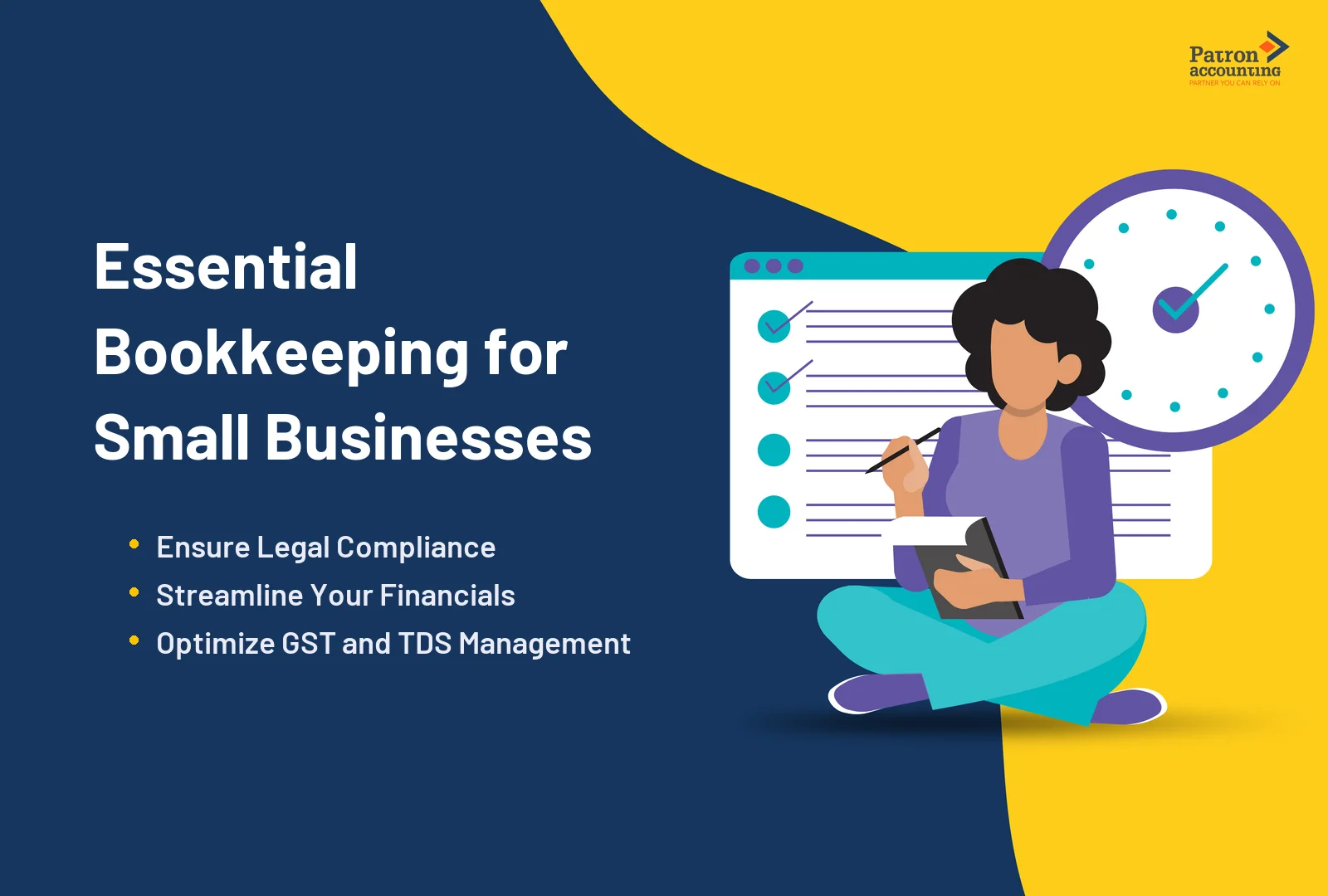
Bookkeeping is the foundation of every financial decision your business makes - from knowing whether you can afford a new hire, to filing your GST return correctly, to convincing a bank to approve your loan application. Yet it is the most neglected function in Indian small businesses. The owner handles it in spare time, transactions pile up, the CA gets a shoebox of receipts in March, and everyone scrambles to file returns with incomplete data.
This guide covers everything an Indian small business owner needs to know about bookkeeping in 2026 - legal requirements, what books to maintain, daily/weekly/monthly tasks, GST and TDS integration, software selection, and when to hire a professional. For businesses already using Zoho Books, see our complete Zoho Books guide.
Legal Requirements: Who Must Maintain Books of Accounts?
Income Tax Act (Section 44AA): Professionals (doctors, lawyers, CAs, architects, engineers, etc.) earning above Rs 25 lakh/year and businesses with turnover above Rs 2 crore/year (Rs 3 crore if 95%+ digital receipts and payments) must maintain prescribed books. Below these thresholds, you can use presumptive taxation (Section 44AD/44ADA) - but even then, basic records are recommended.
Companies Act (Section 128): Every company (Pvt Ltd, OPC, Public Ltd) and LLP must maintain books of accounts on accrual basis. These must be kept at the registered office and preserved for 8 financial years.
GST Act (Section 35): Every registered GST taxpayer must maintain records of production/manufacture, inward/outward supply, stock, input tax credit, output tax, and all other statutory data. These records must be maintained at the principal place of business.
Penalty for non-maintenance: Income Tax: up to Rs 25,000 penalty under Section 271A. GST: up to Rs 25,000 per year per GSTIN. Companies Act: officer in default may face imprisonment and fines.
What Books of Accounts Must an Indian Small Business Maintain?
| Book / Register | What It Records |
|---|---|
| Cash Book | All cash receipts and payments - petty cash, counter sales, vendor payments in cash |
| Bank Book | All bank transactions - NEFT/RTGS/UPI receipts, cheque payments, bank charges, interest |
| Sales Register | All sales invoices - customer, date, amount, GST, HSN code, place of supply |
| Purchase Register | All purchase bills - vendor, date, amount, GST, HSN code, ITC claimed |
| Journal | Non-cash adjustments - depreciation, provisions, accruals, write-offs, inter-account transfers |
| General Ledger | Account-wise summary of all transactions - every account's running balance |
| Stock Register | Inventory - opening stock, purchases, sales, closing stock, valuation method |
| GST Records | Input/output tax, ITC register, RCM register, HSN-wise summary, e-invoicing log |
| TDS Register | TDS deducted on vendor payments and TDS deducted by customers - Section 393 mapping |
| Fixed Asset Register | All fixed assets - cost, depreciation, WDV, date of purchase, location |
In cloud accounting software like Zoho Books, all these registers are maintained automatically as you create invoices, bills, payments, and journal entries. The software generates each register from the underlying transaction data.
Cash Basis vs Accrual Basis: Which to Use?
Cash Basis: Revenue recognised when money is received; expenses recognised when money is paid. Simpler. Allowed for sole proprietors and partnerships below Rs 2 crore turnover. Not allowed for companies or LLPs.
Accrual Basis: Revenue recognised when earned (invoice issued); expenses recognised when incurred (bill received) - regardless of when money moves. Mandatory for companies, LLPs, and businesses under tax audit. Provides a more accurate picture of financial performance.
CA Recommendation: Use accrual basis even if not legally required. It gives you accurate receivables, payables, and profitability - essential for decision-making. Zoho Books supports both methods, but accrual is the default.
The Indian Small Business Bookkeeping Calendar
Daily Tasks (15-30 minutes)
- Create and send invoices for all sales
- Record all expenses and upload receipts
- Categorise bank feed transactions (if using auto-feeds)
Weekly Tasks (1-2 hours)
- Review and reconcile bank transactions - match bank feed with records
- Follow up on overdue invoices (or let automated reminders handle it)
- Review cash flow - do you have enough to cover upcoming payments?
Monthly Tasks (3-5 hours)
- Complete bank reconciliation for the month
- Deposit TDS by the 7th
- File GSTR-1 by the 11th and GSTR-3B by the 20th
- Deposit PF and ESI by the 15th (if applicable)
- Review monthly P&L - are you profitable? Where are the costs?
- Reconcile GSTR-2B with purchase register for ITC accuracy
Quarterly Tasks (2-4 hours)
- File TDS returns (Form 26Q/27Q) and generate Form 16A
- Pay advance income tax (15 June, 15 Sept, 15 Dec, 15 March)
- Review quarterly financial performance against budget
Annual Tasks (Year-End: March-April)
- Record year-end adjustments - depreciation, provisions, accruals, prepaid amortisation
- Physical stock count and inventory valuation
- Prepare financial statements - Balance Sheet, P&L, Cash Flow (if applicable)
- File income tax return (ITR-3/ITR-4/ITR-5/ITR-6 depending on entity)
- File GSTR-9 (annual GST return)
- ROC annual return filing (for companies - Form AOC-4, MGT-7)
Tax audit (if turnover exceeds Rs 1 crore business / Rs 50 lakh profession). For monthly GST filing support, explore our GST return filing services.
Software vs Manual Bookkeeping: When to Switch
| Factor | Manual / Spreadsheet | Cloud Accounting Software |
|---|---|---|
| Best For | Under 50 transactions/month, very early stage | 50+ transactions/month, any GST-registered business |
| GST Compliance | Manual - compute, format, export, upload to portal | Automated - auto-calculate, push to GSTN, reconcile |
| Bank Reconciliation | Download statement → manual matching → hours of work | Auto bank feeds → smart matching → minutes |
| Error Rate | High - formula errors, duplicate entries, missed transactions | Low - system-enforced double-entry, auto-calculations |
| Collaboration | Email files back and forth, version conflicts | Real-time - owner + accountant + CA access simultaneously |
| Cost | Rs 0 (but 10-20 hours/month of your time) | Rs 899-2,999/month (but saves 10-15 hours/month) |
Recommendation: Switch to cloud accounting software the moment you register for GST. The automation, compliance accuracy, and time savings pay for the subscription within the first month. For software selection, see our Zoho Books GST setup guide.
Cost of Bookkeeping for Indian Small Businesses
| Approach | Monthly Cost | Annual Compliance | Total Annual |
|---|---|---|---|
| Full DIY (spreadsheets) | Rs 0 (+ your time) | Rs 15,000-30,000 (CA for ITR/audit) | Rs 15,000-30,000 |
| Software + DIY daily | Rs 899-1,499 (software only) | Rs 15,000-30,000 | Rs 26,000-48,000 |
| Software + Outsourced bookkeeping | Rs 3,000-10,000 (software + CA/bookkeeper) | Rs 15,000-50,000 | Rs 51,000-1,70,000 |
| Full-time in-house accountant | Rs 25,000-50,000 (salary + software) | Rs 20,000-50,000 | Rs 3,20,000-6,50,000 |
The sweet spot for most Indian SMBs: Software (Rs 899-1,499/mo) + outsourced bookkeeping and compliance (Rs 3,000-10,000/mo) - total Rs 50,000-1,40,000/year. You handle daily invoicing and expenses; the bookkeeper/CA handles GST, TDS, reconciliation, and annual filing. For details on this hybrid approach, see our CA vs DIY bookkeeping guide.
Common Bookkeeping Mistakes Indian Small Businesses Make
Mistake 1: Mixing personal and business transactions. Using your personal bank account for business payments makes reconciliation impossible. Open a dedicated current account for the business - every business rupee flows through this account.
Mistake 2: Recording expenses only at tax time. If you wait until March to record 12 months of expenses, you will miss deductions, misclassify entries, and produce inaccurate financial statements. Record expenses as they occur - the mobile app takes 30 seconds per receipt.
Mistake 3: Not reconciling bank statements monthly. Unreconciled bank accounts mean you do not know your real cash position. Errors, duplicate entries, and fraudulent transactions go undetected. Reconcile every month without fail.
Mistake 4: Ignoring GST compliance deadlines. GSTR-1 by the 11th, GSTR-3B by the 20th, TDS by the 7th, PF/ESI by the 15th - missing any one triggers penalties. Set up calendar reminders or use software that reminds you automatically.
Mistake 5: Not keeping receipts and supporting documents. Every expense claim, every ITC, every deduction must have a supporting document. During an audit, 'I paid it but do not have the receipt' means the expense is disallowed. Use auto-scan in Zoho Books to digitise receipts instantly. For professional bookkeeping management, explore our Zoho Books accounting services.
Key Takeaways
Bookkeeping is legally mandatory for Indian businesses under the Income Tax Act (Section 44AA), Companies Act (Section 128), and GST Act (Section 35) - with penalties up to Rs 25,000 per statute for non-maintenance.
Every Indian small business must maintain at minimum: cash book, bank book, sales register, purchase register, general ledger, stock register, GST records, and TDS register. Cloud accounting software generates these automatically from transaction data.
The bookkeeping calendar for Indian SMBs follows GST and TDS deadlines - daily invoicing/expenses, weekly bank reconciliation, monthly GST filing (11th/20th) and TDS deposit (7th), quarterly TDS returns and advance tax, and annual financials + ITR + GSTR-9 + ROC filing.
Cloud accounting software (Rs 899-1,499/month) saves 10-15 hours/month over manual bookkeeping and ensures GST compliance accuracy - the cost is recovered in the first month through time savings and avoided penalties.
The optimal model for most Indian SMBs is hybrid: owner handles daily bookkeeping (invoicing, expenses, bank categorisation) using software, and a CA/bookkeeper handles monthly GST, TDS, reconciliation, and annual compliance (Rs 3,000-10,000/month outsourced).
Need Professional Bookkeeping Support?
Proper bookkeeping is the foundation of GST compliance, tax planning, cash flow management, and audit readiness. Whether you handle it yourself with cloud software or outsource to a professional - the important thing is that it gets done consistently, accurately, and on time.
Explore our Zoho Books accounting services for CA-supervised bookkeeping, GST filing, TDS compliance, and annual financial statement preparation - starting from Rs 2,999/month for small businesses.