In this guide
You started your business to build a product, serve customers, or pursue a passion - not to maintain ledgers. But here is the reality: every financial decision you make - hiring, pricing, expanding, borrowing - depends on knowing your numbers. And knowing your numbers depends on bookkeeping.
Yet most Indian small businesses treat bookkeeping as an afterthought - something the CA handles in March, or something that can wait until a tax notice arrives. This article explains what bookkeeping actually is, what the law requires, what happens when you do not maintain proper books, and how to get started without overwhelming yourself.
What Is Bookkeeping? A Plain-Language Explanation
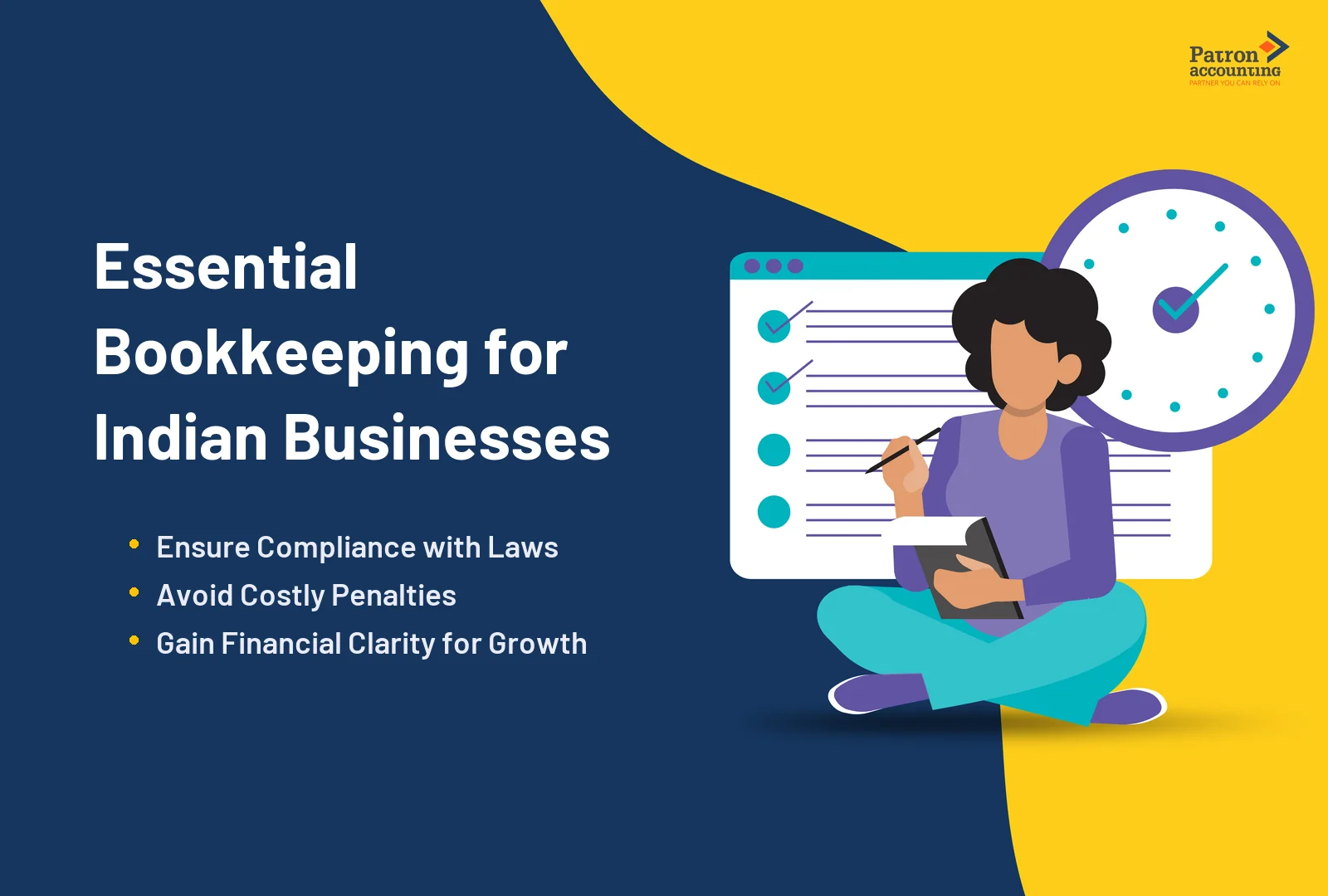
Bookkeeping is the systematic recording of every financial transaction in your business. Every time money comes in (a customer pays you) or goes out (you pay a vendor, salary, rent, or tax), that transaction must be recorded - with the date, amount, source/destination, and category.
These records are then organised into categories called accounts - Sales, Purchases, Rent, Salaries, Bank Charges, GST Payable, and so on. Together, these accounts form your books of accounts - the complete financial history of your business.
From these books, your CA generates financial statements (Balance Sheet, Profit & Loss), files your tax returns, and provides the data you need to make business decisions. Without accurate books, your CA is guessing - and so are you.
Bookkeeping vs Accounting: What Is the Difference?
| Bookkeeping | Accounting |
|---|---|
| Records transactions as they occur | Interprets and analyses recorded data |
| Creates invoices, records expenses, reconciles bank | Prepares financial statements, computes tax, files returns |
| Daily/weekly activity | Monthly/quarterly/annual activity |
| Can be done by the business owner or bookkeeper | Requires a CA or professional accountant |
| Input: source documents (invoices, receipts, bills) | Input: bookkeeping data (ledgers, trial balance) |
| Output: organised financial records | Output: P&L, Balance Sheet, ITR, GSTR, audit report |
Think of it this way: bookkeeping is writing the diary. Accounting is reading the diary and making sense of it. Without the diary (bookkeeping), the analysis (accounting) has nothing to work with.
Why Bookkeeping Is Legally Mandatory in India
Income Tax Act - Section 44AA: Businesses with turnover above Rs 2 crore and professionals above Rs 25 lakh must maintain prescribed books. Below these limits, presumptive taxation (44AD/44ADA) is available - but even then, basic records are needed to support the presumptive return if questioned. Non-maintenance penalty: up to Rs 25,000 (Section 271A).
Companies Act - Section 128: Every company (Pvt Ltd, OPC, Public Ltd) and LLP must maintain books of accounts on accrual basis, keep them at the registered office, and preserve them for 8 financial years. Non-compliance: officer in default faces fine up to Rs 50,000 and possible imprisonment.
GST Act - Section 35: Every GST-registered person must maintain records of production, inward/outward supply, stock, input tax credit, and output tax at the principal place of business. Non-maintenance: penalty up to Rs 25,000 per GSTIN per year. For GST compliance support, explore our GST return filing services.
In total, an Indian business that fails to maintain proper books faces penalties under three separate statutes - the Income Tax Act, the Companies Act (if applicable), and the GST Act. The cumulative penalty exposure can exceed Rs 1 lakh per year before any tax adjustments.
What Happens When You Do Not Maintain Professional Books: 7 Real Consequences
1. Tax Notices and Best Judgement Assessment. If the Income Tax Department cannot verify your income from your books, they can make a 'best judgement assessment' under Section 144 - estimating your income (usually higher than actual) and demanding tax accordingly. You lose the ability to claim deductions, exemptions, and expenses that you could have proven with proper records.
2. GST Penalty and ITC Reversal. Without proper purchase records and GST invoices, your Input Tax Credit claims cannot be substantiated. The GST Department can reverse ITC, impose penalties, and charge 18% interest on the reversed amount. A single missing invoice can trigger a DRC-01C mismatch notice.
3. Loan Application Rejection. Banks require audited financial statements (or at minimum 2 years of ITRs with Balance Sheet) for business loan approval. Without books, you cannot produce these statements. The loan is rejected - not because your business is not profitable, but because you cannot prove it.
4. Investor Due Diligence Failure. If you seek equity investment or a partner, the first thing they ask for is financial statements. Incomplete books mean incomplete statements. Most investors walk away at this stage - they interpret poor books as a red flag for financial management quality.
5. Expense Disallowance Under Section 40(a)(ia). If you paid vendors without deducting TDS (because you had no system to track it), 30% of the payment amount is disallowed as an expense. On Rs 10 lakh of vendor payments, that is Rs 3 lakh disallowed - increasing your taxable income and tax liability by Rs 75,000-90,000 at typical tax rates.
6. Audit Qualification or Disclaimer. If your books are incomplete, the CA conducting your tax audit will issue a qualified or disclaimed audit report. This triggers enhanced scrutiny from the Income Tax Department and potentially from your bank and investors.
7. Cash Flow Blindness. Without books, you do not know your receivables (who owes you), payables (whom you owe), or your real profit margin. Businesses that do not track cash flow run out of money - not because they are not selling, but because they are not collecting, or because expenses are higher than they realise.
What 'Professional Books' Actually Look Like
Professional books are not complicated. They simply mean that every transaction is recorded accurately, categorised correctly, and reconciled with supporting documents. At minimum, professional books include:
- Every sale recorded as an invoice with GST, HSN code, and customer GSTIN (for B2B)
- Every purchase recorded as a bill with vendor details, GST, and ITC eligibility
- Every bank transaction categorised and reconciled monthly
- Every cash transaction recorded with supporting receipt
- GST computed correctly and returns filed on time (GSTR-1/3B)
- TDS deducted on applicable payments and deposited by deadlines
- Year-end adjustments made (depreciation, provisions, accruals)
- Financial statements prepared (Balance Sheet + P&L) from these records
Modern cloud accounting software like Zoho Books generates all of these automatically as you enter transactions daily. For the step-by-step process, see our bookkeeping guide. For the complete software setup, see our Zoho Books guide.
10 Signs Your Business Needs Professional Bookkeeping
- You do not know your exact bank balance without checking the app.
- Customers owe you money but you are not sure how much or who.
- You have filed GST returns late more than twice in the last year.
- You cannot tell whether last month was profitable or not.
- Your CA asks you for data in March and you spend a week gathering receipts.
- You have received a GST mismatch notice (DRC-01C) or tax demand.
- You are applying for a business loan and do not have audited financials.
- You have employees but are not sure if PF/ESI/TDS is being deducted correctly.
- You mix personal and business expenses in the same bank account.
- You have no idea what your business spent on rent, salaries, or marketing last year.
If three or more of these apply to you, your books need professional attention. Our CA vs DIY bookkeeping guide helps you decide whether to manage it yourself or outsource.
Key Takeaways
Bookkeeping is the daily recording and categorising of every financial transaction - it is the raw material from which your CA produces financial statements, tax returns, and compliance filings. Without accurate bookkeeping, accounting is guesswork.
Maintaining books of accounts is legally mandatory under three Indian statutes - Income Tax Act (Section 44AA), Companies Act (Section 128), and GST Act (Section 35) - with cumulative penalty exposure exceeding Rs 1 lakh per year for non-compliance.
The real cost of not maintaining books goes far beyond penalties - tax notices with best-judgement assessments, GST ITC reversal, loan rejections, investor walkouts, expense disallowance (30% under Section 40(a)(ia)), audit qualifications, and cash flow blindness.
Professional books are not complicated - they are simply accurate, complete, and reconciled records maintained in cloud accounting software with GST and TDS configured correctly. Modern software handles 80% of the work automatically.
The cost of professional bookkeeping (Rs 2,000-15,000/month outsourced or Rs 899-1,499/month software for DIY daily tasks) is a fraction of the cost of a single tax notice, loan rejection, or lost investor - making it the highest-ROI investment a small business can make.
Ready to Get Your Books in Order?
Professional bookkeeping is not an expense - it is the infrastructure that makes everything else in your business work: tax compliance, cash flow management, loan applications, investor conversations, and strategic decisions. The cost of maintaining books is always less than the cost of not maintaining them.
Explore our Zoho Books accounting services - we set up your books, configure GST and TDS, handle monthly compliance, and deliver financial statements you can trust. Starting from Rs 2,999/month for small businesses.
How to Get Started with Professional Bookkeeping
- Open a dedicated business bank account - separate personal from business finances from day one.
- Choose cloud accounting software - Zoho Books (Rs 899/mo) or TallyPrime are the leading options for Indian businesses.
- Set up your chart of accounts, GST configuration, and bank feeds - 2-3 hours one-time setup.
- Record every transaction daily - invoices, expenses, payments. 15-30 minutes per day.
- Reconcile your bank account weekly - 30 minutes per week.
- Engage a CA for monthly GST filing, quarterly TDS, and annual compliance - Rs 2,000-10,000/month.
Explore our Zoho Books accounting services for CA-supervised setup, ongoing bookkeeping, and complete compliance management.