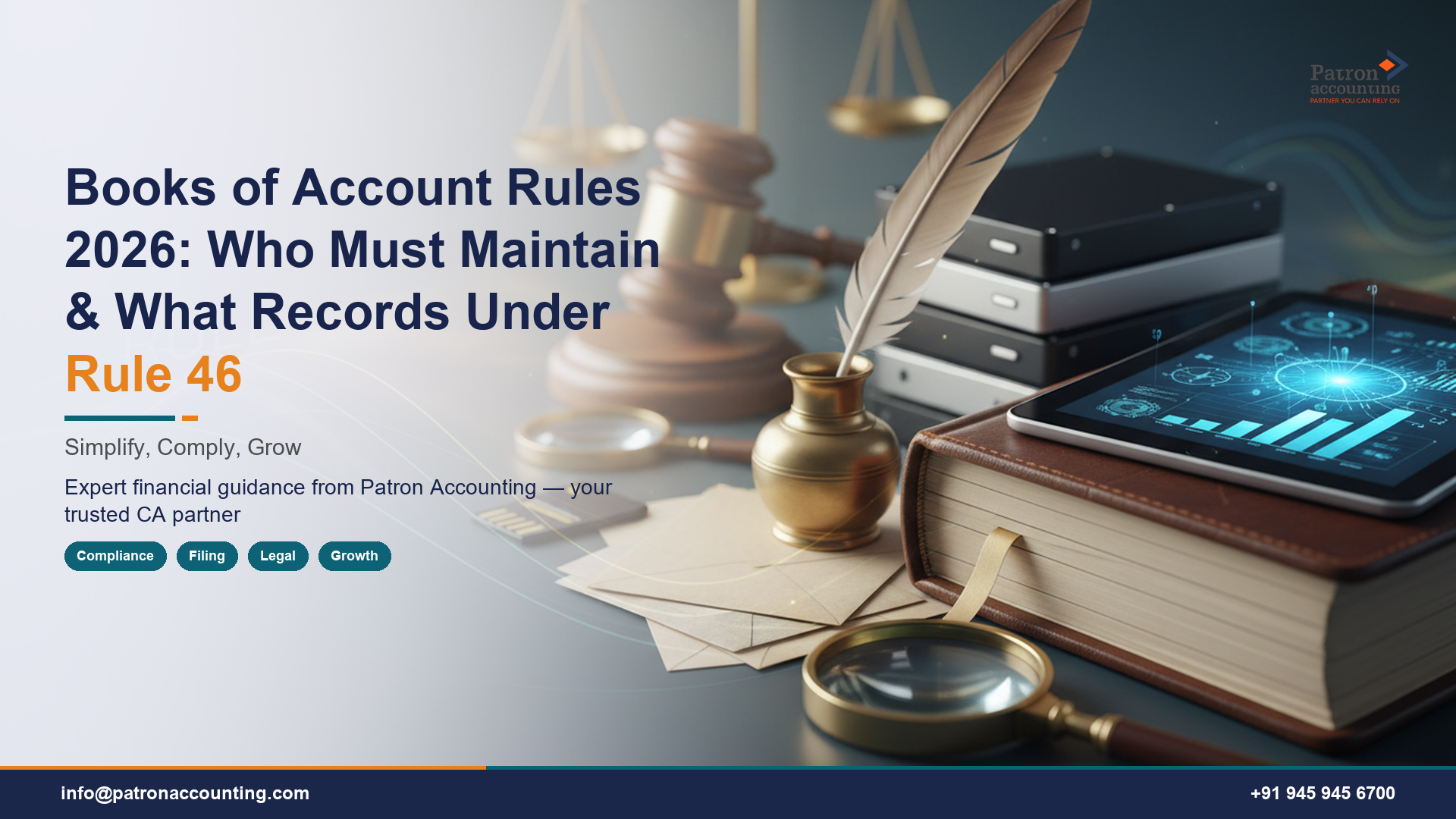
If you are running a business or practising a profession in India, you may already know that keeping proper financial records is not optional—it is a legal obligation. With the Income Tax Act, 2025 replacing the 1961 Act, and the Draft Income Tax Rules, 2026 released by CBDT on 7 February 2026, the framework for maintaining books of account has been restructured. Rule 46 of the new draft rules now consolidates what was previously governed by Rule 6F, and Section 62 replaces the old Section 44AA. Whether you are a doctor, a lawyer, a freelance IT consultant, or a small business owner, understanding these updated provisions is essential to avoid penalties and stay compliant from 1 April 2026.
What Are Books of Account Under Income Tax?
Books of account, under Section 62 of the Income Tax Act, 2025, refer to the financial records that a taxpayer must maintain to enable the Assessing Officer to compute total income. These include cash books, journals, ledgers, bills, receipts, vouchers, and any other documents prescribed by the CBDT through the Income Tax Rules.
The term “books or books of account” is broadly defined to include ledgers, day-books, cash books, account-books, and other records—whether kept in written form or as electronic data stored in any medium including floppy discs, tapes, or electromagnetic storage devices. This definition ensures that both traditional paper records and modern digital accounting systems fall within the legal ambit.
The corresponding rule that prescribes the specifics—such as which books to maintain, who must maintain them, and for how long—is Rule 46 of the Draft Income Tax Rules, 2026, which replaces the earlier Rule 6F of the Income Tax Rules, 1962.
Key Terms Explained
Section 62: The new provision under the Income Tax Act, 2025 that mandates maintenance of books of account. It replaces Section 44AA of the 1961 Act.
Rule 46: The draft rule under the Income Tax Rules, 2026 that specifies which records must be kept, by whom, where, and for how long. It replaces Rule 6F.
Specified Profession: Professions explicitly listed under Section 62(4)(a)—legal, medical, engineering, architectural, accountancy, technical consultancy, interior decoration, information technology, company secretary, authorised representative, and film artist.
Tax Year: Under the new Act, “tax year” replaces the earlier “previous year” terminology. The first tax year under the new Act is 2026–27 (1 April 2026 to 31 March 2027).
Form 25: The new prescribed form (replacing the earlier Form 3C) for maintaining a daily case register by medical professionals.
Who Must Maintain Books of Account Under Section 62?
The obligation to maintain books of account arises in three distinct scenarios under Section 62 of the Income Tax Act, 2025:
1. Specified Professionals (Mandatory Regardless of Income)
If you carry on any of the following professions, you must maintain books of account as prescribed under Rule 46, irrespective of your income level:
- Legal profession (advocates, solicitors)
- Medical profession (doctors, dentists, pathologists, radiologists)
- Engineering profession
- Architectural profession
- Accountancy profession (Chartered Accountants, Cost Accountants)
- Technical consultancy
- Interior decoration
- Information technology
- Company secretary
- Authorised representative (representing others before tribunals for a fee)
- Film artist (producers, directors, actors, music directors, lyricists, cameramen, editors, screenwriters, etc.)
- Any other profession notified by CBDT
However, under Rule 46(3), even specified professionals are exempt from maintaining the detailed prescribed books if their total gross receipts do not exceed Rs 1,50,000 in any one of the three tax years immediately preceding the current tax year. For newly set-up professions, the exemption applies if gross receipts are not likely to exceed Rs 1,50,000 during the current year.
2. Business Persons and Non-Specified Professionals (Threshold-Based)
If you carry on a business or a profession not listed above, you must maintain books of account if, in any one of the three preceding tax years:
- Your income from business or profession exceeded Rs 1,20,000, OR
- Your total sales, turnover, or gross receipts exceeded Rs 10,00,000
For individuals and Hindu Undivided Families (HUFs), the thresholds are higher: income exceeding Rs 2,50,000 or turnover exceeding Rs 25,00,000. This relief protects smaller taxpayers from the compliance burden of detailed bookkeeping. If you are setting up a new business and expect your income or turnover to cross these limits during the first year, the obligation kicks in immediately.
3. Presumptive Taxation Opt-Outs
If you are covered under the presumptive taxation scheme (Section 58(2) or Section 61(2)) but declare profits lower than the deemed income, you must maintain books of account and get them audited under Section 63. For example, a freelancer opting for Section 58(2) who declares actual profit lower than 50% of gross receipts will be required to maintain full books of account to substantiate the lower claim.
Legal Framework: Section 62 and Rule 46
| Provision | Reference | Purpose |
|---|---|---|
| Maintenance of books of account | Section 62, Income Tax Act, 2025 | Mandates who must keep books and empowers CBDT to prescribe details |
| Prescribed books and records | Rule 46, Draft IT Rules, 2026 | Specifies which books, retention period, place of maintenance, electronic compliance |
| Tax audit requirement | Section 63, Income Tax Act, 2025 | Audit of books by CA when turnover exceeds thresholds |
| Penalty for non-maintenance | Section 441, Income Tax Act, 2025 | Fixed penalty of Rs 25,000 |
| Old equivalent (Act) | Section 44AA, IT Act, 1961 | Replaced by Section 62 |
| Old equivalent (Rules) | Rule 6F, IT Rules, 1962 | Replaced by Rule 46 |
Step-by-Step: How to Set Up Compliant Books of Account
Whether you are a specified professional or a business owner, setting up books of account that comply with Rule 46 requires a structured approach. If you need help setting up your books, consider engaging from an experienced CA firm.
- Step 1: Determine Your Category
Check whether you fall under the list of specified professions or whether your income/turnover crosses the applicable thresholds. For individuals and HUFs, use the enhanced limits of Rs 2,50,000 (income) and Rs 25,00,000 (turnover).
- Step 2: Select an Accounting System
Decide between the cash receipts and payments system or the mercantile (accrual) system of accounting. If you choose the mercantile system, you must additionally maintain a journal recording all transactions in chronological order.
- Step 3: Set Up the Prescribed Books
As per Rule 46(4), maintain the following: (a) Cash book recording daily receipts and payments with day-end or month-end balances; (b) Journal (if using mercantile system); (c) Ledger classifying all income and expense heads; (d) Carbon copies or counterfoils of serial-numbered bills and receipts exceeding Rs 25,000; (e) Original bills and receipts for expenditure; (f) Signed payment vouchers for expenses not exceeding Rs 50,000 where bills are not issued.
- Step 4: Additional Records for Medical Professionals
If you are a medical practitioner (doctor, dentist, pathologist, radiologist, etc.), you must additionally maintain: (a) A daily case register in the prescribed Form 25 (previously Form 3C), recording patient details, services rendered, fees received, and date of receipt; (b) An inventory of stock of drugs, medicines, and other consumable accessories as on the first and last day of each tax year.
- Step 5: Choose the Place of Maintenance
Under Rule 46(7), books must be kept at the place where the profession is carried on. If you operate from multiple locations, maintain records at the principal place of profession. Alternatively, you may keep separate books at each location.
- Step 6: Ensure Electronic Compliance (If Applicable)
Under Rule 46(8), if you maintain books electronically, the records must: (a) Remain accessible in India at all times; (b) Be backed up on servers physically located in India; (c) Have backups updated on a daily basis. This provision has significant implications for businesses using cloud-based accounting software hosted on overseas servers.
- Step 7: Set Up a Retention Schedule
Under Rule 46(9), all books of account and documents must be retained for seven tax years from the end of the relevant tax year. If an assessment is reopened under Section 279 (or Section 147 of the old Act), retain all records until the reopened assessment is completed.
Documents and Records Checklist
Here is a complete checklist of records required under Rule 46 of the Draft Income Tax Rules, 2026:
- For All Specified Professionals:
- Cash book (daily receipts and payments, with balance at end of day or month)
- Journal (only if mercantile system is followed)
- Ledger (all accounts classified under relevant heads)
- Carbon copies / counterfoils of bills and receipts exceeding Rs 25,000
- Original bills and receipts for all expenditure
- Signed payment vouchers for expenses up to Rs 50,000 (where no bill is issued)
- Additional for Medical Professionals:
- Daily case register in Form 25
- Inventory of drugs, medicines, and consumables (opening and closing stock)
- For Business Persons (Non-Specified):
- Such books and documents as enable the AO to compute total income (no specific format prescribed)
Turnover and Income Thresholds at a Glance (Tax Year 2026–27)
| Category | Income Threshold | Turnover / Gross Receipts Threshold |
|---|---|---|
| Specified Professionals | No income threshold (mandatory) | Gross receipts > Rs 1,50,000 in any 1 of 3 preceding years |
| Business / Non-Specified Profession (Non-Individual, Non-HUF) | > Rs 1,20,000 in any 1 of 3 preceding years | > Rs 10,00,000 in any 1 of 3 preceding years |
| Business / Non-Specified Profession (Individual or HUF) | > Rs 2,50,000 in any 1 of 3 preceding years | > Rs 25,00,000 in any 1 of 3 preceding years |
| Presumptive Scheme Opt-Out (Section 58/61) | When declared profit < deemed profit | Books mandatory + audit under Section 63 |
Common Mistakes in Maintaining Books of Account
Even experienced professionals and business owners make errors that can lead to penalties or assessment complications. For a broader overview of compliance pitfalls, read our guide on .
Mistake 1: Assuming Presumptive Taxation Means No Records at All.
What happens: While taxpayers under Sections 58(2) or 61(2) need not maintain detailed prescribed books, they must still retain basic documents like bills, invoices, and bank statements. If the AO questions your declared income, absence of any records invites a best-judgment assessment. How to avoid: Maintain at least bank statements, invoices, and receipts even under the presumptive scheme.
Mistake 2: Not Updating Cash Book Daily.
What happens: Rule 46(4) requires the cash book to show the balance at the end of each day or, at the latest, at the end of each month. Many professionals update it only during filing season. How to avoid: Use accounting software that automatically records transactions and generates cash book entries daily.
Mistake 3: Using Overseas Cloud Servers Without India-Based Backups.
What happens: Rule 46(8) mandates that electronic books must have daily backups stored on servers physically located in India. Using a cloud tool hosted entirely abroad without India-based replication violates this requirement. How to avoid: Verify with your accounting software provider that data is replicated on Indian servers, or maintain a separate daily local backup.
Mistake 4: Destroying Records Before the Retention Period Ends.
What happens: Under Rule 46(9), records must be kept for seven tax years. Discarding records after six years (the old retention period under the 1961 Act) can leave you exposed during a reopened assessment. How to avoid: Update your retention policy to seven tax years under the new rules.
Mistake 5: Medical Professionals Skipping Form 25.
What happens: Doctors, dentists, and pathologists who fail to maintain the daily case register in Form 25 (previously Form 3C) risk having their expense claims disallowed. How to avoid: Use a clinic management system that auto-generates Form 25 entries or maintain a physical register updated daily.
Penalties for Non-Maintenance of Books of Account
Failure to keep, maintain, or retain books of account and documents as required under Section 62 or Rule 46 attracts a penalty of Rs 25,000 under Section 441 of the Income Tax Act, 2025.
This penalty can be imposed by the Assessing Officer, Joint Commissioner, or Commissioner. Under the earlier Income Tax Act, 1961, the equivalent penalty was prescribed under Section 271A at the same amount of Rs 25,000.
In addition to the monetary penalty, non-maintenance of books can lead to:
- Best-judgment assessment: The Assessing Officer may estimate your income based on available information if proper books are unavailable.
- Disallowance of expenses: Claimed deductions may be rejected if supporting records are not produced.
- Enhanced scrutiny: Non-compliance may trigger more intensive assessment proceedings.
For international transactions, failure to maintain prescribed information and documents can attract a penalty of 2% of the value of each such transaction.
The penalty may be avoided if the taxpayer can demonstrate a reasonable cause for the failure to maintain records.
How Rule 46 Connects with Tax Audit and Presumptive Taxation
Section 62 (maintenance of books) does not operate in isolation. It is closely linked with Section 63 (tax audit) and Sections 58/61 (presumptive taxation). Understanding how these provisions interact is critical for compliance.
When a taxpayer under the presumptive scheme (Section 58(2) or Section 61(2)) declares actual profits lower than the deemed percentage, Section 62 immediately requires full book-keeping and Section 63 mandates a by a Chartered Accountant. This linkage ensures that taxpayers cannot claim lower profits without evidentiary support.
Similarly, if your turnover crosses the threshold under Section 63, maintaining books under Rule 46 becomes a prerequisite for the audit itself. Without proper books, the audit report cannot be furnished, triggering additional penalties.
For a deeper understanding of audit obligations, refer to our guide on .
Old Rules vs New Rules: Section 44AA vs Section 62 Comparison
| Parameter | Old (IT Act, 1961) | New (IT Act, 2025) |
|---|---|---|
| Governing section | Section 44AA | Section 62 |
| Prescribing rule | Rule 6F, IT Rules 1962 | Rule 46, Draft IT Rules 2026 |
| IT professions included | Not explicitly listed | Information technology and company secretary explicitly added |
| Threshold for Individuals/HUFs | Rs 1,50,000 / Rs 25,00,000 | Rs 2,50,000 / Rs 25,00,000 (income threshold raised) |
| Medical register form | Form 3C | Form 25 |
| Retention period | 6 years from end of assessment year | 7 tax years from end of relevant tax year |
| Electronic records provision | Recognised but not detailed | Mandatory India-based servers, daily backup, accessible in India at all times |
| Penalty section | Section 271A – Rs 25,000 | Section 441 – Rs 25,000 |
| Terminology | Previous year / Assessment year | Tax year |
Key Takeaways
1. Rule 46 of the Draft Income Tax Rules, 2026 prescribes the books of account to be maintained under Section 62 of the Income Tax Act, 2025, effective from 1 April 2026.
2. Specified professionals—including legal, medical, engineering, IT, company secretary, and film artists—must maintain prescribed books if gross receipts exceed Rs 1,50,000 in any one of the three preceding tax years.
3. Individuals and HUFs in business enjoy higher thresholds: income above Rs 2,50,000 or turnover above Rs 25,00,000.
4. Electronic books must be accessible in India with daily updated backups on Indian servers under Rule 46(8).
5. Non-maintenance of books attracts a penalty of Rs 25,000 under Section 441 and may result in best-judgment assessment.
Need Help Setting Up or Maintaining Books of Account?
Understanding the new Income Tax Rules can be complex, especially with the transition from the 1961 framework to the 2025 Act. If you need assistance with setting up accounting systems, maintaining compliant books of account, or preparing for tax audits, our experienced CA team at Patron Accounting can help.
Learn more about our or reach out to us for a consultation.
Phone: +91 945 945 6700 | WhatsApp: +91 945 945 6700