Talk to an Expert
Talk to an Expert ✆ +91 945 945 6700
Trusted by 10,000+ Businesses

NGO Accounting Services in India

Reviewed by CA and CS Team, Patron Accounting LLP ICAI & ICSI Registered| 15+ Years Experience| Last Updated: July 2026 Verify Credentials →

Corpus that stays corpus: The permanent fund on your balance sheet is one you can evidence entry by entry, from the paperwork the donor signed.

Foreign and domestic money apart: Foreign contribution enters only the designated FCRA account and moves to utilisation accounts. It never shares an account or voucher series with.

Donor certificates that match filings: Your receipt register is reconciled to the statement of donations filed, and the Form 10BE certificates issued tie back to it.

Spending held to the approved budget: We book each cost to the project and activity that incurred it. Each head is checked against what the funder sanctioned.

15+ YearsIndustry Experience
CA & CSCertified Experts
4.9
Based on real Google reviews

Get Free Consultation

Talk to a CA/CS expert today

🇮🇳 +91

Our team will get back to you shortly. No spam.

Real Stories from Real People

Verified Google reviews from founders and businesses Patron works with across India.

Join 3,000+ Founders and Businesses on Patron

Rated 4.9 on Google - trusted for startup accounting since 2019.

Talk to an Expert
10,000+Businesses ServedGST compliance and litigation support across India.
15+Years ExperienceDeep expertise in IP registration, GST & business compliance.
50,000+Documents FiledReturns, appeals, and filings handled accurately.
4.9★Client RatingTrusted by entrepreneurs, startups, and growing businesses.
ISO CertifiedProfessional standards and documented processes.
SSL SecureYour financial and business data is fully protected.

What NGO Accounting Covers — Scope, Deliverables and Who It Suits

📌 TL;DR - NGO and Non-Profit Accounting Services at a Glance

NGO accounting services answer to the donor before the taxman: every rupee traceable to the grant that funded it. Foreign contribution pulls the audit onto Form 10B rather than 10BB. Patron files FCRA returns from the designated account, issues utilisation certificates and keeps 12A and 80G registration intact. Designed for trusts, societies and Section 8 companies across India.

Coding starts the day a receipt is entered, tagged to the grant that funded it, so restricted, unrestricted and corpus balances stay apart through the year instead of being untangled at audit time. You keep the grant agreements, the board minutes and the field vouchers, while Patron takes the posting, the fund-wise ledgers, the donor schedules and the reporting calendar. Programme staff send documents monthly against a fixed cut-off, and fund tracking for CSR-backed trusts covers the mechanics in practice.

Scoping begins with a count of the funded projects running at once, whether foreign contribution is received in the year, and the registrations that must be kept current. Bookkeeping for a trust, fund reports, donor schedules and utilisation certificates sit inside it. Renewals, valuation work and anything filed via the central tax portal for commercial receipts are handled under a separate assignment.

What Are NGO Accounting Services?

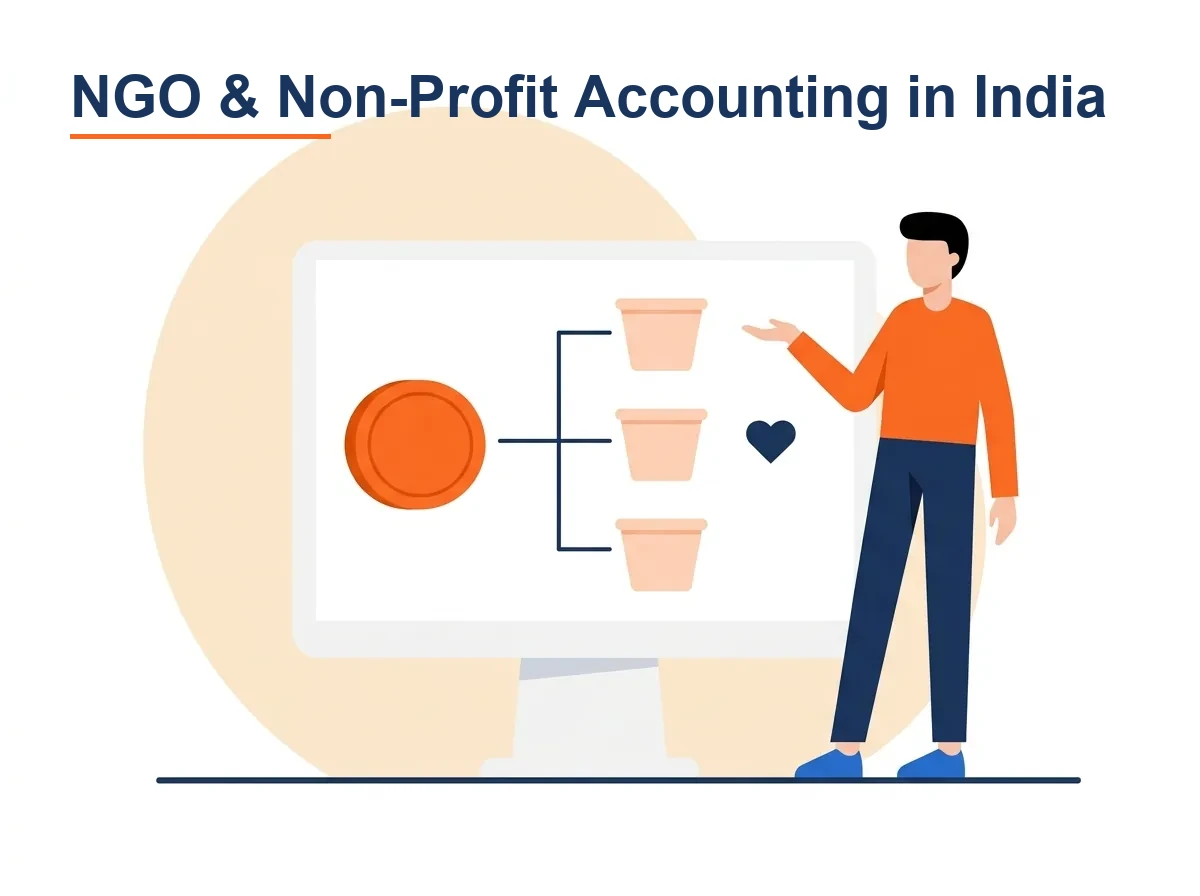
A grant is the unit this work is organised around, with every rupee tagged, from the day it is received, to the fund that paid for it. NGO accounting services keep restricted, unrestricted and corpus balances apart across the whole year. Coding on that basis means a donor can be shown exactly how a contribution was applied, without a reconstruction at audit time.

Fund-wise ledgers are maintained, donor and utilisation schedules prepared, and registrations under Section 12A and 80G kept current, so exemption is not lost. Corpus and restricted gifts are held to the donor's condition rather than released to general use. Where foreign contribution is received, it operates the designated bank account the law requires and files the related returns from it. Trust accounting services of this kind also watch the rule that most income be applied to the objects each year. This engagement stays with the books and the fund reports; commercial income-tax filings sit elsewhere.

Key Terms for NGO and Non-Profit Accounting:

What Are NGO Accounting Services. A grant is the unit this work is organised around, with every rupee tagged, from

Who Needs NGO Accounting Services in India?

NGO accounting services fit organisations that answer to their funders as much as to the tax department. Most are trusts, societies and Section 8 companies whose incoming money carries conditions, and cannot simply pool into one general fund.

  • Trusts that have just received their first foreign grant and now must run an FCRA designated account.
  • Section 8 companies juggling several donor projects at once, each grant tied to its own approved budget.
  • NGOs that must issue utilisation certificates to donors and collect them back from implementing partners.
  • Registered charities filing the annual statement of donations so their donors can claim 80G relief.
  • Societies whose auditor needs Form 10B this year because foreign contribution has changed the report form.
  • CSR-funded foundations reporting to corporate donors on how each project's budget was actually spent.
  • Trusts holding corpus gifts with written donor directions that cannot be spent as ordinary income.

Our NGO Accounting Services

ServiceWhat We Do
Fund-based accounting by restrictionReceipts segregated into corpus, restricted and unrestricted funds with donor direction on record, so each fund is reported and used correctly Monthly
FCRA accounting and utilisationForeign contributions kept unmixed in the designated account with utilisation tracked, following FCRA compliance for NGOs and its schedules Monthly
Project spending against approved budgetsGrant spending tracked activity by activity against approved donor budgets, with shared overheads allocated on a documented basis for each project Monthly
Donor certificates and Form 10BD supportDonation records reconciled to prepare Form 10BD and 10BE donor certificates, so what donors claim matches what the trust reports Annually
Grant and donor reporting packsUtilisation certificates and expense statements compiled for donors and collected from implementing partners, giving trust accounting services donors can rely on On event / as needed
Statutory schedules and audit-ready booksPrescribed trust records maintained and audit-ready schedules prepared, delivered as ngo accounting services with FC assets kept on a separate register Monthly
Our Process

How NGO Accounting Services Work — Our Process

How Patron delivers ngo and non-profit accounting, step by step from onboarding to a clean monthly close.

Step 1

Segregating receipts by restriction

Every receipt is classified at entry as corpus, restricted grant or unrestricted, with donor name, address and identification recorded. Corpus is treated as corpus only where the donor gave a specific written direction, and is then held in the permitted investment forms.

Illustration for Segregating receipts by restriction: Every receipt is classified at entry as corpus, restricted grant or
Step 2

Keeping FCRA funds unmixed

Where you hold FCRA registration, foreign contribution is received only in the designated FCRA account at the specified State Bank of India branch in New Delhi. From there it moves to utilisation accounts. Foreign and domestic money never share an account or a voucher series.

Illustration for Keeping FCRA funds unmixed: Where you hold FCRA registration, foreign contribution is received only in the
Step 3

Project-wise utilisation against budget

Spending is booked against the project and activity it belongs to and compared with the approved budget line by line. Shared overheads are allocated on the basis each donor accepted, and sub-grantee statements are absorbed before their utilisation is reported onward.

Illustration for Project-wise utilisation against budget: Spending is booked against the project and activity it belongs to
Step 4

Maintaining prescribed trust records

Beyond the ledgers, the rules prescribe a specific set of records for a registered trust: contributions received, application of income, projects run, and details of specified persons. We keep those in the prescribed form rather than reconstructing them at audit.

Illustration for Maintaining prescribed trust records: Beyond the ledgers, the rules prescribe a specific set of records for
Step 5

Donation statement to donor certificates

Donations eligible for deduction are reconciled from the receipt register to the statement of donations filed, and the certificates issued to donors are tied back to it. Mismatches are corrected before donors query their own tax records.

Illustration for Donation statement to donor certificates: Donations eligible for deduction are reconciled from the receipt
Step 6

Determining the audit report form

Which audit report applies is tested each year: total income above the prescribed level, any foreign contribution received, or income applied outside India pushes you to the longer form. We settle that early so the right schedules are built through the year, not in a rush.

Illustration for Determining the audit report form: Which audit report applies is tested each year: total income above the
Step 7

Carrying forward FCRA schedules

The previous annual FCRA return's closing balances, asset schedule and utilisation position become this year's opening figures, and interest earned on foreign contribution is itself treated as foreign contribution. Assets bought from FC funds stay on a separate register.

Illustration for Carrying forward FCRA schedules: The previous annual FCRA return's closing balances, asset schedule and

Documents Required for NGO Accounting Services

Section 12A and FCRA both turn on where each rupee came from, so donor records and corpus letters carry more weight than the receipt.

  • Record of voluntary contributions with donor name, address and PAN, split into corpus, restricted and unrestricted
  • Corpus donation letters carrying the donor's specific written direction
  • Grant sanction letters, donor agreements and approved project budgets with restriction conditions
  • FCRA designated account statement (SBI Sansad Marg, New Delhi) and all FCRA utilisation account statements
  • Prior year Form FC-4 annual return with its FCRA asset and utilisation schedules
  • Utilisation certificates issued to donors, and UCs plus expense statements collected from sub-grantees / implementing partners
  • Project-wise and activity-wise expenditure statements with the cost-allocation basis for shared overheads
  • Prior year Form 10B / 10BB audit report, Form 10BD statement of donations and Form 10BE certificates
  • Bank statements for every account, separated into domestic and FCRA accounts
Client Portal

How You Work With Patron

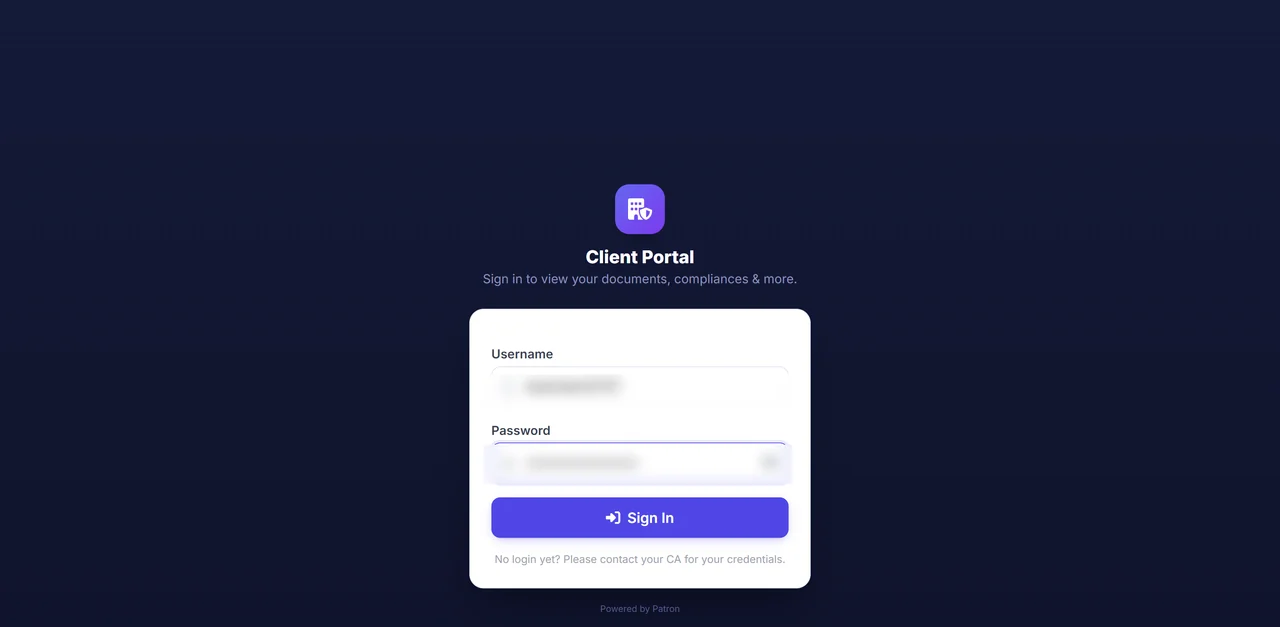
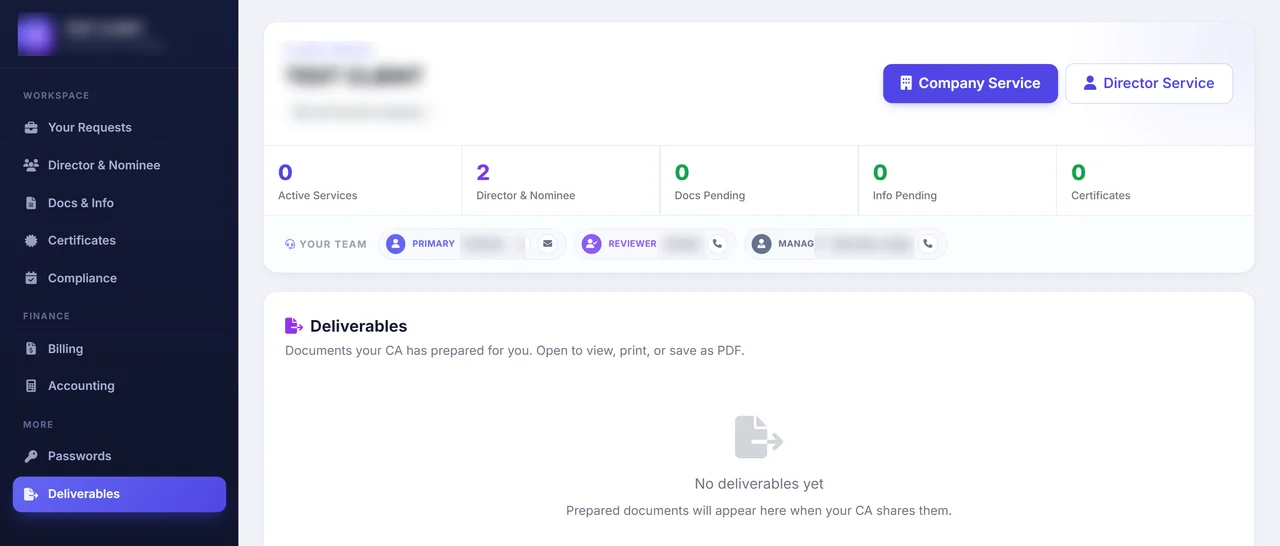
Everything happens in one secure login. You can see your active services, the Patron team on your account, and anything still pending. Once you raise a request, it moves through the same clear steps every time, so you always know exactly where your work stands.

Secure client portal login screen
1

Sign in securely

Your books, documents and requests all sit behind one private, password protected login. The team handling your account is shown on screen, so nothing sensitive ever needs to travel over email or WhatsApp.

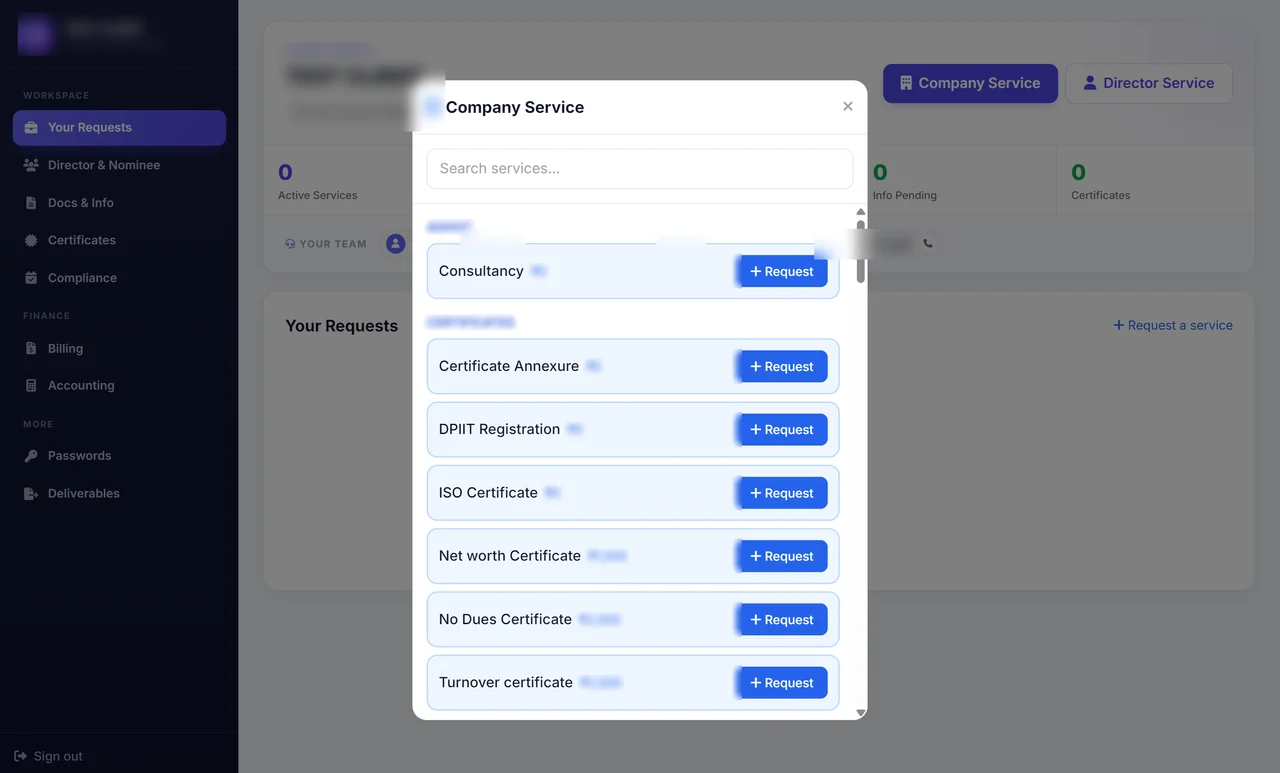
Service catalogue inside the client portal
2

Raise your request

Choose the service you need from the menu inside the portal, where the price is shown before you go ahead. Your request is logged the moment you send it, with no phone calls or reminder emails to wait on.

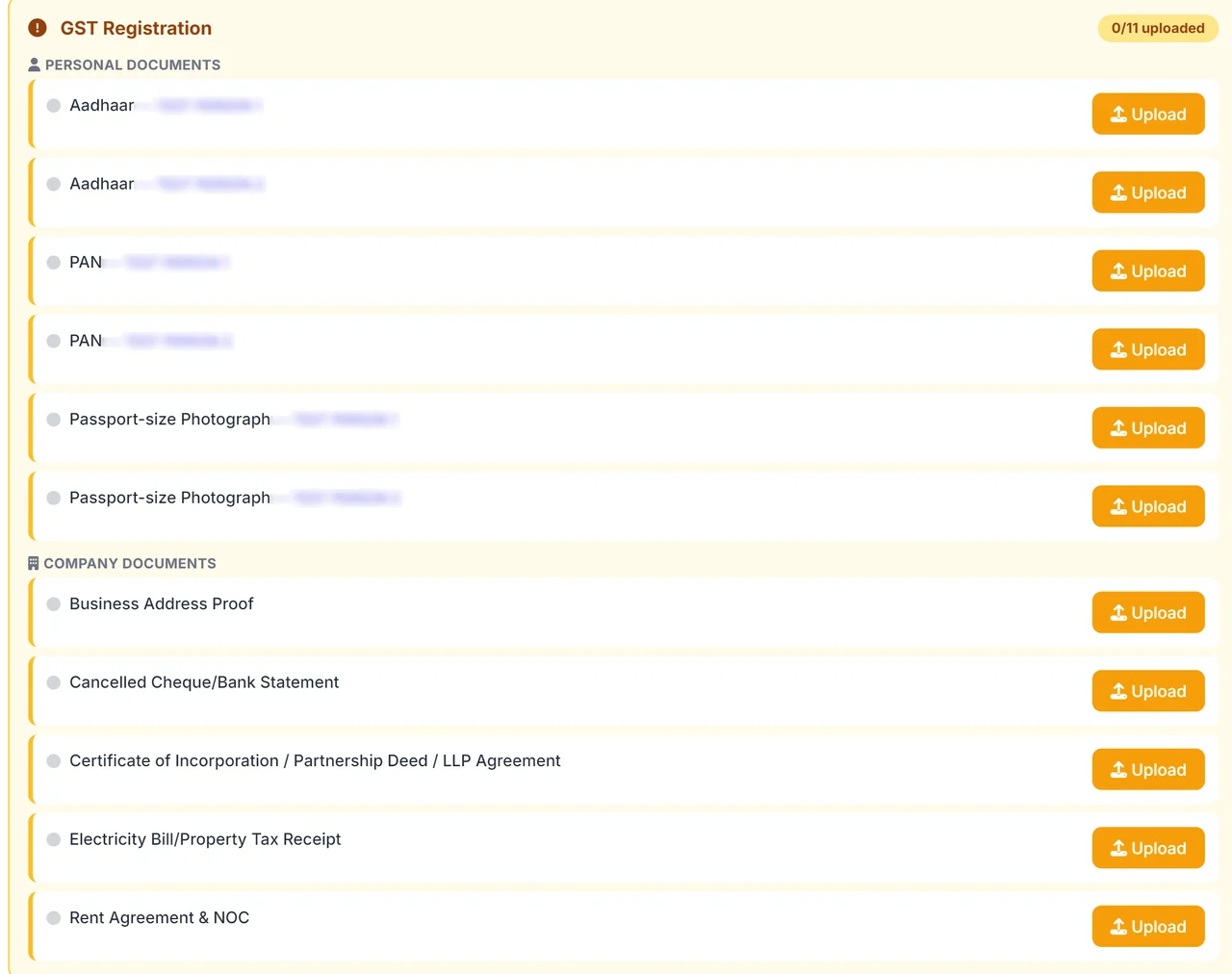
GST registration document checklist in the client portal, with an upload button beside each item
3

Share what the service asks for

For every service, the portal lists the exact documents it needs, each with its own upload button. The example shown here is the GST registration checklist. When a service needs nothing from you, it simply asks for nothing.

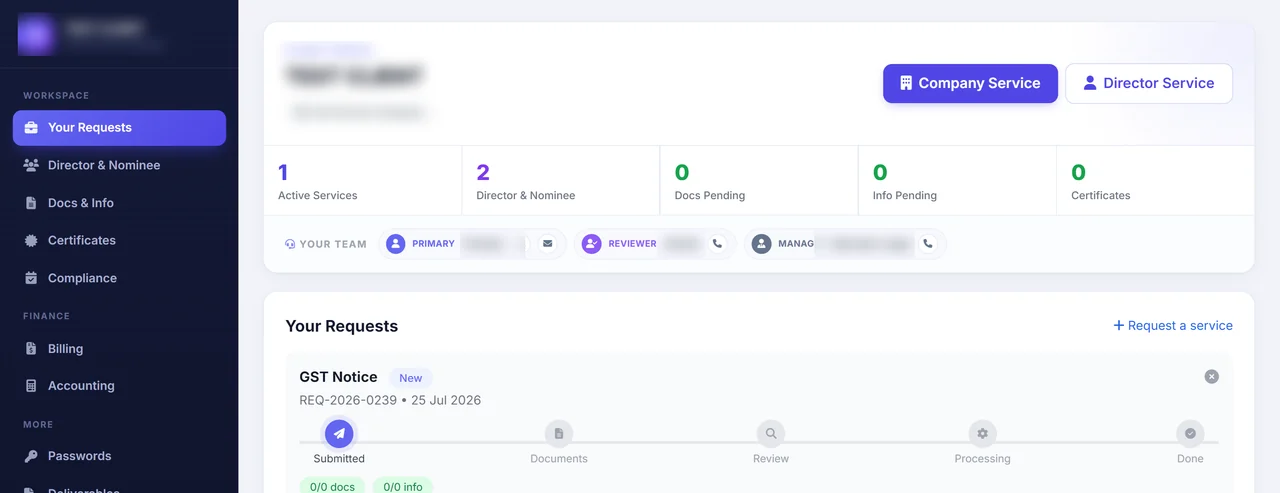
Live request tracker inside the client portal
4

We review, prepare and file

Once your documents are in, your team checks them, prepares the work and files it for you. A live tracker shows each stage as it happens, from review to processing to done, so you never have to ask where things stand.

Deliverables area of the client portal
5

Collect your finished work

Every completed return, computation and certificate is placed in your Deliverables area. You can open, print or download any of them as a PDF whenever you need a copy.

Common NGO Accounting Challenges and How We Solve Them

ChallengeImpactHow Patron Accounting Solves It
Grant spend not matched to the sanctioned budget lineOverspend on one head goes unnoticed until the funder's audit disallows the excess.Our team maps each cost to its sanction budget line and flags variance before reporting to the funder.
Assets bought from grants not tracked to the funderOwnership and disposal conditions on grant-funded equipment are lost, breaching the grant terms.We maintain a grant-wise fixed asset register with funding source and restriction recorded against each item.
Donations in kind recorded at nominal or no valueIncome and expenditure are both understated, distorting the true cost of running programmes.Patron values donations in kind at fair value and records both the receipt and its use.
Section 8 depreciation applied inconsistently to grant assetsSurplus is misstated, complicating the 15% accumulation and application test at year end.We apply consistent depreciation and reconcile income application for the annual 12A and 80G upkeep.
Programme and administrative costs not splitFunders see an inflated overhead ratio, which hurts approval of future grants.Our team allocates shared costs between programme and admin on a documented, defensible basis.

NGO Accounting Fees

Fee ComponentAmount
Starter — one trust with a small set of restricted fund headsINR 2,499
Excl. GST & Government Charges
Growth — more grants, added fund heads or FCRA fund trackingOn quote
Managed — multiple entities with custom donor and fund reportingOn quote

For a single trust with a few restricted fund heads, NGO accounting services begin at INR 2,499. The fee grows with the number of grants and separate fund heads your books track, a split our guide to restricted versus unrestricted funds covers. Speak with an accounting specialist on +91 94594 56700.

Fees exclude GST and government charges. Final quote confirmed after a scoping review.

All fees and charges listed are indicative only and do not constitute a binding offer. Final amounts may vary depending on the volume of work and the complexity involved.

Professional accounting and compliance charges are scoped to your number of entities, funding stage and monthly transaction volume, and are separate from statutory and government charges. Contact us for a detailed, fixed quote.

Get a free NGO and Non-Profit Accounting consultation - Call +91 945 945 6700 or WhatsApp us. No-obligation assessment.

NGO Accounting Compliance Calendar 2026

ComplianceDue DateApplies To
TDS / TCS deposit (Challan ITNS-281)7th of every month (30 April for March)Every business that deducts tax at source on salaries, rent, contractor or professional fees
Provident Fund (ECR) and ESI contribution15th of every monthEmployers registered under EPF and ESI
GSTR-3B (summary return and tax payment)20th of every month for monthly filersGST-registered businesses filing monthly; QRMP filers pay via PMT-06
80G / 12A renewal and Form 10BD statement of donations31 May 2026Trusts issuing 80G receipts to donors
Trust audit report (Form 10B / 10BB)30 September 2026Charitable trusts and institutions registered under 12A/12AB
Trust income-tax return (ITR-7)31 October 2026Registered trusts, societies and Section 8 companies
Annual GST return GSTR-9 and reconciliation GSTR-9C31 December 2026GST-registered businesses above the annual-return and audit thresholds
FCRA annual return (Form FC-4)31 December 2026NGOs holding FCRA registration and receiving foreign contribution

For an NGO the year turns on 30 September, when the Form 10B audit is due, and 31 December for the FCRA annual return FC-4. The 80G renewal and Form 10BD fall on 31 May. Patron keeps NGO accounting and grant reporting on one calendar so registration and foreign-contribution status hold. Book a compliance review with a Patron CA on +91 94594 56700.

Key Benefits

Why Professional NGO Accounting Matters

Corpus that stays corpus

The permanent fund on your balance sheet is one you can evidence entry by entry, from the paperwork the donor signed.

  • receipts segregated by restriction, corpus evidenced entry by entry
  • corpus donation letters held as the footing
  • Without it, corpus reclassified as ordinary income on assessment

Foreign and domestic money apart

Foreign contribution enters only the designated FCRA account and moves to utilisation accounts. It never shares an account or voucher series with domestic funds.

  • foreign contribution kept in the designated SBI New Delhi account
  • no account or voucher series shared with domestic funds
  • Without it, the FCRA registration itself questioned

Donor certificates that match filings

Your receipt register is reconciled to the statement of donations filed, and the Form 10BE certificates issued tie back to it.

  • receipt register reconciled to Form 10BD filed
  • Form 10BE certificates issued tie back to the register
  • Without it, donors lose a deduction and come back to you

Spending held to the approved budget

We book each cost to the project and activity that incurred it. Each head is checked against what the funder sanctioned.

  • spending compared with the approved budget line by line
  • overheads split on the basis each donor accepted
  • Without it, a donor disallowance refunded from unrestricted funds

Prescribed trust records kept live

A question about which project spent what, or who among your specified persons benefited, is answered from records that already exist.

  • Prescribed record set for a registered trust kept current
  • Specified-person and project queries answered from existing records
  • Without it, reconstruction from bank statements takes weeks of senior time

FC assets on their own register

Assets bought from foreign contribution are held on a separate register. Interest earned on those funds is itself treated as foreign contribution.

  • FC asset register kept apart from the general schedule
  • interest on foreign contribution treated as foreign contribution
  • Without it, years of purchase history rebuilt for the annual return

Why Businesses Choose Patron Accounting for NGO & Non-Profit Accounting

Five things a founder can check before handing over the books. Each is a claim with the proof behind it.

Grant-wise books tracking every donor restriction

With 15+ years across 3,000+ businesses, we keep grant-wise books where each donor restriction is tracked to its condition, so restricted and unrestricted funds never blur together.

FCRA reporting, 12A/80G compliance and Form 10B audit

FCRA reporting, 12A and 80G compliance and the Form 10B audit are routine filings, part of the 25,000+ filings completed, so donor and department deadlines are always met.

Fund accounting configured per donor, not per account

We work in whichever of Zoho Books, Xero, Tally Prime or Odoo you run, configuring fund accounting by donor and project rather than simply by bank account.

Utilisation certificates and fund-wise statements every month

Every month we prepare utilisation certificates and fund-wise statements, the cadence behind our 25,000+ filings, so each donor sees exactly how its grant was spent against the approved budget.

Trusts and Section 8 companies among 3,000+ served

Trusts, societies and Section 8 companies sit among the 3,000+ businesses on our accounting and bookkeeping services since 2019. Our in-house team of CAs and CS, 15+ years, a 4.9 star Google rating.

Figures reflect Patron Accounting LLP engagements since 2019. Scope and turnaround are confirmed in your engagement letter.

Fund-Based Accounting vs Commercial Accounting

CriterionFund-Based AccountingCommercial Accounting
Core unitFund-based: money grouped into restricted, unrestricted and corpus funds.Commercial: a single profit and loss and balance sheet.
Revenue recognitionFund-based: grants tied to purpose, recognised as they are spent.Commercial: income booked on accrual when it is earned.
Statutory fitFund-based: expected for 12A, 80G upkeep and Form 10B reporting.Commercial: suits a taxable trading arm, not exempt objects.
FCRA handlingFund-based: foreign contributions kept on a separate designated set.Commercial: no built-in segregation, raising FCRA breach risk.
Donor reportingFund-based: utilisation certificates map to each individual grant.Commercial: hard to prove restricted money spent as intended.
MIS clarityFund-based: surplus per fund visible to the trustees.Commercial: overall surplus clear, but purpose-wise view lost.
VerdictFund-based accounting is the expected basis for exempt trusts. FCRA needs separate books, and the 85% application test and Form 10B reporting rely on it. Proper ngo accounting services keep fund-based accounting for NGOs central.

Legal and Regulatory Framework for NGO Accounting

What the law protects in a not-for-profit is the donor's and the exchequer's shared interest that money given for a purpose was actually spent on it, and Sections 11 and 12 of the Income-tax Act are where that protection is written. Exemption is not automatic; it is earned by applying income to the stated objects and evidencing it.

So the books are built to prove application, restriction and source, all three. A minimum share of the year's income has to be spent, foreign money has to sit in a ring-fenced account, and every donation has to be reported for the donor's deduction to hold. That is why the FCRA Designated Bank Account and Fund-Based Accounting are structural, not optional. NGO accounting services keep these evidenced against the provisions below.

  • Sections 11, 12 and 12AB, Income-tax Act 1961A 12AB-registered trust or society is exempt on income applied to charitable objects, subject to the 85% application rule.
  • Foreign Contribution (Regulation) Act 2010Foreign donations require FCRA registration or prior permission, a designated SBI New Delhi account and annual reporting in Form FC-4. The FCRA Rules 2011 and CBDT's 12AB registration notifications frame the reporting.
  • Section 80G with Form 10BD80G approval lets donors deduct their gift, and the trust reports each donation in the Form 10BD statement - relevant to Restricted Corpus Donations.
  • Section 12A(1)(b) with Form 10B/10BBThe trust files an audit report in Form 10B or 10BB, and fund accounting keeps restricted and unrestricted funds apart.
  • Section 44AA, Income-tax Act 1961Books are maintained once receipts cross the prescribed limits, so the application of income can be computed and defended.
  • Rule 3(1), Companies (Accounts) Rules 2014Where accounting software is used the audit trail stays enabled, so a grant reallocation is always logged. Securing 12A/80G itself is handled on the hub page.

Practical note: During an income-tax assessment, the 85% application of income and the FCRA utilisation are examined first; a shortfall in either is the common trigger for a loss of exemption.

Official sources: Ministry of Corporate Affairs · Income Tax Department · GST Portal · Startup India (DPIIT)

What accounting records must an NGO or trust maintain in India?

An NGO must keep a cash book, ledger, vouchers, receipt register, donation register with donor details, fixed asset register and grant-wise utilisation statements, maintained separately for each project or funding source. Trusts and societies claiming income tax exemption must keep books in the manner the Income Tax Rules prescribe. FCRA recipients maintain a wholly separate set.

Why do NGOs use fund-based accounting instead of ordinary commercial accounting?

Fund accounting separates restricted, unrestricted and corpus funds, so every donor can be shown exactly how their money was used, which profit-focused commercial accounting cannot do. A CSR grant for school buildings cannot sit in the same pool as general donations. Each fund carries its own opening balance, receipts, utilisation and closing balance in the statements.

How do you keep FCRA funds and domestic funds separate?

Foreign contribution is received only into the designated FCRA bank account, with a separate utilisation account and an entirely separate set of books, and is never mixed with domestic donations. We maintain parallel ledgers, asset registers and project reports for each side. Mixing the two is among the most common reasons registrations get suspended.

What are the annual compliance filings for a registered NGO?

The income tax return in Form ITR-7 and the audit report in Form 10B or 10BB are the core annual filings, along with Form 10BD for donations received and Form FC-4 for organisations holding FCRA registration. Societies and Section 8 companies have separate filings with their registrar. You get a dated compliance calendar at onboarding.

How do you handle CSR grant reporting for corporate donors?

Each CSR grant is tracked as its own fund with a budget versus actual utilisation statement, supporting vouchers and an activity report mapped to the agreement milestones. Corporate donors normally require a utilisation certificate signed by a chartered accountant, plus unspent balances reported at year end. We build these packs so donor audits close without repeat queries.

Can weak accounting put 12A or 80G registration at risk?

Yes. Registration can be cancelled where books are not maintained as prescribed, application of income cannot be evidenced, or the audit report is filed late. Donation receipts issued without the details needed for Form 10BD also break the donor's own deduction claim. We fix record-keeping first, because renewals are now scrutinised far more closely.

What does NGO accounting cost?

A small trust with one or two funding sources typically pays Rs 6,000 to Rs 12,000 a month, while an FCRA-registered NGO running several donor projects sits at Rs 20,000 upward because of separate books and donor reporting. Annual audit, return filing and FCRA reporting are quoted separately. We price on number of funds and transaction volume.

What happens when an NGO's previous accountant leaves mid-year and records are incomplete?

We begin by reconstructing the cash and bank position from statements, donation receipts and vouchers, which usually takes 3 to 6 weeks depending on the number of projects. Missing donor confirmations are collected in writing. Where filings have already lapsed, every pending return is listed with its exposure before you decide the order of regularisation.

Do NGOs have to deal with TDS and GST?

Yes. An NGO deducts TDS on rent, contractor and professional payments exactly like any other entity, and GST can apply where it supplies services for consideration, since charitable registration alone does not exempt every activity. We review each income stream to separate exempt receipts from taxable supply, then handle the registrations and periodic returns.

Which bank is best for an NGO account?

For foreign contribution there is no choice of bank: an FCRA registered NGO must hold its designated FCRA account with the State Bank of India, New Delhi Main Branch, following the FCRA Amendment Act 2020, while a utilisation account can be opened with any scheduled bank. For domestic funds, choose a bank offering project wise sub accounts, digital donation collection and clean statement narration, because audit trail matters more than the interest rate.

Quick Answers

Coding starts the day a receipt is entered, tagged to the grant that funded it, so restricted, unrestricted and corpus balances stay apart through the year instead of being untangled at audit time. You keep the grant agreements, the board minutes and the field vouchers, while Patron takes the posting, the fund-wise.

NGO and Non-Profit Accounting Deadlines You Cannot Afford to Miss

TDS / TCS deposit (Challan ITNS-281) is due 7th of every month (30 April for March). Provident Fund (ECR) and ESI contribution is due 15th of every month. GSTR-3B (summary return and tax payment) is due 20th of every month for monthly filers. Patron tracks each against your books so nothing is reconstructed after the fact. Call +91 94594 56700 to set up a filing-reminder schedule.

Start Your NGO Accounting Services with Patron Accounting

Trustees are really deciding how much of a programme officer's week goes into paperwork. Every hour spent reconstructing which grant paid for a field vehicle or a training camp is an hour not spent in the field. The reconstruction happens anyway, later, under a donor's questions rather than on your own timetable.

Applying for a larger grant becomes a decision rather than a gamble once mid-year you can see how far each existing commitment has been drawn. Where foreign contributions are involved, FCRA accounting shows what a funder's ceiling really means: what the organisation can genuinely absorb and account for within the year.

Funder reporting formats are confirmed at the start: what each of your donors demands, in which template, and on what cycle. Books built without those formats in mind get rebuilt for every report, much as reporting for technology clients is shaped by its readers.

Book a Free Consultation - No Obligation.

NGO and Non-Profit Accounting Near You

Local teams for ngo and non-profit accounting in these cities.

Cities We Serve
On-ground teams
Reviewed by the CA & CS Team, Patron Accounting LLP
ICAI & ICSI registered  ·  15+ years in Indian accounting & compliance  ·  Last reviewed 23 July 2026  ·  Next review 23 October 2026