
Talk to an expert

Tell us what you need and we will call you back.

🇮🇳 +91

    Income Tax & ITR

    ITR Filing for Professionals

    File your return as a doctor, lawyer, chartered accountant, architect, consultant or freelancer with a CA; your receipts matched with your AIS and Form 26AS, the right way of declaring profit chosen, and the return filed by your due date.

    ITR filing for professionals: Professional income? File it cleanly.
    Your return, at a glance What is settled before it is filed
    Fee Starting from ₹1,499 Depends on presumptive or full books, a tax audit and what else is in the return · excludes GST and government charges
    • Receipts matched first Your fee receipts and the tax your clients deducted are checked against your AIS and Form 26AS
    • Presumptive or regular books The way of declaring profit is decided before the form is chosen
    • Both regimes compared Your tax worked out the old way and the new way before you choose
    • ITR-3 or ITR-4, filed and e-verified The right form, filed by the due date, with help to finish verification
    FY 2025-26 returns (filed in 2026) are under the Income-tax Act, 1961. The Income-tax Act, 2025 applies from tax year 2026-27 (returns filed in 2027).

    In short

    What professional ITR filing covers

    If you earn fees from your own practice (as a doctor, lawyer, chartered accountant, architect, engineer, consultant, designer or freelancer) that income is taxed as income from "business or profession". It is not salary, even if one client pays you every month.

    Your return brings together your fees, your expenses or the presumptive profit you declare, the tax your clients have already deducted, and any other income such as salary, rent, interest or capital gains.

    Which tax law applies

    • FY
      25-26
      Income-tax Act, 1961 FY 2025-26 returns (filed in 2026) are under the 1961 Act.
    • TY
      26-27
      Income-tax Act, 2025 Applies from tax year 2026-27 (returns filed in 2027).

    This service is for

    • Professionals in their own practice, alone or in a partnership firm
    • Consultants and freelancers paid by Indian or overseas clients
    • Salaried people who also earn fees from a side practice
    • Professionals whose clients deduct tax at source on their fees

    When we file your return, the work covers

    1. Checking your fee receipts against your AIS and Form 26AS
    2. Deciding whether you can declare profit on a presumptive basis or should report actual profit from your books
    3. Working out your tax under the old and the new regime
    4. Choosing the right form, filing the return and helping you e-verify it
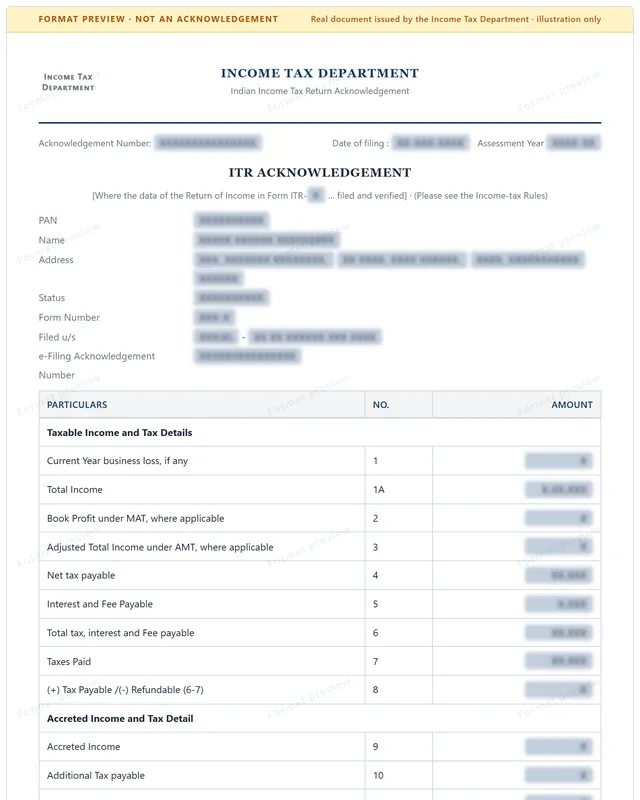
    Sample with values hidden Sample ITR acknowledgement with all values hidden

    See a sample

    ITR acknowledgement

    The acknowledgement that an income-tax return was filed.

    Issued by
    Income Tax Department, through the e-filing portal
    When you get it
    Right after the return is filed.

    Values hidden for privacy. Names, numbers and dates are covered. Your own document carries your details.

    Download ITR acknowledgement sample (PDF) View ITR acknowledgement sample

    The core choice

    Presumptive profit or regular books

    There are two ways to work out a professional's taxable profit.

    PointPresumptive basisRegular books
    How profit is worked outA fixed share of your gross receipts is treated as your profitGross receipts minus the expenses you actually incurred, with depreciation
    Expense recordsNot needed to claim expensesNeeded for every expense you claim
    Advance taxThe whole amount by 15 MarchFour instalments: 15%, 45%, 75% and 100% by 15 June, 15 September, 15 December and 15 March
    Usual formITR-4 (if you qualify)ITR-3
    SuitsPractices with low expensesPractices with staff, rent, equipment or other large costs

    Advance tax rules are the same for FY 2025-26 (1961 Act s.211) and tax year 2026-27 (the corresponding provision of the 2025 Act). Advance tax applies only when the tax for the year, after TDS, is ₹10,000 or more.

    The presumptive scheme for professionals

    50% of gross receipts is treated as profit, or more if you actually earned more. Open where gross receipts are up to ₹50 lakh, or up to ₹75 lakh if cash receipts are no more than 5% of the total.

    For a resident individual or partnership firm (not an LLP, not an HUF) in a listed profession: section 44ADA for FY 2025-26, the corresponding provision of the 2025 Act for tax year 2026-27.

    Which professions can use it

    The listed professions for FY 2025-26 and for tax year 2026-27, the 2025 Act list differs from the earlier one.

    For tax year 2026-27, the corresponding provision of the Income-tax Act, 2025 lists legal, medical, engineering, architectural, accountancy, technical consultancy, interior decoration, information technology and company secretary work, and any other profession the Board notifies. For FY 2025-26, section 44AA(1) of the 1961 Act lists legal, medical, engineering, architectural, accountancy, technical consultancy and interior decoration, and the notified professions: authorised representative, film artist, company secretary and information technology.

    Not one of the listed professions?

    Many software, design, content and marketing freelancers are not. The presumptive scheme for businesses is not automatic: it applies only where the work is a business other than commission, brokerage or agency work. You are a resident individual, HUF or firm other than an LLP within its turnover limit (section 44AD for FY 2025-26; the corresponding provision of the 2025 Act for tax year 2026-27). We check which one fits your work before filing.

    The form

    Which form a professional files

    The form follows from how you declare profit and from who is filing; you alone, or a firm.

    • ITR-4 Sugam, the short form Income declared on a presumptive basis

      For a resident individual or HUF (not "not ordinarily resident") or a resident firm other than an LLP, with total income up to ₹50 lakh. Using it is optional.

      • Not open if, among other things, you are a company director, held unlisted shares, have foreign assets or foreign income, or have losses to carry forward.
    • ITR-3 The full form Business or professional income, actual profit from books

      For an individual or HUF with business or professional income who does not qualify for, or does not choose, the simpler forms.

      • Also carries salary, house property, capital gains and other income in the same return.
    • ITR-5 Firms and LLPs A professional firm or LLP files its own return

      The firm's return is separate from each partner's own return.

      ITR-5 in both years: rule 164(8) of the Income-tax Rules, 2026 for tax year 2026-27, and the ITR-5 notified for AY 2026-27 for FY 2025-26.

    FY 2025-26: Income-tax Rules, 1962, rule 12. Tax year 2026-27: Income-tax Rules, 2026, rule 164(5)-(7). For tax year 2026-27 ITR-4 is also not open to a person with more than two house properties. Read more: ITR-4 and ITR-3.

    If you also have a salary

    Your fees still go in the business-or-profession part of the return, so a one-page salary form will not do. Your salary and your practice income are shown together in ITR-3, or in ITR-4 if you qualify.

    Salary-only returns: ITR Filing for Salaried Individuals

    How we work

    How we file a professional's return

    Eight steps, in the order they happen.

    1. Collect your records

      Your fee register or invoice summary, bank statements, AIS and Form 26AS, and TDS certificates from clients. If you keep books, your expense records too.

    2. Match receipts and TDS

      We compare the fees and TDS shown in your AIS and Form 26AS with your own records, so every rupee of tax deducted by clients is claimed and nothing reported against your PAN is missed.

    3. Confirm your profession and the basis of profit

      We check whether your work is a listed profession and whether the presumptive basis or regular books gives the right result for you.

    4. Compare the two regimes

      We work out your tax under the old and the new regime. If you have business or professional income and want the old regime, the choice has to be made by the due date. For tax year 2026-27 it is made in the return itself; there is no separate Form 10-IEA.

      For FY 2025-26, the old regime is chosen by filing Form 10-IEA on or before the return due date, and that choice can be withdrawn only once.

    5. Choose the form

      ITR-4 or ITR-3, based on how profit is declared and what else you earned.

    6. Report foreign fees correctly

      Fees from overseas clients are part of your professional receipts. If you are resident and ordinarily resident, foreign accounts and assets are also reported.

      Foreign tax credit: for FY 2025-26, Form 67 is filed by the end of the assessment year (31 March 2027) where the return is filed by the due date or as a belated return (rule 128(9) of the Income-tax Rules, 1962); for tax year 2026-27, Form No. 44 is filed within twelve months from the end of the tax year where the return is filed under section 263(1) or (4) (rule 76(12) of the Income-tax Rules, 2026). Schedule FA (foreign assets) must be filled by a resident who is ordinarily resident. Leaving out a foreign asset or foreign income can attract a penalty of ₹10 lakh under section 42 or 43 of the Black Money Act, 2015. This does not apply where the foreign assets other than immovable property total ₹20 lakh or less (from 1 October 2024).

    7. Work out the tax and validate

      We apply the rebate where you qualify, take off TDS and advance tax, pay any balance before filing, and clear every error the portal's checks raise.

    8. File and e-verify

      The return is filed by the due date and e-verified, for example through Aadhaar OTP or net banking. For FY 2025-26 returns, verify within 30 days of filing; if you verify later, the date of verification is treated as the date of filing, and a return never verified is treated as not filed.

    The rates

    Tax rates for professionals

    Your profit from the profession is added to your other income and taxed at the normal slab rates.

    New regime (any age)Tax rate
    Up to ₹4,00,000Nil
    ₹4,00,001 to 8,00,0005%
    ₹8,00,001 to 12,00,00010%
    ₹12,00,001 to 16,00,00015%
    ₹16,00,001 to 20,00,00020%
    ₹20,00,001 to 24,00,00025%
    Above ₹24,00,00030%

    Same slabs and rebate for FY 2025-26 and tax year 2026-27 (Finance Act, 2026).

    Old regime, a person below 60

    • Up to ₹2,50,000 Nil
    • Up to ₹5,00,0005%
    • Up to ₹10,00,00020%
    • Above ₹10,00,00030%

    A 4% cess is added on the tax and any surcharge, under either regime.

    Rebate, new regime Up to ₹60,000 for a resident individual with total income up to ₹12,00,000
    Rebate, old regime Up to ₹12,500 for a resident individual with total income up to ₹5,00,000

    What to keep ready

    Documents to keep ready

    Every professional's return needs the first five. The rest depend on how you keep your accounts and where your clients are.

    • 01 PAN and Aadhaar
    • 02 Your AIS and Form 26AS
    • 03 TDS certificates from clients who deducted tax on your fees
    • 04 Fee register or invoice summary, with client-wise totals
    • 05 Bank statements for every account used for the practice

    Depending on your case

    • 06
      If you keep regular books Expense bills, staff salary records, rent agreement and a list of equipment bought
    • 07
      If you have overseas clients Bank or payment-platform statements showing each foreign receipt
    • 08
      If you use the old regime Proof of investments and insurance

    Keeping books

    Under the Income-tax Act, 2025, people in the listed professions must keep books of account whatever their income, and keep them for seven tax years. Read more: Books of Account.

    For FY 2025-26, under section 44AA(1) of the 1961 Act and rule 6F of the Income-tax Rules, 1962, a person in a listed profession keeps a cash book, a journal (if accounts are on the mercantile system), a ledger, copies of bills issued (above ₹25), and original bills and receipts for expenses (or signed payment vouchers for expenses up to ₹50 where no bill is issued). This applies where gross receipts were above ₹1.5 lakh in each of the three preceding years. These books are kept for six years from the end of the assessment year.

    Dates

    Due dates

    The date depends on whether your accounts need a tax audit.

    Your situationFY 2025-26 (1961 Act)Tax year 2026-27 (2025 Act)
    Professional income, no tax audit31 August 202631 August 2027
    Professional income with a tax audit31 October 202631 October 2027
    No business or professional income31 July 202631 July 2027

    The Finance Act, 2026 moved the non-audit business and profession date from 31 July to 31 August.

    Tax Audit under Section 44AB

    If your receipts cross the audit limit, your accounts must be audited before the return is filed.

    The limit is ₹50 lakh of gross receipts for a profession, in both FY 2025-26 (section 44AB) and tax year 2026-27 (the corresponding provision of the 2025 Act). It does not apply if you declare profit under the presumptive scheme within its limits.

    Filed late?

    ₹5,000 late filing fee₹1,000 if total income is up to ₹5 lakh

    Under section 234F for FY 2025-26 and the corresponding provision of the 2025 Act for tax year 2026-27. Interest on unpaid tax is charged separately.

    For FY 2025-26, a belated return can be filed up to 31 December 2026 and a revised return up to 31 March 2027, unless the assessment is completed earlier. A fee applies to a revision filed after 31 December 2026.

    What it costs

    Fee

    The fee depends on whether you declare presumptive profit or keep full books, whether a tax audit applies, and what else is in the return, salary, capital gains or foreign income.

    Professional fee

    Starting from ₹1,499 (Exl GST and Govt. Charges)

    Fees exclude GST and government charges.

    What moves the fee

    • Presumptive profit or full books
    • Whether a tax audit applies
    • Salary or capital gains in the same return
    • Foreign income

    Tell us what you practise and what else you earned, and we will tell you what the filing will cost.

    Questions

    Frequently asked questions

    The questions professionals ask most before they send us a return.

    Where do I show professional income in my ITR?

    Professional income goes under the head "Profits and gains of business or profession". In ITR-3 it is worked out in Schedule BP, starting from the profit in your accounts. If you declare profit on a presumptive basis and qualify for ITR-4, you report it in that shorter form instead, which has no Schedule BP. It does not go under salary or "other sources", even if one client pays you regularly.

    Do my clients deduct tax from my fees?

    Yes. Under section 194J, Indian clients deduct TDS at 10% on professional fees above ₹50,000 per client in a year. That tax shows in your Form 26AS and AIS and is claimed in your return as tax already paid. If a client deducted the tax but has not deposited it, it will not appear in Form 26AS and cannot be claimed until the client deposits it, so follow up with the client before filing. TDS under section 194J does not by itself make you eligible for the presumptive scheme; that depends on whether your work is a listed profession.

    Can I claim expenses if I use the presumptive scheme?

    No. Under section 44ADA, 50% of your receipts is treated as profit and your expenses are taken as covered by the other half, so they are not claimed separately. Expenses such as office or coworking rent, software, internet, travel for clients, staff and team payments and depreciation on equipment are claimed only when you file ITR-3 on regular books.

    Do I need a tax audit if I declare less than 50% as profit?

    Yes. If you are under section 44ADA but declare profit below 50% of receipts and your income is above the basic exemption limit, a tax audit becomes mandatory. On regular books, the audit applies when gross receipts from the profession are above ₹50 lakh.

    Can I switch between presumptive tax and regular books each year?

    Under section 44ADA there is no five-year lock-in: you can declare presumptive profit one year and file ITR-3 on regular books the next if your expenses are higher. Under section 44AD, the scheme for businesses, opting out before five years means books and a tax audit for the next five years.

    How is income from Upwork, Toptal or Fiverr taxed?

    For a resident it is fully taxable as income from business or profession. Convert each receipt to rupees at the RBI rate on the date it is credited to your bank account (Rule 115), not the rate the platform shows, and keep the FIRC or bank advice for each payment. Under the presumptive scheme the amount credited to your bank is your gross receipt; platform fees can be claimed as an expense only in ITR-3. Foreign platforms do not deduct TDS, so your advance tax has to cover the full tax.

    Do freelancers and professionals need GST registration?

    GST registration is mandatory once your annual turnover from professional work crosses ₹20 lakh (₹10 lakh in special category states), and professional services attract 18% GST. Services to overseas clients can count as export of services, zero-rated under a Letter of Undertaking (LUT). Many freelancers with foreign clients register even below the limit to use the LUT, and many corporate clients ask for a GST invoice.

    Do I also pay professional tax?

    Professional tax is a state levy, so it depends on where you practise. Haryana does not levy it, while Maharashtra, Karnataka and Tamil Nadu do.

    Get a quote

    File your professional return with a CA

    Tell us what you practise, roughly what you received this year and what else you earned. We will tell you which way of declaring profit suits you, which form you need and what the filing will cost.

    Get a quote

    Leave your details and we will call you back.

    🇮🇳 +91

      By sending this form you agree to our privacy policy.

      Call us

      Monday to Saturday, 9 AM to 6 PM

      What you get back

      1. Which way of declaring profit suits you
      2. Which form you need
      3. What the filing will cost

      Get a quote

      Leave your details and we will call you back.

      🇮🇳 +91

        By sending this form you agree to our privacy policy.