Talk to an Expert
Talk to an Expert ✆ +91 945 945 6700
Trusted by 10,000+ Businesses

Accounting for Hospitals and Healthcare Providers

Reviewed by CA and CS Team, Patron Accounting LLP ICAI & ICSI Registered| 15+ Years Experience| Last Updated: July 2026 Verify Credentials →

Receivables aged payer by payer: We follow each claim from raised to approved to settled, against the insurer or TPA that owes it. A part settled claim shows as part settled.

A reason behind every short settlement: Where a claim settles below what you billed, we record the reason against it. Each short settlement carries its cause.

Deducted tax credits fully recovered: We reconcile gross claim value in your register to payer reporting in Form 26AS and AIS. Deducted tax is then traced to your PAN.

Input credit apportioned on real mix: The credit you take is the share your taxable business actually earned. We work it from your own revenue split, not a rule of thumb.

15+ YearsIndustry Experience
CA & CSCertified Experts
4.9
Based on real Google reviews

Get Free Consultation

Talk to a CA/CS expert today

🇮🇳 +91

Our team will get back to you shortly. No spam.

Real Stories from Real People

Verified Google reviews from founders and businesses Patron works with across India.

Join 3,000+ Founders and Businesses on Patron

Rated 4.9 on Google - trusted for startup accounting since 2019.

Talk to an Expert
10,000+Businesses ServedGST compliance and litigation support across India.
15+Years ExperienceDeep expertise in IP registration, GST & business compliance.
50,000+Documents FiledReturns, appeals, and filings handled accurately.
4.9★Client RatingTrusted by entrepreneurs, startups, and growing businesses.
ISO CertifiedProfessional standards and documented processes.
SSL SecureYour financial and business data is fully protected.

What Healthcare Accounting Covers — Scope, Deliverables and Who It Suits

📌 TL;DR - Healthcare Sector Accounting Services at a Glance

Accounting for hospitals ages TPA receivables payer by payer rather than lumping them into one debtors figure. Section 194J is deducted at source on consultant payouts, and individual practices run on the Section 44ADA presumptive basis where it fits. Patron reports department-wise profit and loss and TPA ageing each month. Frequently used by hospitals, clinics, diagnostic chains and practising doctors.

Most hospitals bill from more systems than their ledger has room for. You send the HIS export, the pharmacy and diagnostics billing files, consultant payout sheets, the TPA settlement advices and the bank statements. What comes back is a posted ledger, a consultant payout reconciliation, a deduction summary for the quarter and a schedule of unbilled work your finance head can take straight into a management meeting. Which treatments carry GST decides how the billing lines are coded.

What moves effort is the mix: how many locations bill separately, whether pharmacy and diagnostics run as distinct registrations, the count of empanelled payers and the consultants drawing payouts each month. Healthcare accounting services cover the ledger, the deduction schedules and the reporting pack issued at each month end. Return filing on the GST department's portal sits outside this retainer.

What Is Healthcare Accounting?

A hospital earns from insurers, departments and consultants at once, and one revenue figure hides all of it. Accounting for hospitals is the engagement responsible for pulling that apart: a ledger showing what each department, payer and doctor actually earned and cost. It ages third-party administrator receivables payer by payer, rather than lumping insurance dues into a single debtors figure. It splits revenue between departments, so a management meeting can see which service line carries the month.

Consultant payouts and the tax deducted at source on them are also tracked, and pharmacy stock is kept valued with expired lines written off. It also separates revenue that is exempt from that which is taxable, so each billing line carries the right treatment. For an individual practice, it applies the presumptive basis where the doctor's receipts stay within the statutory cap. Healthcare accounting services here mean the posted ledger, the deduction schedules and the monthly reporting pack that a finance head can act on. Accounting for hospitals stops at the books; the GST and income-tax returns themselves sit with their own teams.

Key Terms for Healthcare Sector Accounting:

What Is Healthcare Accounting. A hospital earns from insurers, departments and consultants at once, and one revenue

Who Needs Healthcare Accounting in India?

Accounting for hospitals fits any provider paid partly by patients and partly by someone else. A TPA, an insurer or a government scheme sits between the treatment and the money. That gap, plus pharmacy stock and doctor payouts, is what separates this work from ordinary bookkeeping.

  • Multi-specialty hospitals billing through TPAs and insurers, where approvals rarely match the claim raised.
  • Clinics and nursing homes empanelled under Ayushman, CGHS or ECHS, waiting on scheme settlements.
  • Diagnostic labs and chains collecting across many centres, needing revenue read location by location.
  • Hospital pharmacies carrying Schedule H stock, where expiry and breakage erode margin quietly.
  • Practising doctors under presumptive tax, or drawing consultant payouts with tax deducted at source.
  • Specialty centres billing fixed packages, where what the payer allows falls short of the quote.
  • Providers mixing exempt treatment with taxable pharmacy and cosmetic revenue, needing input credit apportioned.
  • Hospital groups running separate registrations per unit, where consolidation hides where money is stuck.

Our Healthcare Accounting Services

ServiceWhat We Do
TPA and insurance claim reconciliationClaims raised, approved and disallowed tracked payer by payer, with settlement advices reconciled the way we reconcile TPA and insurance receivables Monthly
Scheme and package receivable trackingGovernment scheme claims such as PM-JAY, CGHS and ECHS tracked against approved packages, with short settlements analysed for each claim Monthly
Deducted tax credit reconciliationSection 194J deducted by TPAs and insurers matched to Form 26AS and AIS, so every rupee of tax credit is recovered Quarterly
Pharmacy inventory and expiry accountingPharmacy purchases, sales and stock reconciled with expiry and breakage provisions, giving medical accounting services that keep drug inventory under control Monthly
Consultant doctor payout accountingVisiting and consultant doctor payouts computed against their engagement terms and correctly classified, supporting clean accounting for doctors and hospital records Monthly
GST revenue split and monthly closeExempt and taxable revenue apportioned for input credit, then a full monthly close delivered as accounting for hospitals with department-wise profit and loss Monthly
Our Process

How Healthcare Accounting Works — Our Process

How Patron delivers healthcare sector accounting, step by step from onboarding to a clean monthly close.

Step 1

Tracking the claim cycle

Every claim is followed from raised to approved to settled, insurer by insurer and TPA by TPA. Settlement advices are matched to bank credits so that a part-settled claim is not shown as fully realised and the receivable ages honestly.

Illustration for Tracking the claim cycle: Every claim is followed from raised to approved to settled, insurer by insurer
Step 2

Analysing disallowances and deductions

Where a claim settles short we record the reason against the claim: tariff cap, non-payable consumable, co-payment or documentation. Recoverable balances are kept alive for re-submission; the genuinely lost portion is written off with your approval.

Illustration for Analysing disallowances and deductions: Where a claim settles short we record the reason against the claim:
Step 3

Reconciling deducted tax credits

Payments by TPAs and insurers to a hospital carry deduction as fees for professional services. We reconcile gross claim value in your register to what appears in Form 26AS and AIS, so credits are not lost where the payer reported against the wrong party.

Illustration for Reconciling deducted tax credits: Payments by TPAs and insurers to a hospital carry deduction as fees for
Step 4

Doctor payouts and engagement status

Consultant and visiting-doctor payouts are computed from the agreed share or session basis and deducted according to whether the agreement makes them employees or professionals. Getting that classification right is checked against the actual engagement terms, not the label.

Illustration for Doctor payouts and engagement status: Consultant and visiting-doctor payouts are computed from the agreed
Step 5

Pharmacy stock and expiry control

Pharmacy purchases, sales summary and the stock register are reconciled, with expiry, breakage and return-to-supplier credit notes accounted separately. Quantities are cross-checked against the controlled-drug register the pharmacy already keeps under its licence.

Illustration for Pharmacy stock and expiry control: Pharmacy purchases, sales summary and the stock register are reconciled,
Step 6

Scheme receivables and package claims

Claims under government and public schemes are tracked separately from commercial insurance, because sanction cycles and documentation differ. Submitted, sanctioned and received amounts are held apart so long-outstanding scheme dues are visible rather than buried in debtors.

Illustration for Scheme receivables and package claims: Claims under government and public schemes are tracked separately
Step 7

Splitting exempt and taxable revenue

Clinical services, pharmacy sales, room categories, canteen and equipment income are separated because healthcare services are exempt while the commercial streams are not. Common input credit is apportioned on that split rather than claimed in full.

Illustration for Splitting exempt and taxable revenue: Clinical services, pharmacy sales, room categories, canteen and

Documents Required for Healthcare Accounting

Revenue arrives from insurers and TPAs weeks after treatment and at amounts they decide, which is why the claim register anchors the whole set.

  • TPA and insurer claim register: claims raised, approved, disallowed, and settlement advices
  • TDS certificates / Form 26AS and AIS showing Section 194J deducted by TPAs and insurers
  • Government / scheme claim statements (Ayushman Bharat PM-JAY, CGHS, ECHS, state schemes)
  • Consultant and visiting-doctor payout sheets with their engagement agreements
  • Pharmacy purchase invoices, sales summary and the pharmacy stock register with expiry/breakage record
  • Schedule H / H1 drug supply register and prescription records maintained by the pharmacy
  • Patient billing register / OPD-IPD revenue summary exported from the HIS or clinic software
  • Bank statements for all collection accounts, POS/UPI settlement reports and the cash counter collection sheets
  • Medical equipment purchase invoices, lease/pay-per-use agreements and AMC contracts
Client Portal

How You Work With Patron

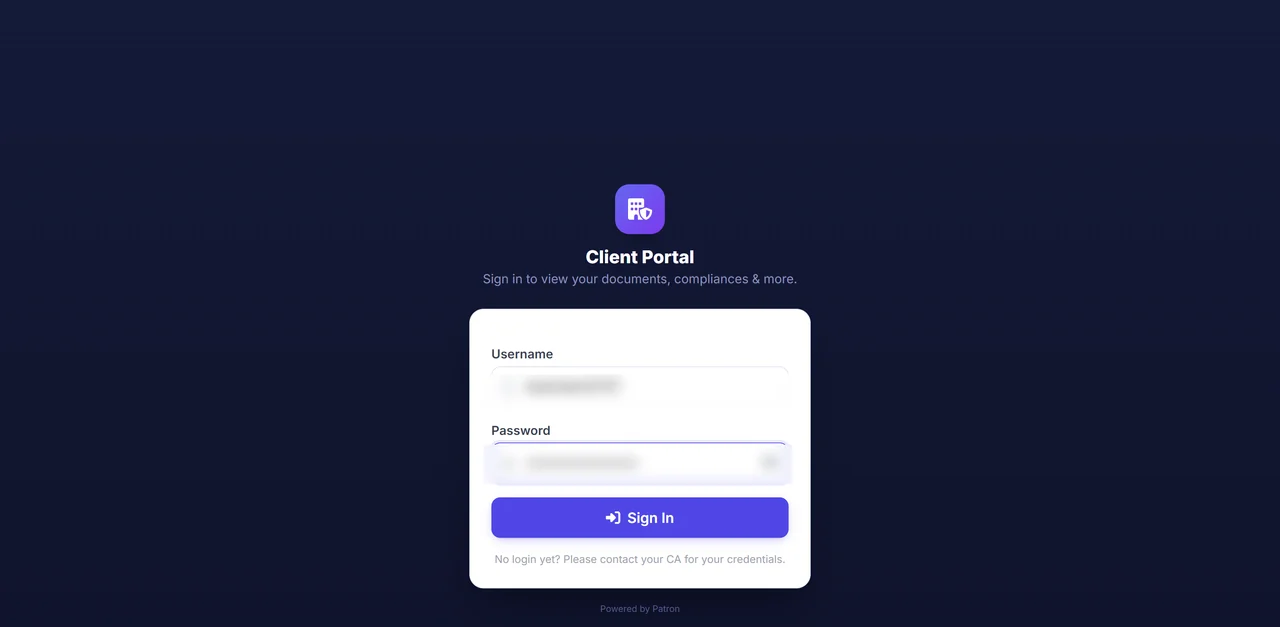
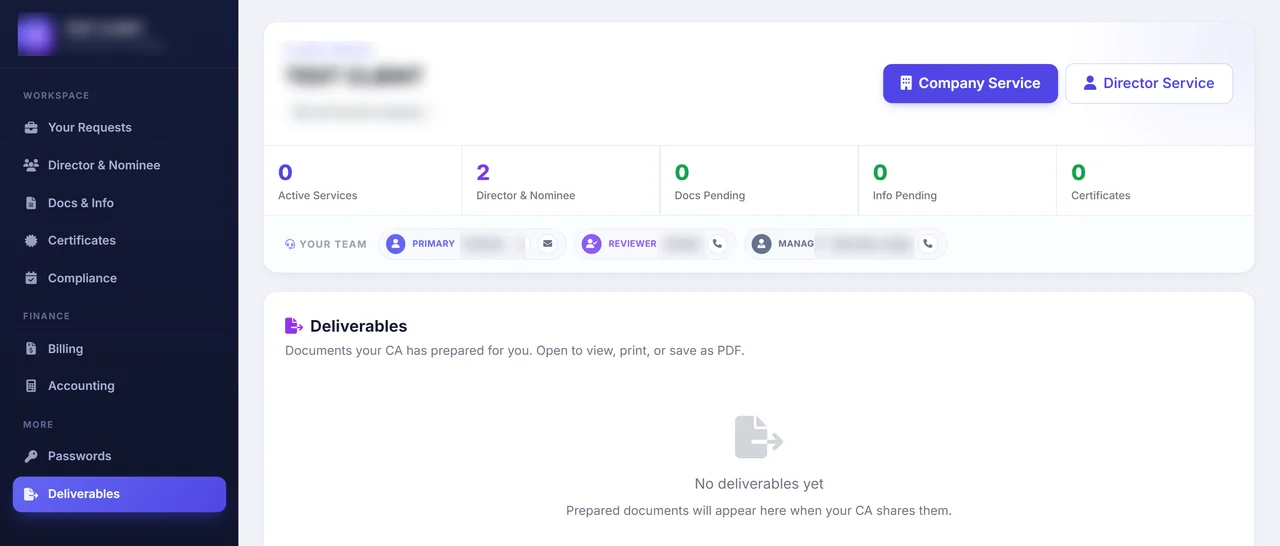
Everything happens in one secure login. You can see your active services, the Patron team on your account, and anything still pending. Once you raise a request, it moves through the same clear steps every time, so you always know exactly where your work stands.

Secure client portal login screen
1

Sign in securely

Your books, documents and requests all sit behind one private, password protected login. The team handling your account is shown on screen, so nothing sensitive ever needs to travel over email or WhatsApp.

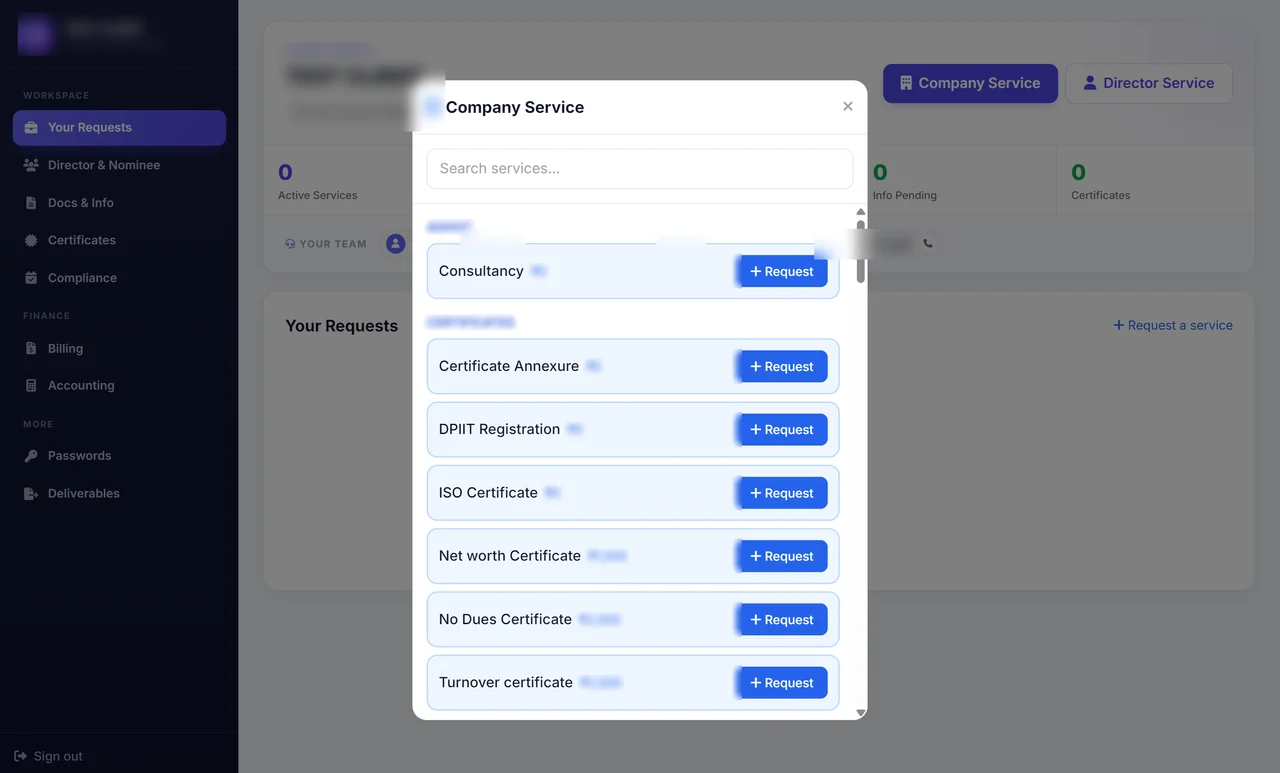
Service catalogue inside the client portal
2

Raise your request

Choose the service you need from the menu inside the portal, where the price is shown before you go ahead. Your request is logged the moment you send it, with no phone calls or reminder emails to wait on.

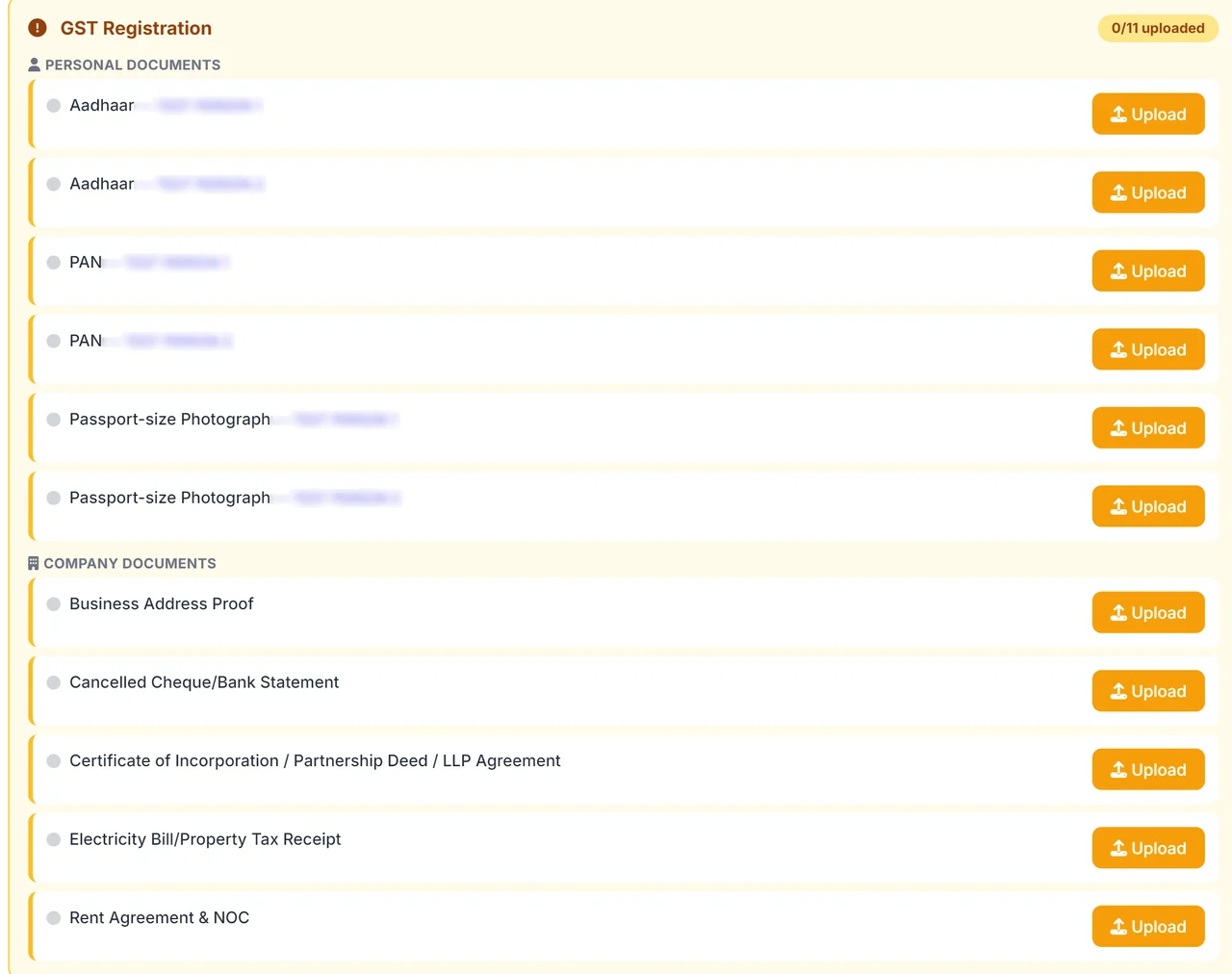
GST registration document checklist in the client portal, with an upload button beside each item
3

Share what the service asks for

For every service, the portal lists the exact documents it needs, each with its own upload button. The example shown here is the GST registration checklist. When a service needs nothing from you, it simply asks for nothing.

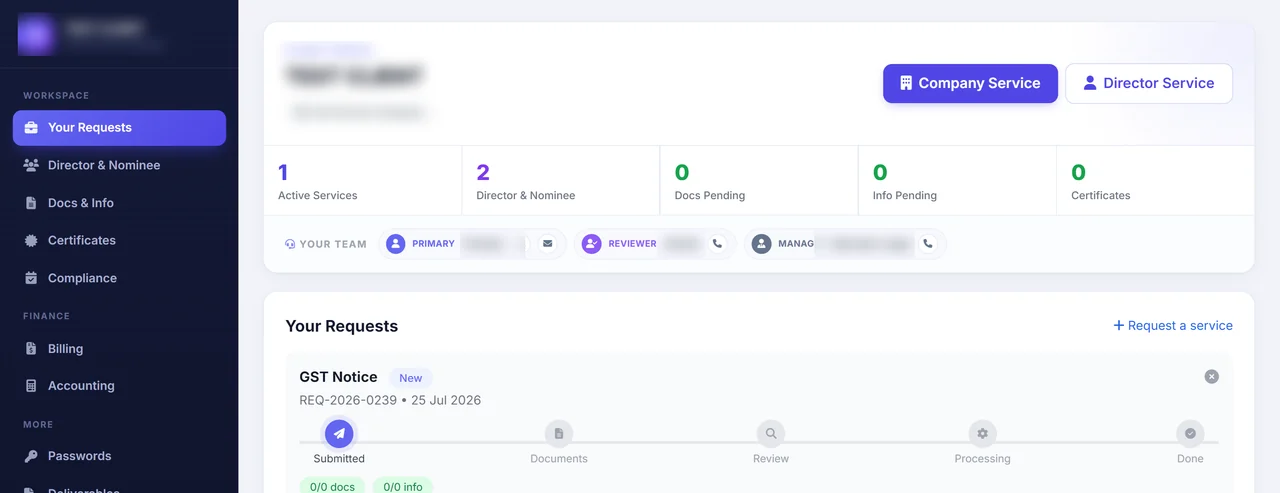
Live request tracker inside the client portal
4

We review, prepare and file

Once your documents are in, your team checks them, prepares the work and files it for you. A live tracker shows each stage as it happens, from review to processing to done, so you never have to ask where things stand.

Deliverables area of the client portal
5

Collect your finished work

Every completed return, computation and certificate is placed in your Deliverables area. You can open, print or download any of them as a PDF whenever you need a copy.

Common Healthcare Accounting Challenges and How We Solve Them

ChallengeImpactHow Patron Accounting Solves It
Pharmacy stock valued without tracking batch expiry or breakageClosing inventory overstates, and expired drugs are written off in one shock at year-endWe value pharmacy stock by batch with an expiry-based provision, so write-offs hit the month stock lapses.
Exempt consultation and taxable pharmacy income mixed in one ledgerInput credit is over-claimed and the exempt-taxable split cannot be defended in scrutinyRevenue tagged exempt or taxable at posting, with common input credit apportioned under Rule 42; see GST exempt versus taxable healthcare.
Surgical packages billed upfront but delivered over several daysRevenue books before the service is given, overstating income in the admission monthPatron holds package advances as deferred income and releases them as procedures complete, matching revenue to treatment.
Consumables issued to theatre never reconciled against what was billedStock leakage hides inside cost of materials, understating true procedure marginsOur team reconciles consumables issued to items billed per procedure, surfacing leakage before it erodes department margins.
Diagnostic equipment taken on lease treated as an outright purchaseAssets, depreciation and finance cost all misstate, and covenant ratios read wrongPatron classifies the lease under Ind AS 116, splitting principal, interest and depreciation, so asset register and P&L reconcile.

Healthcare Accounting Fees

Fee ComponentAmount
Starter — a single clinic or practice with routine monthly volumeINR 3,999
Excl. GST & Government Charges
Growth — more consumable stock lines and busier patient billingOn quote
Managed — multi-location hospital books with department-wise reportingOn quote

Clinics begin on the base fee, which handles monthly bookkeeping, consumable purchases and collections. Costs climb once you track more consumable stock lines or bill across several sites, as accounting for hospitals often demands, right down to a department-wise hospital P&L. Request a customised estimate on +91 94594 56700.

Fees exclude GST and government charges. Final quote confirmed after a scoping review.

All fees and charges listed are indicative only and do not constitute a binding offer. Final amounts may vary depending on the volume of work and the complexity involved.

Professional accounting and compliance charges are scoped to your number of entities, funding stage and monthly transaction volume, and are separate from statutory and government charges. Contact us for a detailed, fixed quote.

Get a free Healthcare Sector Accounting consultation - Call +91 945 945 6700 or WhatsApp us. No-obligation assessment.

Healthcare Accounting Compliance Calendar 2026

ComplianceDue DateApplies To
TDS / TCS deposit (Challan ITNS-281)7th of every month (30 April for March)Every business that deducts tax at source on salaries, rent, contractor or professional fees
Provident Fund (ECR) and ESI contribution15th of every monthEmployers registered under EPF and ESI
GSTR-3B (summary return and tax payment)20th of every month for monthly filersGST-registered businesses filing monthly; QRMP filers pay via PMT-06
Advance tax second instalment (45% cumulative)15 September 2026Companies, firms and individuals liable to advance tax
Tax audit report (Form 3CA/3CB-3CD)30 September 2026Businesses crossing the Section 44AB turnover threshold
Income-tax return, audit cases31 October 2026Companies and audit-liable firms
Annual GST return GSTR-9 and reconciliation GSTR-9C31 December 2026GST-registered businesses above the annual-return and audit thresholds

For a hospital the monthly GSTR-3B on the 20th and PF and ESI on the 15th recur, while the tax audit lands on 30 September. Exempt and taxable supplies need splitting, and insurance and TPA claims reconciling, before each return. Patron maps healthcare accounting to these dates so a NABH-accredited hospital reports exempt revenue correctly. Talk to a Patron CA on +91 94594 56700 about your due dates.

Key Benefits

Why Professional Healthcare Accounting Matters

Receivables aged payer by payer

We follow each claim from raised to approved to settled, against the insurer or TPA that owes it. A part settled claim shows as part settled.

  • Tracked in the TPA and insurer claim register with settlement advices
  • Each claim followed from raised to approved to settled
  • Without it one debtors figure hides which payer stopped paying

A reason behind every short settlement

Where a claim settles below what you billed, we record the reason against it. Each short settlement carries its cause.

  • Reason logged as tariff cap, non payable consumable, co payment or documentation
  • Recoverable balances kept apart from genuinely lost ones
  • Without it recoverable claims get written off and disallowances repeat

Deducted tax credits fully recovered

We reconcile gross claim value in your register to payer reporting in Form 26AS and AIS. Deducted tax is then traced to your PAN.

  • Gross claim value reconciled to Form 26AS and AIS
  • Section 194J deduction by TPAs traced to your own PAN
  • Without it a payer's wrong reporting loses the credit and you fund tax twice

Input credit apportioned on real mix

The credit you take is the share your taxable business actually earned. We work it from your own revenue split, not a rule of thumb.

  • Apportioned on your actual taxable and exempt revenue split
  • Worked from your own figures, not a rule of thumb
  • Without it a credit reversal is argued at assessment and the gap is yours

Pharmacy stock and expiry under control

You see slow moving batches while the supplier will still take them back. Your stock line value is one the pharmacy can produce.

  • Tracked in the pharmacy stock register and Schedule H/H1 register
  • Register and ledger kept aligned on batch and expiry
  • Without it stock expires past the return window and you take the write off

Consultant engagements correctly classified

We treat each consultant and visiting doctor as an employee or a professional on the actual engagement terms. The payout sheet label does not decide it.

  • Read from consultant payout sheets with engagement agreements
  • Deduction follows the engagement status, employee or professional
  • Without it the deduction shortfall falls on the hospital, not the doctor

Why Businesses Choose Patron Accounting for Healthcare Accounting Services

Five things a founder can check before handing over the books. Each is a claim with the proof behind it.

TPA receivables aged by payer, not one debtors figure

We age TPA and insurer receivables by individual payer instead of one debtors figure. Our 15+ years across 3,000+ businesses served make hospital and clinic books familiar ground.

Section 194J on consultant payouts and 44ADA practices

We deduct Section 194J on consultant payouts and apply 44ADA presumptive tax for individual practitioners. Handling this is part of the 25,000+ filings we have completed.

HIS and pharmacy stock reconciled into the ledger

We reconcile your HIS billing and pharmacy stock system into the ledger, working in Zoho Books, Xero, Tally Prime or Odoo, whichever you run. Sector configuration is set to your departments.

Department-wise P&L and TPA ageing each month

Each month you receive a department-wise P&L and a TPA ageing that shows what is stuck with which payer. The monthly cadence shows in our 4.9 star Google rating.

Healthcare providers among the 3,000+ businesses we serve

Hospitals, clinics, diagnostic chains and individual practitioners sit among the 3,000+ businesses we have served since 2019. Our in-house team of CAs and CS brings 15+ years of experience.

Figures reflect Patron Accounting LLP engagements since 2019. Scope and turnaround are confirmed in your engagement letter.

Section 44ADA Presumptive vs Full Books for Practices

CriterionSection 44ADA PresumptiveFull Books for Practices
What it is44ADA: deemed 50% profit on gross receipts, no detailed books.Full books: complete ledgers of actual income and expenses.
Eligibility44ADA: solo professionals within ₹50 lakh, ₹75 lakh if cash light.Full books: mandatory above the limit and for companies.
Expense treatment44ADA: actual costs ignored, half of receipts deemed profit.Full books: consumables, salaries and TPA costs claimed on evidence.
Compliance and tax44ADA: lighter filing, no tax audit if opted correctly.Full books: audit may apply, but real low margins shown.
MIS clarity44ADA: no department view, weak for a hospital.Full books: bed, theatre and pharmacy P&L visible.
Receivables handling44ADA: TPA and insurance dues invisible under presumptive.Full books: TPA receivables aged payer by payer.
VerdictSolo doctors within the ₹50 lakh limit and thin admin can use 44ADA presumptive; any hospital carrying stock, TPA receivables and staff must keep full books. Accurate accounting for hospitals starts with the Section 44ADA presumptive taxation test.

Legal and Regulatory Framework for Healthcare Accounting

The statute that most shapes a hospital's books is not a company-law section but a GST exemption: healthcare services are exempt, and that single fact splits the ledger in two before anything else is decided. Section 128 still governs the books, but the exemption is what makes them distinctive.

Because treatment income is exempt while pharmacy, cosmetic and cafeteria income is taxable, the credit on shared costs cannot be claimed in full. So the books apportion input tax and keep the streams apart, and separately track the tax deducted on the consultants who are not on payroll. That is why Third-Party Administrator (TPA) Receivables and a disciplined Pharmacy Stock Expiry Audit belong to the compliance layer, not just operations. Accounting for hospitals answers to the provisions below.

  • Notification 12/2017-Central Tax (Rate), entry 74Healthcare services by a clinical establishment are exempt, so the books separate exempt treatment income from taxable pharmacy or cosmetic supplies.
  • Section 17(2), CGST Act 2017Input tax credit attributable to the exempt supplies is reversed, so a mixed clinic apportions its credit between taxable and exempt activity.
  • Section 194J, Income-tax Act 1961Professional fees to consultant doctors carry TDS at 10%, tracked separately from salaried medical staff.
  • AS 9 / Ind AS 115Treatment revenue is recognised as care is provided, with unbilled amounts for in-patients carried at the period end.
  • Section 128, Companies Act 2013The underlying books stay on accrual and double entry at the registered office, retained for eight years.
  • Rule 3(1), Companies (Accounts) Rules 2014The audit trail stays enabled, so a reclassified receipt or a credit reversal is always logged. General GST filing runs from the hub page.

Official sources: Ministry of Corporate Affairs · Income Tax Department · GST Portal · Startup India (DPIIT)

What type of accounting is used most often by physicians?

Most doctors in individual practice keep accounts on the cash basis, recording consultation and procedure receipts when the money is actually received, while hospitals and doctor owned companies use the accrual basis. Section 44AA requires a medical practitioner to maintain prescribed books once receipts cross the limit set for the profession. Doctors who opt for the presumptive scheme under Section 44ADA are relieved of that requirement.

Is GST applicable on healthcare services provided by a hospital or clinic?

Healthcare services provided by a clinical establishment or an authorised medical practitioner are exempt from GST, so consultation, diagnosis and treatment are not taxed. Other supplies from the same premises, such as pharmacy sales to outpatients, cosmetic procedures, canteen sales and room charges above the notified limit, can be taxable, which makes hospitals a mixed supply business.

Should visiting consultants be paid under Section 192 or Section 194J?

Visiting consultants engaged on a fee sharing or retainer basis fall under Section 194J as professional fees, while doctors on the rolls with fixed pay and employment terms are salaried and covered by Section 192. The department looks at the substance of the arrangement, including leave, working hours and control, not merely at what the contract is titled.

Can a doctor in private practice use the presumptive scheme under Section 44ADA?

Yes, a resident doctor in individual practice can opt for Section 44ADA and declare 50 percent of gross receipts as taxable income, provided receipts stay within the prescribed limit for the year. The higher limit applies only where cash receipts stay within the small permitted share of turnover. The scheme stops helping once real expenses exceed half of receipts.

How is pharmacy stock accounted for in a hospital?

Pharmacy stock is accounted on a perpetual basis with batch and expiry tracking, so medicines issued to inpatients transfer into treatment cost and only counter sales are recorded as pharmacy revenue. Monthly physical verification, expiry write off and reconciliation of the purchase register with GST input credit keep the pharmacy margin reliable rather than notional.

How are TPA and insurance claims recorded when settlement takes months?

TPA and insurance claims are booked as revenue with a separate receivable per claim at the time of discharge, and disallowed or deducted amounts are written off only when the settlement advice arrives. Ageing of claims by TPA and by disallowance reason is reported every month, because unrecognised deductions are the biggest cause of overstated receivables in hospitals.

How much does accounting for a clinic or hospital cost?

A single doctor clinic usually pays Rs 6,000 to Rs 12,000 a month, a multi speciality clinic Rs 15,000 to Rs 30,000, and a hospital with pharmacy, payroll and TPA billing from Rs 40,000 upwards. Pricing follows transaction volume, staff headcount and whether stock accounting and department wise reporting form part of the agreed scope.

Do you handle payroll for nursing and support staff along with the books?

Yes, payroll for nursing, technical and support staff runs alongside the books, covering salary processing, provident fund and ESI computation, professional tax in states that levy it, and quarterly Form 24Q returns. Shift allowances, night duty and overtime are built into the salary structure, and payslips are issued before the agreed pay date every month.

How to save tax as a doctor?

The largest saving for a doctor comes from choosing correctly between Section 44ADA, which taxes 50 percent of gross receipts as income, and regular books where actual expenses are claimed, since regular books win once real costs exceed half of receipts. Depreciation on medical equipment, clinic rent, staff salary, professional indemnity premium and association fees are all claimable. Practice structure as an LLP or company changes the effective rate.

What if TDS on consultant payments was deducted at the wrong rate in earlier years?

Wrong rate deductions are corrected by depositing the short amount with interest and filing revised TDS returns for the affected quarters, which removes the risk of the expense being disallowed and of demands raised on the hospital as deductor. We first build a payment wise working of what was deducted against what was due before touching any return.

Quick Answers

Most hospitals bill from more systems than their ledger has room for. You send the HIS export, the pharmacy and diagnostics billing files, consultant payout sheets, the TPA settlement advices and the bank statements. What comes back is a posted ledger, a consultant payout reconciliation, a deduction summary for the.

Healthcare Sector Accounting Deadlines You Cannot Afford to Miss

TDS / TCS deposit (Challan ITNS-281) is due 7th of every month (30 April for March). Provident Fund (ECR) and ESI contribution is due 15th of every month. GSTR-3B (summary return and tax payment) is due 20th of every month for monthly filers. Patron tracks each against your books so nothing is reconstructed after the fact. Call +91 94594 56700 to set up a filing-reminder schedule.

Start Your Healthcare Accounting with Patron Accounting

Medical billing companies chase claims; that is revenue cycle work and it belongs with your billing desk. Accounting for hospitals is the ledger behind it: what was actually billed, what the payer finally allowed, and what the difference did to the month. The two jobs get confused constantly, and they need different people entirely.

Bankers funding a new block ask how quickly billed work turns into money, and they do not accept one debtors number as the answer. Accounting for doctors and for the institutions they work in runs on the same evidence: settlements, short payments and write-offs separated in the ledger.

First conversations here map your billing systems onto your entity structure: which unit raises which invoice, where the pharmacy and diagnostics arms sit, and which registration each holds. Postings cannot be designed before those boundaries are drawn. The same discipline shapes ledgers built for technology firms.

Book a Free Consultation - No Obligation.

Explore Our Accounting Services

Related services our CA-led team delivers for businesses across India.

Reviewed by the CA & CS Team, Patron Accounting LLP
ICAI & ICSI registered  ·  15+ years in Indian accounting & compliance  ·  Last reviewed 23 July 2026  ·  Next review 23 October 2026