Trusted by 10,000+ Businesses

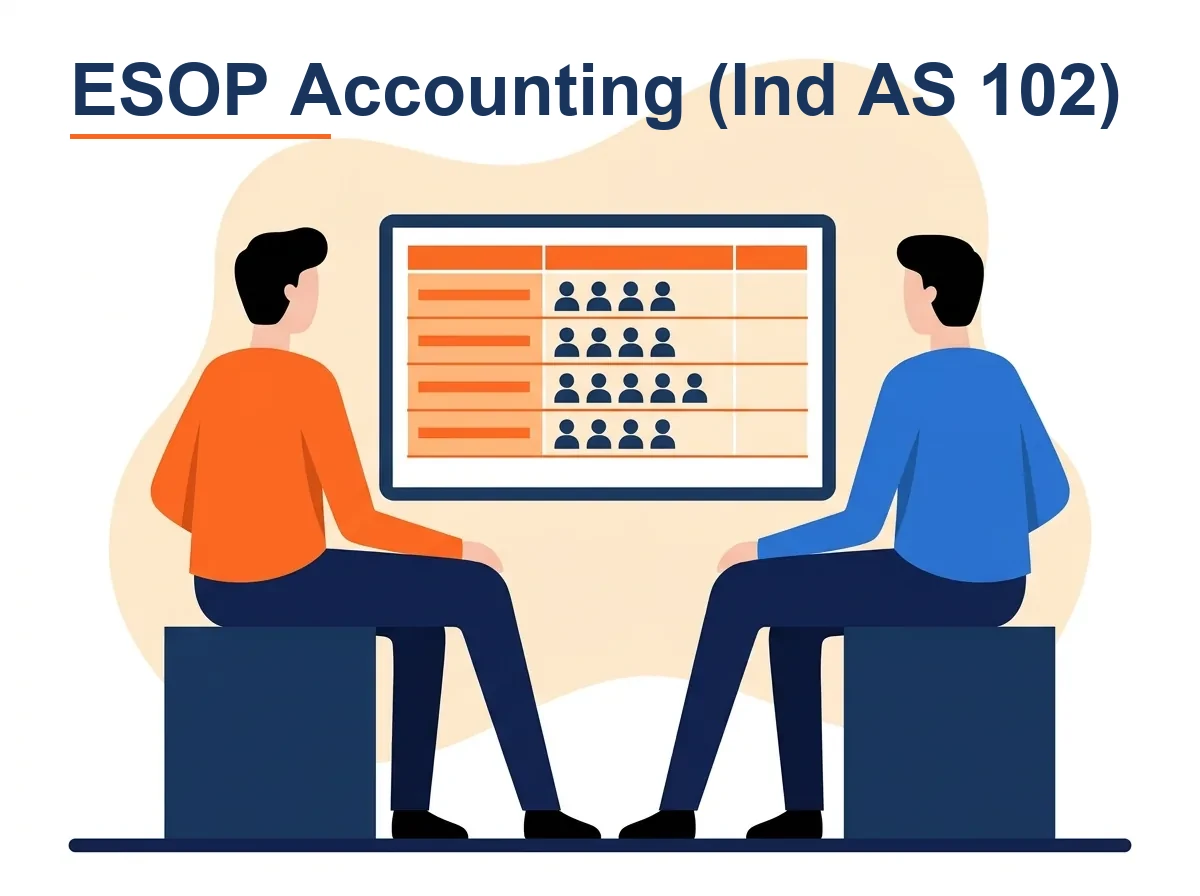
ESOP Accounting under Ind AS 102 in Mumbai

For BKC and Lower Parel finance houses, the Andheri-Powai SaaS belt and Goregaon-Vikhroli founders - Black-Scholes valuations and Schedule III notes built for SEBI's home market, filed with RoC Mumbai.

Reviewed by CA & CS Team · Patron Accounting LLP ICAI & ICSI Registered| 15+ Years Experience| Last Updated: 24 June 2026 Verify Credentials →

Deliverables: Black-Scholes fair value report, year-wise expense schedule, journal entries and Schedule III note disclosures

Fees: From INR 24,999 (Exl GST and Govt. Charges)

Frameworks: Ind AS 102 for Ind AS companies; ICAI Guidance Note 2020 for AS framework companies

Timeline: 5 to 10 working days for year-end run; 2 to 3 working days for fresh-grant accounting

10,000+ Businesses Served | 4.9 Google Rating | 15+ Years in Practice

15+ YearsIndustry Experience
CA & CSCertified Experts
4.9
Based on 500+ reviews

Get Free Consultation

Talk to a CA/CS expert today

🇮🇳 +91

Our team will get back to you shortly. No spam.

Real Stories from Real People

Hear how teams across industries use Patron to save time, cut costs, & stay in control.

Fetching latest Google reviews…
Outstanding experience with Patron. Professionalism and timely communication made the process seamless.
SM
Subhendu Mishra
Business Owner
★★★★★
2 months ago
Glad I connected with Patron. Really helpful and took minimum time.
RD
Rajib Dutta
Entrepreneur
★★★★★
3 months ago
Fantastic experience. Knowledgeable and smooth handling of all documentation.
NG
Nishikant Gurav
Client
★★★★★
1 month ago
Best service for account handling. Extremely happy with dedicated point of contact.
NN
Nikhil Nimbhorkar
Director
★★★★★
4 months ago
Smooth process for ITR filing. They understand basics well and respond promptly.
SH
Sameer Mehta
Client
★★★★★
2 weeks ago

Join 10,000+ Satisfied Businesses

Ind AS 102 and ICAI Guidance Note 2020 dual coverage. Black-Scholes in-house. Schedule III and Directors' Report Rule 12(9) drafted to audit standard.

Talk to an Expert
10,000+Businesses ServedGST compliance and litigation support across India.
15+Years ExperienceDeep expertise in IP registration, GST & business compliance.
50,000+Documents FiledReturns, appeals, and filings handled accurately.
4.9★Client RatingTrusted by entrepreneurs, startups, and growing businesses.
ISO CertifiedProfessional standards and documented processes.
SSL SecureYour financial and business data is fully protected.

ESOP Accounting under Ind AS 102 - Overview

📌 TL;DR - ESOP Accounting Services at a Glance

ESOP accounting under Ind AS 102 requires recognising the grant-date fair value of equity-settled options as a compensation expense over the vesting period, with a corresponding credit to an ESOP Reserve under equity. Cash-settled SARs are recognised as a liability remeasured at each reporting date. Non-Ind AS companies follow the ICAI Guidance Note on Accounting for Share-based Payments 2020. The expense is computed via Black-Scholes or Binomial pricing, adjusted for service-based forfeitures and modifications.

No Indian city carries as much share-based payment weight as Mumbai. SEBI's headquarters sits at BKC, the BSE clock tower anchors Dalal Street, and within a few kilometres you have the Lower Parel financial-services towers, the Andheri-Powai SaaS belt feeding off IIT-Bombay deep-tech, and the Goregaon-Vikhroli founder corridor. A repricing at a Powai SaaS firm, a fresh RSU tranche at a BKC fintech, or a phantom-stock plan at a Lower Parel NBFC each produces a different Ind AS 102 expense - and in this market that number is read by audit committees, analysts and, for listed issuers, the SEBI desk down the road.

Mechanically, ESOP accounting converts an option grant into a compensation charge spread across the vesting period. Three things decide the treatment: whether the company is on Ind AS or the older AS framework, whether the award is equity-settled (an ESOP or RSU) or cash-settled (a SAR or phantom unit), and - uniquely for Mumbai's listed and DRHP-stage companies - whether the SEBI (SBEB and Sweat Equity) Regulations 2021 layer sits on top. Allotment forms PAS-3 and MGT-14 are filed with RoC Mumbai under the Maharashtra jurisdiction.

Patron Accounting LLP delivers the Black-Scholes valuation, the year-wise expense schedule, the journal entries and the Schedule III note - either embedded in your statutory audit or as a standalone run. We have run these for Mumbai listed entities, pre-IPO companies preparing a DRHP and unlisted growth firms since 2009, with CA, audit and tax teams under one roof and a Mumbai presence alongside our Pune, Delhi and Gurugram offices.

What Is Ind AS 102 ESOP Accounting

Take a BKC fintech that grants 1,00,000 stock options to a new product team at an exercise price set to its last fundraise valuation. Ind AS 102 is what tells that company it cannot record zero cost just because cash never changes hands - it must put a fair value on the options at grant date and charge it to the P&L over the vesting period. That is the whole point of the standard: share-based payment is real compensation, and Mumbai's listed and analyst-watched issuers cannot leave it off the income statement.

The standard is notified under Section 133 of the Companies Act 2013 read with Rule 4 of the Companies (Indian Accounting Standards) Rules 2015. For equity-settled awards the grant-date fair value is fixed and not remeasured; for cash-settled awards (a Lower Parel NBFC's SARs, say) the liability is remeasured every reporting date until it is paid out. The matching credit goes to an ESOP Reserve in equity or to a liability, and the share-based payment note is usually the line item an Andheri-Powai SaaS company's auditors and diligence teams probe hardest.

Two routes exist. Mumbai groups with a global parent or an overseas listing benefit from Ind AS 102 being materially converged with IFRS 2 - Share-based Payment, so consolidation runs on one basis. Smaller Goregaon and Vikhroli companies still below the Ind AS net-worth threshold instead apply the ICAI Guidance Note on Accounting for Share-based Payments (September 2020) under the Companies (Accounting Standards) Rules 2006.

Key Terms for ESOP Accounting:

Grant Date: The date on which both parties (company and employee) agree to the share-based payment arrangement. For schemes requiring shareholder approval, grant date is the date approval is obtained.

Vesting Date: The date on which the employee becomes unconditionally entitled to the equity instrument. For service conditions, this is the end of the service period.

Fair Value: The price at which the option could be sold in an arm's-length transaction, determined using a recognised option pricing model such as Black-Scholes or Binomial.

Equity-Settled SBP: Awards settled by issuing the company's own equity instruments. Expense recognised over vesting period with credit to ESOP Reserve in equity.

Cash-Settled SBP: Awards settled by paying cash based on the value of equity instruments. Expense over vesting period with credit to a liability remeasured every reporting date.

Forfeiture Rate: Estimated percentage of granted options expected to forfeit due to attrition before vesting. Service and non-market performance conditions are trued up to actual outcomes.

APL-05 ESOP Accounting
Indian Accounting Standard Ind AS 102

Who Must Apply Ind AS 102 for ESOP Accounting

Ind AS Framework (Mandatory)

  • All listed companies on Indian stock exchanges
  • Unlisted companies with net worth equal to or greater than Rs 250 crore
  • Holding, subsidiary, joint venture or associate companies of the above
  • Voluntary adopters who have notified the choice (the choice is irrevocable)

AS Framework with ICAI Guidance Note 2020 (Non-Ind AS Companies)

  • Unlisted companies with net worth below Rs 250 crore (most Seed and Series A startups)
  • Small companies, One Person Companies and dormant companies
  • Companies following Companies (Accounting Standards) Rules 2006 as amended in 2021

Note: under the AS framework, the ICAI Guidance Note (September 2020) still lets a company pick the Intrinsic Value Method (FMV at grant minus exercise price) - convenient for an early Goregaon startup but a trap once Mumbai's capital markets enter the picture. The moment a BKC or Lower Parel company lists on the BSE or NSE, or even files its DRHP, the SEBI (SBEB and Sweat Equity) Regulations 2021 force the Fair Value Method, and the Intrinsic Value shortcut closes. Andheri and Powai SaaS firms on the IPO track should switch to fair value years ahead of the offer document, not in the final restatement.

What Triggers a Fresh Ind AS 102 Run in Mumbai

  • The inaugural grant after scheme approval - opening reserve and grant-date fair value for the first cohort
  • Each fresh tranche as a Powai or Andheri SaaS team scales its hiring through the year
  • A modification - repricing, exercise-window extension or vesting acceleration, common around pre-IPO restructuring
  • A cancellation or settlement that accelerates the unrecognised charge
  • The year-end close feeding the cumulative true-up, Schedule III note and, for listed issuers, the SEBI-mandated disclosures
  • The DRHP and IPO track, where historical share-based payment accounting is restated and stress-tested by the merchant banker and auditors

Patron ESOP Accounting Deliverables

For Mumbai's listed issuers, BKC fintechs and Lower Parel financial-services firms, the deliverables below are built to survive both statutory audit and the heavier disclosure bar that comes with being a listed or IPO-track company in SEBI's home market. Each output ties back to a documented, defensible input.

ServiceWhat We Do
Grant-Date Fair Value ComputationBlack-Scholes Option Pricing model run on each grant tranche using underlying share price (FMV from IBBI valuer), exercise price, expected option life, volatility, risk-free rate and dividend yield. Binomial model used where complex features apply.Included
Year-Wise Expense ScheduleExcel-style schedule covering each grant tranche, number of options, fair value per option, total expense, vesting schedule (cliff or graded), forfeiture rate, year-by-year expense recognition and cumulative expense to date.Included
Journal Entry ScheduleQuarterly or annual journal entries. ESOP Compensation Expense (P and L) debit, ESOP Reserve (Equity) credit for equity-settled, or SAR Liability for cash-settled. Forfeiture true-ups and modification entries documented separately.Included
Forfeiture Rate Estimation and True-UpHistorical employee attrition analysis to estimate forfeiture rate; revised at each reporting date based on actual outcomes; true-up of cumulative expense at year-end for service and non-market performance conditions.Included
Modification and Cancellation AccountingOn scheme modification (extension of exercise window, repricing, pool top-up impacting prior grants), Patron computes incremental fair value and recognises it over remaining vesting period. Cancellation accelerates remaining expense.Add-on
Schedule III Disclosure and Directors' Report NoteNotes to Accounts disclosure under Schedule III; ESOP movement table (outstanding, granted, exercised, lapsed, expired); Directors' Report disclosure under Rule 12(9) of Companies (Share Capital and Debentures) Rules 2014.Included
Audit Working Paper FileSensitivity analysis on Black-Scholes inputs (volatility, risk-free rate, expected life), source documents index and statutory auditor coordination - audit-ready file for sign-off without rework.Included
Ind AS 101 First-Time Adoption (Transition)Migration from AS framework with ICAI Guidance Note to Ind AS 102 on crossing the net worth threshold; opening ESOP Reserve restated; prior years reconciled.Add-on
Our Process

7-Step ESOP Accounting Procedure

Whether you are a Lower Parel NBFC running its first phantom-stock plan or an Andheri SaaS company restating ESOP cost for a DRHP, the seven steps below take you from a raw scheme document to a number your statutory auditor - and, for IPO-track issuers, your BKC merchant banker - can sign without rework. The run follows Ind AS 102 paragraphs 10 to 29 and the ICAI Guidance Note 2020, and closes in 5 to 10 working days.

Step 1

Data Collection

Collect the approved ESOP Scheme document, all Board Resolutions for grants, Form SH-6 Register of Employee Stock Options, IBBI Valuer FMV report and a list of grantees with grant dates, vesting schedules and exercise prices.

Scheme document SH-6 register
Documents Ready 01
Step 2

Black-Scholes Input Build

Compute expected share price volatility from listed peer comparables (typically 30 to 60 percent for Indian SaaS, 25 to 40 percent for B2B), risk-free rate from the RBI G-Sec yield curve matched to option life, expected option life (3 to 6 years) and dividend yield.

Peer volatility G-Sec yield curve
Inputs Built 02
Step 3

Fair Value Computation

Run Black-Scholes per option for each grant tranche; overlay binomial model where performance conditions or market conditions exist. Document all inputs and the rationale for each parameter. Produce a sensitivity table showing fair value at +/- 10 percent volatility and risk-free rate.

Per-tranche fair value Sensitivity table
FV
Fair Value Set 03
Step 4

Vesting Schedule Mapping

Map vesting tranches against accounting periods. Straight-line recognition for cliff vesting; graded recognition for tranche-based vesting per Ind AS 102 paragraph 20 (each tranche treated as a separate award). Produce the year-wise expense schedule.

Cliff or graded Para 20 tranches
Schedule Mapped 04
Step 5

Forfeiture Rate Application

Apply the estimated forfeiture rate from historical attrition data, compute expected options to vest and true up at year-end to actual. Service conditions and non-market performance conditions are subject to true-up; market conditions are baked into grant-date fair value.

Attrition history Year-end true-up
Forfeiture Trued 05
Step 6

Journal Entry Generation

Generate quarterly and annual journal entries. Dr ESOP Compensation Expense in P and L; Cr ESOP Reserve in Equity for equity-settled awards, or Cr SAR Liability for cash-settled. Pass year-end remeasurement entries for cash-settled liabilities at fair value.

P and L expense ESOP Reserve credit
DrCrP&L Entry
Entries Posted 06
Step 7

Disclosure and Audit Coordination

Draft the Schedule III Notes to Accounts paragraph (Note 14 typically) with ESOP movement table, the Directors' Report Rule 12(9) paragraph and the audit working paper file. Coordinate with the statutory auditor for sign-off without rework.

Schedule III note Audit working paper
Audit Ready 07

Documents and Data Checklist

In Mumbai the same pack does triple duty: it supports the statutory audit, the Schedule III note, and - for a BKC listed issuer or a Powai company drafting a DRHP - the SEBI disclosure and offer-document trail. So we gather it once. Send whatever the finance and company-secretary teams have to hand; anything missing we reconstruct from the RoC Mumbai registered-office records.

  • Approved ESOP Scheme Document and EGM Special Resolution
  • All Board Resolutions for grant tranches (per quarter or per batch)
  • Form SH-6 Register of Employee Stock Options
  • Grant Letters with vesting schedule, exercise price and expiry per employee
  • IBBI Registered Valuer FMV report (grant-date fair value source)
  • List of grantees with grant date, options granted, vesting tranches and status (active, exited, exercised)
  • Historical employee attrition data for forfeiture rate estimation
  • Last year's audited financials (for opening ESOP Reserve balance)
  • Any modification or cancellation Board Resolutions during the year

Common ESOP Accounting Errors and How We Fix Them

In a market this close to SEBI, an ESOP error rarely stays quiet. It surfaces in an audit-committee pack at a Lower Parel head office, in an analyst's question on a results call, or as a DRHP comment that stalls a Powai company's listing. The five below are the ones we most often clean up for Mumbai clients before they cost a qualification.

ChallengeImpactHow Patron Accounting Solves It
Intrinsic Value Method on Face-Value SchemesMany Seed-stage startups use the ICAI Guidance Note's Intrinsic Value Method with exercise price equal to face value (Rs 10), producing near-zero compensation expense despite real economic value. Auditor non-disclosure flag triggers Series A diligence reopen.Patron computes both Intrinsic Value (for current books) and shadow Fair Value (for diligence) to bridge the gap proactively before the next funding round.
Grant Date ConfusionFounders treat the EGM resolution date as the grant date for all employees. Ind AS 102 defines grant date as the date both parties agree - for new hires, this is the date the grant letter is accepted, not the EGM date.Patron tracks each grantee's individual grant date in the SH-6 register and runs separate fair value computations per grant cohort.
Cash-Settled SAR Treated as Equity-SettledSome schemes hide SAR features (cash payment on exercise window) inside the ESOP document. These are cash-settled SBPs requiring liability accounting with remeasurement at each reporting date.Patron reviews the scheme document line by line, classifies each award correctly and applies the right measurement model.
Missing Forfeiture True-UpCompanies estimate forfeiture rate at grant and forget to update. Ind AS 102 paragraph 20 requires updating the estimate at each reporting date and trueing-up cumulative expense at vesting based on actual outcomes.Patron's annual run includes the forfeiture true-up working, with revised cumulative expense computation and audit-ready supporting paper.
Modification Not AccountedPool top-ups, exercise window extensions or repricing are treated as administrative tweaks. Ind AS 102 paragraph 27 requires recognising incremental fair value over the remaining vesting period.Patron computes incremental fair value at modification date and recognises the additional expense alongside the original grant expense.

ESOP Accounting Fees and Engagement Tiers

Fee ComponentAmount
Single Scheme - Single Grant - Annual RunBlack-Scholes, year-wise schedule, journal entries and Schedule III disclosure for one scheme with one grant batchQuoted on scoping call
Single Scheme - Multiple Grant Tranches - Annual RunAbove plus multiple quarterly grants, forfeiture true-up and modifications if applicableQuoted on scoping call
Multi-Scheme Annual Run (2 to 3 schemes)Above plus multi-scheme reconciliation and group consolidation if subsidiary grants existQuoted on scoping call
Modification or Cancellation AccountingIncremental fair value working plus journal entries and disclosure refresh for one modification eventQuoted on scoping call
Ind AS 101 First-Time Adoption (Transition)Migrate from AS framework with ICAI Guidance Note to Ind AS 102; opening balance restatement and prior-year reconciliationQuoted on scoping call
Bundled with Audit EngagementESOP accounting embedded within the statutory audit deliverableQuoted separately
Patron Accounting Professional FeesStandard starting price for single-scheme annual ESOP accounting run under Ind AS 102 or ICAI Guidance Note 2020From INR 24,999 (Exl GST and Govt. Charges)

All fees and charges listed are indicative only and do not constitute a binding offer. Final amounts may vary depending on the volume of work and the complexity involved.

Professional service charges for drafting, filing, and representation are separate from the statutory fees. The exact fee depends on the complexity of the case, disputed amount, and number of hearings required. Contact us for a detailed quote.

Disclaimer: All fees and charges listed are indicative only and do not constitute a binding offer. Final amounts may vary depending on the volume of work and the complexity involved.

Get a free ESOP Accounting consultation - Call +91 945 945 6700 or WhatsApp us. No-obligation assessment.

Engagement Timeline

StageEstimated Timeline
Data collection from finance and HR teams1 to 2 working days
Black-Scholes input build (volatility, risk-free, expected life)1 working day
Fair value computation and grant-wise schedule1 to 2 working days
Forfeiture rate estimation and true-up working1 working day
Journal entries and audit working paper file1 working day
Schedule III note and Directors' Report disclosure draft1 working day
Review with management and auditor coordination1 to 2 working days
Total Annual Run5 to 10 working days
Fresh-grant fair value computation (quarterly grant batches) can be turned around in 2 to 3 working days from the date of data submission. Year-end consolidated run typically aligned to the statutory audit timeline (April to June for March year-end companies).
Key Benefits

Why Engage Patron for ESOP Accounting

Dual Framework Coverage

Ind AS 102 and ICAI Guidance Note 2020 dual coverage - one team handles both frameworks, including transition under Ind AS 101 when the company crosses the net worth threshold.

In-House Black-Scholes

Black-Scholes and Binomial computations done in-house with documented input rationale - no actuarial pass-through delays. Sensitivity analysis on volatility, risk-free rate and expected life included.

Audit-Ready File

Working paper file with full input source documentation - statutory auditor sign-off without rework. Coordinated with IBBI Valuer and SEBI Merchant Banker for input consistency.

Schedule III + Rule 12(9)

Notes to Accounts and Directors' Report disclosure drafted to audit standard. ESOP movement table aligned to the audit committee presentation format.

Annual Retainer Calendar

Engagement synced to your reporting and, for listed issuers, your SEBI disclosure calendar - no last-minute scramble before the audit committee. Quarterly fresh-grant valuations turned around in 2 to 3 working days.

15+ Years Across MCA, ICAI

Experience spans MCA filings, ICAI audit standards, statutory audit and Ind AS conversion engagements. CA, audit and tax teams under one roof.

Trusted by Indian Businesses for Statutory Accounting

10,000+ Businesses Served | 4.9 Google Rating | 50,000+ Documents Filed | 15+ Years in Practice

Our Series B investor's diligence team flagged missing share-based payment expense in our books. Patron rebuilt 2 years of ESOP accounting under the ICAI Guidance Note with shadow Fair Value workings, journal entries and a clean Schedule III note. The audit sign-off followed in three weeks. - CFO, B2B SaaS startup (Bengaluru).

As we crossed the Rs 250 crore net worth threshold and moved from AS framework to Ind AS, Patron ran the Ind AS 101 first-time adoption ESOP transition - opening ESOP Reserve restated, prior years reconciled. Zero adjustments at the audit committee. - Group Controller, growth-stage logistics (Mumbai).

With offices in Pune, Mumbai, Delhi and Gurugram, Patron Accounting serves businesses across India - both in-person and remotely.

Equity-Settled vs Cash-Settled Share-Based Payment

A Lower Parel NBFC might give equity-settled ESOPs to its senior desk but cash-settled phantom units to dealers it cannot easily put on the cap table; a BKC fintech might run RSUs for engineers and SARs for advisory roles. That mix is common across Mumbai's financial-services and fintech firms, and the two routes diverge sharply on measurement, balance-sheet presentation and - for listed issuers - the SEBI disclosure that follows. The table below lays out exactly where.

Parameter Equity-Settled (ESOP / RSU) Cash-Settled (SAR / Phantom)
SettlementCompany's own equity shares delivered on exerciseCash equal to the appreciation in share value
Measurement DateGrant date fair value, NOT remeasuredRemeasured at fair value every reporting date until settled
Credit AccountESOP Reserve under EquitySAR Liability under Other Liabilities
P and L ImpactCompensation expense over vesting period, fixed at grantCompensation expense plus remeasurement gains and losses
Cumulative ExpenseEqual to grant-date fair value times options vestedEqual to actual cash paid on settlement
Schedule III PresentationReserves and Surplus - ESOP ReserveCurrent or Non-Current Liabilities - SAR Liability
Ind AS 102 ParagraphsParagraphs 10 to 29Paragraphs 30 to 33D

Legal and Accounting Framework

For a Mumbai company the statute stacks in layers: allotment forms go to RoC Mumbai under the Maharashtra jurisdiction, the accounting rests on the Ind AS 102 framework set out below, and any BSE- or NSE-listed issuer carries the SEBI (Share Based Employee Benefits and Sweat Equity) Regulations 2021 on top - administered, fittingly, from SEBI's own BKC headquarters. The core measurement provisions are these.

  • Indian Accounting Standard (Ind AS) 102 - Share-based Payment - notified under Section 133 of the Companies Act 2013 read with Rule 4 of the Companies (Indian Accounting Standards) Rules 2015. Ministry of Corporate Affairs (MCA21).
  • Ind AS 102 paragraphs 7 to 9 - recognition principle. Goods or services received are recognised when received with a corresponding equity or liability entry.
  • Ind AS 102 paragraphs 10 to 29 - equity-settled SBP. Fair value at grant date NOT remeasured; recognised over vesting period.
  • Ind AS 102 paragraphs 19 to 21 - vesting and non-vesting conditions. Service and non-market performance conditions trued up to actual outcomes; market conditions baked into grant-date fair value.
  • Ind AS 102 paragraphs 26 to 29 - modifications, cancellations and settlements. Incremental fair value over remaining vesting period; cancellation accelerates remaining expense.
  • Ind AS 102 paragraphs 30 to 33D - cash-settled SBP. Liability remeasured at fair value each reporting date until settled; changes through P and L.
  • Ind AS 102 paragraphs 44 to 52 - disclosure requirements. Description of arrangements, weighted average exercise price, total expense and year-end movement table.
  • Companies (Indian Accounting Standards) Rules 2015 - mandatory Ind AS for listed companies, unlisted companies with net worth equal to or greater than Rs 250 crore, and group entities of the above.
  • Companies (Accounting Standards) Rules 2006 (as amended 2021) - AS framework for non-Ind AS companies.
  • ICAI Guidance Note on Accounting for Share-based Payments (September 2020) - for AS framework companies. Permits Fair Value Method or Intrinsic Value Method. Institute of Chartered Accountants of India (ICAI).
  • Schedule III, Companies Act 2013 - presentation of ESOP Reserve under Reserves and Surplus on the balance sheet and Notes to Accounts disclosure.
  • Rule 12(9), Companies (Share Capital and Debentures) Rules 2014 - ESOP disclosure in Directors' Report (options granted, vested, exercised, lapsed, employees benefited).
  • Section 134(3)(c), Companies Act 2013 - statutory requirement for the Directors' Report to include the prescribed disclosures.
  • IFRS 2 - Share-based Payment - international standard issued by the IFRS Foundation. Ind AS 102 is materially converged with this.

Where do Mumbai companies file ESOP forms and do listed issuers face extra rules?

Mumbai-registered companies file Form MGT-14 and Form PAS-3 with RoC Mumbai for the Maharashtra jurisdiction. Unlisted companies follow the Companies (Share Capital and Debentures) Rules 2014. Listed Mumbai issuers on the BSE or NSE additionally comply with the SEBI (Share Based Employee Benefits and Sweat Equity) Regulations 2021, administered from SEBI's headquarters in BKC. The Ind AS 102 accounting expense recognition is the same underlying number, but listed companies have stricter disclosure and trust-route requirements layered on top.

Do BKC and Lower Parel listed companies have to use the Fair Value Method?

Yes. For Mumbai listed issuers, the SEBI (SBEB and Sweat Equity) Regulations 2021 require the Fair Value Method for ESOP accounting, so the Intrinsic Value Method is effectively unavailable once a BKC or Lower Parel company is listed or has filed its DRHP. The fair value is computed at grant date using Black-Scholes (or Binomial for complex features) under Ind AS 102 and recognised over the vesting period, with the SEBI-mandated disclosures in the Directors' Report and notes to accounts.

How should a Mumbai startup filing a DRHP handle past ESOP accounting?

An Andheri, Powai or Goregaon SaaS startup filing a DRHP must present restated financials with correct Ind AS 102 share-based payment expense for the back years shown in the offer document. The most common issue is prior reliance on the Intrinsic Value Method with face-value exercise price, which understated the ESOP charge. Patron computes the back-years fair value true-up, restates the ESOP Reserve and prepares the merchant-banker and statutory-auditor working file before the DRHP is finalised.

What is the difference between equity-settled and cash-settled share-based payment?

Equity-settled SBP delivers the company's own equity instruments (ESOPs, RSUs) to the employee on vesting and exercise. The expense is the grant-date fair value, NOT remeasured later, with a credit to ESOP Reserve in equity. Cash-settled SBP (Stock Appreciation Rights, Phantom Stock) pays cash equal to the appreciation in share value. The liability is remeasured at fair value each reporting date until settled, with changes through P and L. The cumulative expense for cash-settled equals the actual cash paid.

How is the ESOP expense recognised in books?

For equity-settled awards: compute grant-date fair value per option using Black-Scholes, multiply by options expected to vest (after forfeiture estimate), divide by vesting period and recognise straight-line for cliff vesting or per-tranche for graded vesting under Ind AS 102 paragraph 20. Journal entry: Dr ESOP Compensation Expense (P and L) and Cr ESOP Reserve (Equity). True up at each reporting date for service and non-market performance conditions.

How is forfeiture rate estimated under Ind AS 102?

Forfeiture rate is estimated at the grant date based on historical employee attrition data, weighted for the seniority and tenure profile of grantees. The estimate is updated at each reporting date as actual forfeitures crystallise. At vesting date, cumulative expense is trued up to reflect the actual number of options that vested. Service conditions and non-market performance conditions are subject to true-up; market conditions (share price targets) are baked into the grant-date fair value and not adjusted later.

Can a non-Ind AS company use the intrinsic value method for ESOP?

Yes. The ICAI Guidance Note on Accounting for Share-based Payments (September 2020), applicable to non-Ind AS companies under the AS framework, permits both the Fair Value Method and the Intrinsic Value Method. Under Intrinsic Value, the expense equals FMV at grant minus exercise price multiplied by options expected to vest, recognised over the vesting period. For schemes with exercise price equal to face value, this often produces near-zero expense - a known Series A diligence flag. Most growth-stage companies voluntarily adopt the Fair Value Method.

What is modification accounting under Ind AS 102?

If the company modifies an ESOP grant (extends exercise window, lowers exercise price, accelerates vesting, expands pool to existing grants), Ind AS 102 paragraph 27 requires the company to compute the incremental fair value (modified fair value minus original fair value at modification date) and recognise this incremental expense over the remaining vesting period. The original grant-date fair value continues to be recognised over its original vesting period.

How is ESOP accounting done?

ESOP accounting is carried out under Ind AS 102. At the grant date, the fair value is computed using Black-Scholes, and the expense is recognised over the vesting period (typically 4 years) - Dr ESOP Expense and Cr ESOP Reserve. For cash-settled SARs, the liability must be remeasured at each reporting date. Non-Ind AS companies follow the ICAI Guidance Note 2020. Listed Mumbai companies must also comply with the SEBI SBEB Regulations 2021. From its Mumbai office, Patron delivers the full schedule and journal entries within 5 to 10 working days. Call +91 945 945 6700.

Quick Answers

  • What journal entry is passed at grant? No entry at grant. Expense is recognised over the vesting period starting from the grant date.
  • Is grant-date fair value remeasured later for equity-settled awards? No. Equity-settled grant-date fair value is fixed. Cash-settled liability is remeasured each reporting date.
  • What happens to the ESOP Reserve at exercise? On exercise, the ESOP Reserve balance transfers to Share Capital and Securities Premium against the new share allotment.
  • What if options lapse unexercised after vesting? The ESOP Reserve is transferred to General Reserve at expiry. No P and L impact post the vesting date.
  • Is Black-Scholes the mandatory valuation model under Ind AS 102? No single model is mandated; Ind AS 102 paragraph B4 requires a recognised option pricing model. Black-Scholes is most common; Binomial is used for complex features; Monte Carlo for market conditions.
  • When is ESOP expense reversed under Ind AS 102? On forfeiture before vesting for service conditions and non-market performance conditions, through a true-up reversal of cumulative expense at the reporting date or vesting date.

Series A or Audit Coming Up - Get Your ESOP Accounting in Order

Missing share-based payment expense in the books is the most common Series A diligence reopen. Wrong classification of SARs as equity-settled is the most common audit qualification. Get a free scoping call with the Patron Ind AS 102 team - we will tell you in 20 minutes what your ESOP accounting actually needs. Call +91 945 945 6700 or WhatsApp us for a free scoping conversation.

Get Your ESOP Accounting Done Right - Talk to Patron

ESOP accounting under Ind AS 102 (or the ICAI Guidance Note 2020 for non-Ind AS companies) is the layer where stock option grants become P and L compensation expense over the vesting period. The mechanics are technical - Black-Scholes inputs, vesting tranches, forfeiture true-ups and modification accounting - but the audit and diligence consequences of getting it wrong are significant.

Patron Accounting LLP handles ESOP accounting as a focused deliverable or as an embedded module within the statutory audit engagement, with CA, audit and tax teams under one roof. The firm has been advising Indian businesses since 2009 across Pune, Mumbai, Delhi and Gurugram.

Call +91 945 945 6700 or WhatsApp us for a free scoping call. Response within 2 hours during business hours.

Book a Free Consultation - No Obligation.

Related Services

Start with the national ESOP Accounting Ind AS 102 service, then explore complementary ESOP services across India.

ESOP Accounting Ind AS 102 by City

Available across our four office cities. You are viewing the Mumbai page.

Content Created: 24 June 2026  |  Last Updated: 24 June 2026  |  Next Review: 24 September 2026  |  Reviewed By: CA & CS Team · Patron Accounting LLP

Tier 2 quarterly review. Triggers for review: Ind AS 102 amendments by ICAI or NACAS, ICAI Guidance Note revisions, Companies (Indian Accounting Standards) Rules updates and IFRS 2 amendments adopted into Ind AS. Sources: MCA21 notifications, ICAI announcements and IFRS Foundation updates.

10,000+
Happy Clients

Helping businesses stay compliant and stress-free.

15+
Years Experience

Deep expertise in GST, Income Tax, ROC & business compliance.

50,000+
Documents Filed

Returns, registrations, and filings handled accurately.

4.9★
Client Rating

Trusted by entrepreneurs, startups, and growing businesses.

ISO
Certified

Professional standards and documented processes.

SSL
Secure

Your financial and business data is fully protected.