In this guide
Every hospital administrator knows the GST exemption exists. Fewer know what happens when the department decides to test it. The revenue officer does not walk in asking "are you a hospital?" - they walk in asking "show me your clinical establishment certificate, your room-wise tariff card, your in-patient billing structure, your canteen vendor contracts, and your ITC register."
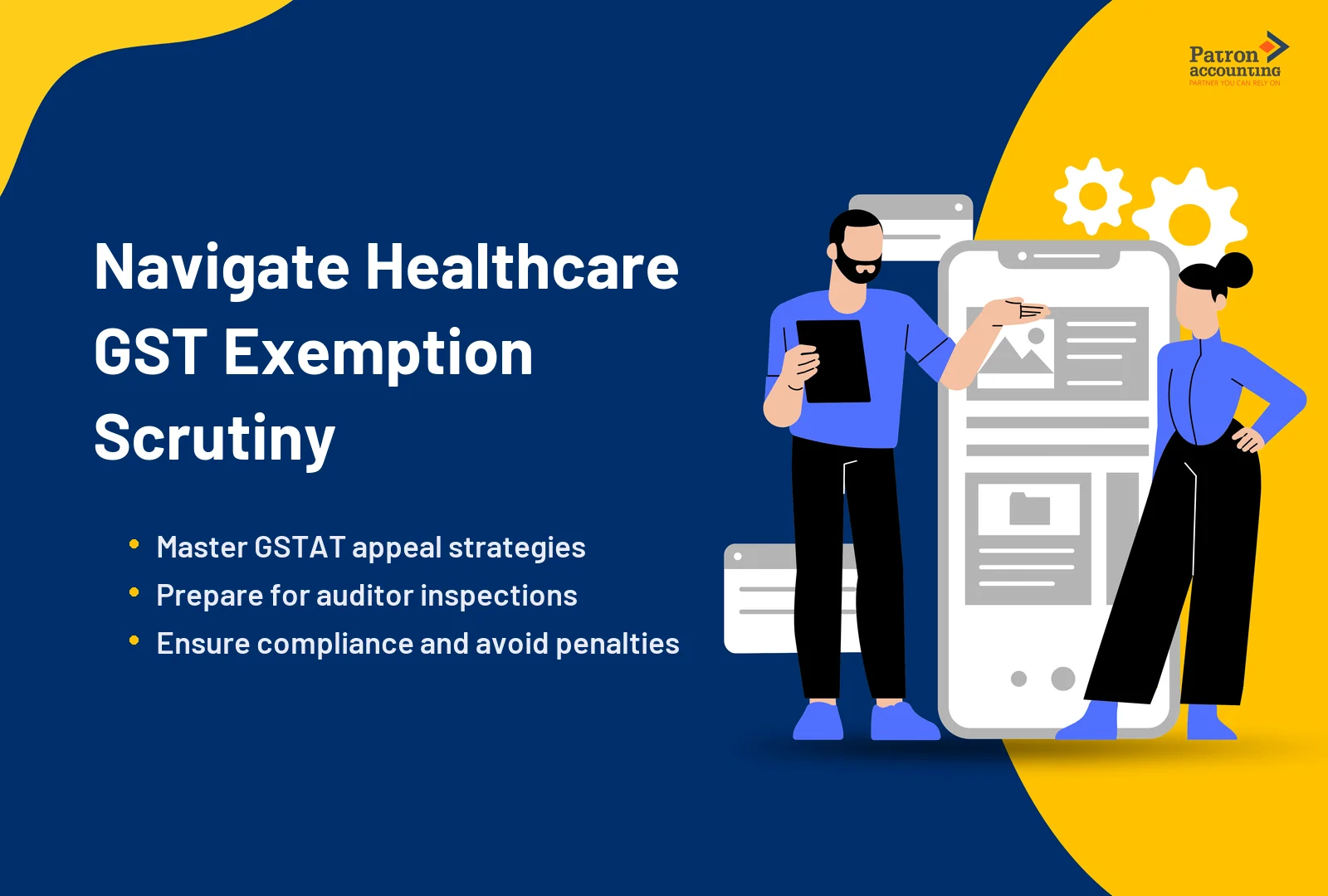
Understanding what auditors and revenue officers actually look for - their specific checkpoints, the documentary evidence they demand, and the patterns that trigger deeper scrutiny - is the best way to prepare for a GST demand and, if needed, a GSTAT appeal.
This guide reverses the lens. Instead of explaining the exemption from the taxpayer's perspective, it maps the exact scrutiny process from the department's side - covering the eight checkpoints officers use, the documents they demand, and how this knowledge shapes a stronger GSTAT appeal.
What Do Revenue Officers Actually Examine in Healthcare GST Scrutiny?
Revenue officers examining a healthcare GST exemption claim follow a structured assessment that tests three foundational questions: (1) Is the provider a qualifying entity under Entry 74? (2) Is each service correctly classified as exempt healthcare vs taxable ancillary? (3) Are ITC obligations properly handled for mixed revenue streams?
The scrutiny is not random. It is triggered by specific patterns in the hospital's GST returns - GSTR-1 showing high exempt turnover with no corresponding taxable supplies, GSTR-3B with zero ITC reversal despite claiming exemption, or GSTR-9 annual return discrepancies between reported turnover and financial statements.
Healthcare businesses that work with GSTAT healthcare appeal services (know more) proactively prepare for these checkpoints - because understanding the department's approach is the first step in defending the exemption.
Key Terms You Should Know
Scrutiny Assessment: A targeted review by the GST proper officer under Section 61 of the CGST Act, triggered by return discrepancies. The officer issues a notice requesting specific documents and explanations.
ASMT-10 Notice: The notice issued by the officer to the taxpayer during scrutiny, specifying the discrepancies found and the documents required. The taxpayer must respond within 30 days.
DRC-01A (Intimation): A pre-show-cause-notice intimation introduced in 2024, giving the taxpayer an opportunity to pay the demand voluntarily before a formal SCN is issued. Hospitals receive this when the officer finds a prima facie exemption violation.
Composite Supply Test: The test officers apply to determine whether bundled hospital services (treatment + room + food + medicines) constitute a single composite supply (exempt) or a mixed supply (taxable at highest rate). The key factors: naturally bundled, provided in conjunction, and not artificially packaged.
Revenue Leakage Indicator: A pattern in the hospital's returns that suggests potential tax evasion - e.g., 100% exempt turnover with significant capital expenditure (suggesting ITC should have been reversed), or sudden reclassification of previously taxable services as exempt.
Entry 74 Exclusion Test: The officer's check to determine whether a service falls within the exclusions from healthcare exemption - hair transplant, cosmetic surgery, plastic surgery (unless restorative). The burden of proof for the restorative exception lies with the hospital.
Who Faces Healthcare GST Scrutiny Most Frequently?
Based on patterns from demand notices and first appellate orders, the following healthcare entities face the highest scrutiny frequency:
- Large multi-speciality hospitals with annual turnover above Rs 20 crore - high-value targets for the department
- Hospitals that charge room rent in multiple tiers (economy, deluxe, suite) - the Rs 5,000/day threshold creates billing complexity
- Cosmetic surgery and aesthetic clinics - every procedure is tested against the restorative vs elective classification
- Hospital chains with outsourced canteen, pharmacy, and parking - each outsourced service is separately assessed for taxability
- Wellness centres, naturopathy resorts, and AYUSH clinics where the 'healthcare' characterisation is disputed by the department
- Hospitals that claimed ITC on construction or major renovation while reporting only exempt healthcare revenue
For the complete exemption list, read our healthcare GST exemption requirements list (know more).
Legal Framework: Provisions Officers Use to Challenge Healthcare Exemption
| Officer's Checkpoint | Legal Basis | What They Examine |
|---|---|---|
| Clinical establishment status | Para 2(s) of Notification 12/2017-CT(Rate) | Registration certificate, Clinical Establishments Act licence, scope of services offered |
| Authorised practitioner | Para 2(k) of Notification 12/2017-CT(Rate) | Medical council registration, AYUSH practitioner certificate, qualification documents |
| Room rent threshold | Notification 03/2022-CT(Rate) | Room tariff card, actual billing records, ICU/CCU/NICU classification evidence |
| Composite supply | Section 2(30) CGST Act | Invoice structure - bundled vs separate line items; whether services are naturally bundled |
| Cosmetic surgery exclusion | Entry 74 proviso | Surgical records showing whether procedure was elective vs restorative |
| Food to non-patients | Circular 32/06/2018-GST | Canteen billing - in-patient on doctor's advice (exempt) vs outpatient/visitor (taxable) |
| ITC reversal | Section 17(2), Rule 42/43 | ITC register showing reversal on exempt supplies; apportionment for mixed revenue |
| Doctor engagement model | Circular 32/06/2018-GST | Employment contract vs independent consultancy; Schedule III employer-employee exclusion |
The Eight Scrutiny Checkpoints: Step-by-Step Officer's Process
1. Verify Clinical Establishment Registration. The officer's first action is to confirm whether the entity holds a valid registration under the Clinical Establishments (Registration and Regulation) Act, 2010, or the applicable state equivalent. A wellness centre or naturopathy resort without this registration faces immediate challenge. Officers also verify the scope - does the registration cover the specific services claimed as exempt?
2. Cross-Check Room Rent Against the Rs 5,000 Threshold. Officers pull the hospital's room tariff card and compare it against billing data. They check: (a) rooms charged above Rs 5,000/day that were not taxed at 5%, (b) whether the hospital correctly excluded ICU/CCU/NICU from the threshold, (c) whether discounts or packages artificially brought the effective rate below Rs 5,000. Businesses using GST audit services (know more) pre-emptively reconcile tariff cards against actual billing.
3. Examine Invoicing Structure for Composite Supply. This is the most consequential checkpoint. Officers review whether the hospital's invoices show a single bundled in-patient package or separate line items for room, food, medicines, and treatment. Separate invoicing for each component allows the officer to treat each as a distinct supply - breaking the composite supply exemption. The officer also checks if the hospital charges separate fees for items that should be bundled (e.g., a separate invoice for surgical consumables).
4. Audit Food and Canteen Operations. Officers request canteen vendor contracts and food billing records. They check: (a) food served to in-patients on doctor's orders - exempt as composite supply, (b) food served to outpatients, attendants, or visitors - taxable, (c) whether the hospital or a third-party vendor operates the canteen. The Department consistently challenges hospitals that treat all food as exempt regardless of the recipient.
5. Test Cosmetic Surgery Classification. For hospitals offering cosmetic procedures, officers examine surgical records to determine whether each procedure is elective (taxable at 18%) or restorative (exempt under the Entry 74 exception). The burden of proof lies with the hospital - it must show the surgery was undertaken to restore anatomy affected by congenital defects, developmental abnormalities, injury, or trauma.
6. Verify ITC Reversal Under Section 17(2). Officers examine the ITC register and GSTR-3B filings. If the hospital reports 100% exempt healthcare revenue but has claimed ITC on construction, equipment, or other inputs, the officer flags this as a direct violation. For hospitals with mixed revenue (exempt healthcare + taxable room rent + pharmacy), officers verify Rule 42/43 apportionment calculations. For GSTAT appeal preparation, see our guide on how to file a GSTAT appeal (know more).
7. Assess Doctor/Consultant Engagement Model. Officers check whether doctors serve the hospital as employees (Schedule III - not a supply) or as independent consultants (exempt healthcare under Circular 32/06/2018-GST). The distinction matters because some officers have attempted to treat consultant fees as taxable services provided TO the hospital, rather than healthcare services provided BY the hospital through the consultant.
8. Reconcile GSTR-9 with Financial Statements. The annual return reconciliation is the final checkpoint. Officers compare the hospital's P&L statement with GSTR-9. Discrepancies - such as parking income, equipment rental, cafeteria revenue, or sponsorship income not reported as taxable - trigger demand notices for the unreported taxable supplies.
Documents Revenue Officers Demand During Healthcare Scrutiny
- Clinical establishment registration certificate (under Clinical Establishments Act 2010 or state equivalent)
- Medical practitioner registration certificates for all doctors and AYUSH practitioners
- Hospital licence from state health authority
- Room tariff card with effective dates and room category classifications
- Room-wise billing data for the scrutinised period showing rates charged vs tariff
- In-patient invoice samples showing bundled vs unbundled billing structure
- Canteen vendor contracts, food billing records, and recipient classification (patient vs visitor)
- Surgical records for cosmetic procedures showing diagnosis - congenital defect, injury, or elective
- ITC register with Section 17(2) reversal entries and Rule 42/43 apportionment worksheets
- Doctor/consultant engagement letters or employment contracts
- GSTR-1, GSTR-3B, GSTR-9, and GSTR-9C for the scrutinised period
- Audited financial statements (P&L, balance sheet) for cross-verification with GST returns
- Capital expenditure records - construction, renovation, equipment purchases - with ITC treatment
What Triggers Deeper Scrutiny: Six Red Flags Officers Watch For
| # | Red Flag | Why It Triggers Scrutiny | How to Prepare |
|---|---|---|---|
| 1 | 100% exempt turnover + high capital expenditure | Suggests ITC claimed on inputs for exempt services without reversal | Maintain Section 17(2) reversal register; reconcile annually |
| 2 | Sudden reclassification of revenue as exempt | Previously taxable services now claimed as exempt - pattern of avoidance | Document the legal basis for reclassification; cite the specific Entry |
| 3 | Room tariff above Rs 5,000 but no 5% GST charged | Direct violation of Notification 03/2022-CT(Rate) threshold | Segregate billing above/below Rs 5,000; file amended returns if needed |
| 4 | Large outsourced canteen/pharmacy without GST | Third-party services to hospital are taxable; pharmacy sales are taxable | Separate billing streams; vendor invoices with GST; proper disclosure |
| 5 | High cosmetic surgery revenue reported as exempt | Elective cosmetic procedures are taxable at 18%; officers presume taxability | Maintain surgical records proving restorative nature with diagnosis evidence |
| 6 | GSTR-9 turnover lower than audited P&L revenue | Unreported taxable income (parking, rental, sponsorship, canteen) | Reconcile GSTR-9 with P&L before filing; disclose all revenue streams |
Note: Revenue officers in 2026 increasingly use data analytics to identify these red flags before initiating physical scrutiny. The GST portal's risk profiling system flags hospitals matching these patterns for priority assessment.
Common Mistakes That Weaken Your Position During Scrutiny and Appeal
Mistake 1: Not maintaining a clinical establishment certificate in the current period. Many hospitals obtained registration years ago and never renewed. If the certificate has lapsed or the registration does not cover the specific services under scrutiny, the exemption claim fails at the first checkpoint. For appeal preparation, GSTAT appeal filing (know more) always starts with document verification.
Mistake 2: Issuing separate invoices for components of in-patient treatment. A hospital that issues one invoice for room, another for surgery, another for medicines, and another for food destroys the composite supply argument. Officers treat each invoice as a separate supply. Bundled single-invoice billing - with itemised breakup on a single document - preserves the composite supply exemption.
Mistake 3: Not segregating food billing between patients and non-patients. Food served to in-patients on doctor's advice is exempt. Food to everyone else is taxable. Without billing segregation, the officer treats all canteen revenue as taxable. Read our guide on GSTAT pre-deposit rules (know more) if the demand has been confirmed.
Mistake 4: Claiming ITC on construction without reversal. Hospitals that built new wings, renovated wards, or purchased expensive equipment and claimed ITC - while reporting 100% exempt healthcare revenue - face certain demand notices. Section 17(2) requires full ITC reversal for exempt suppliers.
Mistake 5: Not documenting the restorative nature of cosmetic procedures. For every cosmetic procedure claimed as exempt (restorative), the hospital must have a medical record showing the diagnosis: congenital defect, developmental abnormality, injury, or trauma. Without this documentation, the officer presumes the procedure is elective and taxable. For GSTAT representation support, explore GSTAT e-filing assistance (know more).
Penalties Officers Can Impose for Healthcare Exemption Violations
Under Section 73 of the CGST Act, 2017, if the exemption violation is without fraud (e.g., genuine misclassification of room rent or ancillary services), the demand includes the tax amount plus 18% interest and 10% penalty. The demand covers 3 financial years preceding the year of the SCN.
Under Section 74, if the officer alleges fraud, wilful misstatement, or suppression of facts (e.g., a cosmetic clinic systematically misclassifying elective procedures as restorative), the demand covers 5 years with 100% penalty. This is the most severe outcome of a healthcare GST scrutiny.
Under Section 17(2) read with Rule 42/43, ITC wrongly claimed on exempt supplies is recoverable with interest. This is in addition to any demand under Section 73/74 for the exemption itself - creating a potential double exposure.
Under Section 112(9), once the GSTAT pre-deposit is paid, recovery is automatically stayed. For hospitals facing large demands from healthcare scrutiny, this stay is essential to protect operating cash flow.
How Scrutiny Findings Shape Your GSTAT Appeal Strategy
The specific checkpoints the officer focused on during scrutiny directly determine the grounds of your GSTAT appeal. If the officer challenged your clinical establishment status, the appeal must include the registration certificate and scope-of-services documentation. If the officer broke your composite supply by pointing to separate invoices, the appeal must include evidence that the billing structure was administrative (single underlying healthcare transaction) and not an indicator of separate supplies.
The GSTAT, as the highest fact-finding authority, can re-examine all evidence de novo. Unlike the First Appellate Authority (which often relies on the officer's findings), the Tribunal independently evaluates invoices, contracts, registration certificates, and surgical records. This makes the GSTAT the most effective forum for challenging healthcare exemption denials based on factual disputes.
The strongest GSTAT appeals in healthcare anticipate the officer's checkpoints and address each one proactively in the Statement of Facts. For example: "The clinical establishment certificate (Annexure C) confirms registration covering diagnostic, surgical, and in-patient care services. The invoices (Annexure D) show bundled billing for all in-patient services. The ITC register (Annexure E) shows full reversal under Section 17(2)." Each checkpoint gets its own annexure and ground of appeal.
Auditor's Scrutiny vs GSTAT Appeal: How the Evidence Maps
| Scrutiny Checkpoint | What Officer Demands | What GSTAT Appeal Must Include |
|---|---|---|
| Clinical establishment | Registration certificate; state health licence | Same + scope-of-services evidence + case law on broad interpretation |
| Room rent threshold | Tariff card + billing data | Same + period-wise analysis + ICU/CCU classification proof |
| Composite supply | Invoice samples | Same + composite supply legal analysis + industry billing norms |
| Food to non-patients | Canteen contracts + billing split | Same + doctor-advised food records for in-patients + vendor GST invoices |
| Cosmetic classification | Surgical records | Same + diagnosis showing congenital/injury/trauma basis |
| ITC reversal | ITC register + GSTR-3B | Same + Rule 42/43 worksheet + CA certificate on apportionment |
| Doctor engagement | Contracts/letters | Same + Circular 32/06/2018-GST citation + Schedule III analysis |
| GSTR-9 reconciliation | P&L + GSTR-9 comparison | Same + line-by-line reconciliation explaining each difference |
Key Takeaways
Revenue officers examining healthcare GST exemption follow eight structured checkpoints: clinical establishment status, room rent threshold compliance, composite supply invoicing, food billing segregation, cosmetic surgery classification, ITC reversal verification, doctor engagement model, and GSTR-9 vs financial statement reconciliation.
The six red flags that trigger deeper scrutiny are: 100% exempt turnover with high capital expenditure, sudden reclassification of revenue as exempt, room rates above Rs 5,000 without 5% GST, large outsourced services without GST, high cosmetic surgery revenue reported as exempt, and GSTR-9 turnover lower than audited P&L.
The strongest GSTAT appeals anticipate each scrutiny checkpoint and address it proactively - with a dedicated annexure and ground of appeal for each point the officer challenged.
Billing structure directly impacts exemption. Bundled single-invoice in-patient packages preserve composite supply exemption. Separate invoices for room, food, medicines, and treatment destroy it.
The 30 June 2026 GSTAT deadline applies to all backlog healthcare exemption appeals. Hospitals that received demand notices and lost at the first appeal level must file before this date.
Need Help Preparing for Healthcare GST Scrutiny or Appeal?
Understanding what auditors and revenue officers look for is the most effective preparation for both scrutiny defence and GSTAT appeal. Proactive documentation of clinical establishment status, room rent classification, composite supply billing, and ITC reversal eliminates the most common grounds for demand notices.
Explore our GSTAT healthcare appeal services (know more) for scrutiny preparation, demand response, and end-to-end GSTAT filing and representation.