In this guide
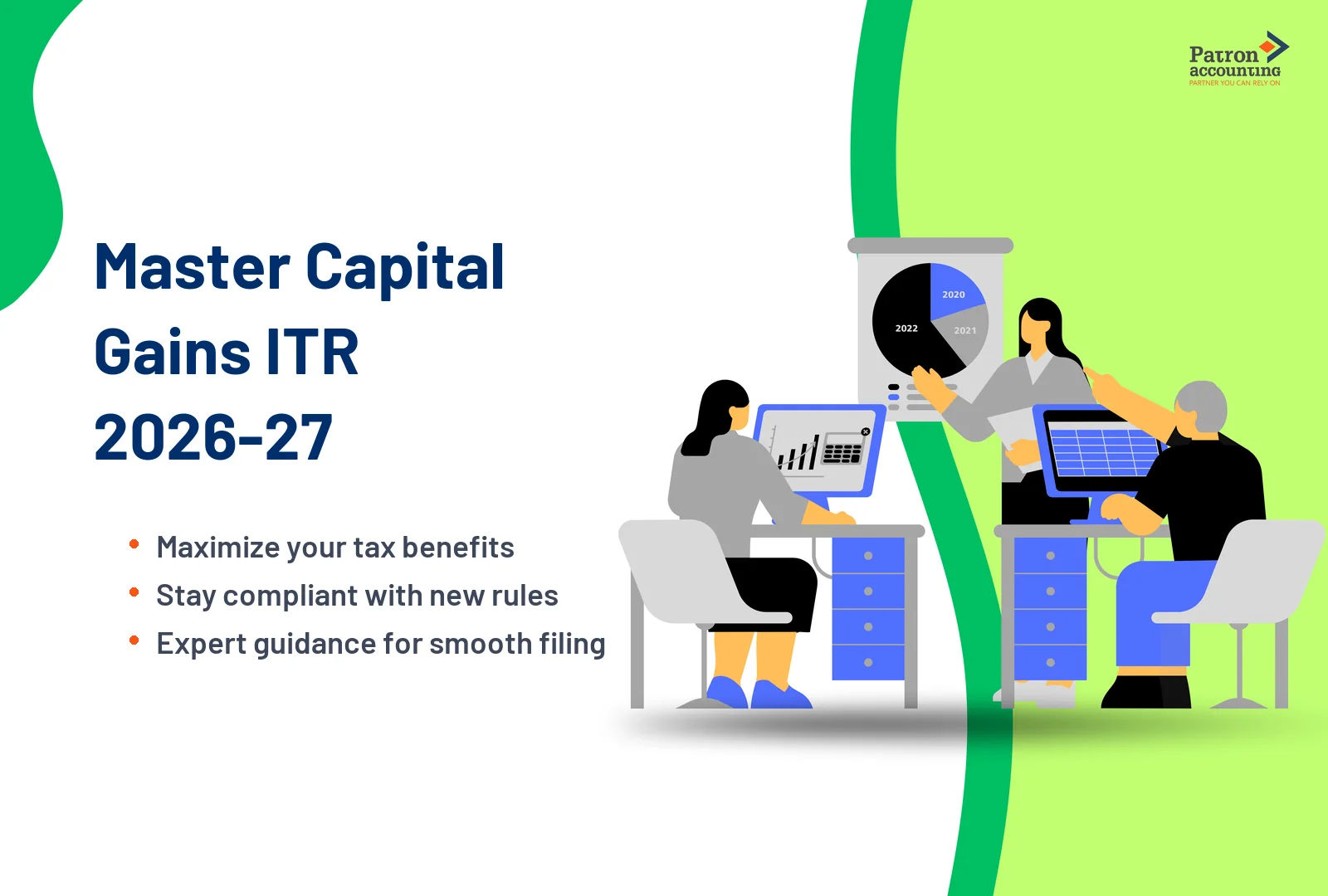
If you sold shares, redeemed mutual funds, transferred property, or earned from crypto during FY 2025-26, you have capital gains to report in your income tax return. For AY 2026-27, the capital gains tax framework continues with the rates introduced by Finance Act 2024 (effective 23 July 2024) - and the ITR forms have been updated with simplified reporting that removes the earlier bifurcated pre/post July 2024 structure.
This guide covers every capital gains tax rate by asset class, the correct ITR form selection, exemptions under Sections 54/54EC/54F, loss set-off and carry-forward rules, and the key ITR form changes for AY 2026-27.
What Are Capital Gains and Why Does ITR Filing Matter?
Capital gains are profits earned from the sale or transfer of a capital asset - shares, mutual funds, property, gold, bonds, or virtual digital assets (crypto). Under the Income Tax Act, capital gains are classified as Short-Term (STCG) or Long-Term (LTCG) based on how long you held the asset before selling.
Capital gains are taxed at special rates - separate from your salary or business income slab rates. This means even if your total income is below Rs 12 lakh (tax-free under the new regime), you must still pay tax on capital gains because Section 87A rebate does not apply to special rate incomes.
For individuals managing capital gains ITR filing services, accurate classification of each transaction as STCG or LTCG, correct rate application, and proper exemption claims are critical to avoiding assessment demands.
Key Terms You Should Know
- STCG (Short-Term Capital Gain): Profit from selling an asset held for less than the specified holding period. For listed equity/MFs: less than 12 months. For unlisted shares/property/gold: less than 24 months.
- LTCG (Long-Term Capital Gain): Profit from selling an asset held beyond the specified holding period. Taxed at lower special rates with exemption thresholds.
- Section 112A (LTCG on Equity): LTCG on listed equity shares, equity-oriented mutual funds, and business trust units taxed at 12.5% on gains exceeding Rs 1.25 lakh per year. No indexation. Surcharge capped at 15%.
- Section 111A (STCG on Equity): STCG on STT-paid listed equity and equity-oriented MFs taxed at 20% (increased from 15% effective 23 July 2024).
- Section 112 (LTCG on Other Assets): LTCG on property, unlisted shares, gold, debt MFs taxed at 12.5% without indexation. For property bought before 23 July 2024: option of 20% with indexation (whichever is lower for resident individual/HUF).
- Section 115BBH (Crypto/VDA): Virtual Digital Assets taxed at flat 30% regardless of holding period. No deductions except cost of acquisition. No loss set-off from any other income.
- Cost Inflation Index (CII): Index used to adjust purchase cost for inflation. FY 2025-26 CII is 363. Available only for property LTCG option (20% with indexation for pre-July 2024 purchases).
- Schedule CG: The capital gains schedule in ITR-2 and ITR-3 where all capital gains transactions are reported - asset-wise, with purchase/sale dates, amounts, and tax computation.
Who Needs to File Capital Gains in Their ITR?
- Equity investors who sold listed shares or redeemed equity mutual funds during FY 2025-26 - even if gains are below the Rs 1.25 lakh LTCG exemption
- Property sellers who transferred residential or commercial property - must compute LTCG with Section 54/54EC/54F exemptions
- Mutual fund investors who redeemed debt MFs, hybrid funds, or international funds - taxed at slab rates (STCG) or 12.5% (LTCG)
- F&O traders - futures and options income is treated as business income (not capital gains) and filed in ITR-3
- Crypto/VDA traders who sold, exchanged, or transferred any virtual digital asset - flat 30% tax under Section 115BBH
- Gold/jewellery sellers - physical gold or gold ETFs held beyond 24 months qualify as LTCG
Individuals filing income tax return filing with capital gains must carefully determine the correct ITR form - ITR-1 for small LTCG, ITR-2 for all other capital gains, or ITR-3 if combined with business income.
Legal Framework: Capital Gains Tax Rates for AY 2026-27
The following rates apply for FY 2025-26 (AY 2026-27), continuing from Finance Act 2024:
| Asset Type | Holding Period for LTCG | STCG Rate | LTCG Rate | Exemption/Special Rule |
|---|---|---|---|---|
| Listed equity shares (STT paid) | > 12 months | 20% (Section 111A) | 12.5% (Section 112A) | LTCG up to Rs 1.25 lakh exempt per year |
| Equity-oriented mutual funds | > 12 months | 20% (Section 111A) | 12.5% (Section 112A) | LTCG up to Rs 1.25 lakh exempt per year |
| Unlisted shares | > 24 months | Slab rates | 12.5% (Section 112) | No exemption threshold |
| Residential property | > 24 months | Slab rates | 12.5% without indexation (Section 112) | Pre-23 July 2024 purchase: 20% with indexation option for resident individual/HUF |
| Gold / jewellery / gold ETFs | > 24 months | Slab rates | 12.5% (Section 112) | No exemption threshold |
| Debt mutual funds | > 24 months | Slab rates | 12.5% (Section 112) | No exemption threshold |
| Virtual Digital Assets (crypto) | Any period | 30% flat (Section 115BBH) | 30% flat (Section 115BBH) | No deductions except cost. No loss set-off |
| Sovereign Gold Bonds (at maturity) | > 12 months | N/A | Exempt (if held to maturity) | Secondary market sale: 12.5% LTCG |
Note: Section 87A rebate (Rs 60,000 under new regime / Rs 12,500 under old regime) does NOT apply to capital gains taxed at special rates. Even if your normal income is below Rs 12 lakh, you must pay full tax on STCG and LTCG. 4% Health and Education Cess applies on all capital gains tax.
How to File Capital Gains in ITR: Step-by-Step
- Determine Holding Period for Each Asset. Listed equity/MFs: more than 12 months = LTCG. Unlisted shares/property/gold/debt MFs: more than 24 months = LTCG. Crypto: always special rate regardless of period.
- Calculate Gains or Losses for Each Transaction. Gain = Sale consideration minus cost of acquisition minus improvement cost minus transfer expenses. For property LTCG (pre-23 July 2024 purchase): compute both 12.5% without indexation and 20% with indexation (CII 363 for FY 2025-26) - pay whichever is lower. Professional tax planning services can optimise your capital gains computation across multiple asset classes.
- Select the Correct ITR Form. ITR-1: Only if LTCG under Section 112A is up to Rs 1.25 lakh with no carry-forward losses (new for AY 2026-27). ITR-2: For all other capital gains - STCG, LTCG above Rs 1.25 lakh, property, unlisted shares, crypto. ITR-3: If capital gains combined with business/profession income.
- Fill Schedule CG in ITR-2 or ITR-3. Report each asset type separately. Provide purchase date, sale date, sale consideration, cost of acquisition, improvement cost, transfer expenses, and computed gain/loss. For AY 2026-27, bifurcated pre/post 23 July 2024 reporting is removed - all transactions reported uniformly.
- Claim Exemptions Under Sections 54, 54EC, 54F. Section 54: Reinvest property sale proceeds in another residential property within 2 years (or construct within 3 years) - LTCG exempt. Section 54EC: Invest up to Rs 50 lakh in specified bonds (NHAI/REC) within 6 months - LTCG exempt. Section 54F: Reinvest sale proceeds from any LTCG asset into residential property - proportional exemption.
- Set Off Losses Against Gains. STCL can be set off against both STCG and LTCG. LTCL can be set off only against LTCG. Crypto losses cannot be set off against any other income. Carry forward unabsorbed losses for up to 8 years - only if ITR filed by due date.
- Pay Advance Tax and Self-Assessment Tax. If capital gains tax exceeds Rs 10,000 in a year, advance tax is payable. For gains arising after 15 September, pay in subsequent instalments. Self-assessment tax must be paid before filing ITR.
Documents Needed for Capital Gains ITR Filing
- Broker contract notes - for every equity/MF buy and sell transaction during FY 2025-26
- Depository (CDSL/NSDL) transaction statements - consolidated holding and transaction history
- Mutual fund CAS (Consolidated Account Statement) from CAMS/KFintech - showing SIP, redemption, switch transactions
- Property sale deed and purchase deed - with stamp duty, registration charges, and improvement costs
- Section 54EC bond investment proof - NHAI/REC bond allotment letter (if claiming exemption)
- Capital Gains Account Scheme (CGAS) deposit receipt - if Section 54/54F reinvestment not completed before ITR due date
- Gold/jewellery purchase receipts - for cost of acquisition computation
- Crypto exchange transaction history - all buy, sell, swap, and transfer records with timestamps
- AIS (Annual Information Statement) - cross-verify all securities and property transactions reported
- Form 26AS - verify TDS on property sale (Section 194-IA) and other applicable TDS
Capital Gains Tax: Holding Periods and Classification
| Asset | Short-Term (STCG) If Held For | Long-Term (LTCG) If Held For |
|---|---|---|
| Listed equity shares (STT paid) | Up to 12 months | More than 12 months |
| Equity-oriented mutual funds | Up to 12 months | More than 12 months |
| Unlisted shares | Up to 24 months | More than 24 months |
| Immovable property (land/building) | Up to 24 months | More than 24 months |
| Gold / jewellery (physical) | Up to 24 months | More than 24 months |
| Gold ETFs / Gold MFs | Up to 12 months | More than 12 months |
| Debt mutual funds | Up to 24 months | More than 24 months |
| Bonds and debentures (listed) | Up to 12 months | More than 12 months |
| Virtual Digital Assets (crypto) | Any period - 30% flat rate | Any period - 30% flat rate |
Note: For listed bonds/debentures, the holding period for LTCG classification is 12 months. For unlisted bonds, it is 24 months. Sovereign Gold Bonds held to maturity are exempt from capital gains tax; secondary market sale is taxed as LTCG at 12.5%.
Common Mistakes to Avoid in Capital Gains ITR Filing
Mistake 1: Filing ITR-1 with capital gains above Rs 1.25 lakh. ITR-1 now allows LTCG under Section 112A up to Rs 1.25 lakh - but only if there are no carry-forward losses. Any STCG, LTCG above Rs 1.25 lakh, or gains from property/unlisted assets/crypto require ITR-2. Filing the wrong form triggers a defective return notice. For F&O traders, profits are business income requiring ITR-3 - refer to ITR for F&O traders for detailed guidance.
Mistake 2: Assuming Section 87A rebate covers capital gains. Even if your salary income is below Rs 12 lakh (zero tax under new regime), you must pay full tax on STCG and LTCG. The rebate applies only to normal income taxed at slab rates, not to special rate incomes. Example: Rs 10 lakh salary (zero tax via rebate) + Rs 3 lakh LTCG on equity = Rs 21,875 tax on LTCG [(Rs 3L - Rs 1.25L) x 12.5%] + cess.
Mistake 3: Not computing property LTCG under both methods. For property purchased before 23 July 2024 by a resident individual or HUF, you have two options: 12.5% without indexation or 20% with indexation (CII 363 for FY 2025-26). You must compute under both methods and pay the lower amount. Many taxpayers miss the indexation option and overpay.
Mistake 4: Missing the ITR due date and losing loss carry-forward. Capital losses can be carried forward for 8 assessment years - but only if the original return is filed by the due date (31 July 2026 for ITR-2). Filing even one day late permanently forfeits the right to carry forward that loss. For investors with large losses, this is the most costly mistake.
Mistake 5: Setting off crypto losses against equity gains. Under Section 115BBH, losses from Virtual Digital Assets cannot be set off against any other income - including other capital gains. Crypto losses can only be carried forward (for 8 years) and set off against future crypto gains. If you have both equity gains and crypto losses, they are computed independently. Refer to ITR for crypto traders for detailed VDA reporting requirements.
Penalties for Non-Disclosure of Capital Gains
AIS now captures all equity and mutual fund transactions from depositories and all property transactions from sub-registrars. If capital gains visible in AIS are not declared in your ITR:
Section 143(1) intimation with additional tax demand plus interest at 1% per month under Section 234A (delay) and Section 234B (advance tax shortfall). For large undeclared gains, penalty of up to 200% of tax on concealed income under Section 270A.
Late filing fee of Rs 5,000 under Section 234F if ITR filed after 31 July 2026 (Rs 1,000 if income below Rs 5 lakh). More critically, loss carry-forward is permanently lost if ITR is not filed by the due date.
Property sales above Rs 50 lakh attract TDS at 1% under Section 194-IA - this TDS appears in Form 26AS. If the corresponding capital gain is not declared in ITR, the mismatch is immediately flagged during automated processing.
How Capital Gains Connect With Other Provisions
Capital gains interact with multiple provisions of the Income Tax Act. The advance tax requirement applies if total capital gains tax exceeds Rs 10,000 in a year - interest under Section 234C accrues if instalments are not paid on time. For property transactions, ITR for crypto traders and equity investors alike must ensure AIS reconciliation before filing.
Section 54 and 54F exemptions for property reinvestment require that the new property be purchased within 2 years or constructed within 3 years of the original sale. If the reinvestment is not completed before the ITR due date, the gain amount must be deposited in a Capital Gains Account Scheme (CGAS) before filing. Failure to deposit in CGAS means the exemption is lost and the full gain is taxable.
From Tax Year 2026-27, the capital gains framework continues under the Income Tax Act, 2025 with renumbered sections but identical rates and holding periods. The transition from Section 112A (old Act) to the corresponding new Act provision does not change the 12.5% rate or Rs 1.25 lakh exemption.
Capital Gains: ITR Form Changes for AY 2026-27
| Change | Impact |
|---|---|
| Bifurcated pre/post 23 July 2024 reporting removed | All transactions reported uniformly - no split by transfer date |
| Old STCG 15% and LTCG 10%/20% rate fields removed | Only current rates (STCG 20%, LTCG 12.5%) in ITR-2/ITR-3 forms |
| ITR-1 now includes LTCG up to Rs 1.25 lakh | Investors with small equity gains can use the simpler ITR-1 form |
| Schedule BBS removed from ITR-6 | Buyback taxation shifted to capital gains - separate schedule no longer needed |
| Enhanced F&O reporting in ITR-3 | Separate turnover and P&L disclosure for derivatives trading |
| Dividend interest deduction field added | Reports disallowance of interest on borrowed funds used for dividend-yielding investments |
Key Takeaways
For AY 2026-27, LTCG on listed equity and equity MFs is taxed at 12.5% on gains above Rs 1.25 lakh per year under Section 112A. STCG on STT-paid equity is taxed at 20% under Section 111A. These rates continue from Finance Act 2024 with no changes in Budget 2026.
Section 87A rebate does not apply to capital gains taxed at special rates. Even if your salary is below Rs 12 lakh (zero tax under new regime), you must pay full tax on STCG and LTCG separately.
Property LTCG for pre-23 July 2024 purchases offers a choice: 12.5% without indexation or 20% with indexation (CII 363 for FY 2025-26) - compute both and pay the lower amount. Crypto/VDA is taxed at a flat 30% with no loss set-off.
ITR-1 now allows LTCG under Section 112A up to Rs 1.25 lakh (new for AY 2026-27). All other capital gains require ITR-2. F&O income requires ITR-3 as it is treated as business income.
Capital losses can be carried forward for 8 years only if ITR is filed by the due date (31 July 2026). LTCL offsets only LTCG. STCL offsets both STCG and LTCG. Missing the deadline permanently forfeits carry-forward rights.
Need Help with Capital Gains ITR Filing?
Capital gains ITR filing involves multiple asset classes, different tax rates, exemption computations, and strict deadlines. A professional CA can correctly classify each transaction, optimise Section 54/54EC/54F exemptions, ensure AIS reconciliation, and preserve your loss carry-forward rights.
Explore our capital gains ITR filing services for end-to-end support - from Rs 1,499 for equity/MF ITR.