In this guide
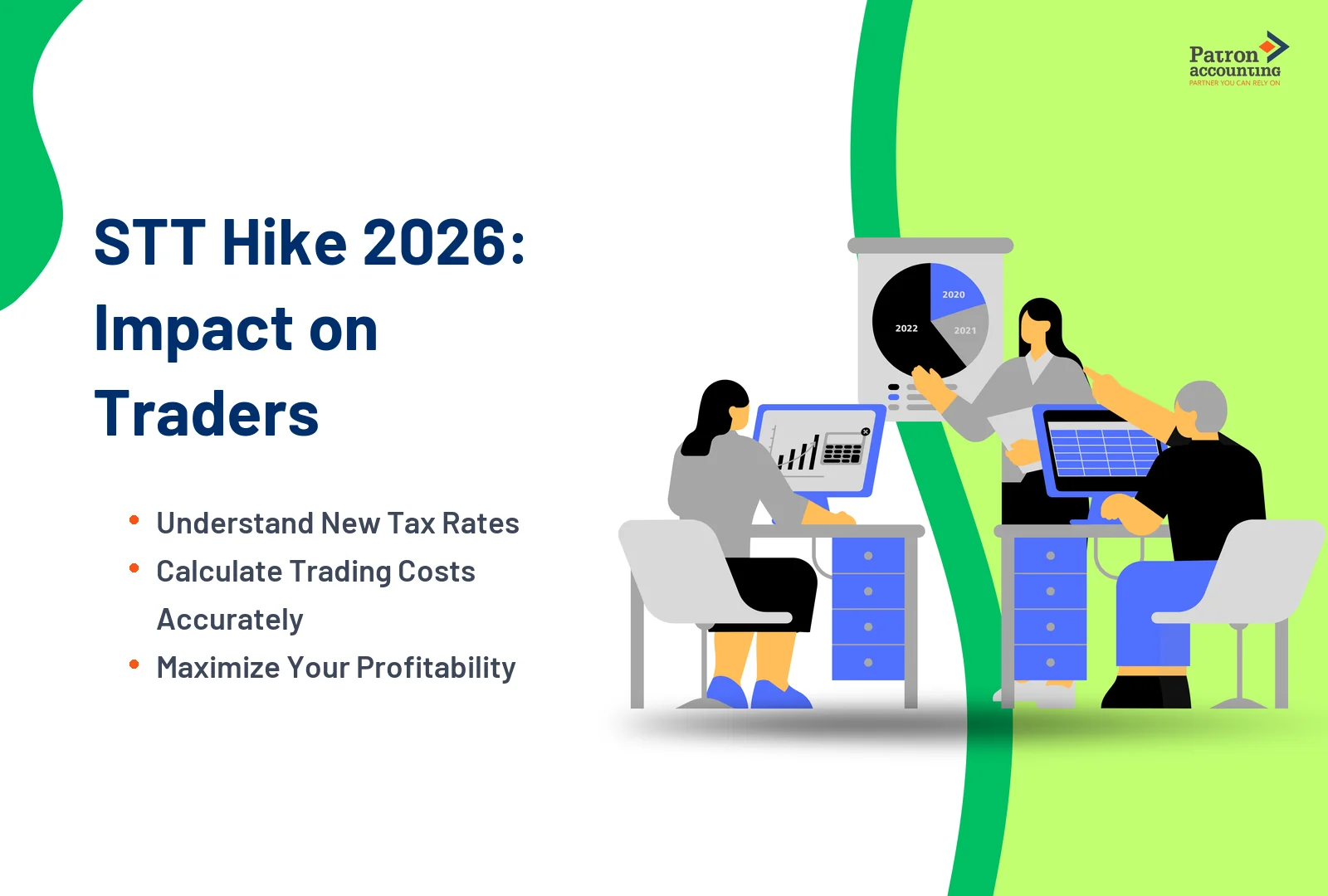
On 01 February 2026, Finance Minister Nirmala Sitharaman announced the sharpest increase in Securities Transaction Tax on derivatives in two decades. The futures STT jumped 150% - from 0.02% to 0.05%. Options premium STT rose 50% - from 0.10% to 0.15%. Markets reacted immediately: the Sensex fell over 1,000 points on Budget Day, and broking stocks plunged as traders priced in the higher cost of doing business.
This guide explains the new STT rates effective 01 April 2026, how much more you will pay per trade, who is most affected, whether STT is deductible, and how to report it correctly in your ITR.
What Is Securities Transaction Tax (STT) and Why Was It Hiked?
Securities Transaction Tax (STT) is a direct tax levied under the Finance (No. 2) Act, 2004 on the purchase and sale of securities transacted through recognised stock exchanges in India (NSE, BSE). It is collected automatically by the exchange at the time of the transaction and is non-refundable.
The Budget 2026 hike targets derivatives specifically. SEBI data published in 2024-25 revealed that 90-93% of individual F&O traders incurred net losses, with many continuing to trade despite repeated losses. The government’s stated rationale is to curb excessive speculation, protect retail investors, and redirect capital toward the cash equity market.
For F&O traders filing ITR for F&O traders, the STT increase directly reduces net profitability because it applies to every transaction regardless of whether the trade was profitable or loss-making.
Key Terms You Should Know
- Securities Transaction Tax (STT): A direct tax on buying/selling securities on recognised exchanges. Introduced in 2004. Non-refundable. Rates vary by transaction type.
- Finance (No. 2) Act, 2004: The original legislation that introduced STT. Amended by subsequent Finance Acts including Finance Act 2026.
- Sell-Side STT: STT charged only when selling a security. Applies to futures, options premium, and intraday equity trades. The buyer does not pay STT in these cases.
- Intrinsic Value (Options Exercise): The difference between the spot price and the strike price of an option at the time of exercise. STT on exercise is calculated on this value, not the premium.
- Section 36 Deduction: Under the Income Tax Act, STT paid on F&O transactions is deductible as a business expense when F&O income is declared as business income (not capital gains).
- Section 112A: Concessional LTCG tax rate of 12.5% on listed equity. Requires that STT was paid on both acquisition and transfer of the security.
- Turnover (F&O): For tax audit purposes, turnover of futures is the absolute sum of all profits and losses. For options, turnover is the premium received/paid. STT is not included in turnover calculation.
Who Is Most Affected by the STT Hike?
The STT increase is targeted at derivatives traders. Equity delivery investors and mutual fund investors are virtually unaffected.
- Futures traders - 150% increase in STT per contract, directly reducing margins on every trade
- Options sellers (premium collection strategies) - 50% more STT on every premium sold, making straddles, strangles, and iron condors costlier
- Options buyers who hold until exercise - 20% increase in STT on intrinsic value at exercise
- High-frequency and algorithmic traders - business model depends on thin margins across thousands of trades; the cumulative STT increase can make strategies unviable
- Arbitrage fund managers - arbitrage strategies involve simultaneous futures and cash trades; higher futures STT reduces the arbitrage spread by approximately 0.5% annually
- Retail traders with thin profit margins - SEBI data shows 90-93% already lose money; higher STT makes breakeven harder
Long-term equity investors, SIP investors, and commodity derivatives traders on MCX (STT unchanged at 0.01%) are not meaningfully impacted.
Legal Framework: Old vs New STT Rates Under Finance Act 2026
The following table shows the complete STT rate structure effective 01 April 2026, covering all transaction types. For context on how capital gains tax rules interact with STT, refer to our detailed guide.
| Transaction Type | Old Rate | New Rate (April 2026) | % Increase | Charged On |
|---|---|---|---|---|
| Equity Delivery - Buy | 0.1% | 0.1% (No change) | - | Buy side |
| Equity Delivery - Sell | 0.1% | 0.1% (No change) | - | Sell side |
| Equity Intraday - Sell | 0.025% | 0.025% (No change) | - | Sell side only |
| Futures - Sell | 0.02% | 0.05% | 150% | Sell side only |
| Options Premium - Sell | 0.10% | 0.15% | 50% | Sell side (on premium) |
| Options Exercise | 0.125% | 0.15% | 20% | Buyer (on intrinsic value) |
| Mutual Fund - Equity Redemption | 0.001% | 0.001% (No change) | - | Sell side |
| Commodity Derivatives (MCX) | 0.01% | 0.01% (No change) | - | Sell side |
Note: Only futures and options STT rates have been increased. Equity delivery, intraday, mutual fund, and commodity derivatives rates remain unchanged. The hike is targeted exclusively at the equity derivatives segment.
How to Calculate Your New STT Cost: Step-by-Step
- Identify your trade type. Futures (sell side), options premium (sell side), or options exercise (buyer on intrinsic value). Each has a different STT rate.
- Determine the contract or premium value. For futures, STT applies on the total contract value (lot size × price). For options, it applies on the premium value for sell trades and intrinsic value for exercise.
- Apply the new STT rate. Futures: 0.05% of contract value. Options premium: 0.15% of premium value. Options exercise: 0.15% of intrinsic value (spot price minus strike price × lot size).
- Calculate daily and monthly STT outgo. Multiply per-trade STT by the number of trades per day and trading days per month (typically 22). This gives your total monthly STT cost.
- Compare with old STT cost. For futures: new cost is 2.5× the old cost. For options premium: new cost is 1.5× the old cost. Calculate the difference to understand the exact additional burden.
- Factor STT into breakeven analysis. Add STT to brokerage, exchange charges, GST, and SEBI turnover fees. Your minimum profit per trade must exceed this total to be net positive.
- Ensure STT is recorded for ITR filing. STT appears on contract notes issued by your broker. Aggregate annual STT for reporting as business expense under Section 36 in ITR-3.
Documents and Records Needed for STT Deduction and ITR Filing
- Contract notes from broker - show STT charged per trade (available on broker platform)
- Annual consolidated statement from broker - summarises total STT paid during the financial year
- P&L statement from trading platform - trade-wise profit/loss with STT breakup
- Form 26AS - cross-verify STT credits if applicable
- AIS (Annual Information Statement) - high-value transaction details including F&O turnover
- ITR-3 form - required for declaring F&O income as business income (Schedule BP)
- Tax audit report (Form 3CA/3CD) - if F&O turnover exceeds Rs 2 crore (or Rs 10 crore with 95% digital transactions)
- Bank statements showing fund transfers to/from trading account
- Ledger of expenses - brokerage, exchange charges, GST on brokerage, and STT for deduction claim
Real Cost Impact: STT Before and After Budget 2026
The following table shows the actual STT cost per trade for common contract sizes.
| Trade Scenario | Contract/Premium Value | Old STT | New STT (Apr 2026) | Extra Cost Per Trade |
|---|---|---|---|---|
| Nifty Futures (1 lot, 25 units @ 25,000) | Rs 6,25,000 | Rs 125 | Rs 312.50 | +Rs 187.50 |
| Bank Nifty Futures (1 lot, 15 units @ 52,000) | Rs 7,80,000 | Rs 156 | Rs 390 | +Rs 234 |
| Nifty Options Sell (premium Rs 100, 25 units) | Rs 2,500 | Rs 2.50 | Rs 3.75 | +Rs 1.25 |
| Nifty Options Sell (premium Rs 500, 25 units) | Rs 12,500 | Rs 12.50 | Rs 18.75 | +Rs 6.25 |
| 10 Nifty Futures lots/day (25 trading days) | Rs 1,56,25,000/month | Rs 31,250/month | Rs 78,125/month | +Rs 46,875/month |
Note: For an active futures trader executing 10 Nifty lots daily, the monthly STT increase alone is approximately Rs 46,875 - or Rs 5.6 lakh annually. This must be recovered through trading profits just to maintain the same net income as before the hike.
Common Mistakes to Avoid After the STT Hike
Mistake 1: Not recalculating breakeven after the STT hike. Your minimum required profit per trade has increased by 150% for futures and 50% for options. Strategies that were marginally profitable before April 2026 may now be loss-making. Recalibrate every strategy with updated cost assumptions.
Mistake 2: Declaring F&O income as capital gains instead of business income. STT on F&O is deductible as a business expense only under Section 36 when declared as business income. If you classify it as capital gains, you lose the deduction. Review our intraday trading ITR guide for correct classification.
Mistake 3: Ignoring STT on options exercise. When an in-the-money option is exercised, STT is charged at 0.15% on the intrinsic value - which can be significantly larger than the premium value. A Nifty call option with Rs 6,500 intrinsic value per lot attracts Rs 9.75 in STT - 3× more than the premium-based STT on the same lot.
Mistake 4: Not tracking STT separately for tax audit purposes. If your F&O turnover exceeds the tax audit threshold (Rs 2 crore, or Rs 10 crore with 95% digital transactions), you need a detailed expense ledger. STT is a line item in Form 3CD. Missing it means understating expenses.
Mistake 5: Assuming commodity derivatives STT also increased. Commodity derivatives traded on MCX continue at the old STT rate of 0.01% on the sell side. The Budget 2026 hike applies only to equity derivatives. Some traders may find commodity strategies relatively more cost-efficient now.
Tax Consequences of Incorrect STT Reporting
STT itself does not attract penalties - it is collected and remitted by the exchange. However, incorrect reporting of F&O income and STT in your ITR can create problems.
Under Section 270A of the Income Tax Act, 2025, under-reporting of income attracts a penalty of 50% of the tax on the understatement. If you fail to report F&O turnover correctly or misclassify trades, the AO may treat the entire F&O income as unreported.
Under Section 44AB (tax audit requirement), failure to get accounts audited when F&O turnover exceeds Rs 2 crore (or Rs 10 crore with 95% digital transactions) attracts a penalty of 0.5% of total sales, turnover, or gross receipts, subject to a maximum of Rs 1.5 lakh.
Importantly, claiming STT as a business expense under Section 36 while simultaneously classifying F&O income as capital gains is inconsistent and will invite scrutiny. F&O income must be declared as business income in ITR-3 (Schedule BP) to claim STT deduction.
How STT Connects with Capital Gains, Business Income, and Tax Audit
STT occupies a unique position in the tax framework. It is a prerequisite for claiming the concessional LTCG rate under Section 112A - you can claim 12.5% LTCG on listed equity only if STT was paid on both acquisition and transfer. For delivery-based equity trades (STT unchanged at 0.1%), this requirement continues without disruption.
For F&O traders, STT is not a prerequisite for any concessional rate - it is simply a cost. But because F&O income is treated as business income (non-speculative), STT becomes deductible under Section 36. This interaction means that tax audit requirements for high-turnover F&O traders must account for STT as part of the profit and loss computation.
The STT hike also affects arbitrage funds. These funds simultaneously buy in the cash segment (STT 0.1%) and sell in the futures segment (STT now 0.05%). The increased futures STT reduces the arbitrage spread by approximately 0.03% per transaction, which compounds to roughly 0.5% annually on fund NAV according to market experts.
STT Impact: Futures vs Options vs Equity Delivery
| Parameter | Futures | Options | Equity Delivery |
|---|---|---|---|
| New STT Rate | 0.05% (sell side) | 0.15% (premium sell) / 0.15% (exercise) | 0.1% (both sides) - unchanged |
| Rate Increase | 150% | 50% (premium) / 20% (exercise) | Nil |
| Tax Treatment of Income | Business income (ITR-3) | Business income (ITR-3) | Capital gains (ITR-2/3) |
| STT Deductible? | Yes - Section 36 (business expense) | Yes - Section 36 (business expense) | No - added to cost of acquisition |
| Tax Audit Trigger | Turnover > Rs 2 Cr | Premium turnover > Rs 2 Cr | Not applicable |
| Typical Trader Profile | Active/intraday traders | Options writers, scalpers | Long-term investors |
| Impact of Hike | High - margins shrink significantly | Moderate to High - depends on volume | Nil - no change |
Key Takeaways
The Finance Act 2026 increased STT on equity futures from 0.02% to 0.05% (150% increase) and on equity options from 0.10% to 0.15% on premium sell (50% increase), effective 01 April 2026.
Equity delivery, intraday equity, mutual fund redemption, and commodity derivatives STT rates remain unchanged - the hike targets only equity F&O derivatives.
An active Nifty futures trader executing 10 lots daily will see annual STT costs rise by approximately Rs 5.6 lakh - a cost that must be recovered through trading profits to maintain the same net income.
STT paid on F&O trades is deductible as a business expense under Section 36 of the Income Tax Act when F&O income is classified as business income in ITR-3 - making correct ITR classification more important than ever.
SEBI data showing 90-93% of retail F&O traders incur losses was the stated rationale for the hike, aimed at curbing excessive speculation and protecting uninformed retail participants.
Need Help Filing ITR for F&O Trading Income?
With STT costs rising sharply, correct ITR classification - business income vs capital gains - now has a bigger impact on your net tax liability than ever. Claiming STT as a business expense requires ITR-3 filing with proper Schedule BP reporting, turnover calculation, and tax audit compliance where applicable.
Explore our expert F&O tax filing for end-to-end compliance support including STT deduction, turnover computation, and audit coordination.