back
Net Worth Certificate for Bank Loans and Working Capital Limits
  • Why do banks ask for a net worth certificate? - To assess total financial strength - not just income - before sanctioning loans. Banks want to know if you can repay even if your income drops.
  • Is it needed for every type of loan? - Not always for small personal loans, but typically required for business loans, MSME credit, CC/OD limits, project finance, and loans above Rs 10 lakh.
  • Who issues it for bank purposes? - Only a practising CA registered with ICAI, with a mandatory UDIN stamped on the certificate.
  • Do guarantors also need one? - Yes - banks require separate net worth certificates for each guarantor to assess their guarantee capacity.
  • How often must it be renewed? - For working capital limits (CC/OD), banks require an updated net worth certificate annually at the time of limit renewal.
  • What is the typical cost? - Rs 1,500 to Rs 5,000 per certificate depending on complexity.

Your bank has sent you a checklist for your business loan application. Alongside the ITR, bank statements, and project report, there is one item many borrowers overlook until the last minute: a CA-certified net worth certificate. For working capital limits - cash credit (CC) and overdraft (OD) facilities - this certificate is not a one-time requirement. Banks ask for it every year at renewal.

This guide explains why banks require net worth certificates, how they use the figures in credit appraisal, which loan types require it, what format banks expect, the specific requirements for guarantors and promoters, and how to avoid the mistakes that delay loan sanction.

What Is a Net Worth Certificate for Bank Loans and Why Do Banks Require It?

A net worth certificate for bank loans is a CA-certified document showing the borrower's (or guarantor's) total assets minus total liabilities on a specific date. Banks use it to assess repayment capacity beyond income. Income shows what you earn today. Net worth shows what you have accumulated over time - and what the bank can potentially recover if the loan defaults.

Banks evaluate two dimensions before sanctioning a loan: (1) the borrower's ability to repay from cash flow (assessed via ITR, P&L, bank statements), and (2) the borrower's overall financial strength (assessed via the net worth certificate). A person earning Rs 12 lakh per year but holding Rs 2 crore in assets and zero external debt is a far stronger credit profile than someone earning Rs 20 lakh with Rs 1.5 crore in existing liabilities. The CA-certified net worth certificate quantifies this second dimension - and for working capital limits, it directly influences the sanction amount.

Key Terms You Should Know

  • Cash Credit (CC): A working capital facility where the bank allows the borrower to draw funds up to a sanctioned limit against the security of stock and debtors. The limit is renewed annually based on updated financials including the net worth certificate.
  • Overdraft (OD): A facility allowing the borrower to withdraw more than the account balance up to a pre-approved limit. Banks assess net worth to determine OD eligibility and limit amount.
  • Term Loan: A loan with a fixed repayment schedule and tenure (1-10 years). Net worth certificate is required at sanction and may be required at annual review for large exposures.
  • Promoter Net Worth: For companies and LLPs, banks assess the personal net worth of the promoter(s)/director(s) separately from the entity's balance sheet. The promoter NWC shows personal financial strength backing the company's borrowing.
  • MPBF (Maximum Permissible Bank Finance): The working capital amount a bank can lend, calculated using the Tandon/Nayak Committee formula. Net worth of the entity is a factor in determining the borrower's margin contribution.
  • CGTMSE: Credit Guarantee Fund Trust for Micro and Small Enterprises - provides collateral-free loan guarantees up to Rs 5 crore. Udyam registration and promoter net worth assessment are part of the eligibility evaluation.

Which Loan Types Require a Net Worth Certificate?

Not every loan requires a net worth certificate. Here is the breakdown:

Loan TypeNWC Required?Who Must SubmitRenewal Frequency
Business Term Loan (above Rs 10 lakh)Yes - almost alwaysBorrower (entity + promoters) + guarantorsAt sanction; sometimes at annual review
Cash Credit (CC) / Working CapitalYes - mandatoryBorrower + promoters + guarantorsAnnually at limit renewal
Overdraft (OD)Yes - typically requiredBorrower + guarantorsAnnually at renewal
MSME Loan / Mudra LoanOften required for amounts above Rs 5 lakhBorrower (proprietor/promoter)At sanction; annual for CC component
Home LoanSometimes - for self-employed borrowersBorrower and co-borrowerAt sanction only
Personal Loan (below Rs 5 lakh)Rarely requiredN/AN/A
Project Finance / Consortium LendingYes - mandatoryAll consortium members + promoters + guarantorsAnnual review mandatory
Loan Against Property (LAP)Yes - typically requiredBorrower + property co-ownersAt sanction

Note: For guarantors, banks require a separate net worth certificate in the guarantor's individual name showing their personal financial position. The guarantor's net worth must be sufficient to cover the guaranteed amount. Businesses seeking net worth certificate for individual guarantors should prepare the guarantor's documents alongside the borrower's.

How Banks Use the Net Worth Certificate in Credit Appraisal

The net worth certificate is not just a compliance checkbox for banks. It feeds directly into the credit appraisal process in three ways:

1. Margin contribution assessment. For working capital limits, banks calculate the borrower's required margin using the Turnover Method or MPBF Method. The borrower must fund a portion (typically 25-40%) from own funds. The net worth certificate proves the borrower's ability to contribute this margin from personal or business resources.

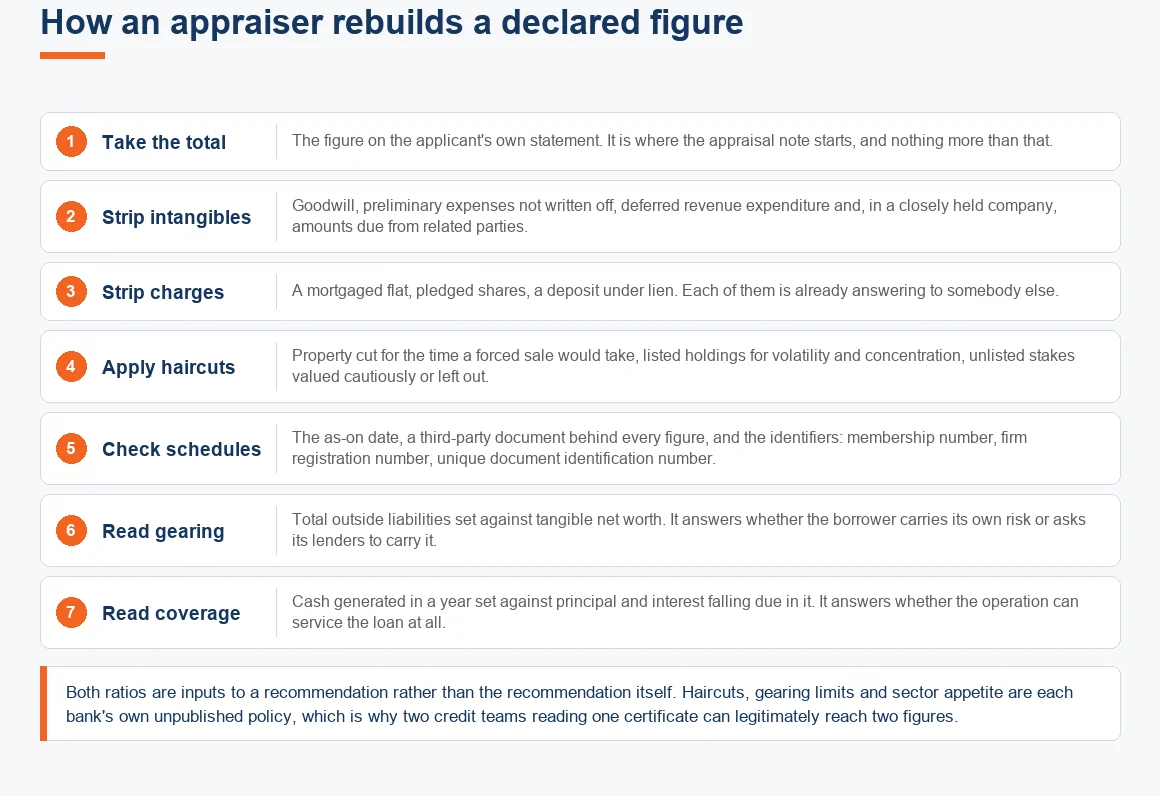
2. Debt-to-equity ratio evaluation. Banks assess the ratio of total external debt to the borrower's net worth. A healthy debt-to-equity ratio is typically 2:1 to 3:1 for MSMEs. If the borrower's net worth is Rs 50 lakh and existing debt is Rs 1 crore, the debt-to-equity ratio is 2:1 - within the acceptable range. A new loan request that pushes this ratio beyond 4:1 may be declined.

3. Security coverage ratio. Banks compare the total value of security (collateral + personal net worth of guarantors) against the loan exposure. The net worth certificate provides the certified figure that credit officers use in this calculation. Insufficient net worth means insufficient security coverage, leading to either a reduced sanction amount or a request for additional collateral.

How to Get a Net Worth Certificate for Bank Loan: Step-by-Step

  1. 1. Check the bank's specific format requirements. Many banks (SBI, PNB, Bank of Baroda, HDFC, ICICI) have their own prescribed net worth certificate formats. Ask your branch manager or loan officer for the format before engaging a CA. Using an incorrect format delays processing.
  2. 2. Engage a practising CA. The CA must hold a valid Certificate of Practice from ICAI. For businesses structured as partnerships or LLPs, a net worth certificate for partnership firms requires the CA to compute net worth from the partnership's capital accounts and the partners' individual assets.
  3. 3. Submit complete financial documents. PAN, Aadhaar, bank statements (12 months from all accounts), FD certificates, investment statements, property documents, vehicle RC, gold valuation, all loan outstanding statements, and latest 2-3 years ITR with computation of income. For companies: audited balance sheet, P&L, and schedules.
  4. 4. CA verifies, computes, and certifies. The CA independently verifies each document, computes Total Assets minus Total Liabilities, prepares the certificate on letterhead with UDIN, and signs with seal and membership number. For companies, the CA follows the Section 2(57) Companies Act definition: paid-up share capital + reserves minus accumulated losses minus deferred expenditure.
  5. 5. Submit to the bank with loan application. Attach the original signed certificate with the loan application file. The bank's credit officer may verify the UDIN at udin.icai.org. For working capital renewals, submit the updated certificate 30-45 days before the existing limit expires to avoid disruption in credit facility.

Documents Required for a Bank Loan Net Worth Certificate

For individual borrowers / sole proprietors:

  • PAN card and Aadhaar card
  • Bank statements - all personal and business accounts, last 12 months
  • Fixed deposit certificates
  • Mutual fund and share holding statements
  • Property registration documents (for all owned properties)
  • Vehicle registration certificates
  • Gold/jewellery valuation (if included)
  • All loan outstanding statements - home loan, personal loan, car loan, business borrowing, credit cards
  • Latest 2-3 years ITR acknowledgements with computation of income
  • Business financials - capital account statement, stock statement, debtor/creditor aging (for proprietorships)

For companies / LLPs (entity-level NWC):

  • Audited balance sheet and profit & loss account (latest 2-3 years)
  • Schedule of fixed assets with depreciation
  • Schedule of investments
  • Share capital / partners' capital account details
  • Reserves and surplus schedule
  • All borrowing schedules with outstanding amounts
  • Director/partner-wise shareholding pattern

Net Worth Certificate: Borrower vs Promoter vs Guarantor Requirements

Banks typically need multiple net worth certificates for a single loan. Understanding who needs what is critical:

Certificate TypeWho SubmitsWhat It ShowsWhen Required
Entity NWCThe borrowing company/LLP/firmEntity's net worth from audited books (Section 2(57) for companies)Term loans, CC/OD, project finance - always required for entity borrowers
Promoter NWCDirectors/partners of the borrowing entity individuallyEach promoter's personal assets minus personal liabilitiesBusiness loans above Rs 25 lakh; CC/OD limits; project finance
Guarantor NWCEach individual standing as guarantorGuarantor's personal net worth independent of the borrowerWhen guarantee is a condition of sanction - almost all business loans
Co-borrower NWCJoint borrower (e.g., spouse for home loan)Co-borrower's personal financial positionHome loans, joint personal loans, LAP

Note: For a typical MSME business loan, the bank may need: (1) the firm's NWC, (2) each partner's individual NWC, (3) each guarantor's individual NWC - potentially 4-6 separate certificates. Plan document collection for all parties simultaneously to avoid delays.

Common Mistakes That Delay Bank Loan Sanction

Mistake 1: Using the wrong format. SBI has a different prescribed format than HDFC or Bank of Baroda. Submitting a generic format when the bank has a specific template causes rejection and re-submission. Always ask the branch for their format before preparing the certificate.

Mistake 2: Not separating entity net worth from promoter net worth. For companies and LLPs, the bank needs BOTH: the entity's NWC from audited books AND the promoter/director's personal NWC. Submitting only one when both are required delays appraisal.

Mistake 3: Inflating net worth to get a higher loan amount. Banks cross-reference the NWC against ITR, bank statements, and property documents. Claiming Rs 2 crore net worth when the ITR shows Rs 5 lakh annual income and property documents show Rs 30 lakh registered value triggers fraud investigation. The CA is also liable under the Chartered Accountants Act, 1949 for certifying inflated figures.

Mistake 4: Missing the annual renewal deadline for CC/OD limits. Working capital facilities expire annually. The bank requires updated financial statements AND an updated net worth certificate for renewal. Missing the deadline can result in the CC/OD limit being frozen - disrupting business cash flow. Submit renewal documents 30-45 days before expiry. Businesses with Udyam registration accessing CGTMSE-backed loans face the same annual renewal requirement.

Mistake 5: Guarantor's NWC submitted without adequate coverage. The guarantor's net worth must be sufficient to cover the guaranteed portion. If the loan is Rs 50 lakh and the guarantor's net worth shows only Rs 10 lakh, the guarantee is considered inadequate and the bank will either request an additional guarantor or reduce the sanction.

What Happens If Your Net Worth Is Insufficient for the Loan Amount?

If the borrower's or promoter's net worth is insufficient relative to the requested loan, banks typically take one or more of these actions:

Reduced sanction amount: The bank sanctions a lower amount that maintains an acceptable debt-to-equity ratio. Example: If net worth is Rs 30 lakh and the bank's policy is maximum 3:1 debt-to-equity, the maximum loan sanction is Rs 90 lakh regardless of the project cost.

Additional collateral requirement: The bank asks for additional property, FDs, or other security to compensate for the lower net worth. This increases the security coverage ratio to acceptable levels.

Additional guarantor requirement: The bank asks for one or more additional guarantors with certified net worth to bridge the shortfall in security coverage.

Loan rejection: In cases where net worth is significantly below the threshold and no additional security is available, the bank declines the application. This is most common for unsecured business loans and CGTMSE-backed facilities where the promoter's net worth is the primary recourse.

How the Net Worth Certificate Connects with Other Loan Documents

The net worth certificate is one element of a comprehensive loan documentation package. For a typical MSME business loan, the bank's credit appraisal file includes: audited financials (balance sheet, P&L, schedules), bank statements (12 months from all accounts), ITR with computation of income (2-3 years), GST returns (for turnover verification), stock and debtor statements (for CC/OD), property valuation reports (for collateral), project report (for term loans), and the net worth certificate(s) for the borrower, promoters, and guarantors. For spouses or family members who are co-owners of properties listed in the NWC, a net worth certificate for joint owners ensures the proportionate share is correctly attributed.

The credit officer uses the net worth certificate at two critical evaluation points: first, during the debt-to-equity ratio calculation to determine if the borrower has sufficient own funds relative to external borrowing; and second, during the security coverage assessment to determine if the combined value of collateral plus guarantor net worth covers the bank's exposure. A well-prepared, accurate, and up-to-date net worth certificate speeds up both evaluations and reduces back-and-forth between the bank and the borrower.

For working capital limits specifically, the annual renewal cycle requires the borrower to submit updated audited financials AND an updated NWC simultaneously. Banks use the year-on-year net worth trend to assess whether the business is growing (increasing net worth), stable, or deteriorating (declining net worth). A declining net worth trend may trigger a limit reduction or enhanced monitoring.

Net Worth Certificate for Bank Loan vs Visa vs Tender: What Is Different?

ParameterBank Loan NWCVisa NWCTender NWC
CurrencyINR onlyINR + foreign currency (dual)INR only
FormatOften bank-prescribed; entity + promoter may be separateEmbassy-compliant; purpose statement mandatoryTender-document-prescribed; sometimes specific minimum NW threshold
RenewalAnnual for CC/OD limitsFresh for each visa applicationFresh for each tender bid
Guarantor NWCUsually required separatelyNot applicableMay be required for consortium bids
Entity vs IndividualBoth required (entity + promoter)Individual (or sponsor)Entity (with promoter if specified)
Key FocusRepayment capacity, debt-to-equity ratio, security coverageFinancial ties to India, ability to fund stay abroadFinancial capacity to execute the project
Validity3-6 months (annual for renewal)3 months (embassy-specific)As per tender document

Key Takeaways

Banks require net worth certificates to assess total financial strength - not just income - before sanctioning loans, with the certificate directly influencing debt-to-equity ratio calculations, margin contribution assessments, and security coverage evaluations in the credit appraisal process.

For working capital facilities (cash credit and overdraft), the net worth certificate is not a one-time requirement - it must be renewed annually at the time of limit renewal, along with updated audited financials, and failure to submit on time can result in the facility being frozen.

A typical MSME business loan requires multiple certificates: the entity's NWC (from audited books), each promoter/director's personal NWC, and each guarantor's individual NWC - potentially 4-6 separate certificates that must all be prepared with UDIN authentication.

The five most common mistakes that delay bank loan sanction are: using a generic format instead of the bank's prescribed template, not separating entity NWC from promoter NWC, inflating net worth figures, missing the annual CC/OD renewal deadline, and submitting a guarantor NWC with insufficient coverage relative to the guaranteed amount.

Always ask the branch for their specific net worth certificate format before engaging a CA, submit renewal documents 30-45 days before the existing CC/OD limit expires, and ensure all figures in the NWC are consistent with the ITR, bank statements, and property documents in the loan file.

Need a Net Worth Certificate for Your Bank Loan? Get It Right the First Time

A net worth certificate that does not match the bank's prescribed format, contains inconsistent figures, or arrives after the CC/OD renewal deadline can delay your loan sanction by weeks. For MSME borrowers managing tight cash flow cycles, this delay has real financial consequences.

Explore our net worth certificate services - bank-format-compliant, UDIN-verified, with separate promoter and guarantor certificates. Available for all entity types: sole proprietorships, partnerships, LLPs, and companies.

+91 945 945 6700 (Call or WhatsApp)

Frequently Asked Questions

Have a look at the answers to the most asked questions.

Banks assess two things: your ability to repay from cash flow (income) and your overall financial strength (net worth). The net worth certificate provides the second assessment. It shows the bank what you own versus what you owe, helping them calculate debt-to-equity ratio, security coverage, and margin contribution. For working capital limits, it directly influences the sanctioned amount.

For salaried individuals, banks usually rely on Form 16 and bank statements. For self-employed borrowers, most banks require a CA-certified net worth certificate to verify overall financial standing. For joint home loans, both co-borrowers may need separate certificates.

Banks use the borrower's net worth to assess margin contribution - the portion of working capital the borrower must fund from own resources (typically 25-40%). Net worth also feeds into the debt-to-equity ratio calculation. If the ratio exceeds 3:1 or 4:1 (bank-specific), the credit officer may reduce the limit or ask for additional security.

Yes. Banks require each guarantor to submit an individual net worth certificate showing their personal assets and liabilities. The guarantor's net worth must be sufficient to cover the guaranteed portion of the loan. If the guarantor's net worth is inadequate, the bank may request an additional guarantor or collateral.

Annually. Cash credit (CC) and overdraft (OD) limits are renewed every year. Banks require updated audited financials and a fresh net worth certificate at each renewal. Submit these documents 30-45 days before the existing limit expiry to prevent disruption.

Technically yes, if both banks accept the same format and the certificate is within the validity period. However, many banks have their own prescribed formats. In practice, most borrowers need a separate certificate for each bank - especially if format requirements differ.

Rs 5 lakh se upar ke MSME loans mein typically zaroori hota hai. CGTMSE-backed collateral-free loans mein bhi promoter ka net worth assess hota hai. Annual renewal ke liye bhi updated certificate dena padta hai. Udyam registration ke saath net worth certificate dena loan approval chances badhata hai.

Complete documents hone par 1-3 working days. Same-day express bhi available hai. Companies ke liye audited balance sheet zaroori hai - agar audit pending hai toh pehle audit complete karna padega. Sole proprietors ke liye process faster hota hai kyunki personal aur business assets combine hote hain.

Updated audited balance sheet aur P&L, latest 12 months bank statements, stock statement (for CC), debtor/creditor aging, latest ITR, aur updated CA-certified net worth certificate - borrower ka, promoter(s) ka, aur guarantor(s) ka sab chahiye. 30-45 din pehle submit karein.

Entity net worth is the company's or LLP's net worth computed from audited books (paid-up capital + reserves minus losses). Promoter net worth is the director's or partner's personal financial position (personal assets minus personal liabilities). Banks assess both: entity NWC for the borrower's business health, and promoter NWC for personal financial backing. Both are required for business loans.
CA Sundaram Gupta
CA Sundaram Gupta

Top trending

Section 8 Company vs Society vs Charitable Trust: Which NGO Structure Should You Choose?
REGISTRATION

Section 8 Company vs Society vs Charitable Trust:...

CA Sundaram Gupta
CA Sundaram Gupta Apr 8, 2026
How to Form a Charitable Trust in India: Trust Deed Drafting, Registration and RNPO Application
COMPANY REGISTRATION & COMPLIANCE

How to Form a Charitable Trust in India: Trust Dee...

CA Sundaram Gupta
CA Sundaram Gupta Apr 8, 2026
Net Worth Certificate for NRI: How an Indian CA Issues It and What It Must Certify
NRI

Net Worth Certificate for NRI: How an Indian CA Is...

CA Sundaram Gupta
CA Sundaram Gupta Apr 8, 2026
How to Calculate Net Worth for a Certificate: Assets, Liabilities and Adjustments Explained
FINANCIAL PLANNING & ADVISORY

How to Calculate Net Worth for a Certificate: Asse...

CA Sundaram Gupta
CA Sundaram Gupta Apr 8, 2026
Net Worth Certificate Format: What Must Be Included and ICAI Certification Standards
FINANCIAL PLANNING & ADVISORY

Net Worth Certificate Format: What Must Be Include...

CA Sundaram Gupta
CA Sundaram Gupta Apr 8, 2026

Table of content

Loading content...

Subscribe to get updates from Patron Accounting

Share this article

Connect With Our Experts

India Flag +91
Get updates on WhatsApp WhatsApp

More articles on the go.

Play Icon

Bring back the joy of reading newsletters & blogs

Subscribe and be ready for an amazing experience

10,000+
Happy Clients

Helping businesses stay compliant and stress-free.

15+
Years Experience

Deep expertise in GST, Income Tax, ROC & business compliance.

50,000+
Documents Filed

Returns, registrations, and filings handled accurately.

4.9★
Client Rating

Trusted by entrepreneurs, startups, and growing businesses.

ISO
Certified

Professional standards and documented processes.

SSL
Secure

Your financial and business data is fully protected.