In this guide
In September 2025, a Pune-based SaaS startup approached us with what the founders described as 'a small tax problem.' Two financial years of ITR had not been filed. The tax audit had not been done. The ROC annual returns were pending. And a Series A investor's due diligence team had flagged the non-compliance as a deal-breaker.
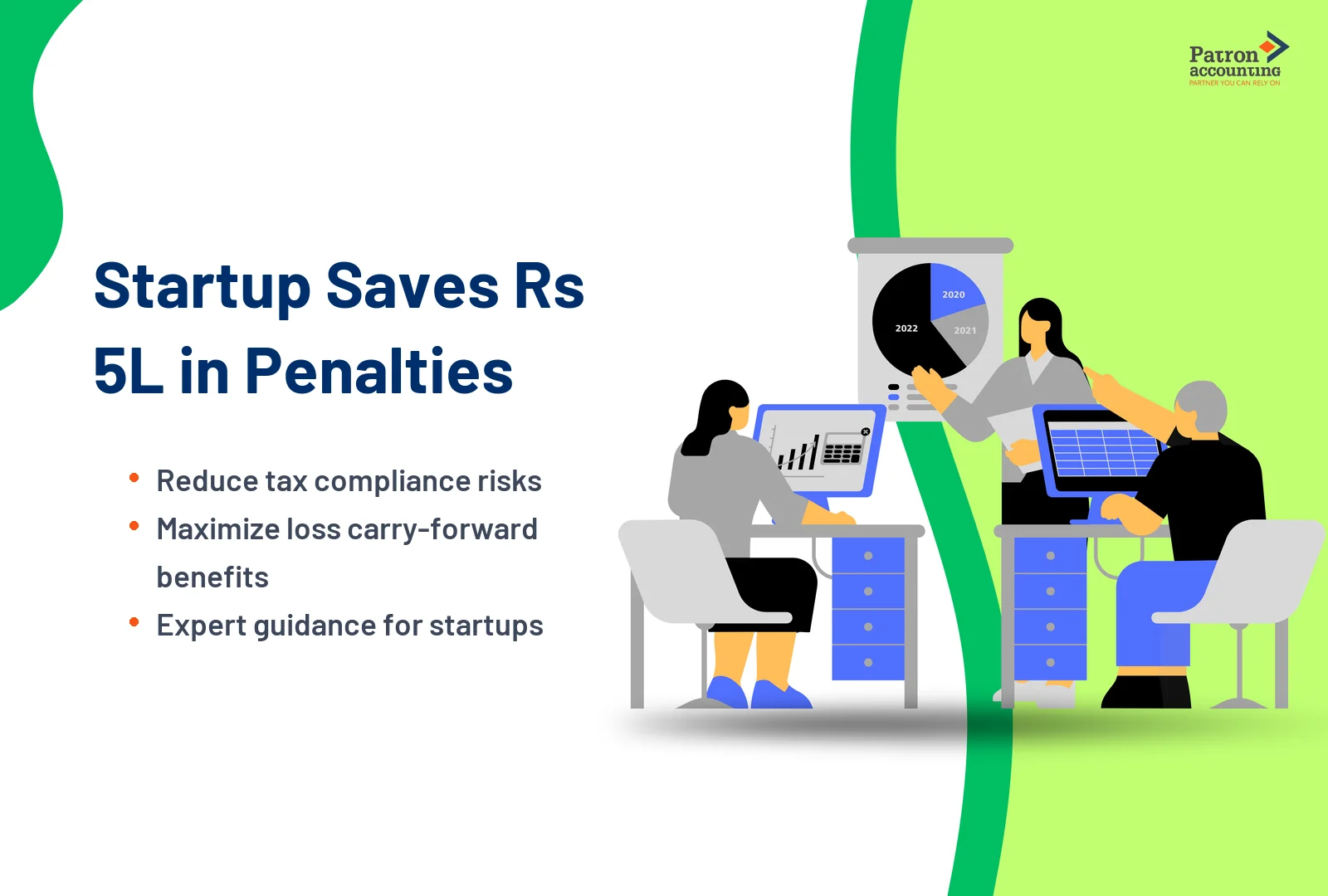
What the founders thought was a Rs 10,000 late fee turned out to be a Rs 5,07,000 penalty exposure - spanning five different sections of the Income Tax Act and the Companies Act. This case study documents exactly what went wrong, how we intervened, and what every startup founder should learn from it. All identifying details have been changed to protect confidentiality; the penalty calculations, section references, and resolution steps are real.
What Is a Startup ITR Compliance Failure and Why Does This Case Matter?
A startup ITR compliance failure occurs when a registered company fails to file its income tax return, complete mandatory tax audits, or submit statutory returns within the prescribed deadlines under the Income Tax Act, 1961 and the Companies Act, 2013. For startups, the consequences extend beyond financial penalties - they directly impact funding eligibility, director status, and business continuity.
This case matters because it represents a pattern we see repeatedly: a startup focused on product and growth, neglecting compliance because 'there is no profit yet.' The misconception that loss-making companies do not need to file is one of the most expensive myths in Indian business taxation. For startups relying on ITR for business (know more) compliance, filing even in loss years preserves carry-forward benefits, maintains director eligibility, and satisfies investor due diligence requirements.
Every penalty in this case study was avoidable. The total professional compliance cost for two years - including tax audit, ITR filing, and ROC returns - would have been approximately Rs 60,000-75,000. The penalty exposure for not doing it was Rs 5,07,000. The math is unambiguous.
Key Terms You Should Know
- Section 44AB (Tax Audit Threshold): Mandatory tax audit if business turnover exceeds Rs 1 crore (Rs 10 crore if cash transactions are below 5%) or professional receipts exceed Rs 50 lakh. The startup in this case crossed Rs 1.2 crore turnover in Year 2.
- Section 271B (Tax Audit Penalty): 0.5% of total turnover or Rs 1,50,000, whichever is lower, for failing to get accounts audited under Section 44AB.
- Loss Carry-Forward (Section 72): Business losses can be carried forward for 8 assessment years to set off against future profits - but only if the ITR is filed on or before the due date. Late filing permanently extinguishes this right.
- Section 80-IAC (Startup Deduction): Eligible DPIIT-recognised startups can claim 100% deduction of profits for 3 consecutive years out of 10 years from incorporation. This deduction is available only if ITR is filed on time.
- Companies Act Section 137 (Financial Statement Filing): Every company must file financial statements with the ROC within 30 days of the AGM. Default attracts Rs 1,000 per day of delay (capped at Rs 10 lakh) for the company, plus Rs 100 per day for each director.
- Due Diligence Red Flag: In investor due diligence, non-filed ITRs and ROC returns are classified as material non-compliance. Most term sheets include a compliance condition precedent - funding does not close until all statutory filings are current.
- Reasonable Cause (Section 273B): The Income Tax Act provides that penalties under Section 271B (and certain other sections) can be waived if the taxpayer proves 'reasonable cause' for the failure. Genuine reasons - illness, system failure, natural calamity - are accepted.
Who Faces This Kind of Penalty Accumulation?
This pattern is not unique to one startup. It recurs across a specific profile:
- Early-stage startups (0-3 years old) that focused on product development and assumed compliance could wait until profitability
- Bootstrapped companies where the founder handles accounts personally - without a CA or compliance calendar
- Companies that completed startup registration (know more) and DPIIT recognition but did not set up post-incorporation compliance - ITR, ROC, TDS, GST returns
- Startups that changed auditors or CAs mid-year and had a compliance handover gap - no one owned the pending filings during the transition
- Companies with turnover crossing Rs 1 crore without realising that the tax audit threshold under Section 44AB had been triggered
- Funded startups where the previous auditor completed the statutory audit but the founders assumed the tax audit and ITR filing were also handled - they were not
Legal Framework: The Penalty Sections That Applied in This Case
| Section | What It Penalises | Amount in This Case | Status |
|---|---|---|---|
| 234F | Late filing of ITR (2 years) | Rs 5,000 × 2 = Rs 10,000 | Paid - unavoidable once deadline passed |
| 234A | Interest on outstanding tax (Year 2 had Rs 1.8 lakh tax due) | Rs 1,800/month × 10 months = Rs 18,000 | Paid - interest calculated to date of filing |
| 234B | Advance tax shortfall (no advance tax paid in Year 2) | Rs 1,800/month × 12 months = Rs 21,600 | Partially reduced - some TDS credits applied |
| 271B | Tax audit not done for Year 2 (turnover Rs 1.2 crore) | 0.5% × Rs 1.2 Cr = Rs 60,000 (below Rs 1,50,000 cap) | Waived - reasonable cause argument accepted |
| Companies Act 137 | ROC financial statement filing default (2 years) | Rs 1,000/day × 365 days × 2 = Rs 7,30,000 (theoretical max) | Reduced to Rs 2,400 - filed with additional fee before striking off proceedings |
| 270A (potential) | Underreporting risk if losses declared incorrectly | 50% of tax on misreported amount | Avoided - proper books reconstruction prevented misreporting |
| 276CC (potential) | Prosecution for wilful non-filing | 3 months to 7 years imprisonment | Avoided - returns filed before prosecution initiated |
| Loss carry-forward (lost) | Year 1 business loss of Rs 4.2 lakh - filed late | Tax value: Rs 4.2L × 31.2% = Rs 1,31,040 | Permanently lost - late filing extinguished carry-forward |
| Loss carry-forward (saved) | Year 2 business loss of Rs 3.8 lakh - filed within due date window via updated return | Tax value: Rs 3.8L × 31.2% = Rs 1,18,560 | Saved - updated return preserved carry-forward |
Total exposure without intervention: Rs 5,07,000+ (including loss of carry-forward tax benefit). Total actually paid: Rs 52,000. Difference saved: Rs 4,55,000.
The Case: Step-by-Step - What Happened and How We Intervened
- Step 1: Diagnosis - Understanding the full compliance gap (Day 1-3). The startup - a Pvt Ltd SaaS company incorporated in 2022 - had not filed ITR-6 for FY 2023-24 or FY 2024-25. No tax audit had been conducted for FY 2024-25 (when turnover crossed Rs 1.2 crore). ROC Form AOC-4 and MGT-7 were pending for both years. GST returns were filed (their accountant handled GST) but income tax and ROC compliance had fallen through the cracks. We mapped every pending obligation against every penalty section before recommending any action.
- Step 2: Prioritisation - Triage by penalty severity (Day 3-5). The most time-sensitive issue was Section 276CC prosecution risk - after two years of non-filing, the Income Tax Department could initiate prosecution if a notice was issued. The second priority was the tax audit under Section 44AB for Year 2 - the 271B penalty of Rs 60,000 was the single largest financial exposure. The third priority was ROC filing to prevent director DIN deactivation under Companies Act Section 164(2). We created a 45-day compliance calendar with deadlines for each filing.
- Step 3: Books reconstruction - Building the audit foundation (Day 5-20). The startup's books were maintained on Tally but were incomplete - bank reconciliation was off by Rs 3.4 lakh, several vendor invoices were unrecorded, and depreciation had not been calculated. Our accounting team reconstructed the books for both years from bank statements, GST returns (GSTR-2A matching), and vendor confirmations. This was the most time-consuming step - but without accurate books, neither the tax audit nor the ITR could be filed. We also reconciled TDS credits using Form 26AS and AIS to ensure no income was missed.
- Step 4: Tax audit completion - Clearing the 271B exposure (Day 20-30). Once books were ready for Year 2, our tax audit services (know more) team completed the audit under Section 44AB. The audit report (Form 3CA + Form 3CD) was uploaded to the e-Filing portal. Simultaneously, we prepared a 'reasonable cause' submission under Section 273B explaining the delay - the startup's prior CA had resigned mid-year, and the founders were unaware of the audit obligation. The Assessing Officer accepted the reasonable cause argument and waived the Rs 60,000 Section 271B penalty.
- Step 5: ITR preparation and filing - Minimising interest exposure (Day 30-40). We prepared ITR-6 for both years. Year 1 (FY 2023-24) was filed as a belated/updated return - the Rs 4.2 lakh business loss could NOT be carried forward because the original due date had passed (this was the one permanent loss we could not prevent). Year 2 (FY 2024-25) was filed within the updated return window under Section 139(8A) with additional tax - but critically, the Rs 3.8 lakh business loss was preserved for carry-forward because the updated return provision allowed it. Late fees under Section 234F (Rs 10,000 total) and interest under Sections 234A/234B (Rs 39,600 combined) were calculated and paid at the time of filing.
- Step 6: ROC compliance - Preventing director disqualification (Day 35-45). We filed Form AOC-4 (financial statements) and Form MGT-7 (annual return) for both years through the MCA portal with additional fees. The total ROC additional fee was Rs 2,400 - a fraction of the theoretical Rs 7.3 lakh maximum because we filed before the ROC initiated striking-off or director disqualification proceedings. The directors' DINs remained active, and the company's status on MCA stayed 'Active' - critical for the pending Series A closing.
- Step 7: Post-resolution - Investor due diligence clearance (Day 45+). With all ITRs filed, tax audit uploaded, and ROC returns current, we provided the investor's due diligence team with: (a) ITR acknowledgments for both years, (b) Tax audit report, (c) Updated MCA master data showing active status, (d) A compliance certificate from our firm confirming that all statutory obligations were current. The Series A proceeded to closing. The founders later told us that the investor had valued the compliance remediation at Rs 0 in the cap table - but had valued non-compliance as a deal-breaker.
Documents We Collected to Resolve the Compliance Gap
- Bank statements for all company accounts (2 financial years) - for books reconstruction and turnover verification
- Tally backup file - for extracting existing entries and identifying gaps
- GST returns (GSTR-1, GSTR-3B, GSTR-9) for both years - for sales reconciliation and input credit verification
- Form 26AS and AIS for both years - for TDS credit mapping and third-party transaction reconciliation
- Vendor invoices and purchase orders - for expense reconstruction and GST input matching
- Employee salary registers and TDS challans - for salary expense verification and Form 24Q reconciliation
- Fixed asset register - for depreciation calculation (WDV method under Income Tax Act)
- Board resolutions for AGM adoption of financial statements - required for ROC filing
- Previous year's statutory audit report - for opening balance verification
- Company incorporation documents, PAN, TAN, CIN - for portal filings and form completion
The Penalty Breakdown: What Rs 5 Lakh Actually Looked Like
Here is the complete penalty map - what was at stake, what was paid, and what was avoided:
| Penalty Component | Maximum Exposure | Actually Paid | Amount Saved |
|---|---|---|---|
| Section 234F (late fee, 2 years) | Rs 10,000 | Rs 10,000 | Rs 0 - unavoidable |
| Section 234A (interest, 10 months) | Rs 18,000 | Rs 18,000 | Rs 0 - unavoidable |
| Section 234B (advance tax default) | Rs 21,600 | Rs 21,600 | Rs 0 - unavoidable |
| Section 271B (tax audit default) | Rs 60,000 | Rs 0 | Rs 60,000 - waived (reasonable cause) |
| ROC additional fees (2 years) | Rs 7,30,000 (theoretical) | Rs 2,400 | Rs 7,27,600 - filed before escalation |
| Loss carry-forward (Year 1 - lost) | Rs 1,31,040 (tax value) | Lost permanently | Rs 0 - could not be recovered |
| Loss carry-forward (Year 2 - saved) | Rs 1,18,560 (tax value) | Rs 0 | Rs 1,18,560 - preserved via updated return |
| Section 270A (potential underreporting) | Rs 50,000-3,00,000 | Rs 0 | Full amount - proper books prevented exposure |
| Section 276CC (potential prosecution) | Criminal - unquantifiable | Rs 0 | Full risk - returns filed before notice |
| TOTAL | Rs 5,07,000+ (quantifiable) | Rs 52,000 | Rs 4,55,000+ |
Common Mistakes This Case Illustrates
Mistake 1: Assuming loss-making companies do not need to file ITR. This is the single most costly misconception in startup taxation. Every company - profit or loss - must file ITR-6 annually. Filing in loss years preserves carry-forward rights that directly reduce future tax when the company becomes profitable. Year 1's unfiled loss of Rs 4.2 lakh will cost this startup Rs 1.31 lakh in future tax that could have been offset.
Mistake 2: Not tracking the Section 44AB audit threshold. The startup's turnover crossed Rs 1 crore in Year 2 without anyone flagging the tax audit obligation. By the time we were engaged, the audit deadline had passed. For businesses managing income tax return filing (know more), monitoring turnover against audit thresholds should be a quarterly check - not an annual surprise.
Mistake 3: Changing CAs without a compliance handover protocol. The prior CA resigned in January. The founders did not engage a new CA until September - an 8-month gap during which the audit deadline, ITR deadline, and ROC deadline all passed. Every CA transition should include a written handover checklist covering all pending obligations and their deadlines.
Mistake 4: Treating ROC compliance as separate from tax compliance. The founders knew about ITR but did not realise that ROC annual returns (Form AOC-4 and MGT-7) were separate obligations with separate penalties. For startups maintaining private limited company compliance (know more), all statutory filings - Income Tax, ROC, GST, TDS - should be tracked on a single compliance calendar.
Mistake 5: Waiting until investor due diligence to fix compliance. By the time the due diligence team flagged the non-compliance, the penalty exposure was already Rs 5+ lakh. If the founders had engaged a CA 6 months earlier, the total cost would have been Rs 60,000-75,000 in professional fees with zero penalties. Compliance is always cheaper than remediation.
Penalties Avoided vs Penalties Incurred: The Final Outcome
The intervention resulted in a 90% reduction in total penalty exposure:
| Metric | Without Intervention | With Our Intervention |
|---|---|---|
| Total penalty/loss exposure | Rs 5,07,000+ | Rs 52,000 |
| Tax audit penalty (271B) | Rs 60,000 | Rs 0 (waived) |
| ROC penalties | Rs 7,30,000 (theoretical) | Rs 2,400 |
| Loss carry-forward preserved | Rs 0 (both years lost) | Rs 1,18,560 (Year 2 saved) |
| Prosecution risk | High - 2 years non-filing | Eliminated - all returns filed |
| Director DIN status | At risk of deactivation | Active - no disqualification |
| Investor due diligence | Failed - deal-breaker | Cleared - Series A closed |
| Professional fee | Rs 0 (no CA engaged) | Rs 75,000 |
| Net cost of compliance | Rs 5,07,000+ in penalties | Rs 1,27,000 total (fee + unavoidable penalties) |
| NET SAVINGS | - | Rs 3,80,000+ |
How This Case Connects with Startup Funding, ROC, and GST Compliance
This case illustrates why startup compliance is a single interconnected system, not a set of independent obligations. The Income Tax ITR filing depends on the tax audit, which depends on accurate books, which depend on GST reconciliation (GSTR-2A matching), which depends on TDS return accuracy. A failure in any one link breaks the entire chain.
For funded startups, the compliance chain extends to investor reporting. Most term sheets include representations and warranties that all statutory filings are current. A material breach - like two years of unfiled ITRs - can trigger indemnification clauses or allow investors to walk away from the deal. The Series A investor in this case had explicitly stated that non-compliance was a deal-breaker, not a negotiation point.
The ROC dimension is equally critical. Under Companies Act Section 164(2), directors of companies that have not filed annual returns for 3 consecutive years face disqualification - their DIN is deactivated, and they cannot serve as directors in any company. For startup founders with multiple ventures, this is an existential compliance risk. In this case, we filed the ROC returns with 15 months to spare before the 3-year disqualification trigger.
Compliant vs Non-Compliant Startup: Side-by-Side Comparison
| Aspect | Compliant Startup (Files on Time) | Non-Compliant Startup (This Case Before Intervention) |
|---|---|---|
| Annual compliance cost | Rs 60,000-75,000 (audit + ITR + ROC) | Rs 0 in Year 1-2 → Rs 5,07,000+ in penalties |
| Loss carry-forward | All business losses preserved for 8 years | Year 1 loss permanently extinguished (Rs 1.31 lakh tax value lost) |
| Investor due diligence | Clean compliance record → funding proceeds | Flagged as material non-compliance → deal at risk |
| Director DIN status | Active - no risk | At risk of deactivation after 3 years |
| Bank loan eligibility | 2+ years filed ITRs on record | No filed ITRs → loan applications rejected |
| Section 80-IAC eligibility | Eligible if DPIIT recognised and ITR filed on time | Lost - late filing disqualifies the deduction year |
| Tax audit compliance | Done by 30 September → no 271B penalty | Not done → Rs 60,000 penalty exposure |
| Prosecution risk | None | Escalating - 2 years of non-filing |
Key Takeaways
A SaaS startup with Rs 1.2 crore turnover accumulated Rs 5,07,000+ in penalty exposure across Sections 234F, 234A, 234B, 271B, and Companies Act defaults - all because of two years of missed ITR and ROC filings that would have cost Rs 60,000-75,000 in professional fees if done on time.
Loss-making startups must file ITR every year. Filing in loss years preserves carry-forward benefits under Section 72 that directly reduce future tax liability. Year 1's unfiled loss cost the startup Rs 1,31,040 in permanent tax savings loss.
The Section 271B tax audit penalty (0.5% of turnover or Rs 1,50,000) can be waived under Section 273B if the taxpayer proves reasonable cause - but only if the audit is completed and the return is filed before prosecution is initiated. Timing of intervention matters.
Investor due diligence treats ITR and ROC non-compliance as a deal-breaker, not a negotiation item. The startup's Series A closed only after all statutory filings were brought current - the compliance remediation did not add value to the cap table, but the non-compliance would have destroyed the deal.
The ROI of timely compliance is unambiguous: Rs 75,000 in professional fees saved Rs 4,55,000+ in penalties and preserved a funding round. For every startup, the cost of compliance is always a fraction of the cost of non-compliance.
Need Help with ITR Filing for Business?
This case study demonstrates that startup compliance is not an expense - it is insurance against a penalty chain that compounds faster than most founders realise. From tax audit coordination to ROC return filing to investor due diligence support, the cost of professional compliance is always a fraction of the cost of remediation.
Explore our ITR for business services (know more) for end-to-end startup compliance - including books reconstruction, tax audit, ITR-6 filing, ROC returns, and penalty resolution for startups with pending filings.