In this guide
Faceless assessment was India's boldest experiment in tax administration - removing the face-to-face interaction between the taxpayer and the assessing officer to reduce corruption, regional bias, and discretionary harassment. Launched in 2020, it operated through executive orders and scheme notifications under the old IT Act 1961 (primarily Section 144B).
The IT Act 2025 changes the game: faceless assessment is no longer just a scheme that can be withdrawn by executive order. It is now a statutory framework embedded in the Act itself. This guide explains what this means for you - the taxpayer - including the new personal hearing right, updated penalty structure, and how the assessment process works under the new Act.
From Scheme to Statute: Why This Matters
| Aspect | Under IT Act 1961 | Under IT Act 2025 |
|---|---|---|
| Legal basis | Section 144B + Faceless Assessment Scheme (executive order) | Chapter VIII (Sections 236-261) - statutory provisions |
| NFAC establishment | By government notification (scheme) | By statute - part of the Act itself |
| Personal hearing right | Discretionary - could be denied | Codified - statutory right to request hearing |
| Time limits for assessment | Prescribed by scheme/circulars | Explicitly prescribed in the Act |
| Penalty for non-compliance | General penalty provisions | Specific penalty: Rs 10,000 to Rs 1,00,000 |
| Scheme-making power | Government could modify/withdraw by notification | Section 532 empowers government but within statutory framework |
| Constitutional protection | Scheme could be challenged as executive overreach | Statutory framework carries higher legal standing |
Why does 'statutory' vs 'scheme' matter? An executive scheme can be modified, suspended, or withdrawn by the government without Parliament's approval. A statutory provision in the Act requires an amendment through Parliament. This gives faceless assessment permanent legal standing - it cannot be quietly rolled back. For taxpayers, this means greater certainty that the faceless framework is here to stay. For the department, it means stricter accountability in implementing the framework.
How Faceless Assessment Works Under IT Act 2025
The core process remains the same but with stronger statutory backing:
- 1. Automated case selection and allocation. Cases are selected for scrutiny through risk-based criteria and data analytics. The NFAC assigns the case to an Assessment Unit (AU) in a Regional Faceless Assessment Centre (RFAC) through an automated allocation system - no human discretion in choosing which officer handles your case.
- 2. Notice issued through NFAC. All notices (including the initial Section 143(2) equivalent notice) are issued by and through the NFAC. The taxpayer does not know which AU or officer is handling the case. Communication is entirely through the e-filing portal.
- 3. Taxpayer responds through the portal. All submissions - documents, explanations, evidence, and replies - are uploaded on the income tax e-filing portal (incometax.gov.in). No physical submissions. No office visits.
- 4. AU examines and may request further information. The Assessment Unit reviews your response. If additional information is needed, the AU requests it through NFAC. The AU may also request the Verification Unit (VU) to conduct field verification, or the Technical Unit (TU) for expert input on complex legal issues.
- 5. Draft Assessment Order (DAO). The AU prepares a Draft Assessment Order. If adverse to the taxpayer (proposing additions or modifications), the draft is shared through NFAC for the taxpayer's response before finalisation.
- 6. Personal hearing (if requested). Under the new Act, the taxpayer has a statutory right to request a personal hearing before the designated NFAC officer. This must be granted - it is no longer discretionary. The hearing can be conducted in virtual mode (video conferencing).
- 7. Final Assessment Order. After considering the taxpayer's response and hearing (if any), the final assessment order is passed and served through the e-filing portal. The taxpayer receives notification via SMS and email. For assessment response support, income tax return filing services include faceless assessment reply assistance.
The 4 Units Behind Faceless Assessment
| Unit | Role | When Involved |
|---|---|---|
| Assessment Unit (AU) | Examines the case, prepares the draft and final assessment order | Every case - the primary unit |
| Verification Unit (VU) | Conducts physical or electronic verification of facts, documents, or premises | When the AU needs field verification |
| Technical Unit (TU) | Provides legal and technical expertise on complex issues | When the AU needs expert guidance on disputed legal questions |
| Review Unit (RU) | Reviews the draft assessment order for quality and consistency | Quality control before the order is finalised |
Key principle: The taxpayer never knows which specific AU, VU, TU, or RU is handling their case. All communication is routed through NFAC. This eliminates the possibility of the taxpayer 'approaching' or 'influencing' the specific officer - the entire point of the faceless system.
The Personal Hearing Right: What Is New
Under the old scheme: The Faceless Assessment Scheme provided for personal hearing in limited circumstances - primarily when a variation was proposed to the taxpayer's prejudice. However, several High Courts found that NFAC was denying hearing requests or providing inadequate hearing opportunities. The old Section 144B(9), which restricted natural justice requirements, was a significant point of litigation.
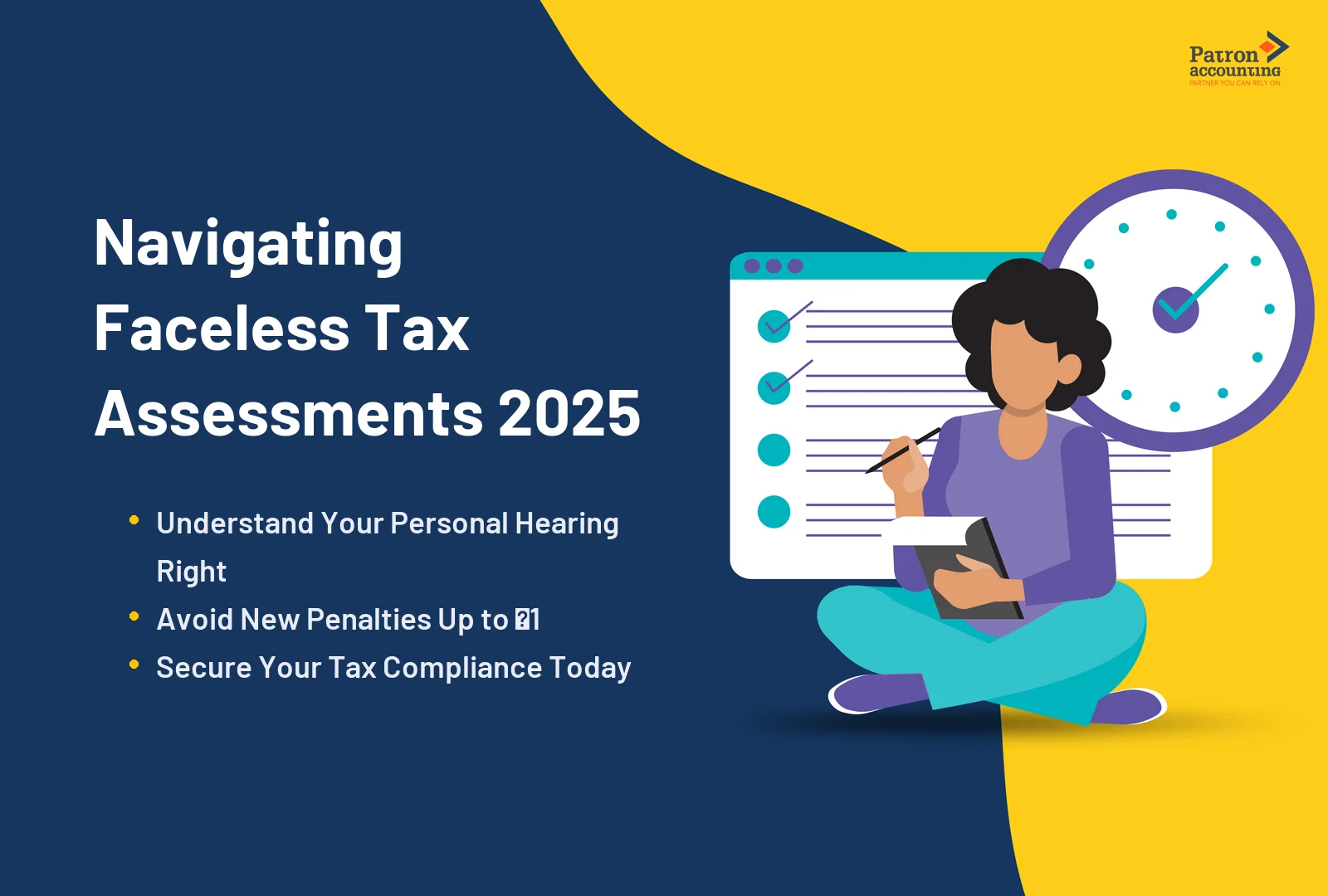
Under IT Act 2025: The right to personal hearing is now codified as a statutory right. The taxpayer can request a hearing before the designated NFAC officer whenever an adverse assessment is proposed. The hearing can be conducted through video conferencing - maintaining the 'faceless' character while ensuring natural justice. This addresses the key criticism of the earlier scheme. For businesses facing income tax notices, the personal hearing right strengthens your position.
Practical tip: Always request a personal hearing when you receive a draft assessment order proposing any addition. It is free, it is your statutory right, and it gives you an opportunity to explain your position before the order is finalised. Many additions can be resolved at the hearing stage without needing to go through the appeal process.
New Penalty: Rs 10,000 to Rs 1,00,000 for Non-Compliance
IT Act 2025 introduces a specific penalty for failure to comply with notices under faceless assessment. If you do not respond to a notice, do not upload requested documents, or do not appear for a hearing (after requesting one), a penalty of Rs 10,000 to Rs 1,00,000 can be imposed.
How to avoid: Respond to every notice within the specified time. Upload all requested documents in the format specified (typically PDF, max 20 MB). If you need more time, file an adjournment request before the deadline - not after. If you requested a hearing, attend it (in person or virtually). For accounting and compliance services, timely response to faceless notices is part of our compliance management.
Faceless Appeal: The Other Half of the System
Faceless assessment is just the first stage. Faceless appeal - where appeals before the Commissioner of Income Tax (Appeals) are also conducted without face-to-face interaction - also continues under the new Act. The process is similar:
- Appeal filed electronically through the portal
- All communication through NFAC
- Commissioner (Appeals) assigned through automated allocation
- Right to submit additional evidence and grounds of appeal
- Personal hearing available upon request
- Order passed electronically and served through the portal
Beyond CIT(A): If the first appeal does not succeed, the next step is ITAT (Income Tax Appellate Tribunal) - which operates with physical hearings (not faceless). For GST disputes escalating to GSTAT, our GSTAT appeal filing services provide parallel litigation support.
Tips for Navigating Faceless Assessment Successfully
- 1. Monitor the portal daily during assessment proceedings. Notices are served electronically. SMS/email alerts are sent, but do not rely on them exclusively. Log into incometax.gov.in daily during the assessment period and check the 'Notices/Proceedings' tab.
- 2. Respond within the time limit - always. The single biggest mistake in faceless assessment is missing a response deadline. The system is unforgiving - there is no physical office to visit and explain. If you need more time, file an extension request before the deadline. For managing GST return filing and income tax compliance simultaneously, maintain a centralised compliance calendar.
- 3. Upload documents in proper format. PDF format, max 20 MB per file, properly paginated and indexed. Name files descriptively ('Bank_Statement_April2026_SBI.pdf' not 'doc1.pdf'). Poor document quality leads to additional queries and delays.
- 4. Request personal hearing for every adverse proposal. It is your statutory right under the new Act. A 15-minute video conference hearing can resolve issues that would otherwise require a 12-month appeal. Always request it.
- 5. Keep your authorised representative's NFAC access updated. If your CA or advocate is responding on your behalf, ensure their digital authorisation on the portal is current. Expired authorisation means they cannot access your case or respond to notices. For tax audit and compliance services, representative portal access is maintained proactively.
Key Takeaways
Faceless assessment transitions from an executive scheme under the 1961 Act (Section 144B + government notifications) to a full statutory framework under Chapter VIII (Sections 236-261) of the IT Act 2025 - giving it permanent legal standing that cannot be withdrawn without Parliamentary amendment and higher constitutional protection.
The NFAC continues as the single point of contact with four specialised units (Assessment, Verification, Technical, Review) operating behind the anonymity shield - the taxpayer never knows which specific officer handles their case, with all communication routed through the e-filing portal.
The most significant improvement for taxpayers is the codification of the personal hearing right - previously discretionary and frequently denied, it is now a statutory right that must be granted upon request, conducted through video conferencing, and provides an opportunity to resolve adverse proposals before the final assessment order.
A new specific penalty of Rs 10,000 to Rs 1,00,000 for non-compliance with faceless assessment notices means timely responses, proper document uploads, and hearing attendance are more important than ever - with no physical fallback to explain delays.
Practical success in faceless assessment requires: daily portal monitoring, timely responses to every notice, properly formatted PDF document uploads, personal hearing requests for every adverse proposal, and current CA/advocate portal authorisation - all achievable with systematic compliance management.
Need Help Responding to a Faceless Assessment Notice? We're Online Too
Faceless assessment runs on deadlines, documents, and digital discipline. Missing a single response can trigger an adverse order and a Rs 1 lakh penalty. Professional support ensures every notice is answered on time, every document is properly formatted, and every hearing opportunity is used effectively.
Explore our income tax return filing and assessment services - faceless assessment response, personal hearing representation, document preparation, and appeal support if the assessment is adverse.
+91 945 945 6700 (Call or WhatsApp)
Common Questions
Frequently Asked Questions
Have a look at the answers to the most asked questions.