ITR filing for professionals and freelancers
If your work is closer to freelance or consulting.
Open
Income Tax & ITR
File your return as a creator with a CA: brand deals, gifted products, platform payouts and foreign income reported in the right form, with your expenses and TDS claimed.

In short
Money you earn as an influencer or creator (from brand deals, sponsored posts, platform payouts, affiliate links, courses or merchandise) is income from your work, not a hobby or a gift. It is added to your other income and taxed at your normal slab rates.
Brands and platforms often deduct tax at source, and that tax shows in your AIS and Form 26AS, so the department can see what you were paid.
FY 2025-26 returns (filed in 2026) are under the Income-tax Act, 1961. The Income-tax Act, 2025 applies from tax year 2026-27 (returns filed in 2027).
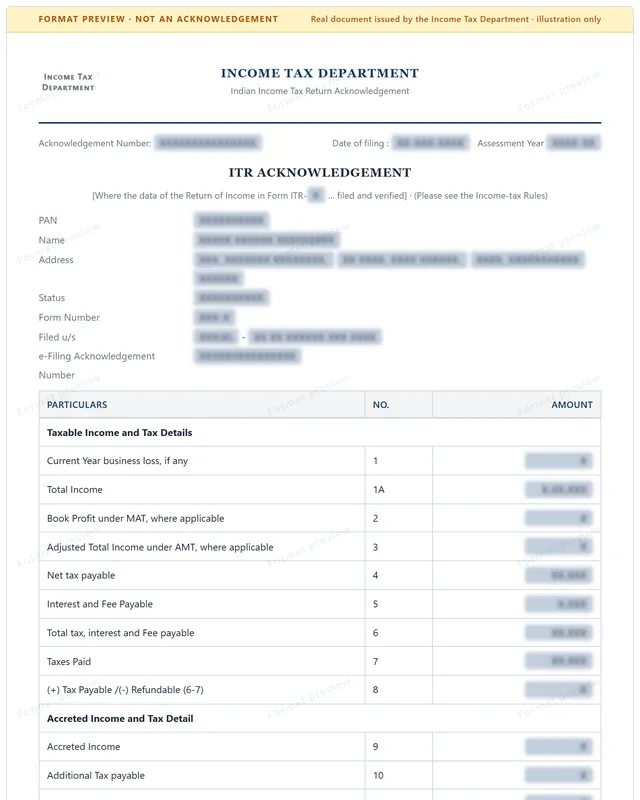
See a sample
ITR acknowledgement
The acknowledgement that an income-tax return was filed.
Values hidden for privacy. Names, numbers and dates are covered. Your own document carries your details.
Download ITR acknowledgement sample (PDF) View ITR acknowledgement sample
Your income
All of these are part of your income for the year.
On any platform
Such as advertising revenue from a video platform
From shopping and other referral programmes
Sold online
Sold under your name
Such as memberships and paid chats
Received for promotion
A product a brand gives you to promote, and which you keep, can be a taxable benefit from your work.
Such a benefit, in cash or in kind, is taxed as income from your business or profession at its value (FY 2025-26: section 28(iv) of the 1961 Act; tax year 2026-27: The corresponding provision of the 2025 Act). A brand that gives you benefits worth more than ₹20,000 in a year must deduct TDS at 10% of their value before handing them over (section 194R of the 1961 Act; the corresponding provision of the 2025 Act). This applies for FY 2025-26 and tax year 2026-27.
Brands often deduct tax before paying you. Whatever was deducted is credited against your tax when you file, so it must match your AIS.
Fees for professional services: 10% where the year's payments exceed ₹50,000 (Section 194J of the 1961 Act, threshold ₹50,000 from 1 April 2025; the corresponding provision, Table Sl. 6(iii) of the Income-tax Act, 2025). Work under a contract: 1% for an individual or HUF and 2% for others, where one payment exceeds ₹30,000 or the year's total exceeds ₹1,00,000 (Section 194C of the 1961 Act; the corresponding provision, Table Sl. 6(i) of the 2025 Act). The Act does not say which of these applies to influencer work; it depends on the facts of the case. This applies for FY 2025-26 and tax year 2026-27.
The form
The form depends on whether you declare your actual profit or use the presumptive basis. The simpler forms for salaried people do not cover business or professional income.
Your income less the costs of making content. The form for individuals with business or professional income not covered by the simpler forms, for FY 2025-26 and for tax year 2026-27.
A creator with foreign platform income files ITR-3.
Same form for FY 2025-26 (1961 Act) and tax year 2026-27 (2025 Act).
Some creators may instead declare profit on a presumptive basis and use the shorter ITR-4. Under the presumptive scheme for small businesses:
Same rules for FY 2025-26 (1961 Act) and tax year 2026-27 (2025 Act).
Business or profession? Whether a creator's work is a business or a profession decides which presumptive scheme, if any, can be used. Influencing is not in the list of specified professions, so the professionals' scheme (section 44ADA of the 1961 Act for FY 2025-26; the corresponding provision of the 2025 Act for tax year 2026-27) applies only where your work falls within a named or notified profession. If it is a business, the business scheme is closed to anyone who earns commission or brokerage income, such as affiliate commissions, or runs an agency business. Otherwise you keep regular books. We check this for your income mix before choosing a form.
The activity code in the form. The return asks for a code that describes your work.
For FY 2025-26 (AY 2026-27), the ITR-3 and ITR-4 forms list code 16021, "Social Media Influencers", as the nature-of-business code.
How we work
Six steps, in the order they happen.
Payout reports from each platform, brand deal invoices, affiliate statements, course and merchandise sales, for 1 April to 31 March.
Every product kept, trip sponsored or barter arrangement, with the date received and the brand's details, and any tax the brand deducted.
We compare every TDS entry and reported payment with your own records and clear differences before filing.
Bills for cameras, microphones, lights, editing software, internet, travel for shoots and studio rent, where you declare actual profit.
We compare actual profit with the presumptive figure, where the scheme is open to you, and pick the form that fits.
We work out the tax under the old and the new regime, file by the due date and help you e-verify. For FY 2025-26 returns, e-verification is due within 30 days of filing.
Check the time limit for verifying your return on the e-filing portal before you file.
Paid from abroad
If a platform pays you from abroad, that income is part of your Indian income if you are a resident. If tax was deducted abroad, you may be able to claim credit for it in India.
Credit for tax paid abroad
The lower of the Indian tax on that income and the foreign tax paid is the most you can claim as creditThe credit is allowed only if you file the statement of foreign income and tax before the return.
FY 2025-26 (1961 Act) and tax year 2026-27 (2025 Act, Income-tax Rules, 2026 rule 76).
What to keep ready
Ten items cover most creator returns.
Dates
A creator's return includes business or professional income, so the 31 August date applies even if you also have a salary.
| Return | FY 2025-26 (1961 Act) | Tax year 2026-27 (2025 Act) |
|---|---|---|
| Business or professional income, no tax audit | 31 August 2026 | 31 August 2027 |
| Tax audit report | 30 September 2026 | 30 September 2027 |
| Return with tax audit | 31 October 2026 | 31 October 2027 |
The Finance Act, 2026 moved the non-audit business date from 31 July to 31 August.
A business needs a tax audit when turnover is above ₹1 crore, or above ₹10 crore where cash receipts and cash payments are each no more than 5%.
A profession needs a tax audit when gross receipts are above ₹50 lakh in the year. There is no audit under this limit where you declare at least 50% of receipts as profit under the professionals' scheme; declaring less under that scheme, with total income above the exemption limit, brings books and an audit. This applies for FY 2025-26 (section 44AB of the 1961 Act) and tax year 2026-27 (the corresponding provision of the 2025 Act).
The late filing fee is ₹5,000, or ₹1,000 if total income is up to ₹5 lakh.
Section 234F of the 1961 Act; the corresponding provision of the 2025 Act.
If your tax for the year after TDS is ₹10,000 or more, you pay it in instalments. If you declare profit on a presumptive basis, the whole amount is due by 15 March.
What it costs
The fee depends on how many platforms and brands you work with, whether you keep accounts, and whether you have foreign income.
Professional fee
Exl GST and Govt. Charges.
Tell us where your income comes from and we will tell you what the filing will cost.
Questions
What creators ask most before they send us a return.
Yes. Payments from brands, platforms, affiliate programmes and your own products are income from your work. They are added to your other income for the year and taxed at your slab rate. Tax a brand deducted before paying you is not the final tax; you report the full income and claim that TDS as credit in your return.
For tax, it is everything you receive for creating or promoting content: brand deals and sponsored posts, platform payouts, affiliate commissions, course and merchandise sales, fan memberships, and products or trips you receive in return for promotion. Your taxable profit is this income less the costs of making the content, unless you declare profit on a presumptive basis.
If you declare actual profit, you can claim costs incurred for your content work, such as cameras, microphones, editing software, internet, travel for shoots and studio rent, with bills to support them. Costs that are partly personal, like your phone, are claimed only for the work share. If you declare profit on a presumptive basis, these costs are treated as already covered and are not claimed separately. Under the old regime you can also claim personal deductions such as investments and health insurance.
Get a quote
Tell us where your income comes from (brands, platforms, affiliate links or abroad) and whether you received gifted products. We will tell you which form fits and what the filing will cost.
Leave your details and we will call you back.
By sending this form you agree to our privacy policy.
Sources