GST Returns
The returns every regular taxpayer files, with due dates and late fees.
View service
GST Returns
In short: SEZ stands for Special Economic Zone. Under GST, a supply of goods or services to an SEZ unit or developer for its authorised operations is a zero-rated supply, treated like an export. That has two sides. A supplier to an SEZ normally charges no tax under a Letter of Undertaking and claims back its input tax credit as a refund. An SEZ unit or developer is itself a registered person that files GST returns, and has to keep its authorised and non-authorised activities apart. We handle the returns and refunds on both sides.
Part of our GST Returns services.
Who it is for
This page is for two groups of businesses.
A business in the domestic tariff area (outside the zone) that sells goods or services to an SEZ unit or developer: a contractor building a developer's facilities, a vendor of raw materials or machinery to an SEZ manufacturing unit, a software or facility-management company serving an IT/ITES SEZ unit. Its supplies are zero-rated, which changes how it invoices, how it reports in GSTR-1 and how it recovers its credit.
The SEZ entity holds its own GST registration for the zone and files returns on what it supplies and receives, to and from other SEZ entities, to the domestic market and abroad.
Typical triggers for this service:
The conditions
A "zero rated supply" means an export of goods or services, or a supply of goods or services for authorised operations to a Special Economic Zone developer or a Special Economic Zone unit (IGST Act section 16(1)). The words "for authorised operations" were inserted with effect from 1 October 2023 (Finance Act 2021, brought into force by Notification 27/2023-Central Tax). A supply to an SEZ entity for something outside its authorised operations is therefore not zero-rated and is taxed in the normal way.
Input tax credit may be taken for making zero-rated supplies even where the supply is an exempt supply, subject to the blocked credits in section 17(5) of the CGST Act (IGST Act section 16(2)).
A registered person making zero-rated supplies can supply without payment of integrated tax under a bond or Letter of Undertaking and claim a refund of the unutilised input tax credit, under section 54 of the CGST Act (IGST Act section 16(3), as substituted from 1 October 2023). The LUT is furnished for a financial year, so a new one is filed for each year (Notification 37/2017-Central Tax, paragraph (ii)).
Since 1 October 2023, supplying a zero-rated supply on payment of integrated tax and claiming that tax back is available only to the class of persons, or for the class of goods or services, that the Government notifies (IGST Act section 16(4)). The notification issued under section 16(4), Notification 01/2023-Integrated Tax (31 July 2023), as substituted by Notification 05/2023-Integrated Tax with effect from 1 October 2023, covers all goods and services, except the listed pan masala and tobacco goods, as the class that may be exported on payment of IGST with a refund of the tax paid. It also covers all suppliers to an SEZ developer or unit for authorised operations.
No refund of unutilised credit, or of integrated tax paid, is allowed on zero-rated supplies of goods that are subject to export duty (IGST Act section 16(5), inserted by the Finance (No.2) Act 2024).
Supplies to SEZ units and developers are covered by e-invoicing for suppliers above the e-invoicing threshold (aggregate turnover above ₹5 crore in any preceding year from 2017-18, from 1 August 2023). SEZ units themselves were listed among the classes exempted from issuing e-invoices in the GSTN e-invoice overview (version 1.2, 1 November 2020).
Notification 13/2020-Central Tax, as amended by Notification 61/2020-Central Tax, excludes "a Special Economic Zone unit" from e-invoicing; the exclusion names SEZ units only, not SEZ developers.
At a glance
| Transaction | Zero-rated? | What decides it |
|---|---|---|
| Domestic supplier to SEZ unit, for authorised operations | Yes | Authorised operations confirmed; endorsement on file (IGST Act section 16(1)(b)) |
| Domestic supplier to SEZ unit, for other purposes | No | Taxed as a normal supply |
| Domestic supplier to SEZ developer, for authorised operations | Yes | As above |
| SEZ unit to a customer outside India | Yes | It is an export (section 16(1)(a)) |
| SEZ unit to another SEZ unit, for authorised operations | Yes | As for any supply to an SEZ |
| SEZ unit to a buyer in the domestic market | No | Not zero-rated: the DTA buyer clears the goods on a bill of entry and pays customs duty and IGST as on an import (SEZ Act section 30) |
The table is a starting point only. Each line depends on the documents behind it, and the same customer can receive both zero-rated and taxable supplies from you in the same month.
Supplier side
We ask the SEZ customer for confirmation of its authorised operations and check the items on the purchase order against them. Without this, the supply is not zero-rated (IGST Act section 16(1)(b)).
For the financial year, before the first invoice without tax (Notification 37/2017-Central Tax, paragraph (ii)).
The invoice shows the supply as made to an SEZ unit or developer, under LUT without payment of IGST, and (if you are above the e-invoicing threshold) is reported to the Invoice Registration Portal with the IRN and QR code.
For goods, the SEZ officer's endorsement that the goods have been received in the zone for authorised operations; for services, the endorsement on the invoice that the services were received. This document is what the refund depends on.
Rule 89(1), second proviso, requires goods to be admitted in full in the zone for authorised operations, as endorsed by the specified officer of the Zone, and for services, evidence of receipt for authorised operations so endorsed.
As supplies to SEZ without payment of tax, separately from domestic B2B sales.
Zero-rated supplies are reported in the table for zero-rated outward supplies. Because no tax is collected on them, credit builds up in the electronic credit ledger.
For the period in Form GST RFD-01, within two years of the relevant date. The officer issues an acknowledgement or a deficiency memo within 15 days, and for zero-rated supplies 90% can be sanctioned provisionally. Interest at 6% a year is payable if the refund is paid late. The detailed refund process is on our GST Refund page.
Inside the zone
To other SEZ entities, to the domestic market, to customers abroad, and what it buys from domestic suppliers and imports.
Only supplies received for authorised operations are zero-rated in the hands of the domestic supplier. Purchases for anything else (a café run by the developer for the public, say) attract tax in the normal way.
Domestic vendors should be invoicing under LUT without tax for authorised operations. Where a vendor has charged tax in error, it is cheaper to have the invoice corrected than to claim the tax back later.
These are themselves zero-rated supplies by the SEZ entity, and are reported as such (IGST Act section 16(1)).
Reported as taxable outward supplies.
How a clearance of goods from an SEZ unit to the domestic market is documented and taxed (bill of entry, customs duty and IGST) follows the SEZ law: the DTA buyer clears the goods on a bill of entry and pays customs duty and IGST as on an import (SEZ Act section 30).
Services that are not for authorised operations, and any services on which tax is payable under reverse charge, are reported and paid.
How the omission of the intermediary rule from 30 March 2026 affects services received by an SEZ entity depends on the facts of each supply; check the position for your case.
For each period, and the annual return where it applies. See GST Returns for the returns and dates.
Worked example
A manufacturer sells components both to domestic buyers and to an SEZ unit. In a quarter:
| Item | Amount |
|---|---|
| Sales to the SEZ unit, under LUT, without IGST | ₹50,00,000 |
| Domestic sales, taxed at 18% | ₹30,00,000 |
| Adjusted total turnover | ₹80,00,000 |
| Net input tax credit for the quarter | ₹9,60,000 |
Formula as in CGST Rules rule 89(4); the figures are examples only.
Pitfalls
What to send us
Scope
See a sample
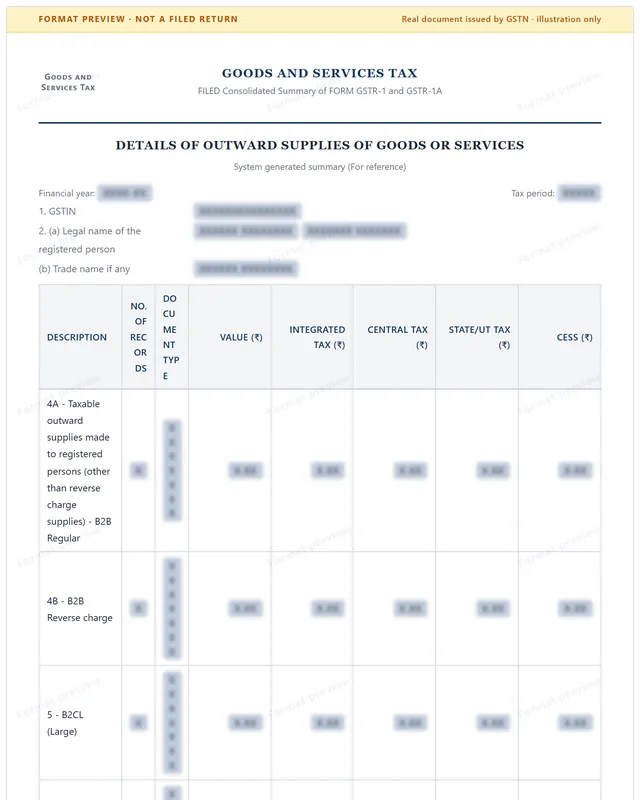
GSTR-1 filing acknowledgement
The acknowledgement that the GST portal gives once Form GSTR-1 is filed.
Values hidden for privacy. Names, numbers and dates are covered. Your own document carries your details.
Download GSTR-1 filing acknowledgement sample (PDF) View GSTR-1 filing acknowledgement sample
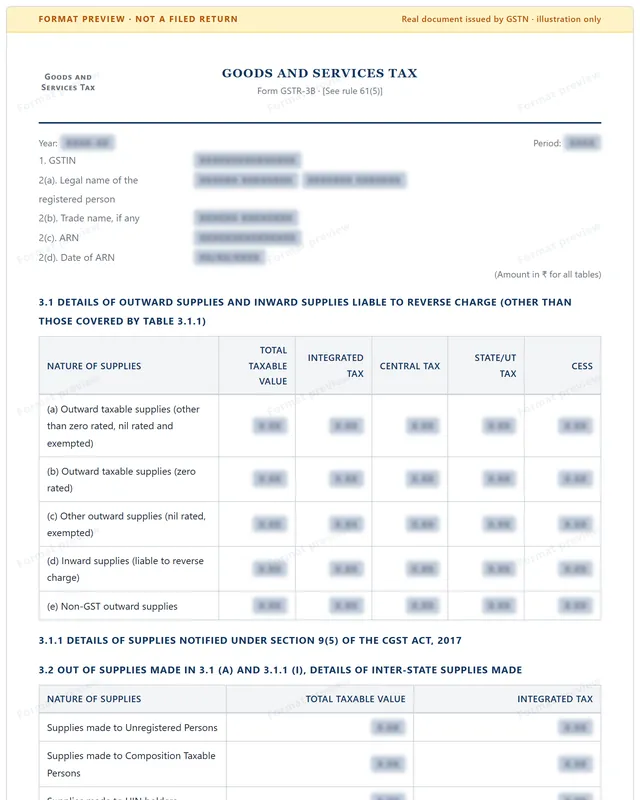
GSTR-3B filing acknowledgement
The acknowledgement that the GST portal gives once Form GSTR-3B is filed.
Values hidden for privacy. Names, numbers and dates are covered. Your own document carries your details.
Download GSTR-3B filing acknowledgement sample (PDF) View GSTR-3B filing acknowledgement sample
Fees
GST compliance for SEZ suppliers, units and developers
Exclusive of GST and government charges.
We confirm the fee in writing before any work starts.
The fee depends on the number of GSTINs, the volume of SEZ invoices, and whether refund claims are included.
Quality
Before a return or refund claim is filed, a second person checks:
Get a quote
Tell us whether you supply to an SEZ or operate inside one, and we will tell you what the returns and refunds involve.
Leave your details and we will call you back.
By sending this form you agree to our privacy policy.
Sources used on this page