All refund types
GST refund services
All refund types in one place.
View service
GST Refund Services
In short: a supply of services counts as an export only if all five conditions in section 2(6) of the IGST Act are met, including that you are paid in convertible foreign exchange (or in rupees where the RBI permits). If it is an export, it is zero-rated, and you can either export under a Letter of Undertaking and claim back the unused input tax credit, or pay IGST and claim that back. For services, the refund turns on when the money arrives: the time limit and the formula both run from the date of payment.
Exporters of services
This page is for businesses in India that supply services to clients outside India (software and IT services, consulting, design, back-office and support, engineering, research, marketing and similar work) and that have:
Credit building up because their export invoices carry no GST, or
IGST paid on export invoices that they want refunded, or
Months of exports not yet claimed, and a question about which are still in time.
The refund depends first on whether the supply is an export at all. A supply that fails any condition is a taxable domestic supply, with no refund, and possibly tax due.
Section 2(6)
Under section 2(6) of the IGST Act, a supply of services is an export only if all of these are true:
Or in Indian rupees wherever permitted by the RBI.
For example, a branch abroad of the same company is not a foreign client.
CBIC has stressed that realisation of payment is one of the conditions for export of services, unlike exports of goods (Circular 125/44/2019-GST, paragraph 48).
For many services the place of supply follows the location of the recipient, but several categories have their own rules. The general rule in IGST Act s.13(2) places the supply at the location of the recipient (or the supplier's location where the recipient's location is not available in the ordinary course of business). Sub-sections (3) to (13) set out the exceptions; for example, services on goods made physically available, and services that need the recipient's physical presence, are supplied where they are actually performed (s.13(3)).
The intermediary rule in IGST Act s.13(8)(b) (place of supply at the supplier's location) was omitted by the Finance Act, 2026 from 30 March 2026; intermediary services now follow the general rule, the recipient's location. Leaving out s.13(8)(b) does not by itself make an intermediary service an export. It is an export of services only where all five conditions in IGST Act s.2(6) are met: the supplier is in India, the recipient is outside India, the place of supply is outside India, payment is received in convertible foreign exchange (or in Indian rupees where the RBI permits), and the two are not merely establishments of the same person.
The Finance Act, 2026 sets no separate rule for contracts or invoices that span 30 March 2026; check the position for your case before filing.
Two routes
| Under LUT, without IGST | With IGST paid | |
|---|---|---|
| Who may use it | Any exporter with an LUT (rule 96A) | From 1 October 2023, only notified classes of persons or services (IGST Act s.16(4)) (Notification 01/2023-Integrated Tax, as substituted by 05/2023-Integrated Tax from 1 October 2023, notifies all goods and services except the listed goods, so any service may be exported on payment of IGST) |
| What is refunded | Unused credit, by formula (rule 89(4)) | The IGST paid |
| Form | RFD-01: "exports without payment of tax" | RFD-01: "export of services with payment of tax" (rule 96(9)) |
| Statements | Statement 3 and 3A, Annexure B | Statement 2 |
| Proof of export | Invoices with BRCs or FIRCs (rule 89(2)(c)) | BRCs, FIRCs or other proof of receipt of proceeds |
| Provisional 90% | Yes | Yes: with a self-declaration on non-prosecution (Circular 125/44/2019-GST, Annexure A row 2) |
Circular 125/44/2019-GST, Annexure A rows 1 and 2; IGST Act s.16(3), (4).
They have little or no domestic output tax to set the credit against, and paying IGST first only to wait for it to come back ties up cash.
If payment for an export of services under LUT is not received in convertible foreign exchange (or permitted rupees) within one year of the invoice, or the FEMA period with any RBI extension if that is later, or a further period the Commissioner allows, you must pay the tax with interest within 15 days after that period (rule 96A(1)(b)). See LUT filing.
Relevant date
The time limit. Two years from the relevant date. For services, the relevant date is one of two dates (CGST Act s.54, Explanation (2)(c)):
In rule 89(4), the turnover of zero-rated services for a period is (rule 89(4)(D)):
payments received in the period for zero-rated services + services completed in the period for which an advance was received in an earlier period − advances received in the period for services not yet completedSo a period's refund grows with the money received in it, not with the invoices raised. The refund is then:
Zero-rated turnover × Net ITC ÷ Adjusted Total TurnoverNet ITC is credit on inputs and input services in the period, and the claim is capped by the credit ledger balance at the period end and on the filing date (rule 89(4); Circular 125/44/2019-GST, paragraph 37).
Four cases
The figures below are illustrations chosen to show how the rules work. They are not client figures.
A design firm completes a project in April, invoices a US client on 30 April, and is paid on 25 June. The relevant date is 25 June (payment after completion), so the two-year limit runs from then. If instead the client had paid an advance on 10 March and the invoice was issued on 30 April, the relevant date would be 30 April (CGST Act s.54, Explanation (2)(c)).
In the next quarter the firm raises ₹90,00,000 of export invoices but receives only ₹20,00,000. Its zero-rated turnover for the formula is about ₹20,00,000 (plus or minus advance adjustments), so the refund for that quarter is small. The unclaimed credit stays in the ledger and is claimed in the quarter in which the money is received. The firm should also watch the rule 96A deadline on the unpaid invoices.
A company in India provides services to its own branch in Singapore and is paid in dollars. The branch is an establishment of the same legal person, so condition 5 fails: the supply is not an export, and no refund arises.
| Item | Amount |
|---|---|
| Foreign exchange received for completed export services | ₹72,00,000 |
| Services completed this quarter against last quarter's advance | ₹8,00,000 |
| Advances received this quarter, services not yet completed | ₹12,00,000 |
| Domestic services | ₹17,00,000 |
| Net ITC (inputs and input services) | ₹7,50,000 |
The result (subject to the ledger balances):
Zero-rated services turnover: ₹80,00,000 (₹72,00,000 received for completed services plus ₹8,00,000 completed against last quarter's advance; this quarter's ₹12,00,000 advance is left out). Adjusted Total Turnover: ₹97,00,000 (₹80,00,000 plus ₹17,00,000 domestic services). Formula amount: ₹80,00,000 × ₹7,50,000 ÷ ₹97,00,000 = about ₹6,18,557.
Before any formula
A service export refund is checked against your own returns, so a few rules apply before any formula:
Exports of services go in GSTR-1 as exports, with or without payment of tax, and any IGST paid on them goes in Table 3.1(b) of GSTR-3B as zero-rated supplies. CBIC has dealt with claims held up because IGST on services exports was shown in the wrong GSTR-3B row (Circular 125/44/2019-GST, paragraphs 25 and 26).
Before the claim (Circular 125/44/2019-GST, paragraph 6).
You cannot claim both the credit refund and the IGST refund on the same supply (CGST Act s.54(3), third proviso).
CGST Act s.54(14); Circular 125/44/2019-GST, paragraph 60.
Clubbed periods cannot cross a financial year (Circular 125/44/2019-GST, paragraph 8).
Our practice: we reconcile GSTR-1, GSTR-3B and the remittance list before preparing the claim, so the officer sees the same figures in all three.
Nine steps
Against the five conditions, including the place of supply.
It must have been furnished before the invoices claimed (rule 96A).
Invoice number and date, FIRC or BRC number and date, amount in foreign currency and rupees.
For every invoice, and drop anything out of time.
From receipts and advances for the period.
For the credit, removing blocked and unreported credit.
Statement 3 and 3A (LUT) or Statement 2 (IGST), the declarations and the undertaking (Circular 125/44/2019-GST, Annexure A).
In chronological order for LUT claims, within one financial year per claim (Circular 125/44/2019-GST, paragraph 8).
Reply to any notice, and claim interest on delay.
Checklist
Watch for these
Scope
See a sample
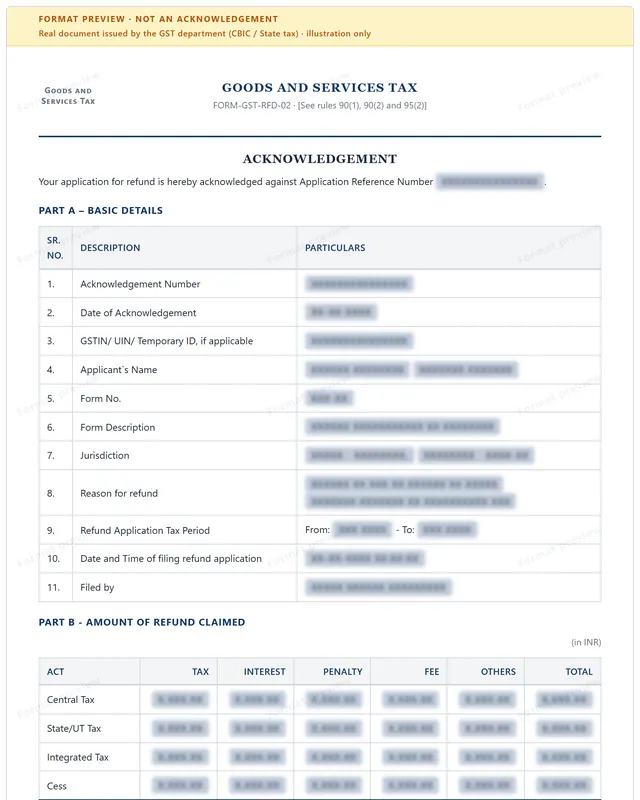
GST refund application acknowledgement (RFD-02)
The acknowledgement given for a GST refund application.
Values hidden for privacy. Names, numbers and dates are covered. Your own document carries your details.
Download GST refund application acknowledgement (RFD-02) sample (PDF) View GST refund application acknowledgement (RFD-02) sample
Fees
Service export refund
Excludes GST and government charges.
Advance rulings and FEMA compliance are separate engagements.
Quality
Before filing, a second person checks:
Regulatory statements on this page are taken from the IGST and CGST Acts and Rules and CBIC circulars, and are reviewed by CA Sundram Gupta.
Subham Jhunjhunwala, reviewed by CA Sundram Gupta
Get a quote
Tell us what services you export, to whom, and which quarters you have not claimed. We will tell you what qualifies and what is still in time.
Leave your details and we will call you back.
By sending this form you agree to our privacy policy.
Sources used on this page