
GST Refund Services
GST RFD-01 Filing: Step-by-Step Guide Across 8 Refund Categories
Form GST RFD-01 is the single online form used for almost every GST refund: exports, SEZ supplies, inverted duty, deemed exports, excess cash, wrong tax head and more. Each category asks for its own statements, declarations and uploads, and a claim that is incomplete on the day it is filed gets a deficiency memo instead of an acknowledgement.

- 12 refund categories on the form Eight cover most claims; each has its own statement
- 4 uploads of up to 5 MB each Everything else is entered in the form itself
- 15 days to the first reply Acknowledgement in RFD-02, or a deficiency memo in RFD-03
- 60 days to the final order Counted from the complete application; 6% a year interest beyond that
Who and when
Who files RFD-01, and when
Any person claiming refund of a balance in the electronic cash ledger, or of any tax, interest, penalty, fee or other amount paid, files Form GST RFD-01 electronically on the common portal, directly or through a notified Facilitation Centre (rule 89(1)). The filing is also subject to Aadhaar authentication under rule 10B.
Rule 10B requires Aadhaar authentication of the proprietor, a partner, the karta, the managing or a whole-time director, a committee member or trustee, as the case may be, and of the authorised signatory, before an RFD-01 refund application can be filed. Persons notified under section 25(6D) are excluded.
Two groups do not file RFD-01
UN bodies, embassies and others notified under section 55
They use a separate form.
Exporters of goods claiming refund of IGST paid on the goods
The shipping bill is their claim.
Most refund claims must be filed within two years from the relevant date for the category (section 54(1)). A claim for the balance in the electronic cash ledger is not subject to that limit.
The categories
The refund categories on RFD-01
CBIC lists twelve categories filed in RFD-01 (Circular 125/44/2019-GST, paragraph 3). Eight cover most claims:
| # | Category | Main statement | Our detailed page |
|---|---|---|---|
| 1 | Unused credit on exports without payment of tax (LUT) | Statement 3 and 3A | Exports under LUT |
| 2 | Tax paid on export of services with payment of tax | Statement 2 | Service exports |
| 3 | Unused credit on supplies to SEZ without payment of tax | Statement 5 and 5A | SEZ supplies |
| 4 | Tax paid on supplies to SEZ with payment of tax | Statement 4 | SEZ supplies |
| 5 | Unused credit from inverted tax structure | Statement 1 and 1A | Inverted duty |
| 6 | Tax paid on deemed export supplies: to supplier or to recipient | Statement 5B | Deemed exports |
| 7 | Excess balance in the electronic cash ledger | No statement | Excess cash ledger |
| 8 | Tax paid on an intra-State supply later held to be inter-State, or the reverse | Statement 6 | Wrong tax head |
The remaining categories are refund of excess payment of tax (Statement 7), refund on account of an assessment, provisional assessment, appeal or other order, and refund on any other ground. The circular also lists deemed export refunds to the supplier and to the recipient as two separate categories, which makes twelve.
Before filing
Before you file: the checks that prevent a deficiency memo
- All returns due must be filed
A refund claim for a tax period can be filed only after furnishing all GSTR-1 and GSTR-3B returns due on or before the filing date. Composition taxpayers, non-resident taxable persons and ISDs must instead have filed their own returns (GSTR-4 with CMP-08, GSTR-5 or GSTR-6).
- Choose the period
You may claim one tax period or club successive periods, but a claim cannot spread across financial years. Quarterly GSTR-1 filers claim by quarter.
- File credit claims in order
For LUT exports, SEZ supplies without tax and inverted duty, claims must be chronological: once a period is claimed, an earlier period cannot be claimed later under the same category, except when refiling after a deficiency memo.
- Check the time limit
For every period in the claim.
- Check the ledger balance
For credit refunds, the claim is debited from the credit ledger on filing, so the balance must be there (rule 89(3)). The refund is the lowest of the formula amount, the ledger balance at the period end, and the balance on the filing date.
- Check the bank account
It must be in the registration and validated; an invalid account is corrected by a non-core amendment in REG-14.
- Check the ₹1,000 minimum per tax head
No refund is paid where the amount under a head is below ₹1,000 (section 54(14)).
Contents
What goes into the form
Filled online, as part of RFD-01
The statements and declarations for the category, for example:
- the statement for the category (Statement 1, 1A, 2, 3, 3A, 4, 5, 5A, 5B, 6 or 7)
- the declaration under the second and third provisos to section 54(3), for credit refunds and export refunds
- the undertaking on sections 16(2)(c) and 42(2); that the refund will be paid back with interest if the supplier is later found not to have paid the tax
- for SEZ supplies, the declaration under rule 89(2)(f) that tax was not collected from the SEZ unit or developer
- the unjust enrichment self-declaration where the claim does not exceed ₹2 lakh, or the CA or cost accountant certificate in Annexure 2 where it does, in the categories that need it (rule 89(2)(l), (m); section 54(4))
Uploaded as documents
Typically:
- the statement of input invoices (Annexure B) for credit refunds, showing for each invoice the supplier GSTIN, invoice details, type (input, input service, capital goods), tax, eligibility and whether it is in the supplier-reported statement
- a copy of the supplier-reported credit statement for the period
(Circular 125/44/2019-GST refers to GSTR-2A; because credit now depends on GSTR-2B under rule 36(4), we upload GSTR-2B and keep GSTR-2A ready if the officer asks.) - self-certified copies of invoices that are claimed but not in that statement
- BRCs or FIRCs for services; shipping bills for goods exported through non-EDI ports
- SEZ officer endorsements; Notification 49/2017-Central Tax documents for deemed exports; orders for appeal-based refunds
CBIC has said that no other document needs to be provided at the filing stage (Circular 125/44/2019-GST, paragraph 4(a)). Where the documents run past the limit, we combine and index files so nothing is left out.
On the portal
Filing, step by step
- Log in and open the refund application
Select the category and the period.
- Enter or upload the statement for the category
For credit refunds, the portal works out the refundable amount from the figures entered.
- Fill the declarations and undertakings
- Upload the documents
Within the four-file limit.
- Enter the bank account
Preferably the same validated account each time, to avoid repeat validation.
- Sign with DSC or EVC
The amount is debited from the credit or cash ledger and the ARN is generated. The ARN is generated only when all uploads are complete and the debit is made.
- The application goes to the jurisdictional officer electronically
If it reaches the wrong officer, it must be reassigned within three working days, and no deficiency memo can be issued only on that ground.
What follows
After filing
| Stage | Form | Time limit |
|---|---|---|
| Acknowledgement if complete | RFD-02 | Within 15 days of the ARN (rule 90(2)) |
| Deficiency memo if incomplete | RFD-03 | Within the same 15 days (rule 90(3)) |
| Provisional refund (zero-rated only) | RFD-04 | Within 7 days of acknowledgement (rule 91(2)) |
| Notice proposing rejection | RFD-08 | Reply in RFD-09 within 15 days (rule 92(3)) |
| Final order | RFD-06 | Within 60 days of the complete application (section 54(7)) |
| Payment order | RFD-05 | With the sanction (rule 92(4)) |
| Interest if late | RFD-05 | 6% a year beyond 60 days |
Deficiency memo
Once an acknowledgement is issued, no deficiency memo can follow. After a memo, the debited amount is re-credited automatically, and you file a fresh RFD-01 for the same period with a new ARN. No second memo should be issued unless the first deficiencies remain or another substantive deficiency is found. The fresh claim must itself be within two years, excluding the time from the first filing to the memo.
Withdrawal
Before an RFD-04, RFD-05, RFD-06, RFD-07 or RFD-08 is issued, you can withdraw the application in RFD-01W, and the debited amount is credited back (rule 90(5), (6)).
Rejection
No application can be rejected without a hearing (rule 92(3) proviso). Rejected credit is re-credited by an order in PMT-03 (rule 93(2)).
Track a filed claim on our refund status page.
In dates
Worked example: one filing, start to finish
An example of the timeline under the rules; dates are not from a client case.
Example Unused credit under LUT
- 3 March day 0 The exporter files RFD-01 for unused credit under LUT; the ARN is generated that day.
- 14 March day 11 The officer issues the acknowledgement in RFD-02.
- 19 March day 16 The system clears the claim and RFD-04 for 90% is issued, within seven days of the acknowledgement.
- 22 April day 50 After verification, RFD-06 for the balance is issued.
- 28 April day 56 The money is credited to the bank account.
What the dates mean
The credit arrives on day 56 from the ARN, inside the 60-day period, so no interest arises.
Had the credit been on 15 May (day 73), interest at 6% a year would be due for the 13 days beyond the 60-day period.
What goes wrong
Common filing mistakes
- Wrong category
For example, an inverted duty claim filed under "any other".
- A period spanning two financial years
A clubbed claim cannot cross the year end.
- A credit claim filed out of sequence
An earlier period cannot follow a later one in the same category.
- Returns not yet filed on the filing date
Every GSTR-1 and GSTR-3B due must be in first.
- Statement totals that do not agree
With GSTR-1 and GSTR-3B.
- Missing declaration or certificate
For the category.
- More documents than the upload limit
So a key document is left out; we combine and index files to fit.
Scope
What we do, and what we do not do
What the service covers
- Choosing the category and the periods
- Preparing every statement, declaration and upload
- Filing RFD-01 and tracking it to payment
- Refiling after a deficiency memo, replying to notices, attending hearings
- Claiming interest on late payment
What it does not cover
- The underlying refund analysis for complex claims, priced on the relevant refund page
- Shipping bill IGST refunds: see exports with IGST
- Appeals: see GSTAT appeal for exporters
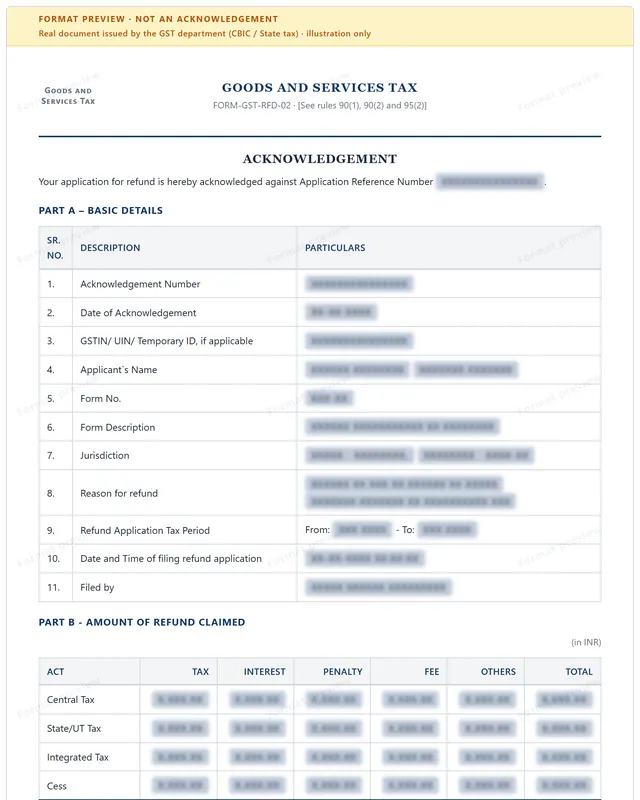
See a sample
GST refund application acknowledgement (RFD-02)
The acknowledgement given for a GST refund application.
- Issued by
- Through the GST portal
- When you get it
- After the refund application is filed.
Values hidden for privacy. Names, numbers and dates are covered. Your own document carries your details.
Download GST refund application acknowledgement (RFD-02) sample (PDF) View GST refund application acknowledgement (RFD-02) sample
What it costs
Fees
RFD-01 filing
Exl GST and Govt. Charges.
The fee is confirmed in writing after we have seen the claim and its documents, before any work starts.
The underlying refund analysis for a complex claim is priced on the page for that refund type.
What moves the fee
- The refund category
- The number of periods in the claim
- How many documents have to be combined and indexed
- Whether a deficiency memo or an RFD-08 notice has to be answered
Tell us the refund type and the periods. We will tell you the category, what the claim needs, and when it can be filed.
Our checks
How we check our work
Before signing, a second person checks:
- the category
- the period
- the statement totals against the returns
- each declaration
- the uploads against Annexure A for the category
- the bank account
Who reviews this page
Regulatory statements on this page are taken from the CGST Act and Rules and CBIC circulars, and are reviewed by CA Sundram Gupta.
Subham Jhunjhunwala, reviewed by CA Sundram Gupta
The Acts, rules, notifications and circulars used on this page are listed at the foot of the page.
Get a quote
Ask us to file your RFD-01
Tell us the refund type and the periods.
Get a quote
Leave your details and we will call you back.
By sending this form you agree to our privacy policy.
What you get back
- The RFD-01 category for your claim, and the periods it can cover
- The statements, declarations and uploads that category needs
- The fee, confirmed in writing before any work starts
Sources used on this page
- Central Goods and Services Tax Act, 2017: section 54(1) (two years from the relevant date), (3) provisos (declaration), (4) (unjust enrichment), (7) (final order within 60 days), (14) (₹1,000 minimum); section 55 (notified persons); sections 16(2)(c) and 42(2) (undertaking).
- Central Goods and Services Tax Rules, 2017: rule 10B (Aadhaar authentication), rule 89(1)-(3) (who files RFD-01, declarations and statements, debit of the credit ledger), rule 90 (acknowledgement RFD-02 and deficiency memo RFD-03 within 15 days; rule 90(3) proviso on time excluded; rule 90(5)-(6) withdrawal in RFD-01W), rule 91(2) (provisional refund within seven days), rule 92 (RFD-08 notice, RFD-09 reply within 15 days, hearing, RFD-06 order, RFD-05 payment order), rule 93 (re-credit by PMT-03).
- Notification 13/2017-Central Tax, 28 June 2017 (6% interest under section 56) and Notification 13/2025-Central Tax (rule 91 as substituted from 1 October 2025).
- Notification 49/2017-Central Tax, 18 October 2017 (evidence for deemed export refunds).
- CBIC Circular 125/44/2019-GST, 18 November 2019: paragraphs 3 (the twelve categories), 4(a)-(d) (contents, four uploads of 5 MB, ARN, reassignment within three working days), 6 (returns to be filed first), 7 (undertaking), 8 (periods, one financial year, chronological order), 9-12 (deficiency memo, re-credit, fresh application, time excluded), 28-30 (bank account), 36 (Annexure B), 37 (lowest of three amounts), 60 (₹1,000 minimum); Annexure A (documents by category); Annexure B (statement of invoices).
- CBIC Circular 166/22/2021-GST, 17 November 2021 (no time limit for refund of excess cash-ledger balance).
- Texts read on the CBIC Tax Information Portal: taxinformation.cbic.gov.in; refund forms and status on the GST portal: gst.gov.in.